
Commercial Lease Attorney | Coral Gables & Sunny Isles Beach
Equipment Lease Default Disputes, Handled With a Clear Plan
KEW Legal helps Florida business owners respond to default notices, negotiate with lessors, and protect operations when leased equipment is in question.
By Kristina E. Wilson · Published October 26, 2026
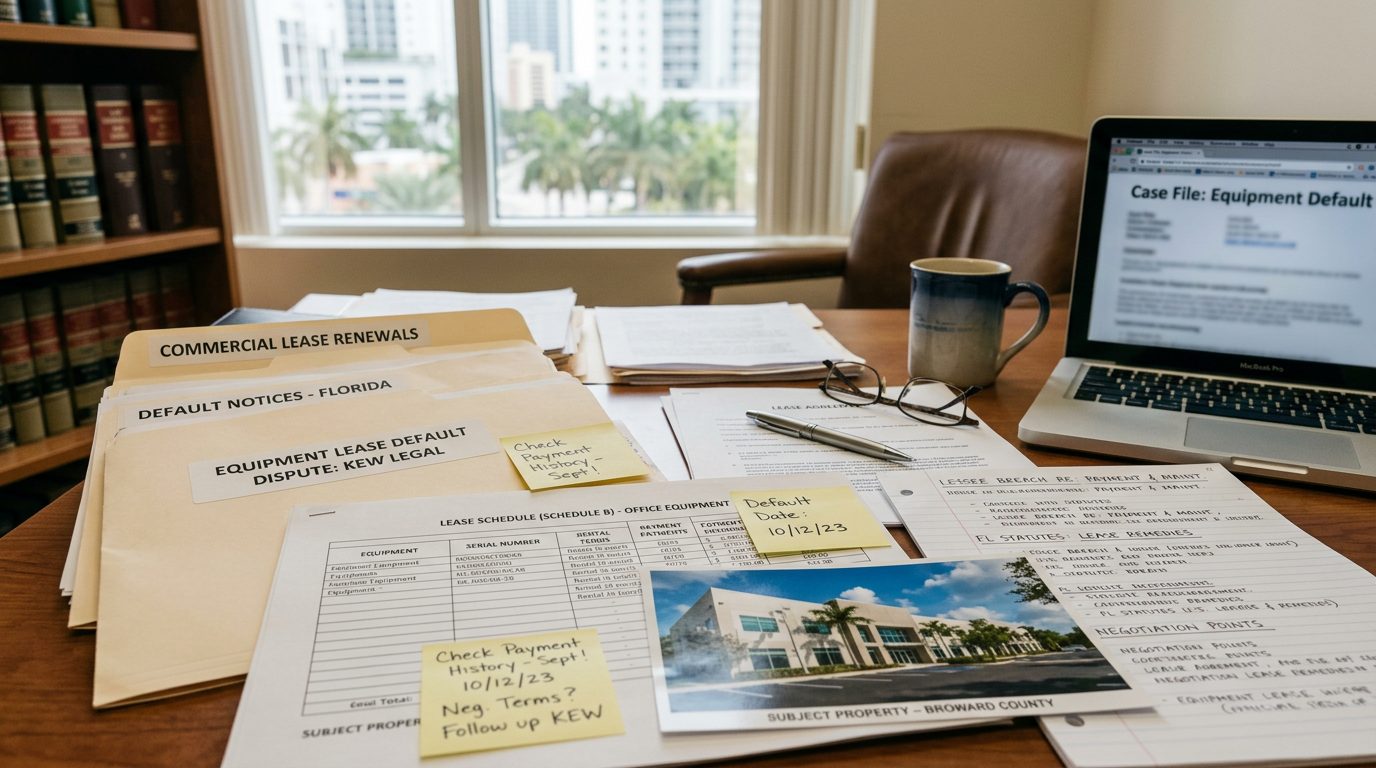
An equipment lease default dispute starts when one side says the other broke the lease and the two sides disagree about what happens next. This page explains how these disputes work and what to review first.
What an Equipment Lease Default Dispute Is and Who It Affects
A default dispute is a disagreement over whether a party failed to meet a lease duty, and what that failure allows the other side to do. An equipment lease is a contract where the lessor provides equipment and the lessee uses it and makes payments. A default is any failure the lease defines as a default, such as a missed payment or a lapsed insurance policy. The lease’s own wording decides what counts.
Leases come in different types. An operating lease and a finance lease can give each side different expectations about equipment risk and what happens at the end of the term. Read the lease’s actual terms, not just the label.
Some leases work like a loan secured by the equipment. In that case, Florida’s secured transaction rules can apply. A financing statement is generally filed with the Florida Secured Transaction Registry, not the county clerk, except for certain collateral.
This page is for owners, operators, and finance managers who signed or received a lease for machinery, medical or restaurant equipment, vehicles, or technology.
If a default notice or a repossession threat over leased equipment has reached you, our team can review the lease with you before the next step is taken. Talk it through with our team — the first consultation is free, confidential, and carries no obligation.
Common Default Triggers and Dispute Types
Most disputes begin with a missed payment, but many begin with a term the reader never noticed. Check each category below against your lease.
- Payment defaults: missed or partial payments, late fees, and cross-default clauses. A cross-default clause treats a default on one agreement as a default on another.
- Non-payment defaults: lapsed insurance, moving equipment without consent, subleasing, skipped maintenance, or unapproved changes to the equipment.
- Performance disputes: equipment that never arrived or does not work. Whether payments must continue turns on the lease’s wording.
- End-of-term disputes: return condition, return location, buyout price, and automatic renewal.
- Personal exposure: an owner or officer who signed a separate personal promise to pay.
Florida Law That Governs Equipment Lease Disputes
Florida statutes set some firm rules, and the lease sets many others. Both matter from the first day of a dispute.
Writing requirements. Florida’s statute of frauds says no one can be charged on a special promise to answer for another person’s debt, default or miscarriage unless the promise is in writing and signed by the person to be charged or by some other person lawfully authorized by that person. The same statute covers some long-term agreements, so check whether the key terms are signed.
Filing deadlines. Florida sets time limits for lawsuits by statute, and the limitations statute is the place to start. A cause of action generally accrues when its last element occurs, under § 95.031. A contract cannot shorten the period below the statute’s time, because a provision that does so is void under § 95.03. Because of this, the date of the default should be reviewed early.
Where to file. Under § 47.011, an action is brought in the county where the defendant resides, where the cause of action accrued, or where the property in litigation is located. This section shall not apply to actions against nonresidents. Miami-Dade and Broward venue questions often turn on these three connections.
Attorney’s fees. Under Florida’s general rule, each side pays its own lawyer unless a contract or statute says otherwise. If the lease has a fee clause, § 57.105(7) can let the court award fees to the party that prevails, whether plaintiff or defendant.
Arbitration and mediation. If the lease has an arbitration clause, § 682.02 makes that agreement valid and enforceable, except on grounds that exist for revoking any contract.
Remedies and Rights When Default Is Declared
Once a default is declared, the lessor may demand a cure, accelerate rent, repossess, or resell the equipment, depending on the lease.
- Notice and cure: Many leases require written notice and a chance to fix the problem first. Missing that step can be a defense.
- Repossession: A repossession that goes wrong can lead to a counterclaim. The method the lessor uses matters as much as the right to take the equipment.
- Deficiency math: The claimed balance usually nets the sale or re-lease proceeds against remaining rent and costs. The lessee can ask for that written accounting and check each number.
- Non-conforming equipment: Equipment that does not match the lease description can support a defense.
- Late fees: Late fee terms are set out in the lease, so it is worth reviewing them closely. The lease wording and the facts both count.
- Contract undoing: A lessee may argue the deal should be undone. Under Florida’s mutual mistake rule, rescission for mutual mistake requires a mistake about a fact that goes to the essence of the contract.
- Unfair terms: A court may refuse to enforce a term only where both how the deal was made and how unfair the term is are present, as the Florida Supreme Court held in Basulto.
- Emergency relief: Parties sometimes ask a court for temporary relief while a dispute is pending.
How an Equipment Lease Dispute Works: Step by Step
Most equipment lease disputes move through five steps. Each step builds on the one before it.
- Review the paperwork. Gather the lease, every schedule and amendment, the payment history, all default notices, and any personal promise signed by an owner or officer.
- Respond in writing. A written response preserves your rights, disputes any amount you think is wrong, and can propose a cure, reinstatement, or payment plan.
- Negotiate. Options may include a settlement, a buyout, a return-and-release, or a structured payoff.
- Use pre-suit steps. Mediation or other agreed steps can come before any lawsuit, depending on the lease and the parties.
- File if needed. A lawsuit is filed in the proper Florida county, and emergency relief can be sought if equipment is at risk.
Timing varies with the lease terms, the amount claimed, and how quickly records are produced. A realistic timeline can be set after the initial review.
Frequently Asked Questions About Equipment Lease Defaults in Florida
An improper repossession can create its own claim.
Does a default automatically end the lease?
Not always. Many leases require written notice and a chance to cure before remedies apply, so check those terms first.
Do I have to keep paying for equipment that does not work?
Whether payments must continue turns on the lease’s wording and the type of lease. Start by reviewing the full agreement.
Am I personally liable if my company defaults?
A signed personal promise is one way to become personally liable, but it is not the only way. Under Florida’s statute of frauds, that promise generally must be in writing and signed.
How long do I have to sue over an equipment lease?
Florida sets lawsuit deadlines by statute, and a contract cannot shorten them below the statute’s period. The date the claim arose matters.
What does the first consultation cost?
KEW Legal offers a free first consultation that is confidential and carries no obligation to continue.
Not sure what your next step is?
Talk it through with our team — the first consultation is free, confidential, and carries no obligation.
Why Work With KEW Legal on an Equipment Lease Dispute
KEW Legal is a Florida business law firm with offices in Coral Gables and Sunny Isles Beach. It serves business owners and investors across Miami-Dade and South Florida.
The firm focuses on business contract and vendor disputes, commercial leases, and outside general counsel work. Equipment lease disputes fit within that day-to-day practice, and the commercial lease dispute page covers the related leasing issues.
Kristina E. Wilson is the responsible lawyer for this page. The firm’s lawyers include Natalie Martinez, who works on business disputes with the team.
As outside general counsel, the firm can review an equipment lease alongside the business’s other contracts, leases, and any personal obligations. That wider view often shows what a default could cost the business and its owners.
If you have received a default notice, a repossession threat, or a demand over equipment, schedule a consultation or call 305-990-2300 to review the lease before the next deadline.
How KEW Legal Approaches Equipment Lease Defaults
We Review the Whole Agreement
We read the lease, the default notice, and any amendments or side letters together, so you understand your obligations before you respond.
We Protect Your Operations
Our goal is to help you keep your business running while we address the dispute, whether that means negotiating, responding in writing, or preparing for the next step.
Clear, Direct Communication
We explain your options in plain language and handle communications with the lessor so you can focus on running your company.
Outside General Counsel Support
For business owners who want ongoing legal guidance, our team can serve as outside general counsel on lease, vendor, and contract matters.
Do Not Ignore a Default Notice
A default notice can carry important deadlines and consequences. Read it carefully, keep copies of every lease document and all communications with the lessor, and speak with counsel before you stop payments or return equipment.
Common Equipment Lease Default Issues
Missed or Late Payments
Disagreements over whether a payment was due, late, or properly credited, and how the lease treats missed payments.
Equipment That Fails or Is Not Delivered
Disputes when leased equipment does not perform as described, is delayed, or does not match the agreement.
Notice and Cure Questions
Questions about whether a default notice meets the lease requirements and what steps the agreement requires before remedies apply.
Repossession and Return of Equipment
Concerns about the lessor retrieving equipment, the condition it must be returned in, and how the business can respond.
Talk With KEW Legal About Your Equipment Lease
Related practice areas
- Business Contract And Vendor Dispute Attorney
- Can I Get Out of a Business Contract in Florida? Your Options Before You Stop Performing
- Small Claims or Circuit Court for Unpaid Business Debt in Florida
Request a Consultation
Fill out the short form and we will take it from there.