
Business Contracts | Coral Gables and Sunny Isles Beach
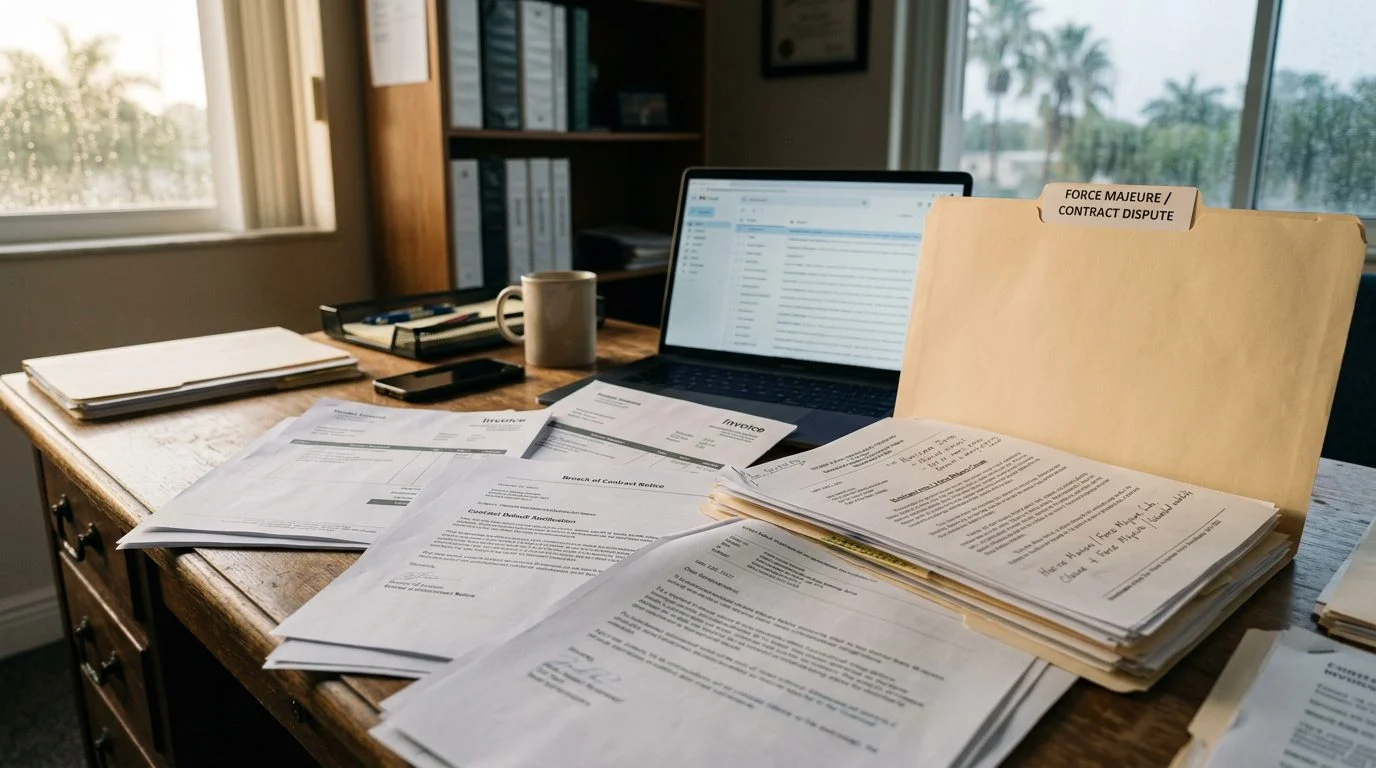
When a Hurricane Stops the Deal: How a Force Majeure Clause Works in Florida
Storm season can interrupt deliveries, leases and closing dates. Here is what business owners should look for in the clause before a storm arrives.
By Kristina E. Wilson · Published November 10, 2026
Your vendor missed a delivery and blamed a hurricane. Does a force majeure clause in a Florida contract excuse that delay? Only if the clause’s wording covers the storm and the way it hit your vendor.
The Short Answer: The Contract Wording Controls
Whether a storm affects a delivery date depends on the wording of the contract, including any force majeure clause. Force majeure is the contract term that handles events outside a party’s control.
Start by reading the clause itself. Look for words like “hurricane,” “storm,” “weather,” “act of God,” or “events beyond reasonable control.” Then check whose performance it protects. Some clauses cover only the vendor’s own work. Others also reach its suppliers, carriers, or access to ports.
The storm’s strength does not decide the question, and neither does the news coverage. If the contract has no clause at all, the analysis changes, as covered below. Pull the contract before you answer the vendor, because your reply can shape what happens next.
Not sure what your next step is?
Talk it through with our team — the first consultation is free, confidential, and carries no obligation.
What a Force Majeure Clause Covers and What It Leaves Out
A force majeure clause lists events that suspend or excuse performance when they happen.
Clauses come in two main styles. A closed list names specific events, such as hurricanes, floods, or government orders. If an event is not on that list, you may not be able to rely on it.
An open phrase, such as “events beyond reasonable control,” covers more ground.
Causation is where many disputes turn. Ask the vendor to show that link.
Some clauses excuse delay but not cancellation. Others let the affected party pause its duties for a stated period only. Read for these limits before you decide whether to wait, cancel, or push back. A clause may also give you the right to end the deal after a set period of delay, even when it excuses the vendor for the early weeks.
When the Contract Has No Force Majeure Clause
Without a clause, no listed event applies. So the answer depends on general contract rules and the facts of the deal. Florida courts apply those rules case by case, so no single result follows from a storm alone.
Florida’s sales chapter of the Uniform Commercial Code (UCC) applies to transactions in goods (Fla. Stat. § 672.102). A deal that mixes goods and services may be split: if the goods side does not predominate, only the sales rules that relate primarily to goods apply, but if the sale-of-goods aspects predominate, the sales chapter applies to the whole transaction, though other law may still govern non-goods parts. Check which rules fit your contract before you rely on them.
Under Fla. Stat. § 672.207, a definite and seasonable expression of acceptance, or a written confirmation that is sent within a reasonable time, operates as an acceptance even if it states additional or different terms, unless acceptance is expressly made conditional on assent to those terms. Between merchants, such additional terms become part of the contract unless (a) the offer expressly limits acceptance to the terms of the offer, (b) the additional terms materially alter it, or (c) notification of objection to them has already been given or is given within a reasonable time after notice of them is received. When a vendor’s acknowledgment adds a storm clause to your purchase order, this rule can decide whether that clause binds you. See our page on purchase order terms conflict for how competing forms are compared.
Notice Requirements: The Deadline That Is Easy to Miss
Many force majeure clauses require written notice within a set number of days after the event begins. Missing that step can cost you the excuse, even when the storm itself would qualify.
Check four things. First, the method: email, certified mail, or a named address. Second, the recipient, which may be a specific officer rather than your sales contact. Third, the content, such as the expected length of the delay. Fourth, whether a follow-up notice is due when the event ends.
Buyers face a parallel trap. Once a buyer accepts goods, it must notify the seller of a breach within a reasonable time after it discovers or should have discovered the breach. Otherwise, it may be barred from any remedy (Fla. Stat. § 672.607). The buyer also carries the burden to establish any breach in goods it accepted (Fla. Stat. § 672.607).
Keep a dated written record of every delay notice you send or receive. How notice periods interact with a right to fix a problem is covered on our notice and cure clauses page.
The Duty to Mitigate and Resume Performance
Many force majeure clauses expect the affected party to limit the delay and to resume as soon as it can. Those steps are often what decides whether the excuse holds.
Mitigation means real steps: sourcing from another supplier, rerouting a shipment, or restarting production once the facility reopens. A vendor that waits for the storm to pass before it looks for alternatives may face hard questions later.
The excuse usually covers only the period when the event actually blocked performance. Once that effect passes, the vendor may still owe the work. So track when the storm’s impact actually ended.
Sellers also have a right to fix a problem. Where a delivery was rejected because it did not conform, and time remains under the contract, the seller may seasonably notify the buyer that it intends to cure. It may then make a conforming delivery within the contract time (Fla. Stat. § 672.508).
Document everything. Dated photos of storm damage, supplier emails, shipping notices, and records of alternative sourcing can show whether mitigation happened. A buyer should keep its own records too, since a buyer that sources elsewhere may face cost questions later.
Drafting Issues That Change the Result
The exact words of the clause often matter more than the storm itself. A clause that lists “hurricane” but not “supplier failure” may not excuse a shortage that began at the vendor’s own supplier. The reverse can also be true, depending on the wording.
Read the whole clause, not one phrase. “Acts of God” next to a specific list raises questions about which words control, so read them together. Also check for a termination right, since it can matter more than the excuse itself.
Two more points deserve attention. A contract cannot fix a shorter time to sue than the statute allows, because a clause that does so is void (Fla. Stat. § 95.03). Also, a court may refuse to enforce a clause it finds unconscionable when the contract was made, or limit it to avoid an unconscionable result (Fla. Stat. § 672.302). A clause that shields a vendor from a predictable storm it could have planned for may face that test.
Not sure what your next step is?
Talk it through with our team — the first consultation is free, confidential, and carries no obligation.
Before Anyone Puts a Position in Writing
Your first written reply can become the record of the dispute, so think before you answer. A letter saying the storm excuses performance, or a letter refusing to excuse it, can be used later.
Maybe your situation looks like this. A vendor missed a delivery and cited the hurricane, or a customer sent you a delay notice. You now have to decide how to respond, keep the account, and protect your remedies.
Does a force majeure hurricane clause excuse a late delivery in Florida?
Can a buyer cancel over a storm delay?
Only if the contract gives that right, such as a termination right after a set period of delay. Check the clause for it.
How long do I have to sue a vendor?
Florida law sets time limits, and a contract clause that shortens them is void (Fla. Stat. § 95.03).
Does an “act of God” clause cover a storm?
It can, but read that phrase alongside the rest of the clause. A specific list in the same clause may shape what the phrase covers.
KEW Legal is a business law firm in Coral Gables that serves business owners and investors across Miami-Dade and South Florida. Kristina E. Wilson is the responsible lawyer for this page, and the firm’s Coral Gables office is the office listed for it. Our lawyers handle partnership and vendor disputes, commercial contracts, and outside general counsel work.
If a vendor or customer has just raised a storm excuse, call 305-990-2300 or send us a message before you answer in writing. The first consultation is free, confidential, and without obligation.
Do not assume a hurricane excuses performance
A force majeure clause helps only when its wording covers the event that happened and when the steps it requires are followed. Review the exact language before you rely on it, and keep records of the storm's impact on your operations.
What to review in a force majeure clause
Which events are covered
Hurricanes, tropical storms and related government orders may or may not be listed. The definition controls what counts.
Notice and documentation
Many clauses require prompt written notice and proof of the event. Missing these steps can weaken a claim.
Effect on payment and performance
Some clauses suspend obligations, while others only excuse delay. Check whether rent, fees or deliveries are still due during the disruption.
Termination and renegotiation
Look for rights to pause, end or renegotiate the agreement if a storm lasts beyond a set period.
How KEW Legal supports business owners
Contract review
We review existing agreements for storm-related language and flag gaps before a disruption occurs.
Clause drafting
We help draft or update force majeure provisions for vendor, customer and lease agreements.
Dispute response
When a counterparty invokes or disputes a storm excuse, we evaluate the clause and respond on your behalf.
Outside general counsel
Our team works with business owners across Miami-Dade and Broward on ongoing contract needs, not just one-time problems.
Have a contract question before the next storm?
Related practice areas
Request a Consultation
Fill out the short form and we will take it from there.