
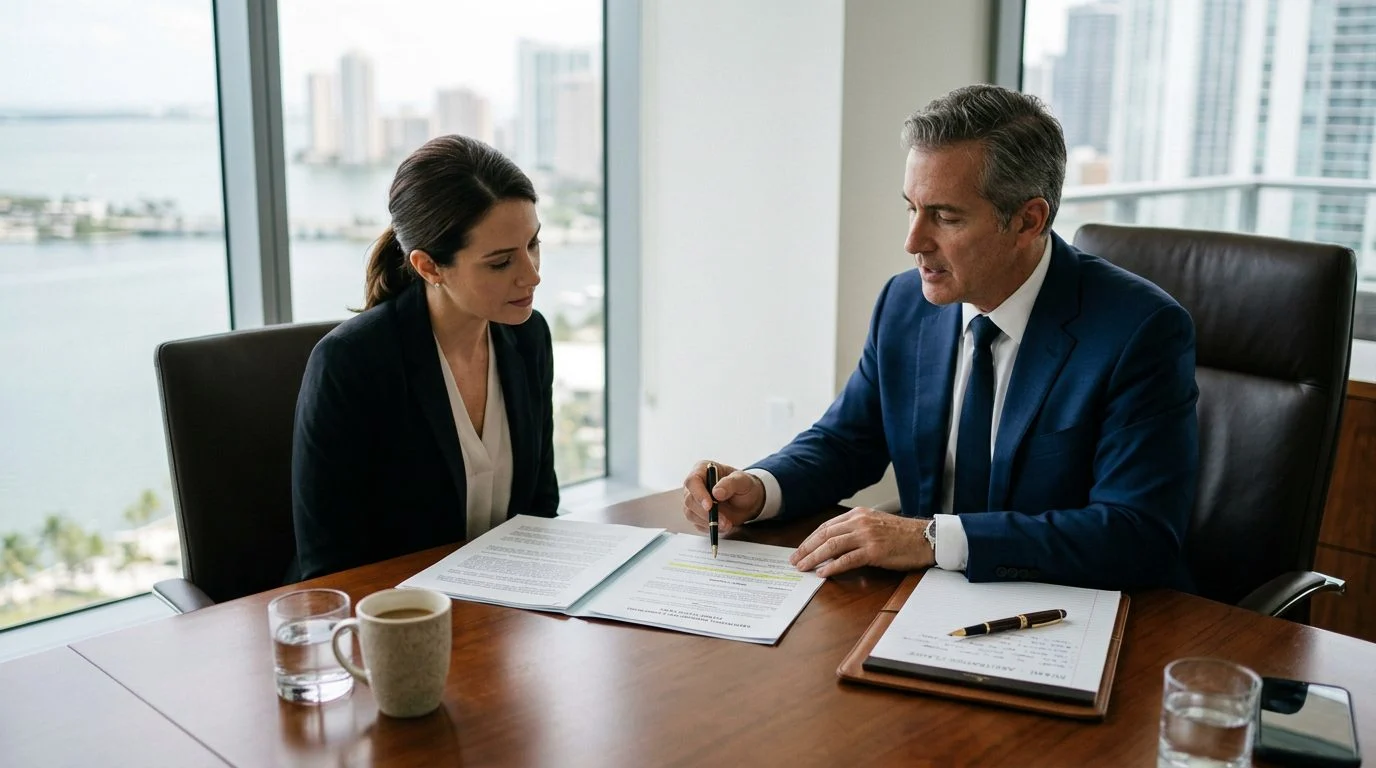
Business Contracts | Miami-Dade and South Florida
Forum Selection and Arbitration Clauses: Know Where Your Business Disputes Will Be Decided
KEW Legal, with offices in Coral Gables and Sunny Isles Beach, focuses on business contract and vendor dispute matters for owners and investors. We review the dispute clauses in your agreements and advise you on what they mean for your business.
By Kristina E. Wilson · Published November 3, 2026
If you need a forum selection and arbitration clause dispute attorney in Miami, start with the exact wording of your contract. A forum selection clause names the court or county where a dispute must be heard. An arbitration clause sends the dispute to a private decision-maker instead of a judge. KEW Legal is a Florida business law firm in Coral Gables and Sunny Isles Beach. The firm works with business owners and investors across Miami-Dade and South Florida, including owners who live abroad.
What Forum Selection and Arbitration Clauses Do
A forum selection clause picks the place for a lawsuit. An arbitration clause picks a private process to decide the dispute. Both sit inside the contract, and both can shape the fight before it starts.
- Forum selection clause: names a court, usually a county or state, for disputes under the contract.
- Arbitration clause: requires the parties to bring the dispute to an arbitrator instead of a judge and jury.
- Where they appear: vendor agreements, partnership and operating agreements, commercial leases, and purchase or sale contracts.
These terms usually sit in a section called dispute resolution, venue, or governing law. Florida treats a written arbitration agreement as valid and enforceable unless a ground exists to revoke a contract.
This page is for owners and investors who signed a contract with one of these terms. They may now face a dispute or a demand from the other side. Reading the clause closely is the first step, because its exact words control.
If an arbitration demand or an out-of-county lawsuit has reached your business, send us the signed contract and we will review the clause with you at your free first consultation. Talk it through with our team — the first consultation is free, confidential, and carries no obligation.

Court, Arbitration, and Mediation: How the Forums Differ
Court is a public process under court rules. Arbitration is a private process set by the contract. Mediation is a facilitated attempt to settle.
- Court: filings are public, a judge (and sometimes a jury) decides, and court rules set the steps.
- Arbitration: the hearing is private, and the contract and any named rules guide the process. A motion to vacate an award generally must be filed within 90 days after notice of the award. Fla. Stat. § 682.13 covers the exceptions, including claims of corruption or fraud.
- Mediation: a settlement step that some contracts require before a lawsuit or arbitration can start. Florida courts must refer filed civil actions for money damages to mediation on one party’s request, unless a listed exception applies.
The forum affects the process, the timing, confidentiality, and where a result can be enforced. That is why the choice of forum is a business decision, not just a legal detail.
Business Disputes That Commonly Reach Arbitration or a Chosen Court
Partnership, vendor, lease, and sale contracts are where these clauses commonly show up.
- Partnership and operating agreement disputes: buyout terms, deadlock provisions, and withdrawal rights.
- Vendor and supplier disputes: nonpayment, late or missing delivery, and disagreements over the scope of work.
- Commercial lease disputes: venue or dispute-resolution terms, including disputes tied to a commercial eviction.
- Acquisition and sale disputes: earn-out, representation, and closing terms that include a forum clause.
A clause may cover only part of a dispute. Some claims may go to arbitration while others stay in court. When a court orders arbitration, it must stay the court proceedings on claims subject to the arbitration. If a claim subject to the arbitration is severable, the court may limit the stay to that claim. Fla. Stat. § 682.03 sets out the stay rules. That is why each claim is reviewed on its own.
What KEW Legal Reviews and Handles
KEW Legal reviews whether the clause is in a signed agreement, whether it covers the claims, and whether Florida law will enforce it. The Florida Arbitration Code (chapter 682, Florida Statutes) governs these questions.
- Signed agreement: whether the clause appears in the final contract, any amendments, and any electronic signatures.
- Scope: whether the clause covers each claim and whether it lists any exceptions.
- Enforceability: a court refuses to enforce a term as unconscionable only when it finds both procedural and substantive unfairness. Basulto v. Hialeah Automotive states that test.
- Who decides: a court decides whether an agreement to arbitrate exists. An arbitrator decides some conditions and whether the contract is enforceable.
- Required steps first: notice, negotiation, or mediation that the contract requires before filing.
- Motions: if the other side refuses arbitration, a court can be asked to order it. A court cannot refuse just because the claim seems weak.
Florida’s venue statute limits where most actions may be brought. A case may go to the county where the defendant resides, where the claim arose, or where the property sits. For out-of-state or overseas parties, a contract that chooses Florida law and includes that party’s consent to Florida courts may allow a Florida suit.
How a Clause Dispute Unfolds: Steps and Timeline
A clause dispute moves from document review, to a forum decision, to a filing or response in the right place.
- Send the papers. Gather the signed contract, amendments, notices, and the other side’s demand or complaint.
- Review the clause and deadlines. Identify the forum, any named arbitration rules, and any response deadline.
- Choose a strategy. Decide with the owner whether to enforce, contest, or negotiate the clause.
- File or respond. Start or answer the case in the correct forum, or ask a court to compel arbitration or address venue.
- Proceed. Length depends on the forum and the facts of the case.
Deadlines can be short. A contract cannot set a time to sue that is shorter than the statute of limitations allows. Fla. Stat. § 95.03 makes that kind of provision void. Early contact gives more room to act before a deadline passes.
Why Businesses Work with KEW Legal
KEW Legal is a Florida business law firm. Its forum selection and arbitration clause dispute work sits inside its business contract practice. The areas named here describe what the firm focuses on.
- Offices: bona fide offices in Coral Gables and Sunny Isles Beach, serving Miami-Dade, Broward County, and South Florida.
- Outside general counsel: ongoing contract and dispute support for business owners, not only one-time filings.
- Lawyers: Kristina E. Wilson, one of the firm’s lawyers, is responsible for this page. Natalie Martinez is also one of the firm’s lawyers. Our lawyers and staff handle clause reviews and filings as each matter requires.
- Owners abroad: the firm also handles commercial evictions for owners who live outside the United States.
- Plain explanations: our team explains the forum question and your options in plain language before any filing decision.
Not sure what your next step is?
Talk it through with our team — the first consultation is free, confidential, and carries no obligation.
Frequently Asked Questions
Can I still go to court if my contract has an arbitration clause?
The clause wording, the claims, and any listed exceptions decide that question. If the other side refuses arbitration, a court decides whether an enforceable agreement exists. Fla. Stat. § 682.03 explains that process.
What is a motion to compel arbitration?
It is a request asking a court to order the parties into arbitration under their contract. If there is an enforceable agreement, the court orders arbitration.
How do I know if my contract requires arbitration or sets a venue?
Check the sections titled dispute resolution, governing law, venue, and notices. These sections usually name the forum, the arbitration rules, and any steps required before filing.
What if the other side filed in a county I did not agree to?
Florida’s venue statute limits where most actions may be brought. Fla. Stat. § 47.011 sets the county rules. Respond early, because timing matters.
Can an arbitration clause bind a partner or investor who did not sign?
That question turns on the agreement and how the parties relate to each other. KEW Legal reviews it case by case.
Is the first consultation free?
Yes. The first consultation is free, confidential, and carries no obligation to continue.
Send Us Your Contract for a Clause Review
If an arbitration demand or an out-of-county lawsuit has reached your business, send the papers for review. Picture an owner holding a signed vendor or lease agreement, a demand for arbitration, and a short response window. Send the contract, any amendments, and the demand through the contact page, or call 305-990-2300. The attorney reviews the clause, the forum, and the deadline, then gives you a plain-language summary of your options.
Why a Dispute Clause Deserves Attention
Clear Terms Before a Disagreement
Forum selection and arbitration language in vendor, partnership and lease agreements often controls where a dispute is heard and how it proceeds. Reviewing that wording early helps you understand your options.
Protection for Your Position
We examine the clause alongside the rest of the contract, including its scope, exceptions and governing law, so you can see how it may apply to the matter in front of you.
Local Business Focus
KEW Legal works with business owners and investors across Miami-Dade, Broward County and South Florida, where contracts often involve parties in several places.
Plain-Language Guidance
We explain the practical effect of each clause in terms you can use when making decisions about your business relationships.
Review the Clause Before a Dispute Starts
A forum selection or arbitration clause can shape where and how a business dispute is resolved. Ask for a review before you sign a new agreement, and contact us as soon as a disagreement begins.
Common Questions We Address
Forum Selection Clauses
Which court or location the parties agreed to use, and whether that choice fits your business and the dispute at hand.
Arbitration Clauses
What the clause requires, which claims it covers, and whether any carve-outs allow a matter to proceed in court.
Motions to Compel Arbitration
How a request to send a dispute to arbitration is presented, and how a court may decide whether an enforceable agreement exists.
Vendor and Partnership Agreements
How dispute clauses in supply, service and ownership agreements fit with the rest of the contract and your overall business goals.
Talk With KEW Legal About Your Agreement's Dispute Clause
Related practice areas
- Business Contract And Vendor Dispute Attorney
- Employee Problems at a Miami Business: Employer First Steps
Request a Consultation
Fill out the short form and we will take it from there.