
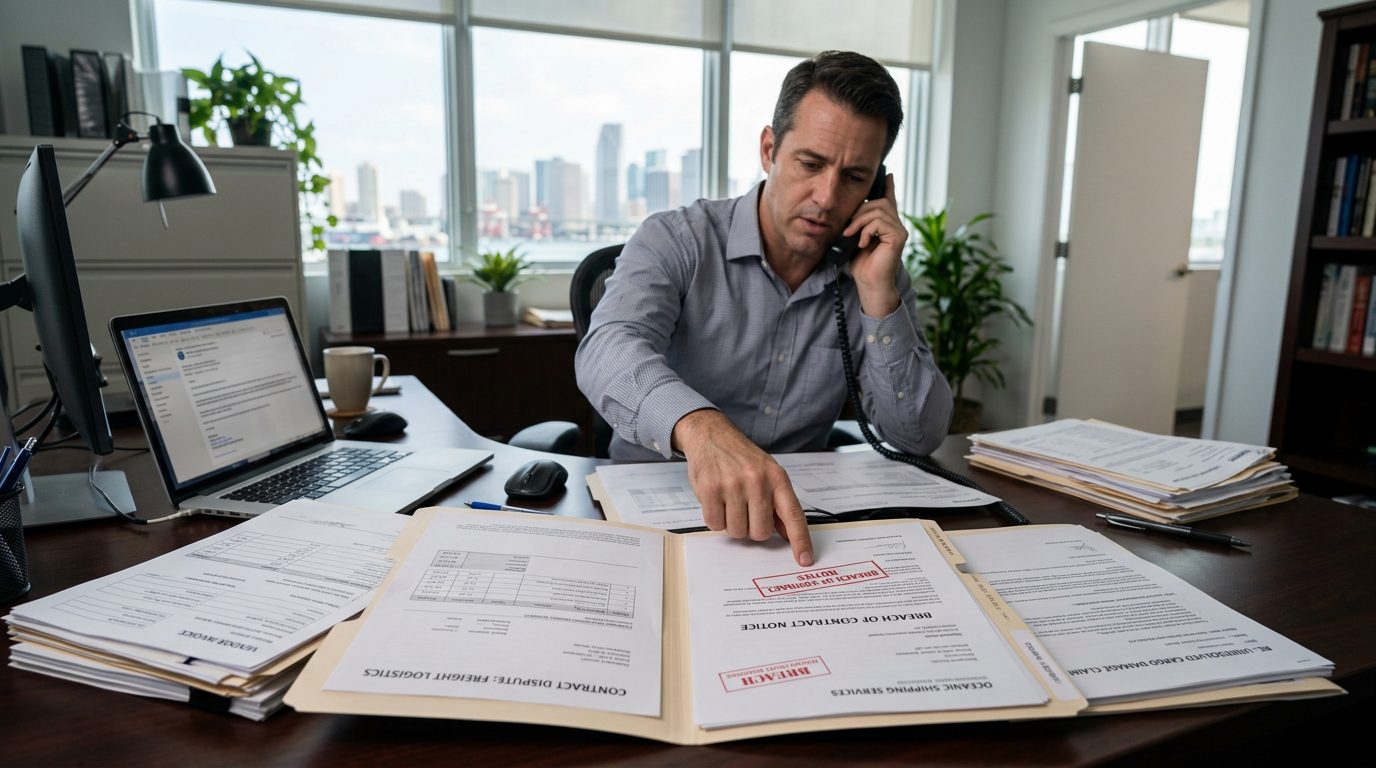
Business Contract & Vendor Disputes | Miami
Freight and Logistics Contract Disputes, Handled Clearly
KEW Legal focuses on business contract and vendor disputes, including freight and logistics agreements, for businesses across Miami-Dade and South Florida.
Why Businesses Call KEW Legal
2
Offices in Coral Gables and Sunny Isles Beach
Free
Confidential first consultation with no obligation to continue
By Kristina E. Wilson · Published October 24, 2026
A freight and logistics contract dispute happens when companies disagree about money, cargo, or performance under a deal to move goods. The paperwork usually shapes how the dispute is argued. KEW Legal is a Florida business law firm that helps business owners work through these disputes, and the sections below explain how.
What Freight and Carrier Contract Disputes Involve
A freight dispute starts when two companies disagree about what one owes the other for moving freight. The deal may be written, spoken, or both.
Common agreements include:
- Broker-carrier agreements between a freight broker and the motor carrier that hauls the load.
- Carrier and shipper-carrier contracts that set how a carrier serves a shipper.
- Freight forwarding and third-party logistics (3PL) agreements that cover arranging and coordinating shipments.
- Rate confirmations that record the price and terms for one load.
Brokers arrange moves, carriers haul, shippers send goods, and forwarders and 3PLs coordinate the work. When one link stops paying or performing, the others feel it fast.
KEW Legal is a Florida business law firm with offices in Coral Gables and Sunny Isles Beach. The firm focuses on business contract and vendor disputes for owners across Miami-Dade and South Florida, and freight relationships fall within that work.
If a freight invoice or cargo claim has put your business in a dispute, you don't have to sort through the paperwork alone. KEW Legal can talk it through with you. Talk it through with our team — the first consultation is free, confidential, and carries no obligation.

Common Disputes This Practice Covers
Most freight disputes center on money, cargo, or ending the relationship. These issues show up often:
- Nonpayment or short payment of freight invoices, including quick-pay or factoring disagreements.
- Detention and accessorial charges, such as fees for waiting or added services, and whether they were approved in writing.
- Cargo loss, damage, and shortage claims, including what the contract says about filing them.
- Liability limits, valuation terms, and insurance or indemnity requirements in carrier paperwork.
- Termination, minimum volume commitments, and access to a lane or customer.
- Disputes over customer information or nonsolicitation terms between brokers and carriers.
Wording choices in a contract can affect how a dispute is read. A line in a rate sheet or terms page can change who pays for a delayed or damaged load.
How the Contract and the Paper Trail Decide the Dispute
The written terms and the paper trail usually shape how a freight dispute is argued. Each document plays a different role:
- The master agreement sets the ground rules, including payment terms and dispute steps.
- The rate confirmation records the price and terms for a specific load.
- The load tender shows what was offered and when it was accepted.
- The bill of lading and proof of delivery show what was picked up, delivered, and in what condition.
Emails and texts often fill the gaps. Whether a spoken or partly written arrangement can be enforced depends on what both sides agreed to and how they acted afterward.
See Basulto v. Hialeah Automotive. A contract clause that sets a shorter time to sue than the statute allows is void under Fla. Stat. § 95.03.
How the Process Works, Step by Step
A typical matter moves through these stages, and each stage can change the timeline.
- Intake and document review. We identify the governing contract, the parties, and any deadlines in the paperwork.
- Claim assessment. We look at what your business can prove and what the other side is likely to argue.
- Demand or contract notice. A demand letter, or a notice the contract requires, often comes before any filing.
- Mediation or arbitration.
- Litigation. If the claim qualifies, the case proceeds in a Florida state court or federal court.
After a dispute, outside general counsel work can include reviewing carrier and vendor contracts for terms that could be clarified.
What to Gather Before You Call
Bring what you have. Missing items are not a reason to wait.
- Signed agreements, master carrier or broker agreements, and every amendment.
- Rate confirmations, load tenders, bills of lading, proof of delivery, and freight invoices.
- Emails and texts about rates, delays, detention, damage, or cancellations.
- Insurance certificates, cargo claim forms, photos, and any written notice of claim sent or received.
- A short timeline of key events and the dollar amounts in dispute.
Dates matter. Write down when the load moved, when the invoice went out, and when any claim was made.
Fees, Costs, and Attorney’s Fees in Florida
See Price v. Tyler.
A contract may allow fees to the winning side. Under Fla. Stat. § 57.105(7), if a contract entered into on or after October 1, 1988 lets one party recover fees for enforcing it, a court may also allow fees to the other party when that party prevails. Under § 57.105(1), upon the court’s initiative or motion of any party, the court shall award a reasonable attorney’s fee, including prejudgment interest, to be paid to the prevailing party in equal amounts by the losing party and the losing party’s attorney on any claim or defense at any time during a civil proceeding or action in which the court finds that the losing party or the losing party’s attorney knew or should have known that a claim or defense when initially presented to the court or at any time before trial was not supported by the material facts necessary to establish the claim or defense, or would not be supported by the application of then-existing law to those material facts. Fee awards are not automatic. Whether fees are available depends on the contract language and the claims asserted.
KEW Legal offers a free first consultation: confidential, with no obligation to continue.
Not sure what your next step is?
Talk it through with our team — the first consultation is free, confidential, and carries no obligation.

Why KEW Legal, and Common Questions
Kristina E. Wilson is the responsible lawyer for this page. The firm’s lawyers, including Natalie Martinez, handle business contract and vendor disputes and serve as outside general counsel for business owners and investors in Miami-Dade and South Florida.
Deadlines and fee terms depend on the facts of each matter, so our team reviews them case by case. We also look at both sides of a relationship, whether you are a broker, carrier, shipper, forwarder, or 3PL.
Do I need a written contract to have a claim?
Not always. A spoken or partly written deal can sometimes be enforced, but proof becomes the central issue.
How long do I have to file a freight payment claim?
Florida sets filing deadlines for contract claims in § 95.11, and they differ for written and unwritten agreements.
Does KEW Legal handle freight and logistics contract disputes in Miami?
KEW Legal handles business contract and vendor disputes in Miami-Dade, and freight matters are part of that work.
If a matter may be better handled by another lawyer or firm, we will say so.
If a freight invoice or cargo claim has put your business in a dispute, you don’t have to work through it alone. Call 305-990-2300 or send us a message to talk through what you have.
Common Freight and Logistics Disputes We Address
Unpaid Freight Invoices
When a shipper, broker or carrier withholds payment for hauling, handling or accessorial charges, we review the agreement and the delivery record to clarify what is owed.
Carrier and Broker Agreements
We examine the terms of transportation contracts, including rates, insurance, liability and termination provisions, and how they apply to the parties' actual conduct.
Cargo Loss, Damage or Delay
Disagreements over who is responsible for damaged, lost or late shipments often turn on the contract language. We help you understand your position under that language.
Warehousing and Dispatch Contracts
Storage, fulfillment and dispatch vendors sometimes fall short of their written commitments. We help businesses evaluate performance issues and available options.
How KEW Legal Approaches Your Dispute
Document-First Review
We start with your contracts, bills of lading, invoices, purchase orders and correspondence to understand what was agreed and what happened.
Outside General Counsel Perspective
We work with business owners and operators as ongoing outside general counsel, so freight disputes are evaluated alongside your broader contracts and operations.
Practical Options
Depending on the facts, we discuss negotiation, demand letters and formal dispute resolution, and help you weigh the costs and benefits of each.
Prompt Attention
Freight disputes can disrupt cash flow and customer commitments. We aim to respond promptly so you can make informed decisions.
Keep Your Records Together
Gather your signed or written agreements, rate confirmations, bills of lading, delivery receipts, invoices and key emails or texts. Complete records make it easier to evaluate a freight dispute from the start.
Talk With KEW Legal About Your Freight Contract Dispute
Related practice areas
- Business Contract And Vendor Dispute Attorney
- Marketing and Advertising Agency Contract Dispute Attorney in Miami-Dade
- Staffing Agency and Labor Supplier Contract Dispute Attorney in Florida
Request a Consultation
Fill out the short form and we will take it from there.