
Business Contract & Vendor Disputes | Miami-Dade
Marketing Agency Contract Disputes in Miami-Dade
KEW Legal helps business owners in Miami-Dade and South Florida review, enforce, and resolve disputes with marketing agencies. Start with a free, confidential first consultation, with no obligation to continue.
By Kristina E. Wilson · Published October 23, 2026
A marketing agency contract dispute is a disagreement over what the agreement requires, what has been paid, or how the relationship ends. KEW Legal acts as outside general counsel for business owners and investors across Miami-Dade and South Florida. This page explains the terms that matter most, how emails and verbal deals can count, and what a practical path forward can look like in Florida.
What a Marketing Agency Contract Dispute Involves
A marketing agency contract dispute is a disagreement between a business and its marketing, advertising, digital or creative agency. The fight is usually over what the contract requires, what has been paid, or how the relationship ends.
Agency work comes in several forms:
- Retainers: a monthly fee for ongoing services.
- Statements of work: a fixed scope for a campaign, website or content series.
- Media buying: the agency places paid ads and bills for the media spend.
- Performance deals: part of the fee depends on measured results.
This page is for brands that hire agencies. It is also for agencies that serve clients in Miami-Dade and Broward County. These disputes often start as business problems. A missed deadline or a surprise invoice becomes a legal question once someone asks what the signed paper says.
If your agency has quit delivering, is holding your ad accounts, or left an invoice unpaid, our team can review the contract with you. Reach out to KEW Legal today. Talk it through with our team — the first consultation is free, confidential, and carries no obligation.

Contract Issues We Handle for Agencies and Clients
The terms that most often shape these disputes are scope, payment, ownership, termination and confidentiality. Each one decides who owes what when a relationship goes wrong.
- Scope and change orders: what was included, what was added informally, and how extra work gets billed.
- Payment: unpaid retainers and invoices, disputed hours, markups and pass-through media spend.
- Ownership: creative, ad accounts, domains, social pages, data and analytics access.
- Termination and notice: minimum terms, cancellation fees and how to exit without breaching the contract.
- Restrictive clauses: exclusivity, confidentiality and non-solicitation terms that limit who can work with whom later.
- Liability and indemnity: limitation-of-liability and indemnity language, and how courts read it.
Florida limits restrictive covenants. A court will not enforce one unless it is in a writing signed by the person it binds. If a restraint is overbroad, overlong or not reasonably necessary to protect a legitimate business interest, a court must modify it and grant only the relief reasonably necessary to protect that interest (Fla. Stat. § 542.335).
When a Verbal Deal or Email Thread Can Still Matter
A verbal deal or email thread can still matter, even when nothing was signed. Many agency relationships begin with a phone call, a proposal email or an approved estimate.
- Electronic signatures count. Unless the law says otherwise, an electronic signature has the same force as a written one (Fla. Stat. § 668.004).
- Verbal terms may be enforceable. Whether they are depends on their terms and what can be proven.
- Deadlines come from statute. Florida sets time limits for filing lawsuits in its statutes of limitations, and the applicable deadline depends on the type of claim.
- Short deadlines in contracts are void. A clause that sets a shorter time to sue than the statute allows has no effect (Fla. Stat. § 95.03).
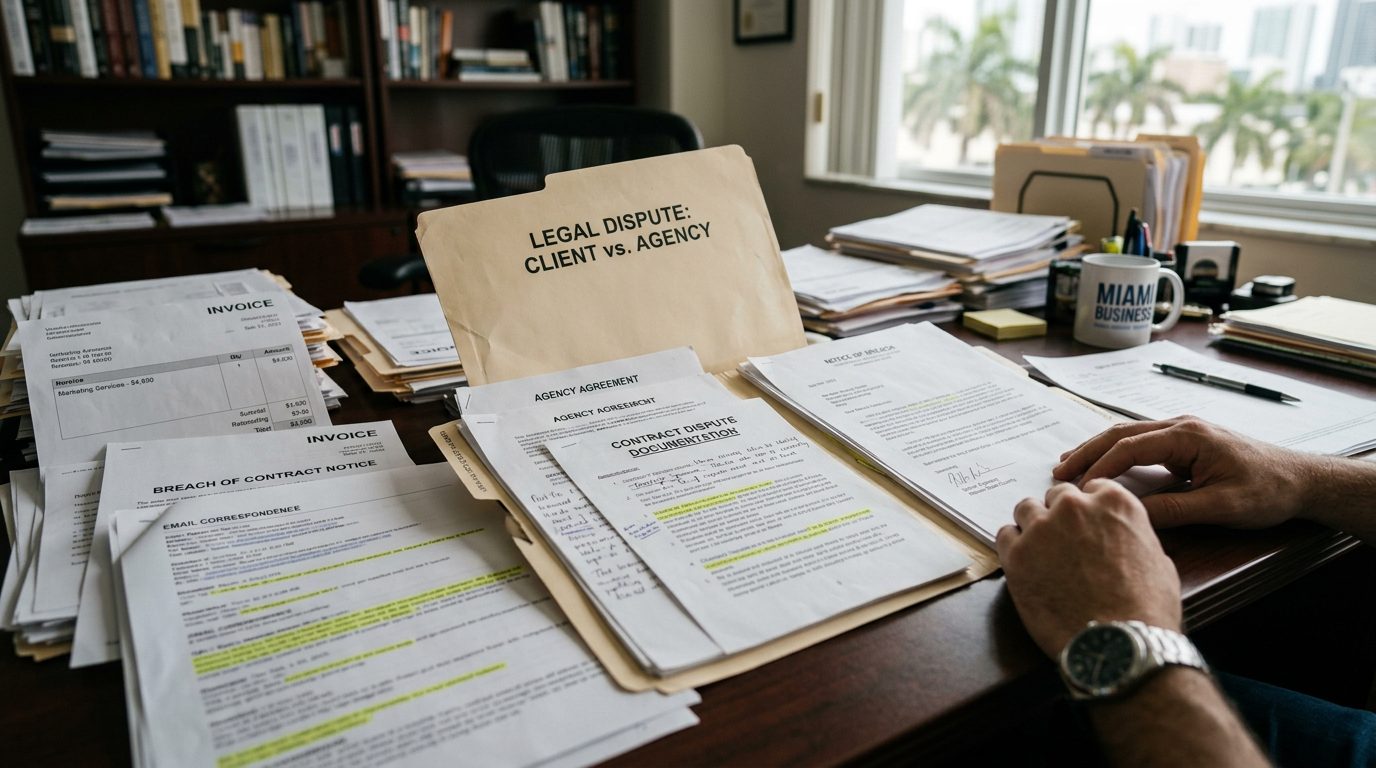
Start preserving the record now. Collect proposals, approvals, invoices and messages before the dispute grows. Payment records and written approvals show what each side agreed to and paid.
How the Dispute Process Works
Most agency disputes move in stages: document review, a written demand, negotiation, and then mediation or court if needed. Each stage depends on the documents and on how the other side responds.
- Intake. A confidential review of the contract, statements of work, invoices and communications.
- Analysis. Identifying which terms control, which are unclear, and what each side can prove.
- Demand and negotiation. A written demand, a response to the other side’s claims, and a settlement proposal.
- Mediation or arbitration. Used when the contract requires it or both sides agree. Arbitration agreements in writing are generally enforceable (Fla. Stat. § 682.02).
- Litigation. Filing, discovery and court proceedings in Florida courts, with a clear view of time and cost.
Fees follow a default rule. If a contract lets one side recover fees for enforcing it, the court may also allow fees to the other side when it prevails (Fla. Stat. § 57.105). This applies to contracts entered into on or after October 1, 1988.
Why Work With KEW Legal on an Agency Dispute
KEW Legal focuses on business law. The firm acts as outside general counsel for business owners and investors across Miami-Dade and South Florida, and it handles agency disputes as part of that work.
- Offices: Coral Gables and Sunny Isles Beach, serving Miami-Dade and Broward County clients.
- Responsible lawyer: Kristina E. Wilson is the responsible lawyer for this page. Our lawyers, including Natalie Martinez, handle business contract matters.
- Whole-record review: Our team reviews the contract, invoices and emails together. The dispute is judged on the full record.
- Business goal first: We weigh the cost of a fight against the goal, whether that is recovering payment, keeping ad accounts or ending the deal cleanly.
No outcome can be promised. What we can offer is a clear plan built on your documents.
Questions Business Owners Ask About Agency Disputes
Here are short answers to common questions about agency disputes.
Can I end my agency contract early?
It depends on the termination clause, the notice it requires, and what both sides did in practice. Read the notice terms first.
Does my agency own the ads it created for me?
Ownership depends on the contract language and on whether the work was paid for in full. Check the ownership clause before you assume either way.
Can I withhold payment over a disputed invoice?
Withholding payment without a written explanation can create problems of its own. Raise the objection in writing and keep a record.
What if we never signed anything?
Emails, proposals, approvals and payment records can still show the terms you agreed to. Gather them now.
Is a free consultation available?
Yes. The first consultation is free, confidential, and carries no obligation to continue.
Not sure what your next step is?
Talk it through with our team — the first consultation is free, confidential, and carries no obligation.

Talk to KEW Legal About Your Agency Dispute
If your agency has quit delivering, is holding your ad accounts, or left an invoice unpaid, act while the documents and timeline are fresh. Gather the contract, statements of work, invoices and key emails before you call.
Reach out to KEW Legal in one of three ways:
- Schedule a consultation through the KEW Legal contact page.
- Call 305-990-2300.
- Send us a message through the same contact page.
How KEW Legal Can Help With Your Agency Dispute
Contract Review
We read your agency agreement closely, including the scope of work, fees, termination, and notice terms, so you understand where you stand.
Ownership of Your Assets
We examine who owns the ads, creative, accounts, and data the agency produced or managed for your business.
Demand Letters and Negotiation
We communicate with the agency on your behalf and work toward a resolution, whether that means a negotiated exit or a corrected agreement.
Practical Strategy
Our team outlines your options and the likely next steps so you can make informed decisions for your business.
Read Before You Act
Before you stop paying, withhold payment, or end the relationship, review the termination and notice clauses in your contract. Acting without reviewing them can complicate your position.
Common Marketing Agency Contract Issues
Termination and Notice
Disagreements over whether, when, and how a contract can be ended, and what notice the agreement requires.
Ownership of Ads and Creative
Questions about who owns campaign materials, and whether ownership depends on payment and the contract language.
Fees and Payment Disputes
Unpaid invoices, retainer disagreements, and charges your business did not expect.
Performance and Deliverables
Disputes over whether the agency delivered the work promised in the scope of services.
Account Access and Data
Control of ad accounts, social media profiles, analytics, and customer data after a relationship ends.
Talk With KEW Legal About Your Agency Contract. Call 305-990-2300 or send us a message.
Related practice areas
Request a Consultation
Fill out the short form and we will take it from there.