
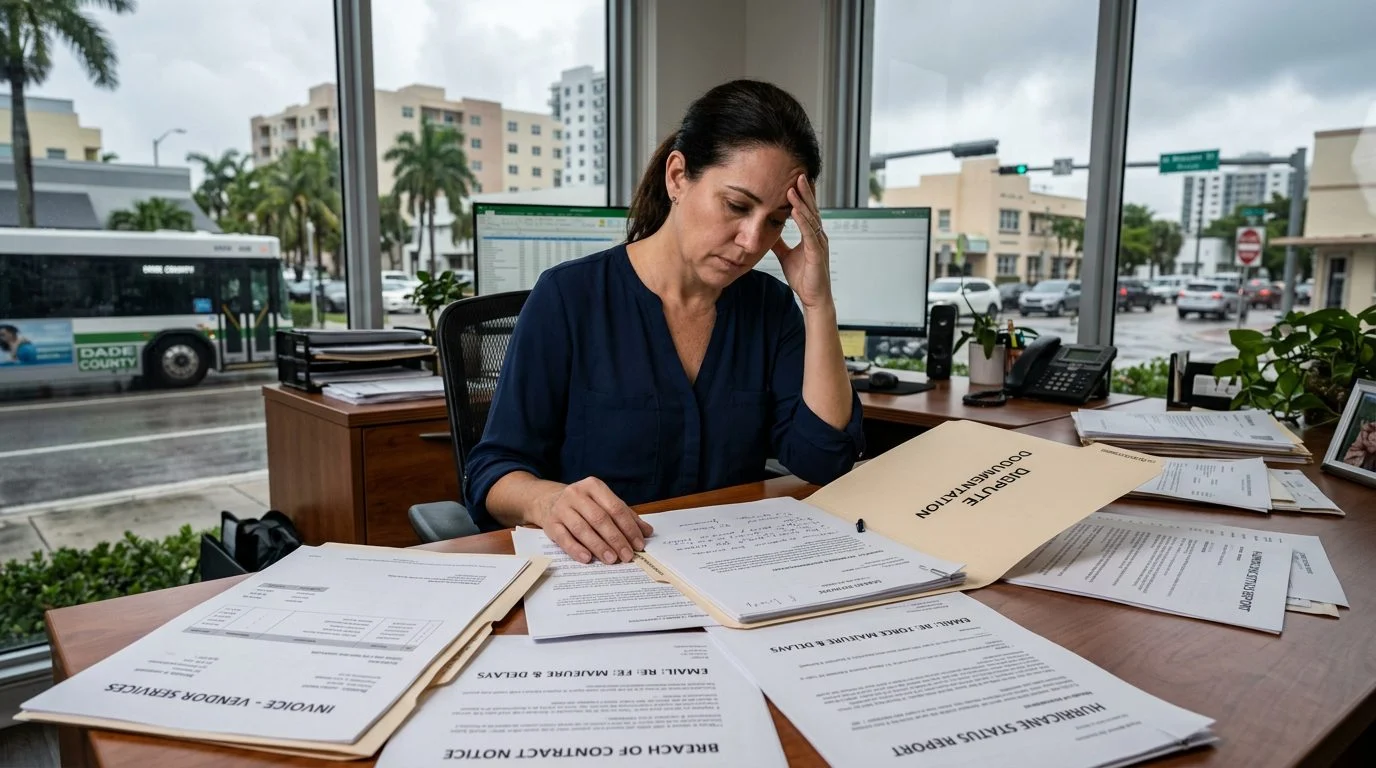
Vendor Disputes & Business Contracts | Coral Gables and Sunny Isles Beach
When a Storm Stops Your Vendor, Who Carries the Loss?
Hurricane season can disrupt a supply chain or a service agreement in a single afternoon. Here is how Florida business owners can think through the contract that governs the delay.
By Kristina E. Wilson · Published November 16, 2026
A hurricane has halted a supplier’s deliveries, and you need to know whether that vendor can walk away from the deal. If a vendor has stopped performing and blamed an event beyond its control, you may be asking whether that excuse holds up.
Three elements decide it: the force majeure clause itself, its notice terms, and what happened and what the vendor did to prepare. This guide walks through that test in order.
What a Force Majeure Clause Does in a Florida Supply Contract
A force majeure clause is a contract term that can excuse or suspend performance when an event outside the parties’ control occurs. Vendors often use these clauses to shift the risk of events neither side could control, such as a major storm. Reviewing the conditions written into the contract is an important first step in understanding whether any excuse applies.
Start with the contract’s own words. For goods, Florida’s sales rules are the next layer. Under Fla. Stat. § 672.102, the chapter covers transactions in goods. In a mixed deal, the question is whether the goods side predominates. If it does, the chapter applies to the transaction, though other law may still apply in appropriate circumstances to aspects that do not relate to the sale of goods. If it does not, only the provisions that relate primarily to goods apply.
KEW Legal is a Florida business law firm with offices in Coral Gables and Sunny Isles Beach. Kristina E. Wilson is the lawyer responsible for this page. The firm focuses on business contract and vendor disputes. For the broader framework, see the business contract and vendor dispute attorney page.
If a hurricane has halted your vendor's deliveries, you don't have to sort out the clause and the deadlines alone. Talk with us before you reply to the vendor. Talk it through with our team — the first consultation is free, confidential, and carries no obligation.
Check Whether a Hurricane Is Actually Listed as an Excusing Event
A hurricane only helps you if the clause covers it. It must either name the storm or use words broad enough to reach it. Read the list first.
Clauses vary a lot. Some name acts of God, named storms, floods, or natural disasters. Others use general words such as “events beyond reasonable control.” A clause that lists only strikes and government orders may not reach a storm at all.
Catch-all wording creates the real fight. Whether a storm fits “beyond reasonable control” depends on the storm and the vendor’s situation, not just the label. Look closely at the verbs, too. A clause that excuses “delay” may not excuse a complete failure to deliver.
Pull the full clause and the definitions section before you rely on any of it. Definitions can narrow or widen a term like “emergency” or “disaster.” A forwarded email excerpt will not show that.
Foreseeability and the Vendor’s Own Role in the Disruption
A vendor’s own preparation can weaken its claim that a storm alone caused the failure. Hurricane season is a known risk in South Florida. A vendor that could expect storms may be expected to plan for them.
Look at what the vendor did before the storm. Did it hold stock, line up a second supplier, or arrange alternate shipping and storage? Did it warn you early, or wait until the last day? If it shipped to other customers during the same period, that matters too.
Gather these facts:
- When the storm was forecast and when it hit
- When and how the vendor told you about a problem
- The vendor’s inventory and shipping records for that period
- Whether the vendor offered partial or alternate delivery
Whether the storm was foreseeable, and whether the vendor added to the shortfall, depends on the facts. A related view of partial performance appears on the vendor breach across multiple locations page.
Notice, Documentation, and Limiting Your Losses
A missed notice deadline can put your excuse at risk, so the notice clause comes first. Many force majeure clauses require written notice within a set period after the event starts.
Florida courts do not favor treating a step as a condition that must happen first. As the Covelli Family decision states, “As a general rule, conditions precedent are not favored, and courts will not construe provisions to be such, unless required to do so by plain, unambiguous language or by necessary implication.” A condition precedent is an act or event that must occur before a right to immediate performance arises, as the Land Co. of Osceola County decision explains. Whether your notice step is one turns on the contract’s words.
Florida courts have also said that failing to perform a minor part of a contract is not a material breach. Don’t count on that. Treat every notice deadline as firm and calendar it the day the disruption begins.
Keep records that show what happened:
- Dated emails, texts, and call notes with the vendor
- Photos or reports of storm damage at your site or the vendor’s
- Shipping and supplier correspondence
- Receipts for costs, and proof of the steps you took to find alternatives
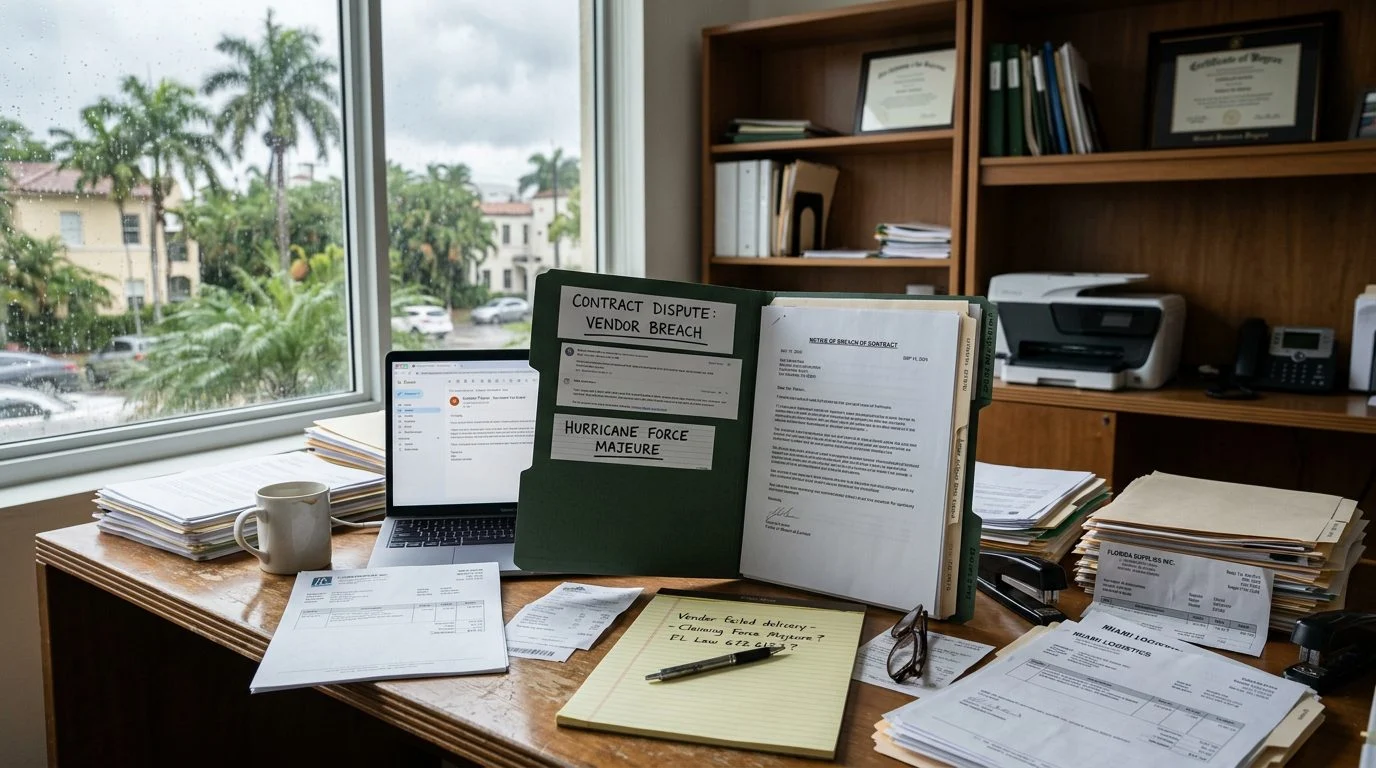
When the Contract Is Silent: Impossibility, Impracticability, and Frustration
If the contract has no force majeure clause, a vendor may still argue general contract doctrines such as impossibility or frustration. Those arguments turn heavily on the facts. A storm that only delays delivery or raises costs may not be enough on its own.
Florida’s sales chapter gives a buyer specific tools for goods, with or without a clause. If you doubt the vendor can deliver, you can demand assurance in writing. Under Fla. Stat. § 672.609, when reasonable grounds for insecurity arise, the other party may demand adequate assurance of due performance in writing. After receiving a justified demand, a failure to give adequate assurance within a reasonable time, not exceeding 30 days, is a repudiation of the contract.
If the vendor repudiates with respect to a performance not yet due, the loss of which will substantially impair the value of the contract to you, Fla. Stat. § 672.610 lets you await performance for a commercially reasonable time or pursue a remedy for breach, and in either case suspend your own performance. Under Fla. Stat. § 672.610, the aggrieved party may resort to any remedy for breach under s. 672.703 or s. 672.711. Keep proof that you were ready to hold up your side.
Be careful with your own words. Under Fla. Stat. § 672.611, a vendor can retract its refusal until its next performance is due. That right ends if, since the repudiation, you have canceled, materially changed position, or otherwise indicated that you consider the repudiation final.
Pandemic-Era Clauses and Why Older Contract Language Matters
Older contract wording matters because a clause covers only the events it names. Some clauses list epidemics, government orders, or emergency declarations. Others do not.
A storm-related emergency order may or may not fall within a clause, depending on its exact terms. Read the wording as it was signed, not as you remember it.
Check the contract’s date and every amendment. A later addendum may change the notice period or the events covered. Note whether the vendor relies on language you did not expect to apply.
If you reject a nonconforming delivery while the time to perform is still open, the vendor may respond. Under Fla. Stat. § 672.508, the seller may notify you it intends to cure and make a conforming delivery within the contract time. For a related Miami-Dade delivery-deadline scenario, see the missed turnover date page.
Not sure what your next step is?
Talk it through with our team — the first consultation is free, confidential, and carries no obligation.
Your Next Step If a Hurricane Has Halted Your Vendor’s Deliveries
Review the clause and your notice deadline before you answer the vendor. Pull the contract, mark every date, and gather the storm records listed above. Waiting can cost you the position you want to take, so get the facts in order now.
Common Questions
Does a hurricane automatically excuse a vendor in Florida?
A hurricane does not automatically excuse a vendor. The clause’s wording, its notice terms, and the facts decide whether it applies.
Can a business demand assurance from a vendor?
For goods contracts, Florida law lets you demand adequate assurance in writing when you have reasonable grounds for insecurity. After receiving a justified demand, a vendor that doesn’t respond adequately within a reasonable time, not exceeding 30 days, is treated as repudiating the contract.
What if I miss the notice deadline?
Whether a missed deadline costs you the excuse depends on the clause’s words. Florida courts do not favor treating a step as a condition unless the language requires it.
The initial consultation is free, confidential, and carries no obligation to continue.
If a hurricane has halted your vendor’s deliveries, call 305-990-2300 or send us a message through our contact page before you reply to the vendor.
How KEW Legal Helps Business Owners Respond
Contract language review
We read the force majeure, notice, and termination provisions together to see how they apply to the facts.
Protection of your position
Our commercial contract and vendor dispute work focuses on preserving your rights while the situation is still developing.
Clear communication with the vendor
Our team can help you prepare written notices and responses that are measured, documented, and easy to follow.
Local focus on South Florida
We serve business owners and investors across Miami-Dade and Broward County from our Coral Gables and Sunny Isles Beach offices.
Do not assume the storm ends your obligations
Before you cancel, withhold payment, or stop performance, review the clause wording and notice terms with counsel.
Questions to Bring to Your Review
What does the force majeure clause say?
Look for the events it covers, whether a storm is named, and whether it excuses delay, performance, or both.
What notice did the vendor give?
Written notice requirements and timing often matter as much as the event itself. Gather every message, email, and text.
How was the loss documented?
Photos, inspection reports, and records of the affected work or inventory help show what actually happened.
Is there a workable alternative?
Some agreements allow partial performance, a schedule change, or an alternate supplier. Reviewing those options early keeps choices open.
The first consultation is free, confidential, and carries no obligation to continue. Bring your contract and we will review it with you.
Request a Consultation
Fill out the short form and we will take it from there.