
Business Contract Disputes | Coral Gables & Sunny Isles Beach
Staffing Agency Contract Disputes, Handled with Clear Business Counsel
KEW Legal helps staffing agency owners and client businesses in Miami-Dade and South Florida review and resolve disputes over invoices, placed workers, and contract terms. Responsible attorney: Kristina E. Wilson, Coral Gables.
By Kristina E. Wilson · Published October 23, 2026
A staffing agency contract dispute is a disagreement about what a signed labor agreement requires. It usually involves money, the scope of work, or the right to end the deal. KEW Legal is a Florida business law firm with offices in Coral Gables and Sunny Isles Beach. We handle vendor and partnership disputes for business owners and investors across Miami-Dade and South Florida.
If you need a staffing agency contract dispute attorney in Florida, start with the signed documents. Every review begins there.
What a Staffing or Labor Supplier Contract Dispute Involves
A staffing or labor supplier contract dispute is a conflict over the terms the parties agreed to. The contract sets the rules, so it is the first thing we read.
Common documents include:
- A master service agreement, the main contract that sets overall terms
- Statements of work, which describe what each job or project covers
- Rate sheets and purchase orders, which set prices and billing approvals
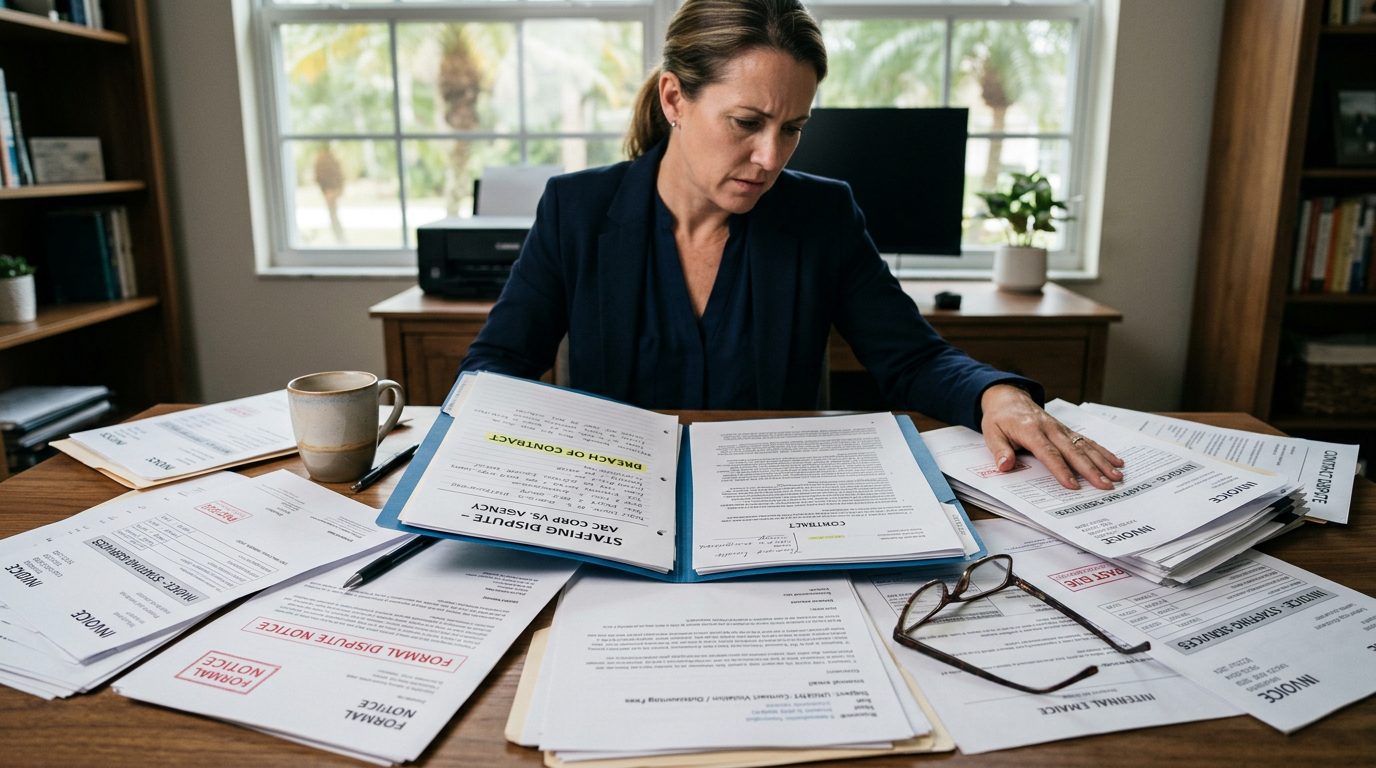
- Invoices and timesheets, which show what was billed and what was worked
- Notices, emails and text messages, which show what each side said and when
KEW Legal focuses on business contract and vendor disputes. We work with business owners and investors across Miami-Dade and South Florida. Kristina E. Wilson is the responsible lawyer for this page. Our lawyers include Kristina E. Wilson and Natalie Martinez.
Not sure what your next step is?
Talk it through with our team — the first consultation is free, confidential, and carries no obligation.

Disputes We Handle in Staffing and Labor Supply Agreements
Most staffing disputes come down to four questions. What is owed? What was delivered? Who can end the deal? Who pays when something goes wrong?
- Unpaid or short-paid invoices. These often involve rates, hours billed, overtime pass-throughs, and whether timesheets match the statement of work.
- Markup and fee disagreements. These include conversion fees, minimum-hours billing, and rate increases the contract may or may not allow.
- Termination and notice. The question is whether each side followed the required notice steps and any cure period before ending the agreement.
- Non-solicitation and direct hiring. A client may hire a placed worker directly. The contract decides whether a conversion or placement fee applies.
- Indemnity and insurance. These clauses decide who bears responsibility for injuries, third-party claims, or payroll-tax exposure.
- Performance and scope. One side may say the workers lacked the agreed skills, quantity, or schedule.
Many disputes turn on exact wording. A clause that mentions a “conversion fee” without a formula can be hard to apply. Read it closely before you respond.
How the Process Works, Step by Step
The process starts with a consultation. It moves to a written review before any demand letter or filing.
- First consultation. Bring the agreement, invoices, emails, texts, and any termination or demand letters. We discuss the facts and your goals.
- Document review. We read the governing terms, definitions, payment schedule, termination clause, dispute terms, and any fee clause against the communication trail.
- Options and recommendation. We explain the realistic paths, which may include a demand letter, negotiation, or formal proceedings. We recommend one based on the documents.
- Negotiation or resolution. Many staffing disputes resolve through written demands and settlement talks. We explain what each path involves.
- Formal proceedings, if needed. If a case must be filed, we explain the forum, the likely stages, and the timeline. The timeline depends on the facts of your matter and the court’s schedule.
Florida Contract Rules That Affect Your Deadline
Florida sets filing deadlines by the type of contract, and a contract clause can’t shorten them. Check your deadline early, because waiting can cost you the claim.
- A claim on an oral contract generally must be filed within four years. Find out which type your agreement is.
- Shorter clauses are void. Under Fla. Stat. § 95.03, a contract term that sets a shorter time to sue than the statute allows is void.
- Oral deals still count. Under St. Joe Corp. v. McIver, an oral contract needs offer, acceptance, consideration, and sufficiently specific essential terms. Proving those terms is often the hard part.
- Electronic signatures count. Under Fla. Stat. § 668.004, an electronic signature may be used to sign a writing and has the same force as a written signature, unless another law says otherwise.
- Fee clauses can shift costs. Under Fla. Stat. § 57.105, if a contract lets a party recover attorney’s fees for enforcing it, the court may also allow reasonable fees to the other side when that side prevails. This subsection applies to any contract entered into on or after October 1, 1988.
- Tort claims need a separate basis. Under Frutafino, S.A.S. v. Dole Chile, Third District law does not allow recovery in tort for a contract dispute unless the tort is independent of the breach.
- Non-solicitation terms need a signed writing. Under Fla. Stat. § 542.335, a court will not enforce a restrictive covenant unless it is in a writing signed by the person against whom enforcement is sought.
Don’t ignore a demand letter, termination notice, or cure deadline. Contract clauses often set short response windows.
Why Businesses Work With KEW Legal on Contract Disputes
KEW Legal acts as outside general counsel for business owners and investors. That means contract disputes are handled alongside everyday business needs, not as a one-time filing.
Related work includes:
- Employment law questions for employers
- Commercial lease matters
- Business acquisition, sale, and succession planning
The firm serves Miami, Miami-Dade County, Aventura, Doral, Brickell, Fort Lauderdale, and Broward County from its Coral Gables and Sunny Isles Beach offices. Our lawyers include Kristina E. Wilson and Natalie Martinez. Our team can review your documents and explain your options before you decide on any next step.
Frequently Asked Questions About Staffing Contract Disputes
Short answers to the questions we hear most often about staffing agency contract disputes.
Can my staffing agency stop paying an invoice if the workers did not perform?
Your agreement’s performance, acceptance, and notice terms decide this. Review them before you withhold any payment.
Can a client hire a placed worker directly?
The non-solicitation and conversion-fee clauses control this. Start by reading their exact wording.
How enforceability of verbal staffing arrangements is evaluated
Whether a verbal staffing arrangement is enforceable depends on the specific facts and the law that applies to the agreement. An oral contract still needs offer, acceptance, consideration, and clear essential terms, and proof is often the hard part.
How long do I have to sue over unpaid invoices?
Florida’s main deadline statute is Fla. Stat. § 95.11. The type of contract decides which period applies.
Do you handle matters in Broward County?
Yes. We serve Miami-Dade, Broward County, and Fort Lauderdale from our Coral Gables and Sunny Isles Beach offices.
What does the first consultation cost?
The first consultation is free, confidential, and carries no obligation to continue.
Not sure what your next step is?
Talk it through with our team — the first consultation is free, confidential, and carries no obligation.

Talk With a Business Contract Attorney About Your Staffing Agreement
If a client stopped paying your staffing invoices, pulled workers mid-project, or sent a conversion-fee claim with a short response window, act now. Call 305-990-2300 or send us a message to schedule your confidential first consultation. Bring your signed agreement, invoices, and correspondence. We will review the documents with you and explain your options. We cannot promise any particular result.
How We Help With Staffing Contract Disputes
Contract Review
We read your staffing agreement line by line, including payment, performance, notice, and conversion terms, so you understand what it says before you act.
Protecting Your Position
We help you respond to invoice disputes, placement complaints, and demands with a plan that protects your business and keeps your options open.
Negotiation and Resolution
Many disputes are resolved through direct negotiation. We work to reach a practical agreement with the other side and document it clearly.
Business-Focused Counsel
We focus on business law for owners and investors across Miami-Dade and Broward, and we keep your operations and client relationships in view.
Review the Contract Before You Act
Before you withhold an invoice, end a placement, or contact a placed worker about working directly for your client, read the exact wording of your agreement. Small differences in the language can change what happens next.
Common Staffing Agreement Terms We Review
Invoicing and Payment
Billing cycles, payment deadlines, rate changes, and how disputed invoices are handled under your agreement.
Performance and Acceptance
How the contract defines acceptable work, how placements are evaluated, and what notice is required before a concern is raised.
Termination and Notice
Notice periods, termination rights, and the steps required to end a placement or the overall agreement.
Non-Solicitation and Conversion Fees
Restrictions on hiring placed workers directly and the fees that may apply if a client converts a placement to a direct hire.
Get Clear Answers About Your Staffing Contract. Start With a Free, Confidential First Consultation, With No Obligation to Continue.
Related practice areas
- Business Contract And Vendor Dispute Attorney
- Marketing Agency Contract Dispute Attorney Miami-Dade
Request a Consultation
Fill out the short form and we will take it from there.