
Business Contracts | Coral Gables & Sunny Isles Beach
When Your Supplier Can't Deliver, Read the Force Majeure Clause First
How force majeure works in a Florida contract, what suppliers and buyers should check, and how KEW Legal's business law team can help you respond. Kristina E. Wilson is responsible for this page.
By Kristina E. Wilson · Published November 4, 2026
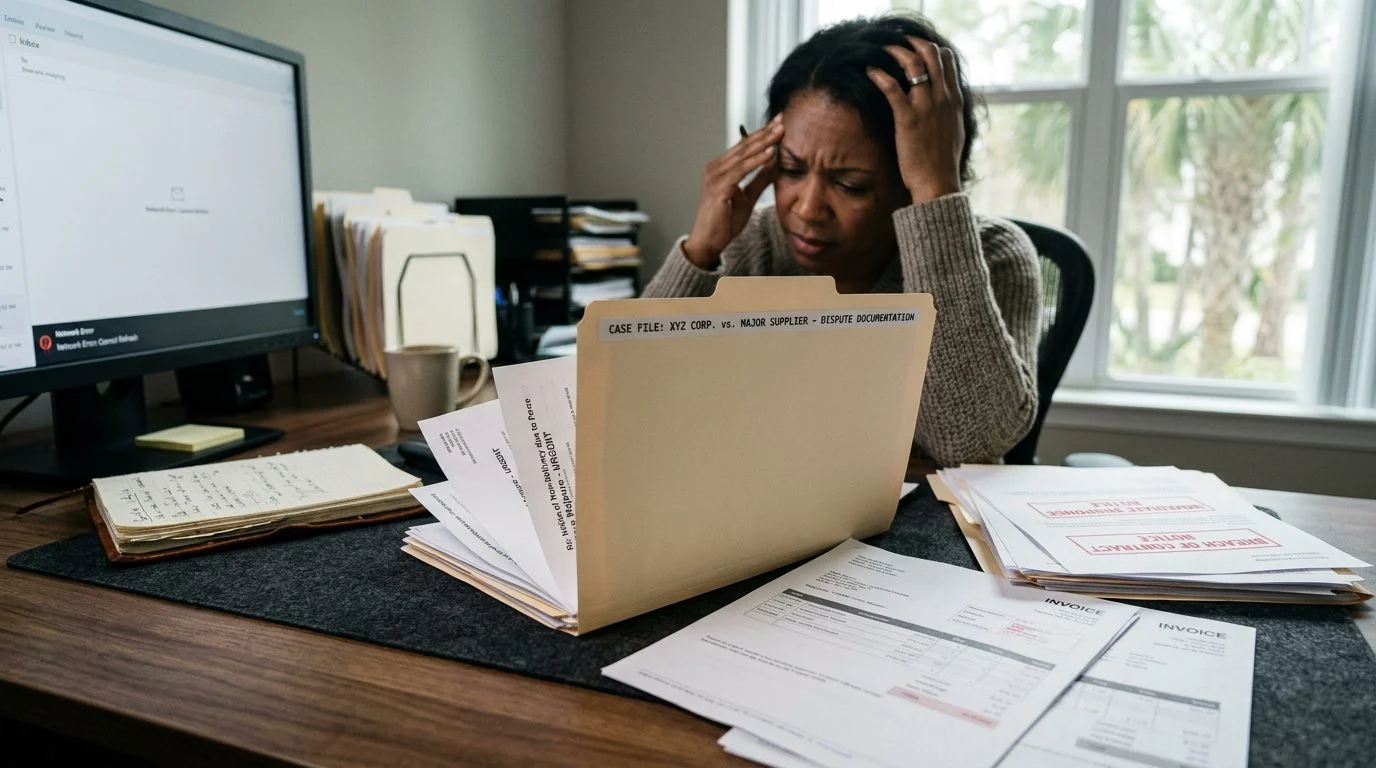
When a supplier can’t deliver, the first question is whether the contract excuses the delay. A force majeure clause may do that, but a shortage is not automatically covered. The answer turns on the clause’s exact words, when the shortage began, and how each side responded.
This page walks through how a Florida business owner or buyer can test a supplier’s shortage excuse. It covers the clause, notice and records, fallback arguments, and lessons from pandemic-era disputes. KEW Legal is a Florida business law firm based in Coral Gables and Sunny Isles Beach. Our lawyers advise business owners and investors across Miami-Dade and South Florida. Kristina E. Wilson is the responsible lawyer for this page. The information here is general and does not replace advice about your own contract.
What a Force Majeure Clause Does in a Florida Supply Contract
A force majeure clause is a contract term that can excuse or suspend performance when an event outside the parties’ control occurs. The parties agree to it in the contract, so it protects a party only as far as its words reach. That makes the clause the first thing to read.
Many supplier contracts for goods fall under Florida’s sale-of-goods law. That chapter applies to transactions in goods. If the goods side of a deal predominates, the chapter governs the whole deal, though other law can still reach parts that do not involve goods (Fla. Stat. § 672.102).
Many business-to-business supply deals fall in that category, and that matters for the rules below.
Read the whole deal, not just the supplier’s last email. Check the purchase order, the supplier’s terms, any definitions, and any later changes.
If a supplier has halted delivery and blames a shortage, our team can review your contract with you and help you see the options you may have. Talk it through with our team — the first consultation is free, confidential, and carries no obligation.
Check Whether a Shortage Is Actually Listed as an Excusing Event
Start by searching the clause for words like “shortage,” “supply,” “materials,” and “inputs.”
Most clauses list events such as natural disasters, war, government orders, and labor disputes. Shortages of materials or an inability to get inputs appear less often. When they are missing, the supplier must argue that its shortage fits a general phrase.
Many clauses also include a catch-all, such as events “beyond reasonable control.” Read that phrase together with the list around it. The specific items next to a catch-all often shape how it is read. A supplier relying on a vague phrase may have a harder argument than one whose clause names supply problems.
For example, imagine a Doral importer whose clause names fires, floods, and government orders but says nothing about supply. When its vendor cannot ship components, the importer should ask whether the shortage fits any listed event. It should also read the rest of the clause, including any notice steps, before it accepts the delay.
Foreseeability and the Supplier’s Own Role in the Shortage
A supplier’s excuse is weaker when the shortage was foreseeable or the supplier helped cause it. The core question is often whether the problem was known or predictable when the parties signed.
Start with the timeline. Did the supplier already know its raw material was tight when it accepted your order? Did it sign the deal with no backup plan? Those facts can count against an excuse, even when the clause lists shortages.
A shortage the supplier created through poor planning is harder to excuse. So is a shortage the supplier failed to address once it knew about it. If the vendor waited weeks to tell you, or made no effort to find other sources, that delay becomes part of the story.
Write down when the supplier first mentioned a problem and what it said. Those dates often matter more than the final letter. Keep every email, text, and call note in order.
A supplier’s acknowledgment or invoice may also add its own force majeure or cancellation term. That conflict is covered later in this guide.
Notice, Documentation, and the Duty to Mitigate
A supplier that wants to rely on force majeure should follow the notice steps in its contract. Many clauses set a deadline and a required form for that notice. Missing those steps can weaken the excuse.
Gather the records that matter. These include the original order, supplier communications, shortage notices, price quotes, and any attempts to find other sources. Your own notes matter too, because they show what was said and when.
Many clauses also expect the party invoking the excuse to limit the harm, such as by seeking other sources where the contract allows. A supplier that never looked for another source may find its excuse questioned.
Buyers have duties too. If you have accepted a delivery, Florida law requires you to notify the seller of any breach within a reasonable time after you discover or should have discovered it. Otherwise you can be barred from any remedy (Fla. Stat. § 672.607). You also carry the burden of proving any breach in goods you accepted.
Put your breach notice in writing and keep a copy. State what went wrong, when it happened, and what you need.
When the Contract Is Silent: Impossibility, Impracticability, and Frustration
When the contract says nothing about the event, a party may argue impossibility, impracticability, or frustration of purpose. These are fallback arguments from general contract law, not from the clause itself.
They tend to be harder to make than a written excuse, and they turn on the facts. A supplier that simply pays more for materials has a weak case that delivery became impossible. Test that claim against the supplier’s own numbers and dates.
A partial shortage or a late delivery often calls for a different analysis than a complete failure to perform. Partial problems also give the supplier room to try a fix.
Florida’s sale-of-goods law addresses that fix. If a delivery is rejected as nonconforming and time remains, the seller may notify you it intends to cure and make a conforming delivery within the contract time (Fla. Stat. § 672.508). That can mean the seller may seasonably notify you of its intention to cure and then make a conforming delivery within the contract time, so weigh the delay before you respond.
Pandemic-Era Clauses in Business Contracts
The COVID-19 pandemic, which reshaped business beginning in early 2020, led many companies to read their force majeure clauses for the first time. The lesson was that one headline event does not excuse performance the same way in every contract.
Outcomes turned on the details. Those details included the exact wording of each clause, the timing of the disruption, and what each party did in response.
Records of timely notice and real efforts to find alternatives helped a party show what it had done. A party that stayed silent had little to point to.
A market slowdown or a price spike is different from a listed event, and the clause decides which one applies. For buyers and owners today, the lesson is simple. Test your supplier’s excuse against the clause before you accept it, and keep your own records as you go.
Not sure what your next step is?
Talk it through with our team — the first consultation is free, confidential, and carries no obligation.
Force Majeure in Commercial Leases and Real Estate Contracts
Yes, a force majeure clause can appear in a commercial lease. Whether it reaches rent depends on how the lease is written, so check payment terms separately.
Lease clauses often address the timing of repairs, access to the space, or when work must be finished. Read those terms next to the rent clause, not on their own.
A tenant that invokes a disruption excuse should respond in writing and follow the lease’s notice steps. Its response can affect whether the landlord may pursue default remedies. Keep records of the disruption and of every request for relief.
Florida’s commercial tenancy rules are in Chapter 83, Part I. A landlord that wants a tenant out must follow those rules.
KEW Legal handles commercial lease and commercial eviction matters, including commercial evictions for owners who live abroad. A dispute can begin with one missed payment or one delayed repair.
Conflicting Terms, Breach Questions, and Your Next Step
A supplier’s invoice or acknowledgment can add terms that change the deal, so review it before you respond. Under Florida’s rule on additional terms, a definite and timely acceptance generally works as an acceptance even if it states different terms (Fla. Stat. § 672.207). The exception is when the acceptance is expressly conditioned on agreeing to those terms.
Between merchants, the extra terms become part of the contract unless the offer limits acceptance to its own terms, the terms materially alter the deal, or you object within a reasonable time.
Florida also sets a short window. Between merchants, if within a reasonable time a written confirmation of the contract is received and you have reason to know its contents, it can satisfy the signed-writing rule against you unless you object in a record within 10 days after receiving it (Fla. Stat. § 672.201).
Some vendor agreements require arbitration.
Can a supplier’s shortage count as force majeure?
Read the exact clause first.
Does a contract term control how long I have to sue?
Not in a way that shortens the time below the statute of limitations. A term that does so is void (Fla. Stat. § 95.03).
Can a written confirmation bind me without my signature?
Between merchants, a written confirmation of the contract can satisfy the signed-writing requirement against you if it is received within a reasonable time and you have reason to know its contents, unless you object in writing within 10 days after receiving it.
If your supplier has halted delivery and blames a shortage, you need to decide whether to accept the delay, press for performance, or pursue remedies. Our team can review your contract, the supplier’s notices, and your records with you. KEW Legal offers a free first consultation that is confidential and carries no obligation to continue. Call 305-990-2300 or send us a message.
How KEW Legal Helps Business Owners Respond
Contract review
We read the exact force majeure, notice, and remedy language in your agreement before you decide on a next step.
Protecting your position
We help you document the disruption, preserve your rights, and avoid actions that could weaken your position.
Outside general counsel
Our team works with owners and managers on vendor disputes, supply chain issues, and ongoing contract management.
Clear next steps
We explain your options in plain language so you can decide how to communicate with the other party.
Act on the Notice Terms Carefully
Many force majeure clauses require prompt written notice, specific content, or a particular delivery method. Missing those requirements can cause problems even when the event itself is real. Review your contract before you respond.
Questions to Answer Before You Respond
What event is covered?
Check whether the clause lists specific events or uses broader language, and whether your situation fits those words.
What does the clause require?
Look for notice deadlines, documentation requests, and steps needed to suspend or excuse performance.
What happens to payments?
Determine whether the clause affects fees, deposits, delivery schedules, or termination rights.
What did the parties do since?
Written confirmations, emails, and partial performance can affect how the agreement is read, so keep records.
Talk With KEW Legal About Your Supplier Problem
Related practice areas
Request a Consultation
Fill out the short form and we will take it from there.