
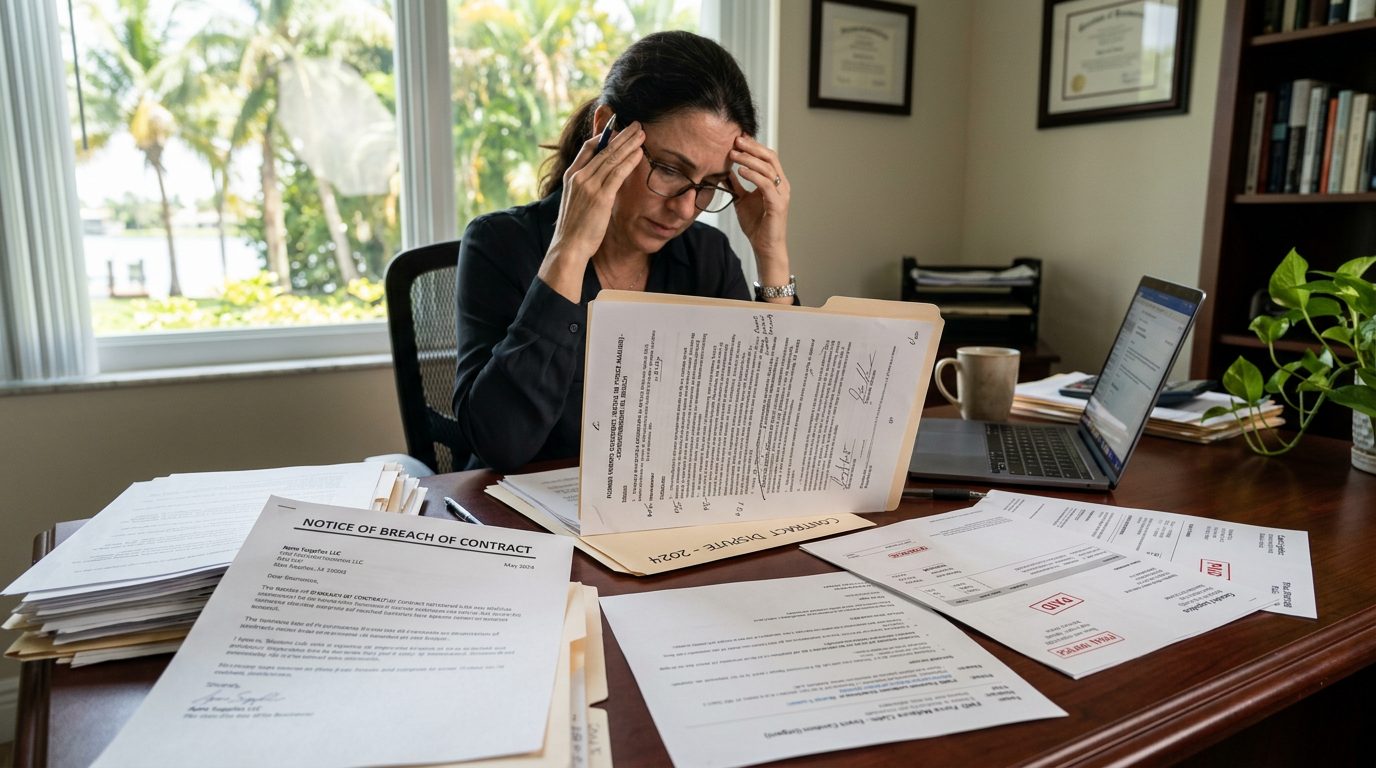
Business Contract Disputes | Coral Gables & Sunny Isles Beach
Facing a Force Majeure Dispute? Get Clear Answers on Your Contract
KEW Legal helps business owners and investors across Miami-Dade and South Florida review force majeure clauses, understand notice requirements, and protect their position when the other side invokes or disputes one.
By Kristina E. Wilson · Published October 24, 2026
Force Majeure Clause Dispute Attorney in Florida
A force majeure clause lets a party delay or excuse contract duties when a defined event outside its control blocks performance. Whether that protection applies turns on the clause’s exact words, the event, and the notice the contract requires. KEW Legal helps Florida business owners and investors review these clauses from its Coral Gables and Sunny Isles Beach offices.
If a supplier or customer has cited a force majeure clause and a reply deadline is close, our team can review the contract and timeline with you. Talk it through with our team — the first consultation is free, confidential, and carries no obligation.

What a Force Majeure Clause Does and Who This Page Is For
A force majeure clause is a contract term that excuses or suspends performance when a defined event beyond the parties’ control prevents it. The phrase is French for “superior force.”
This page is for suppliers, customers, landlords, tenants, and project parties in South Florida who are sending or receiving a force majeure notice. It also helps owners who want to know how the clause would work before a problem starts.
The clause’s power comes from its exact wording, so the full contract controls the analysis. Amendments, side letters, and emails about the event matter too.
KEW Legal acts as outside general counsel for business owners and investors across Miami-Dade and South Florida. Contract disputes are one part of that work, alongside partnership, vendor, lease, employment, and sale matters.
Which Events Qualify: Reading the Clause Word by Word
A qualifying event is one the contract names or one that fits the clause’s general wording.
Many clauses list events such as:
- Hurricanes, floods, and other natural disasters
- Fire, war, and terrorism
- Strikes
- Government orders and permit suspensions
- Epidemics and public health orders
- Supplier or transport failures
A named list is narrow. A catch-all phrase such as “other causes beyond reasonable control” is broader and invites argument. Each side reads it to fit its own position.
The word “foreseeable” causes many disputes. If a risk was known at signing, or was already building, the other side will argue the event does not qualify. The dates matter, so track when the event first appeared.
Causation matters too. Many clauses are read to require that the event actually prevent performance. Higher costs or lower profit may not be enough unless the clause says so.
Notice and Procedure: The Requirements That Often Decide the Dispute
Many force majeure clauses require written notice within a set number of days after the event starts. A late or incomplete notice can put the clause’s protection at risk, so the notice deadline often matters most.
A typical notice identifies:
- The event and the date it began
- The obligations it affects
- How long the delay is expected to last
- The steps taken to reduce the impact
Many clauses also require reasonable efforts to resume performance. The notice should show what was done, such as finding an alternate supplier or rerouting a shipment.
Keep records. Save dated emails, texts, supplier messages, photos, delivery logs, and official government notices. A dispute often turns on whether those records match the timeline in the notice.
Whether a notice was timely and complete depends on the facts and the contract’s exact terms.
When Force Majeure Does Not Apply
A force majeure clause usually does not help when the event did not actually prevent performance, the contract excludes the event, or the required notice was late or missing.
- Harder or more expensive performance is not always excused. Check the clause for cost language.
- Other defenses, such as impossibility, impracticability, and frustration of purpose, are separate ideas. Whether they can be used alongside a clause turns on the contract’s wording.
- A party that had other ways to perform may not qualify.
Informal promises matter too. A casual email saying “take your time” can carry weight, so keep those messages.
Delay can also cost rights. That is a general rule, not an automatic result.
How a Force Majeure Dispute Is Handled With KEW Legal
A typical matter moves from document review to a written response plan, then to negotiation, and to formal proceedings only if needed.
- Intake. We review the contract, amendments, notices, and a timeline of the event, in confidence.
- Clause analysis. We map the defined events, notice deadlines, mitigation duties, termination rights, and any dispute clause.
- Response. We draft or review the notice, the reply to a counterparty’s notice, or a demand letter, consistent with the contract’s deadlines.
- Negotiation. We seek a suspension, a new schedule, a price change, or exit terms, all put in writing.
- Formal proceedings. When needed, we pursue litigation or the process the contract requires. The forum sets the timing.
Dispute clauses matter. Under Fla. Stat. § 682.02, an agreement to arbitrate in a record is valid, enforceable, and irrevocable, except on grounds that exist to revoke any contract.
Results turn on the contract language, the evidence, and the forum. No result can be promised before the documents are reviewed.
Not sure what your next step is?
Talk it through with our team — the first consultation is free, confidential, and carries no obligation.
Why Businesses Work With KEW Legal on Contract Disputes
KEW Legal focuses on business law for owners and investors. The firm has offices in Coral Gables and Sunny Isles Beach and serves Miami-Dade, Broward, and nearby South Florida.
Outside general counsel means ongoing access, not only one filing. Clients can bring in contract review, vendor disputes, lease questions, and employment issues as they arise. A force majeure event often touches several of these areas at once. A supply delay can affect a lease, a vendor agreement, and staffing.
Kristina E. Wilson is the responsible lawyer for this page. Natalie Martinez is also one of the firm’s lawyers. The firm’s support staff handle intake and document coordination, so records stay organized as a matter moves.
Related areas include business contract and vendor disputes, commercial leases, partnership disputes, and commercial eviction. A force majeure claim can arise in each one.
Common Questions About Force Majeure Disputes in Florida
What makes a force majeure clause reasonable?
Clear defined events, workable notice terms, and a clear scope of relief help both sides know where they stand.
Why is it hard to draft one?
Drafters must list events, plan for new risks, and avoid vague wording that invites argument. Those goals pull against each other.
Does a pandemic or government order qualify automatically?
Not automatically. The contract’s wording and the actual effect on performance decide that.
Can a party halt payments during a force majeure event?
Payment relief turns on whether the clause suspends or excuses payment and on the notice given.
Can a contract set a shorter time to sue?
A contract provision that sets a shorter time to bring an action than the statute allows is void, under § 95.03.
Can the winning side recover attorney’s fees?
If a contract allows fees to a party required to enforce it, a court may also allow fees to the other party when that party prevails on the contract, under § 57.105. This applies to any contract entered into on or after October 1, 1988.
What will it cost to get started?
The first consultation is free, confidential, and carries no obligation to continue.
What should a business do now?
Keep the contract, notices, and records intact. Avoid informal written admissions about the event until the clause has been reviewed.

Talk Through Your Force Majeure Notice Before the Deadline
Picture a supplier that cancelled a shipment and cited a storm or a government order. Or picture a customer that sent a notice saying it cannot perform, with a reply window already running. In either case, the clock can matter as much as the clause.
Bring the contract, any amendments, the notice you received or sent, and dated correspondence. Call 305-990-2300 or send us a message, and Kristina E. Wilson can review the contract and timeline with you.
How KEW Legal Approaches a Force Majeure Dispute
Review the Contract Language
We read the clause, its definitions, its notice terms and related provisions to see how your agreement actually addresses the event.
Build the Timeline
We organize when the event occurred, when it was raised, and what was communicated, so the facts are clear from the start.
Protect Your Position
We advise on notices, responses and documentation so that your rights are preserved while the dispute is evaluated.
Pursue a Resolution
We work to resolve the matter through negotiation where possible and prepare for litigation when that becomes necessary.
Review Notice Terms Before You Respond
Many force majeure clauses set conditions for written notice and supporting documentation. Replying to the other party without reviewing those terms can affect your position. Contact our office before sending a response.
Common Questions About Force Majeure Clauses
What counts as force majeure?
Whether an event falls within a clause depends on how the contract defines it. Clear definitions help both sides understand where they stand.
Can a clause excuse performance?
Some clauses suspend or excuse obligations, while others limit the relief available. Our attorneys review the exact wording before discussing options.
Is the other side's claim valid?
We evaluate the clause, the triggering event and the supporting documentation to help you understand your position and next steps.
Should I respond to a notice?
A careless reply can affect your rights. Talk with our team before sending any response to a force majeure claim.
Start With a Free, Confidential Consultation, With No Obligation to Continue
Related practice areas
- Business Contract And Vendor Dispute Attorney
- Outside General Counsel for Buyers Due Diligence Miami
Request a Consultation
Fill out the short form and we will take it from there.