
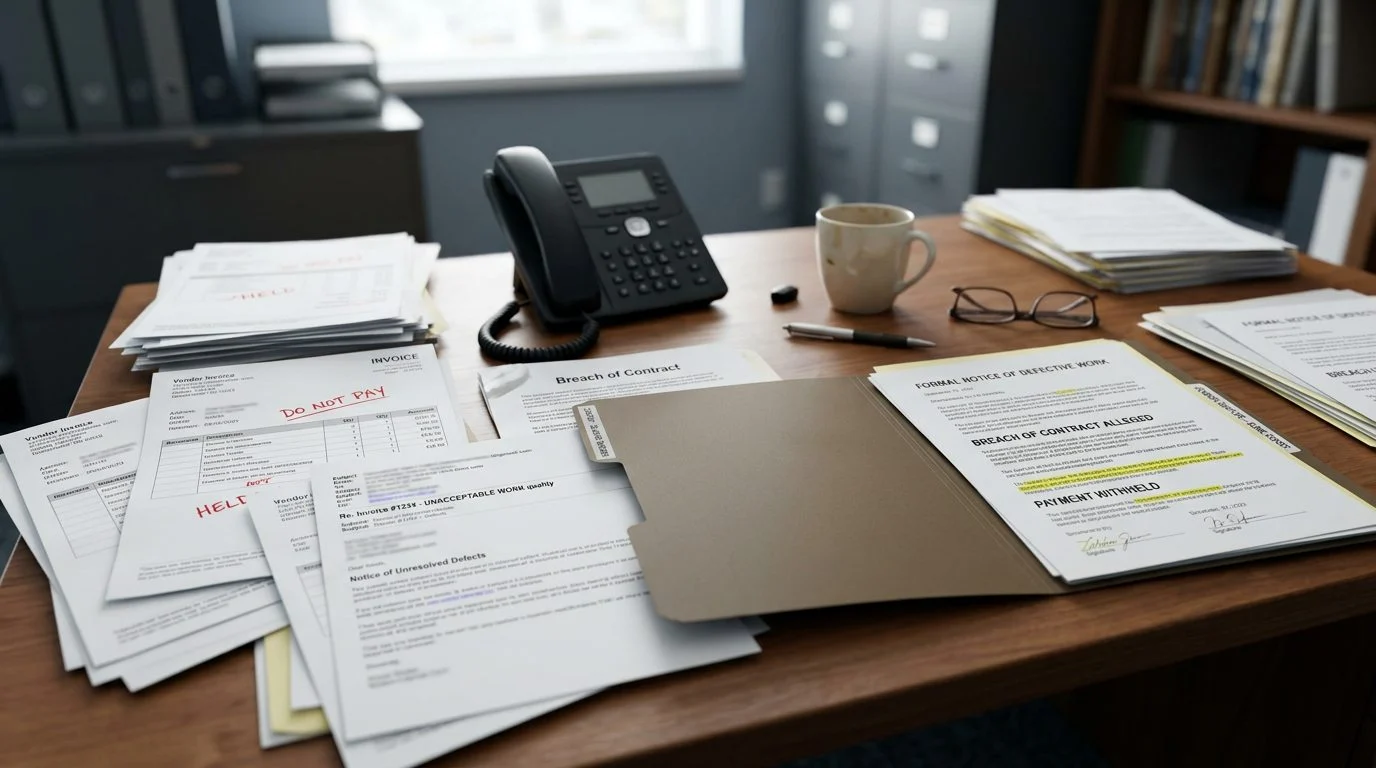
Business Contracts | Coral Gables & Sunny Isles Beach
Defective Work and an Unpaid Vendor Invoice? Get Advice Before You Withhold Payment.
KEW Legal is outside general counsel for business owners and investors across Miami-Dade and Broward Counties. We help you review the contract, the notice, and the next step before you act.
By Kristina E. Wilson · Published November 5, 2026
Whether it can, and how much, turns on the written contract, the kind of defect, and the records kept along the way. This page explains the general Florida framework for vendor payment withholding for defective work. KEW Legal is a Florida business law firm with an office in Coral Gables. It serves business owners and investors across Miami-Dade and South Florida.
Who This Page Is For and What a Defective Work Payment Dispute Involves
A defective work payment dispute usually starts with an unpaid invoice. The goods or work arrived, something is wrong, and someone must decide whether to pay in full, pay less, or hold the payment. This page is for business owners, property owners, general contractors, and managers facing that choice, including people acting for a company they run.
Vendors, suppliers, contractors, and subcontractors all raise this question. The rules are not the same for every deal. The Florida sales rules cited below come from the Uniform Commercial Code (UCC) and apply to contracts for goods. A defective service or construction job may follow different rules, so the contract and the type of project control the analysis.
This is general information about Florida law, not advice on your contract. Kristina E. Wilson is the responsible attorney for this page. She is one of the lawyers at KEW Legal’s Coral Gables office. For a broader view, see our business contract and vendor dispute attorney page.
If a defective delivery has you weighing whether to hold back an invoice, we can review your contract and records with you. Talk it through with our team — the first consultation is free, confidential, and carries no obligation.

The Starting Point: What the Contract Says About Payment and Defects
The written contract is the first place to look. Start with the purchase order, the statement of work, and any terms printed on the quote, invoice, or delivery ticket.
Most contracts address four things: payment schedules, when delivery counts as accepted, warranty terms, and notice-and-cure steps. A notice clause may require written notice of defects within a set period. Missing that window can weaken a withholding position, even when the defect is real.
Some deals are not in writing. Under Fla. Stat. § 672.201, a contract to sell goods for $500 or more is not enforceable without a record signed by the party against whom enforcement is sought, unless an exception applies. One exception covers goods that were paid for and accepted, or received and accepted. So a verbal deal can still matter, and the delivery and acceptance facts count.
Common-Law Principles: Holding Back Money and Competing Claims
That analysis is fact-heavy, so the answer depends on the facts in your file.
One rule is clear from the sources. When a written contract covers the subject, a claim for unjust enrichment generally cannot take its place.
Holding back far more than the defect is worth can also create a separate dispute. A withholding that looks overreaching tends to shift attention away from the defect and onto the business that kept the money.
Florida Statutes That Affect Withholding on Construction and Related Projects
Construction projects can fall under separate payment and lien rules, and those rules carry their own timelines. Which rules apply depends on who the parties are and what kind of project it is.
The UCC sales rules are written for goods. They do not map neatly onto a construction job. A contractor should not assume that the same notice and payment timing applies.
When a construction dispute is in play, check the project type and the parties before acting on any deadline. That early check is a practical first step, and it is one we can help you start.
Pay-When-Paid, Retainage, and Other Payment Terms That Change the Analysis
Payment terms can change when money is owed and whether any of it can be held. A pay-when-paid clause (one that ties your payment to someone else’s payment) can tie your payment to an event outside your control. Another common clause holds back a share of each invoice until the job is finished.
These clauses can limit or expand your right to withhold, so the exact wording controls. Read each payment clause against the defect record before you decide how much to hold. A clause that seems to favor you can also make withholding harder.
Under Fla. Stat. § 95.03, a contract provision that sets a shorter period to bring an action than the applicable statute of limitations is void. For the general limitations periods, see Fla. Stat. § 95.11.
What the Business Must Do After Finding a Defect
After a defect appears, the business must act within a reasonable time. Under Fla. Stat. § 672.607, when a tender has been accepted, the buyer must notify the seller of the breach within a reasonable time after it discovers or should have discovered it. Otherwise, the buyer can be barred from any remedy.
Acceptance is the trigger to watch. Under Fla. Stat. § 672.606, acceptance occurs when the buyer, after a reasonable chance to inspect, signals that the goods conform or that it will keep them anyway, or when it fails to make an effective rejection, but that acceptance does not occur until the buyer has had a reasonable opportunity to inspect them. Fla. Stat. § 672.606 reads: “(c) Does any act inconsistent with the seller’s ownership; but if such act is wrongful as against the seller it is an acceptance only if ratified by her or him.” It also occurs when the buyer does any act inconsistent with the seller’s ownership, but if that act is wrongful as against the seller, it counts as acceptance only if the seller ratifies it. Fla. Stat. § 672.606 reads: “(c) Does any act inconsistent with the seller’s ownership; but if such act is wrongful as against the seller it is an acceptance only if ratified by her or him.”
A seller may also get a chance to fix the problem. Under Fla. Stat. § 672.508, if the time to perform has not yet expired, a seller whose delivery was rejected may notify the buyer of its intent to cure and make a conforming delivery. Silence after learning the facts can also cut against a buyer. As the court put it in Flaherty v. Flaherty: “Ratification occurs when a party entitled to rescind a voidable contract fails to do so after the discovery of facts that warrant a rescission.”
Not sure what your next step is?
Talk it through with our team — the first consultation is free, confidential, and carries no obligation.
Deadlines and Documentation That Protect a Withholding Position
The records that protect a withholding are the signed contract, change orders, inspection notes, photos, and dated written defect notices. Keep every reply from the vendor, too. A written record is usually more persuasive than memory or a phone call.
Under Fla. Stat. § 672.607, the buyer carries the burden to establish any breach in goods it accepted. Send written notice as soon as a defect is found, not at the end of the job.
Warranty language matters too. Under Fla. Stat. § 672.316, words such as “as is” can exclude implied warranties unless the circumstances indicate otherwise. Examining the goods before signing can also remove implied warranties for defects that examination ought to have revealed. Under Fla. Stat. § 672.313, a statement of fact that becomes part of the deal can create an express warranty.
Keep the goods, the work site, or the equipment available for inspection. Track each notice date and payment date so the record shows a clear timeline.
Risks of Withholding: Counterclaims, Fee Shifting, and Relationship Costs
Withholding can lead to a counterclaim, and Florida’s fee rules can make a losing position costly. In Florida, each side generally pays its own attorneys’ fees unless a contract or statute provides otherwise.
Dispute-resolution clauses matter as well. Under Fla. Stat. § 682.02, a written agreement to arbitrate existing or later disputes is generally valid and enforceable. Lien and bond remedies in construction have their own deadlines and rules, which need separate review. Withholding without clear notice can also strain the vendor relationship, even when the defect is real.
How a Subcontractor or Vendor Payment Matter Typically Proceeds
A typical matter moves in steps: records review, written notice of the defect, a cure period, negotiation, and formal steps if needed. The contract and applicable law set the timing of each step.
Start with the contract and the file. Confirm what was delivered, when it was accepted, and what the notice clause requires. Then send written notice that describes each defect, the date it was found, and the remedy requested. Offering the vendor a chance to cure follows the same logic as the UCC cure provision discussed above.
A clear written record can help a dispute settle at the notice or negotiation stage. When talks stall, formal steps can include a lawsuit or arbitration, depending on what the contract requires. Each step carries its own timing, so track every date from the start.
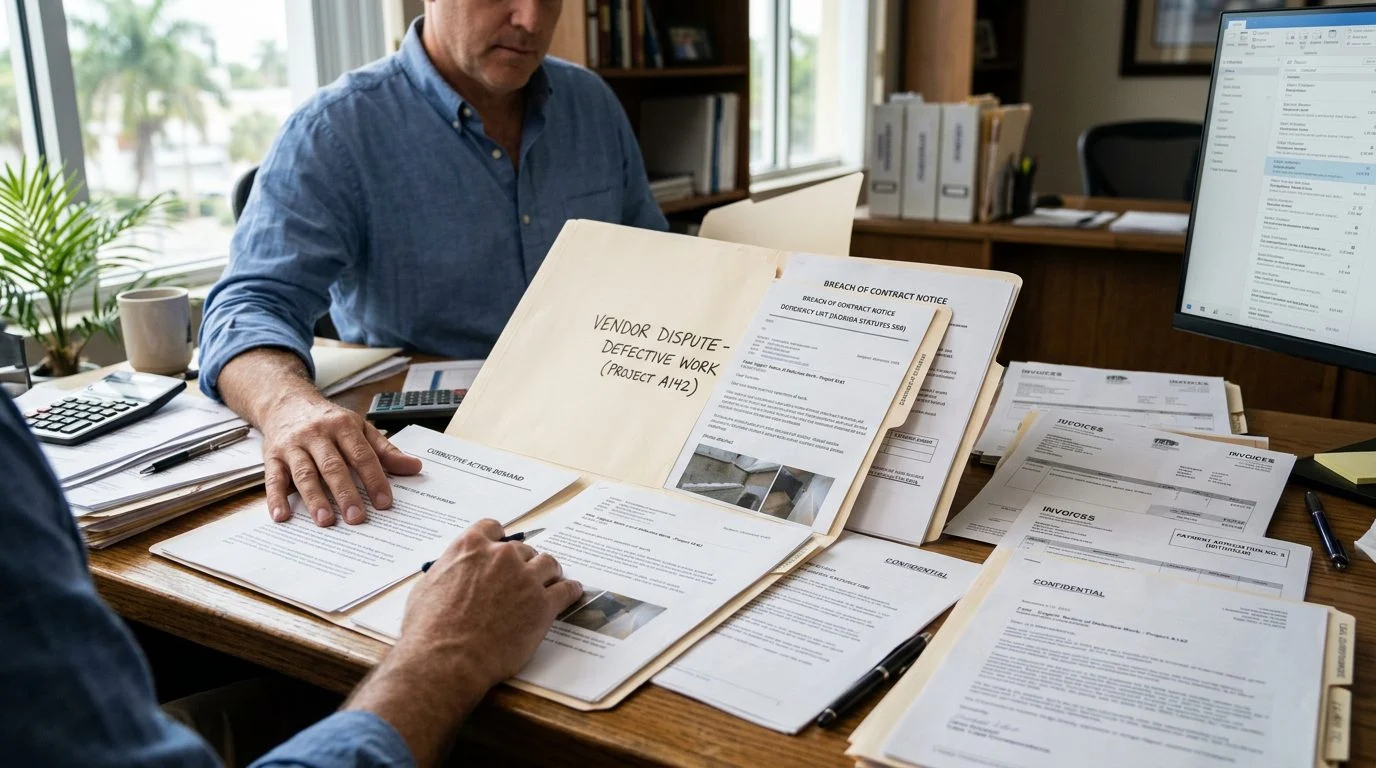
Not Sure What Your Next Step Is? Talk Through Your Contract and Your Records
If an unpaid invoice has you deciding whether to hold money back, the next step is to review the contract, the defect record, and the payment deadlines together. You may be handling this for a company you manage, and the choice can feel urgent. You do not have to face it alone.
Kristina E. Wilson and the team at KEW Legal’s Coral Gables office can review those documents with you. The first consultation is free, confidential, and carries no obligation to continue. Call 305-990-2300 or send us a message.
Can a business withhold payment for defective goods in Florida?
The contract terms, the notice timing, and whether the goods were accepted usually decide the outcome.
How long do I have to notify a vendor of a defect?
Under Fla. Stat. § 672.607, once a tender has been accepted, you must notify the seller of breach within a reasonable time after you discover or should have discovered the breach. Otherwise you can be barred from any remedy. Otherwise you can be barred from any remedy.
Does “as is” language remove my claim for defective goods?
Under Fla. Stat. § 672.316, language that excludes the implied warranty of merchantability must mention merchantability and, if in a writing, be conspicuous; an exclusion of the implied warranty of fitness must be in a conspicuous writing; and expressions like “as is” exclude implied warranties unless the circumstances indicate otherwise. Express warranties from the seller’s statements can still apply.
Can a contract shorten the time to sue in Florida?
No. Under Fla. Stat. § 95.03, a contract provision that sets a shorter period than the statute allows is void.
How KEW Legal Approaches a Defective-Work Dispute
We Review the Contract
Payment terms, inspection and acceptance clauses, warranty language, and any notice requirements often shape how a withholding dispute should be handled.
We Examine the Record
Invoices, photos, emails, change orders, and inspection reports help us understand what was delivered and when the problem was raised.
We Plan Your Position
Before any payment is held back, we discuss the risks, the leverage, and the options available for resolving the matter.
We Keep You Informed
You receive clear guidance on each step so you can make informed decisions about your business and your vendor relationship.
Do Not Stop Payment on Impulse
Withholding money from a vendor can trigger a breach claim, a lien, or a demand for interest and fees. Before you hold back payment or send a formal notice, have the contract and the defect documented and reviewed.
Documents to Gather Before You Call
The Signed Agreement
Include the purchase order, the master contract, any amendments, and the terms and conditions that were incorporated.
Proof of the Defect
Collect photographs, test results, inspection reports, and written descriptions of what failed or did not match the specification.
Communications With the Vendor
Save emails, text messages, and meeting notes, especially any written objections or requests for correction.
Payment and Delivery Records
Gather invoices, delivery receipts, acceptance forms, and records of any partial payments already made.
Have a Vendor Dispute Over Defective Work? Start With a Free, Confidential Consultation.
Related practice areas
Request a Consultation
Fill out the short form and we will take it from there.