
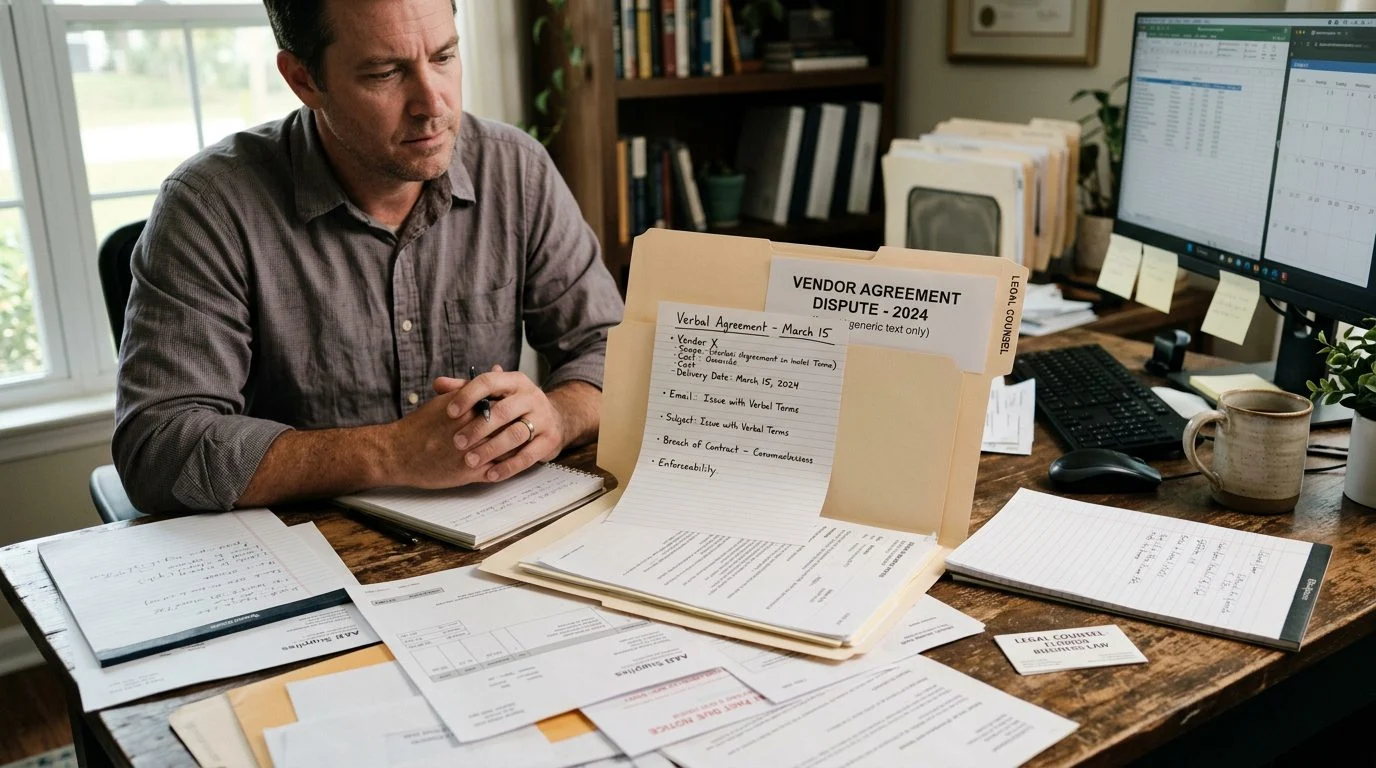
Business Contracts & Vendor Disputes | Coral Gables and Sunny Isles Beach
Is a Verbal Agreement With a Vendor Enforceable in Florida?
A handshake deal can still be a binding contract. KEW Legal helps Miami-Dade and South Florida business owners sort out what was agreed, what can be proven, and what to do next.
By Kristina E. Wilson · Published November 5, 2026
The Short Answer: Most Business Agreements Do Not Have to Be in Writing
Yes, a verbal vendor agreement can be enforceable in Florida. Florida applies the basic rules of contract law to spoken deals, so many ordinary business deals don’t need a signed document to bind the parties. An oral contract must still have an offer, an acceptance, consideration, and enough detail on the essential terms (St. Joe Corp. v. McIver). In plain words, one side asks for something, the other side agrees, each side gives something of value, and the key terms are clear enough to enforce.
Enforceable doesn’t mean easy to prove. Most vendor fights aren’t about whether a deal existed. They’re about what was agreed, such as price, quantity, delivery date, payment timing, or who pays for extra work. Whether your own verbal deal is binding depends on the facts.
If a vendor ignored a deal you struck by phone or handshake, KEW Legal can review what was agreed and the proof you have. Reach out and we'll talk through your options. Talk it through with our team — the first consultation is free, confidential, and carries no obligation.
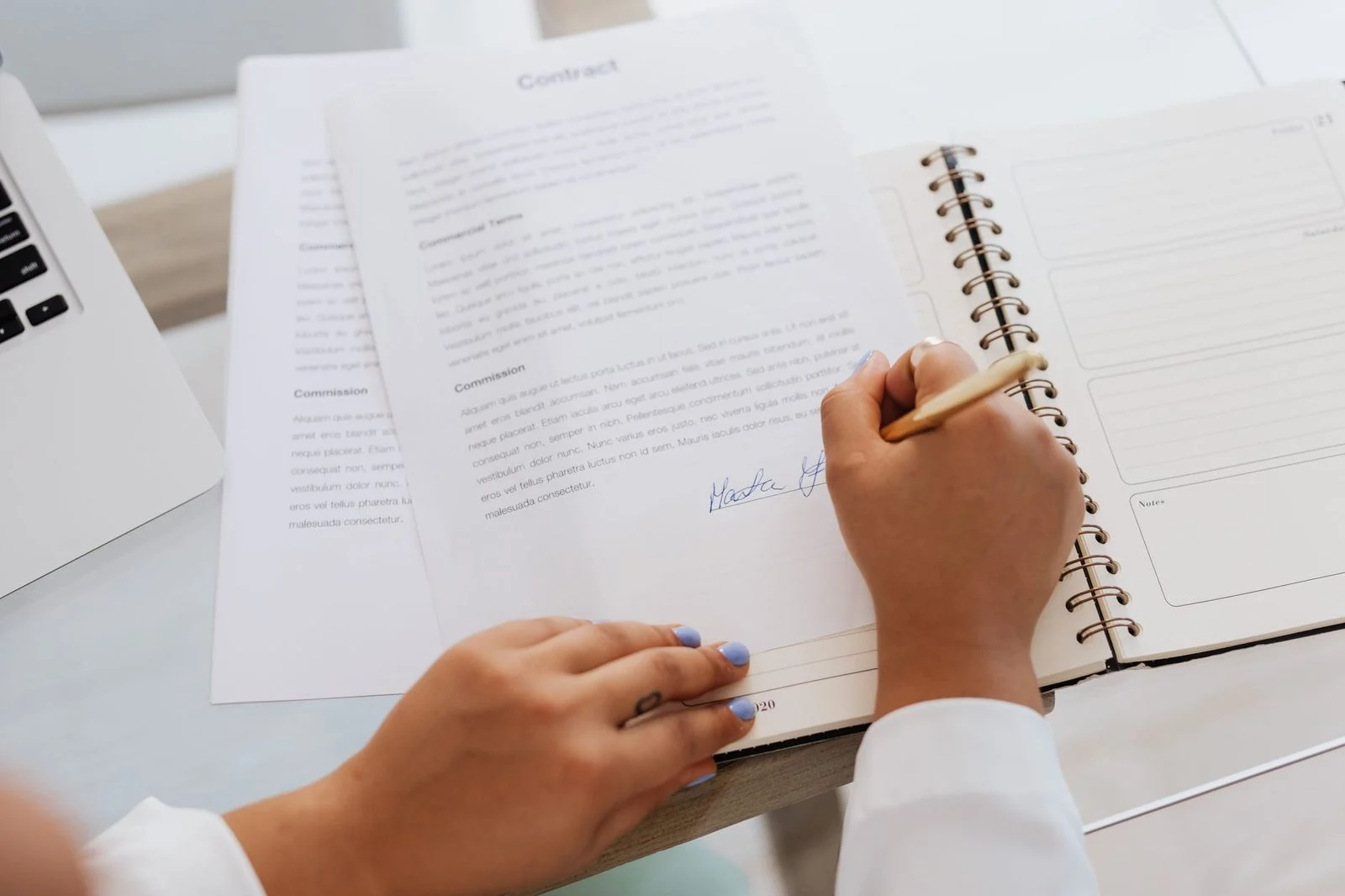
Oral vs. Written Contracts: Key Differences
A written contract puts the terms on paper, so both sides can point to the same words. An oral contract lives in phone calls, meetings, invoices, and what each side actually did. Under Fla. Stat. § 672.201(1), a contract for the sale of goods for the price of $500 or more is not enforceable by way of action or defense unless there is a record sufficient to indicate that a contract for sale has been made between the parties and signed by the party against whom enforcement is sought or by the party’s authorized agent or broker.
The real risk with oral deals is detail. Two people can remember the same call in different ways. Common disputes involve price changes, delivery dates, order quantities, when payment is due, and whether shipping or rush fees were included.
Written confirmations help. A short email that recaps a call can define what was agreed. Between merchants, Florida’s sales rules set a window: a written confirmation that is sufficient against the sender, received within a reasonable time, can satisfy the writing requirement against the recipient if the recipient has reason to know its contents, unless that person objects in writing within 10 days after receiving it (Fla. Stat. § 672.201). If a vendor sends a recap you disagree with, respond in writing within that window.
The Statute of Frauds: Agreements Not Performable Within One Year
Florida’s statute of frauds requires a signed writing for some agreements.
Check the performance period. The rule looks at what the agreement itself requires. A three-year supply arrangement with a vendor may need a signed writing. A one-time order priced under $500 generally falls outside this rule, which covers a contract for the sale of goods for the price of $500 or more.
Some owners hope a promise alone will hold up. In DK Arena, Inc. v. EB Acquisitions I, LLC, the Florida Supreme Court held that promissory estoppel (a fairness theory that enforces a promise someone relied on) cannot be used to get around the statute of frauds. Write down the start date, end date, and any renewal term for every verbal deal you make.
Other Florida Contracts That Require a Writing
Some goods deals need a signed record, even short ones. Under Fla. Stat. § 672.201, a contract for the sale of goods priced at $500 or more is not enforceable unless a record shows a contract was made and is signed by the party against whom enforcement is sought, or by that party’s authorized agent or broker. A record isn’t invalid just because it leaves out or misstates a term. Enforcement stops at the quantity the record shows.
There are exceptions. The contract can still be enforced if the party admits in court that a deal was made, but only up to the quantity admitted. It can also be enforced for goods that are specially manufactured for the buyer, not suitable for sale to others, where the seller, before notice of repudiation and under circumstances which reasonably indicate that the goods are for the buyer, has made a substantial beginning of their manufacture or commitments for their procurement; and for goods paid for and accepted or received and accepted. Accepted deliveries matter.
Real property has its own rules. Florida’s statute of frauds, Fla. Stat. § 725.01, also bars an action on a lease of land for a term longer than 1 year unless the lease, or a note or memorandum of it, is in writing and signed by the party being charged or by someone that party lawfully authorized. Confirm which statute applies before you rely on an oral term.
Service Agreements and Contractor Disagreements
Many vendor fights start with a verbal deal that each side remembers differently. A contractor may expect payment on a schedule the owner never agreed to. A service provider may bill for work the owner believed was already in the price.
Without written scope, it’s hard to tell whether extra work was part of the deal or approved separately. Payment timing often becomes the central question. Who pays, and when, can decide whether a late payment is a breach or a normal delay.
The sales-of-goods rules above cover goods, not pure services. A service deal is usually measured by general contract principles, such as offer, acceptance, and essential terms. Fraud is a separate issue. A promise of future work can support a fraud claim if the promisor never meant to perform. In Frutafino, S.A.S. v. Dole Chile, S.A., the Third District explained that a promise of future action may be fraudulent if the promisor had no intention of performing, or a positive intention not to perform, when making it.
Proving an Oral or Partly Written Business Agreement
Proof is often the hardest part. Start by gathering emails, text messages, purchase orders, quotes, invoices, delivery receipts, and payment records. Even short messages can show the price, quantity, and timing the parties discussed.
Conduct counts too. Under Fla. Stat. § 672.207, conduct by both parties that recognizes a contract for sale can establish that contract, even when the writings alone don’t. The terms are the ones the writings agree on, plus supplementary terms. In practice, accepting deliveries, paying invoices, and reordering over time can show the terms both sides accepted.
Electronic records carry weight. Under Fla. Stat. § 668.004, an electronic signature has the same force and effect as a written signature, unless another law provides otherwise. That matters for e-signed quotes and emailed approvals.
Keep every record, even the minor ones. Don’t edit, delete, or re-save old messages or files, because changes can make the proof harder to trust.
Not sure what your next step is?
Talk it through with our team — the first consultation is free, confidential, and carries no obligation.
Key Takeaways
- Proving what was agreed can be a central issue when a vendor agreement was never put in writing.
- Some deals need a signed writing, including agreements that cannot be performed within one year, goods priced at $500 or more, and many real property interests.
- Between merchants, a written confirmation of the contract that is received within a reasonable time, and that the recipient has reason to know the contents of, can satisfy the signed-writing requirement against the recipient unless the recipient gives written objection to its contents within 10 days after receiving it.
- Promises to rely on alone rarely get around the statute of frauds.
- Consistent records make an oral deal far easier to explain.
Frequently Asked Questions
Is a handshake deal with a vendor legally binding in Florida?
It can be, if the deal has an offer, acceptance, consideration, and clear essential terms. Proof and any statute of frauds requirement often decide whether it’s enforced.
Does a vendor deal have to be in writing in Florida?
Not always. Agreements that cannot be performed within one year and sales of goods priced at $500 or more generally need a signed record, while many short-term orders do not.
Can text messages or emails prove a verbal agreement?
They can show the terms discussed and how both sides behaved. How much weight they carry varies with each case.
Where is KEW Legal located?
KEW Legal has offices in Coral Gables and Sunny Isles Beach. Kristina E. Wilson is the responsible lawyer for this page.

Talk to KEW Legal About a Vendor Deal Made Without a Contract
If a supplier stopped delivering, disputed an invoice, or changed the price after a phone call, the terms you agreed to may still matter. Those terms are easier to sort out when the emails, invoices, and delivery records are gathered early.
KEW Legal serves business owners and investors across Miami-Dade and South Florida on vendor and contract disputes. Bring the records you already have, and the team can review what was agreed and what proof exists. Call 305-990-2300 or send us a message. Your first consultation is free, confidential, and comes with no obligation to continue.
How KEW Legal Helps Business Owners With Vendor Agreements
Reviewing the Record
We look at texts, emails, invoices, purchase orders and payment history to piece together what the vendor actually agreed to.
Protecting Your Position
We help you respond to a vendor who disputes the deal, or who stops performing, without putting your business at unnecessary risk.
Outside General Counsel
Many owners bring us vendor questions as part of ongoing counsel on contracts, partnerships, employees and commercial leases.
Clear Next Steps
We explain your options in plain language so you can decide how to move forward, whether that means negotiating, documenting the deal or formal dispute resolution.
Don't Wait to Document the Deal
A verbal vendor agreement can be hard to prove once the relationship breaks down. Preserve your emails, texts, invoices and payment records now, and avoid making new promises or payments before you talk through your situation.
Questions That Shape a Verbal Vendor Dispute
What Was Actually Agreed?
Price, scope of work, delivery dates and payment terms are often the core of the dispute. Written messages can help show what each side understood.
Can the Terms Be Proven?
Proof matters as much as the promise. Invoices, receipts, project files and messages between the parties can help establish the deal.
Has Either Side Performed?
Whether the vendor delivered, and whether your business paid, can shape how the dispute unfolds and what options are available.
Does the Deal Fall Under a Writing Requirement?
Some agreements, especially those that cannot be completed within one year, are treated differently under Florida law. A review of the specific facts is the best way to find out.
Talk to KEW Legal About Your Vendor Agreement. Your First Consultation Is Free, Confidential and Comes With No Obligation to Continue.
Related practice areas
Request a Consultation
Fill out the short form and we will take it from there.