
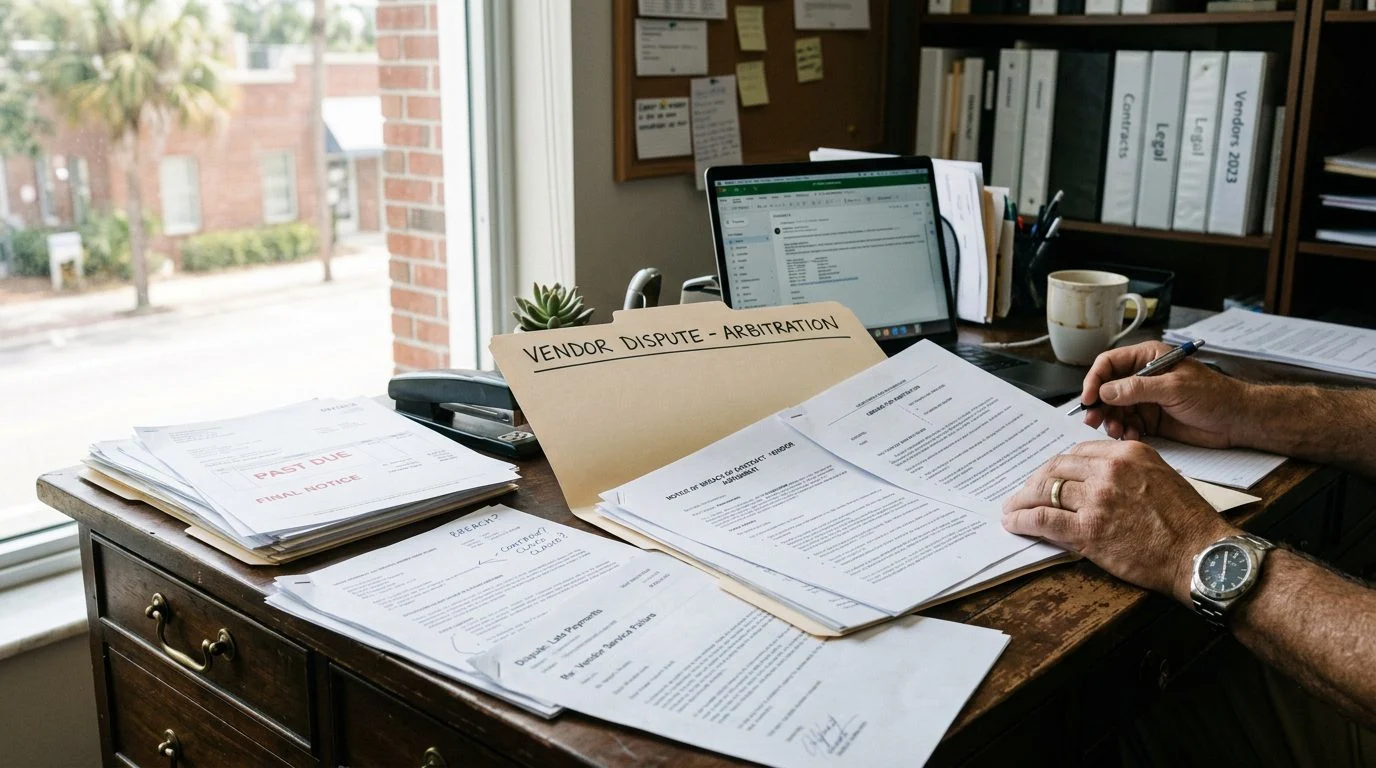
Business Contracts | Coral Gables and Sunny Isles Beach
Is the Arbitration Clause in Your Vendor Contract Enforceable in Florida?
KEW Legal helps business owners across Miami-Dade and Broward County review arbitration clauses in vendor contracts and weigh their options before a dispute escalates.
By Kristina E. Wilson · Published November 4, 2026
An arbitration clause in a vendor contract is usually enforceable in Florida when it is in writing and both sides agreed to it. Florida law starts from that position. Whether your clause holds up depends on the facts, and this page explains the rules that decide it.
What an Arbitration Clause Does in a Vendor Contract
An arbitration clause is a term where both sides agree that future disputes go to a private arbitrator instead of a court or jury. The clause often names an arbitration provider and its rules. It may also say where the hearing takes place.
Many business owners never read this term closely. It often sits in fine print, in a terms-and-conditions attachment, or in a vendor’s standard form. You may have signed it without focusing on it.
Some contracts require mediation first, and only then arbitration. Others require arbitration with no mediation step. Check which one your contract uses, because the order of steps affects what you must do next.
If a vendor says your signed contract requires arbitration, KEW Legal can review that clause with you. You don't have to work out what it means on your own. Talk it through with our team — the first consultation is free, confidential, and carries no obligation.
Florida Law on Arbitration: Chapter 682 and the Federal Arbitration Act
Under Fla. Stat. § 682.02, an agreement contained in a record to submit an existing or subsequent controversy to arbitration is valid, enforceable, and irrevocable, except on a ground that exists at law or in equity for the revocation of a contract. Under Fla. Stat. § 682.02, a written agreement to submit existing or future disputes to arbitration is valid, enforceable, and irrevocable. The exception is a ground that exists in law or equity for revoking any contract.
Federal law can also apply. The Federal Arbitration Act provides that a written provision in a contract evidencing a transaction involving commerce to settle a controversy by arbitration is valid, irrevocable, and enforceable, save upon such grounds as exist at law or in equity for the revocation of any contract. A vendor contract with an out-of-state supplier may fall under federal law, Florida law, or both.
Under § 682.02(2), a court decides whether an agreement to arbitrate exists and whether a dispute falls under it. Under § 682.03(4), a court cannot refuse to order arbitration just because the claim may lack merit.
When a Vendor Arbitration Clause Is Enforceable
There must be a written agreement. Both sides must have agreed to the contract that contains the clause. And the dispute must fall within the clause’s scope.
Scope matters. Some clauses cover only claims arising under the contract. Others use broader words that may reach tort or statutory claims. Courts read the actual wording, so a short phrase can change the result.
Ordinary contract defenses still apply. A party can argue fraud, duress, or unconscionability. Under Basulto v. Hialeah Automotive, the Florida Supreme Court requires both procedural and substantive unconscionability. In Basulto v. Hialeah Automotive, the Supreme Court of Florida concluded that both the procedural and substantive aspects of unconscionability must be present, although not necessarily to the same degree, and both should be evaluated interdependently rather than as independent elements.
Vendor invoices raise another issue. Under § 672.207, between merchants, extra terms in a confirmation do not become part of the deal in some cases. That includes cases where the offer limits acceptance to its own terms, or the terms materially change it.
When a Court May Decline to Enforce or May Set Aside an Award
A court may refuse to enforce a contract clause it finds unconscionable when the contract was made. It may also enforce the rest of the contract without that clause, or limit the clause. See § 672.302.
Once an award is issued, the grounds to undo it are narrow. Under § 682.13(1), upon motion of a party to the arbitration, a court must vacate an award if it was procured by corruption, fraud, or other undue means. Other grounds include evident partiality by a neutral arbitrator and an arbitrator who exceeded their powers.
Timing is strict. Under § 682.13(2), a motion to vacate must generally be filed within 90 days after notice of the award, unless the award was procured by corruption, fraud, or other undue means, in which case the 90 days run from when the ground is known or would have been known with reasonable care. Disagreeing with the arbitrator’s result is not one of the listed grounds.
Participation can also cost you an objection. Under § 682.13(1)(e), a party that joins the arbitration without raising the lack of an agreement, by the start of the hearing, generally cannot later vacate the award on that basis.
What Arbitration Changes About a Vendor Dispute
Arbitration usually replaces a court case with a private hearing. One or more arbitrators decide the matter under the rules the clause names. Those rules control procedure, deadlines, document exchange, and how arbitrators are chosen. Read them before you respond.
Fees vary by clause. The contract or the rules may split arbitrator pay or assign it to one side. Check whether the contract has an attorney fee provision. Florida follows the rule that each party generally pays its own fees unless a contract or statute says otherwise, as stated in Price v. Tyler. So a fee clause often decides who pays.
Appeals are limited. Under § 682.20(1)(a), an order denying a motion to compel arbitration can be appealed. That makes the hearing your main chance to present evidence.
Some contracts carve out certain claims, such as injunctive relief or small claims. Read those carve-outs closely. The carve-out covers only the claims it names; the binding arbitration clause still governs all other disputes between the parties.
What to Do When a Vendor Invokes the Arbitration Clause
Start by gathering the signed contract, every amendment, any incorporated terms, and the vendor’s demand. Write down every response deadline. Missing a deadline in the named rules can hurt your position.
Keep records that show how the deal was made. Save emails, purchase orders, invoices, delivery records, and any proof of how you signed. These facts often decide whether the clause binds you.
Be careful with litigation steps. A party that acts in a way that is inconsistent with arbitration may face an argument that it gave up the right. Talk through each step before you file or respond.
Your options may include asking a court to decide whether the clause applies, or taking part in arbitration while you reserve your objections. You may also negotiate. Under § 682.03(1), a party seeking arbitration may ask a court to order it when the other side refuses. The right path depends on the clause and the facts.
Be careful about continuing to perform. Under Flaherty v. Flaherty, a voidable contract can be ratified when the party entitled to rescind does not act after learning the key facts. Continuing to accept benefits after you learn of a problem can affect your options.
Not sure what your next step is?
Talk it through with our team — the first consultation is free, confidential, and carries no obligation.

Reviewing Your Vendor Contract With KEW Legal
If a vendor is pointing to an arbitration clause, a consultation can clarify where you stand. KEW Legal handles business contract and vendor disputes for owners and investors in Miami, Miami-Dade County, and Coral Gables. Kristina E. Wilson is the responsible lawyer for this page, and the firm’s office is in Coral Gables.
A free first consultation is confidential and carries no obligation to continue. In that meeting, the lawyer can review the signed agreement, the clause wording, the vendor’s demand, and the deadlines that apply. This page is general information and cannot predict how any dispute will turn out.
Is an arbitration clause in a vendor contract enforceable in Florida?
Florida law generally enforces a written arbitration agreement. Whether your clause can be challenged depends on its wording and how it was made.
Can a Florida court refuse to order arbitration?
A court may refuse only on a ground the law allows, such as no enforceable agreement to arbitrate. Disagreement with the claim’s merits is not one of those grounds.
How long do I have to ask a court to vacate an award?
Under Florida law, a motion to vacate generally must be filed within 90 days after notice of the award.
If a vendor has invoked an arbitration clause in your contract, contact KEW Legal to talk through your options. You can send us a message or call 305-990-2300.
How we approach a vendor arbitration clause
Review the contract language
We read the arbitration clause together with the definitions, termination terms, and any incorporated documents to see how it fits the agreement as a whole.
Examine how the agreement was formed
We look at how the contract was negotiated and signed, and whether the clause was presented clearly to both parties.
Map the dispute to the clause
We consider what the dispute is about and whether it falls within the wording of the clause.
Discuss your options
We explain the possible paths, including arbitration, court, or negotiation, so you can decide how to proceed.
Don't assume the clause settles the question
An arbitration clause may or may not hold up in practice. Its wording, how the contract was made, and what the dispute involves all matter. Keep signed copies of your vendor agreement, amendments, and related correspondence before you respond to a demand.
Questions business owners often raise
Does the wording matter?
Small differences in scope, venue, or who decides arbitrability can change how a clause applies to your dispute.
Arbitration or court?
A clause may send some claims to arbitration while others stay in court. Sorting that out early helps you plan your next step.
Disputes beyond the clause
Vendor disputes often involve payment, performance, or termination issues that go beyond a single clause. We review the whole relationship.
Who handles the review?
KEW Legal focuses on business contract and vendor dispute matters for owners and investors in Miami-Dade and Broward County.
Have a vendor contract with an arbitration clause? Talk with KEW Legal. Your first consultation is free, confidential, and carries no obligation to continue.
Related practice areas
Request a Consultation
Fill out the short form and we will take it from there.