
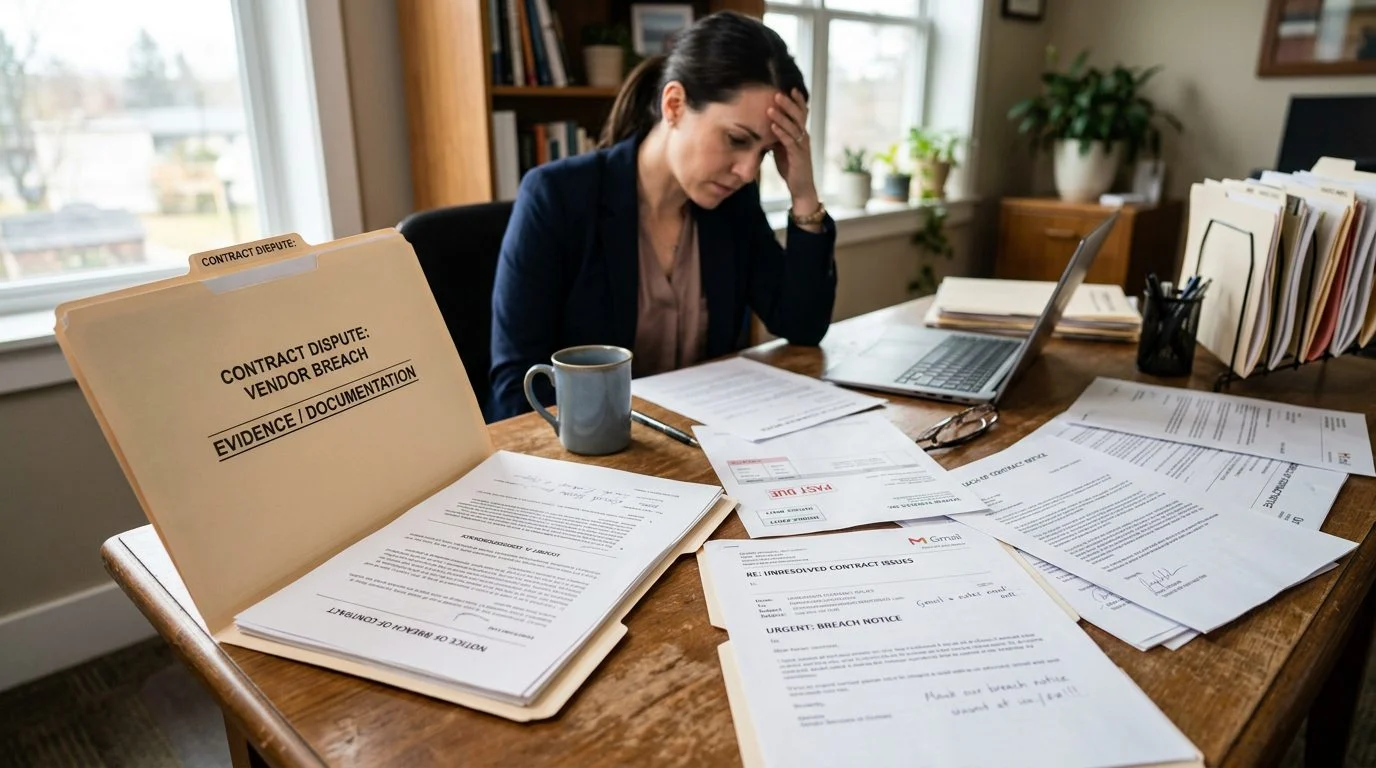
Business Contract Disputes | Coral Gables and Sunny Isles Beach
Breach of Contract in Florida: Understand What Has to Be Shown
KEW Legal advises business owners and investors across Miami-Dade and South Florida on contract and vendor disputes. Start with a free, confidential first consultation with no obligation to continue.
By Kristina E. Wilson · Published November 4, 2026
Breach of Contract in Florida: The Short Answer
Breach of contract disputes often turn on what the agreement says and what each side actually did.
Each one turns on the facts of the deal. Courts look at the contract language, how both sides acted, and what records exist.
Two deals can look alike on the surface. The proof behind each one often tells a very different story. Many of these disputes are won or lost on paper. A signed agreement, a chain of emails, a purchase order, or a set of unpaid invoices can each carry a lot of weight.
This guide walks through each element in plain language. It then covers remedies, time limits, and common defenses. It ends with how to talk through your situation with KEW Legal.
If a vendor, partner, or tenant stopped holding up its end of a deal, you don't have to sort out the proof alone. Our team can review your records with you. Talk it through with our team — the first consultation is free, confidential, and carries no obligation.

Element One: A Valid, Enforceable Contract
A contract needs more than a handshake or a rough idea. It needs an offer, an acceptance, and enough agreement on the essential terms.
Florida courts apply these basic rules to oral deals too. Under general contract principles, an oral agreement requires offer, acceptance, consideration, and essential terms stated clearly enough for the parties to understand them.
Oral deals are harder to prove, because nobody wrote down the terms. Texts, emails, and later payments often fill that gap.
Whether a deal was final is another common fight. Drafts, “let’s finalize later” messages, and unsigned term sheets all matter. A party that acted as if the deal was done, such as by ordering goods or making payments, can strengthen its position.
Sales of goods follow a separate set of rules. A contract can be formed “in any manner sufficient to show agreement,” including conduct by both sides that shows a deal exists (Fla. Stat. § 672.204). Goods priced at $500 or more generally need a record showing a contract was made, signed by the party against whom enforcement is sought or by that party’s authorized agent or broker, with exceptions (Fla. Stat. § 672.201).
Element Two: The Other Party Failed to Perform
That can mean it did not perform at all, performed late, or performed in a defective way.
Start by finding the clause that set the duty. It might be a delivery date, a scope of work, a payment term, a repair duty, or a lease provision. A feeling that the other side let you down is not enough. You need to tie the failure to a specific promise.
Some disputes start before the due date. A party may clearly say it will not perform. That kind of statement can be treated as a breach too.
Goods you accepted follow a stricter notice rule. A buyer generally must notify the seller of a breach within a reasonable time after it discovers, or should have discovered, the problem. Otherwise, the buyer can be barred from any remedy (Fla. Stat. § 672.607).
The same statute puts the burden on the buyer to prove any breach for goods it accepted. Keep dated, written notice of every problem. A short email that names the defect and the date is a simple place to start.
Element Three: The Breach Must Be Material
A minor failure usually does not let the other side walk away from the deal.
Courts look at how much of the expected benefit was lost. A shipment that arrives a few days late, complete and usable, may look minor. A vendor that never delivers the core product looks very different.
Other questions can matter too. Can money fix the problem? Can the other side still fix it? Did it act in good faith? These questions help show how serious the failure was.
That means the details of the dispute, not a label, decide the question. Two late deliveries can look very different when one missed a product launch and the other missed a holiday shipment.
Many contracts also include a notice-and-cure clause. These clauses give the other side a chance to fix a problem after written notice. They can change when a breach counts as final. Read them closely before you send a termination letter.
Element Four: Damages, and Whether You Performed
Examples include money you were never paid, extra cost to replace a vendor, profits you can prove with reasonable certainty, or a drop in business value tied to the breach.
If a condition the contract required never happened, the other side may argue your claim fails.
Proof is what makes damages real. Invoices, payment histories, bids, financial statements, and correspondence each help tell the story. A side-by-side replacement quote can show what it cost to find a new vendor. Keep these records in one place from the start. It saves time and keeps the numbers consistent.
Remedies and Deadlines to File in Florida
Remedies in a contract dispute depend on the facts of each matter. Other remedies exist in narrower situations.
Florida’s time limits for suing on most claims are set in Fla. Stat. § 95.11, which covers actions other than for recovery of real property. Missing the deadline can end a claim, even a strong one. Find out which deadline applies to your contract early.
A provision that sets a shorter time to sue than the statute allows is void (Fla. Stat. § 95.03).
Many commercial contracts include an arbitration clause. That sends disputes to an arbitrator instead of a courtroom. Florida law generally enforces these agreements, except on grounds that exist to revoke any contract (Fla. Stat. § 682.02). An arbitrator decides whether a condition precedent to arbitrability has been fulfilled.
Some contracts also address attorney’s fees. For contracts entered into on or after October 1, 1988, if a contract allows fees to a party that must enforce it, a court may also award reasonable fees to the other side when it prevails (Fla. Stat. § 57.105).
Waiting can also cost you. In general, a party to a voidable contract may ratify it by failing to undo the deal after learning the facts that would justify undoing it. Courts apply this rule case by case, so keep your rights in writing while you review.
Not sure what your next step is?
Talk it through with our team — the first consultation is free, confidential, and carries no obligation.
Common Defenses to a Breach of Contract Claim
The other side usually answers with a defense. Common defenses include no valid contract, a minor breach, a prior breach by you, a condition that never happened, a deadline that passed, or a waiver or signed release.
Each defense ties back to the four elements above. That is why the same contract can support a claim for one side and a defense for the other. Which defenses apply varies case by case.
Once a demand letter arrives, preserve everything. Keep every email, text, invoice, draft, and calendar entry. Do not delete records, and avoid written admissions about fault or about terms you have not reviewed.
What do you have to prove breach of contract in Florida?
Each contract dispute turns on its own facts and the terms of the agreement.
Can an oral contract be enforced in Florida?
An oral contract can be enforceable when it has an offer, acceptance, consideration, and essential terms stated clearly enough. Proof is often the hard part.
How long do you have to sue for breach of contract in Florida?
Florida’s limitation statute, § 95.11, sets the deadlines for actions other than recovery of real property, and a contract cannot shorten them under § 95.03. Raise the timing question with our team early.
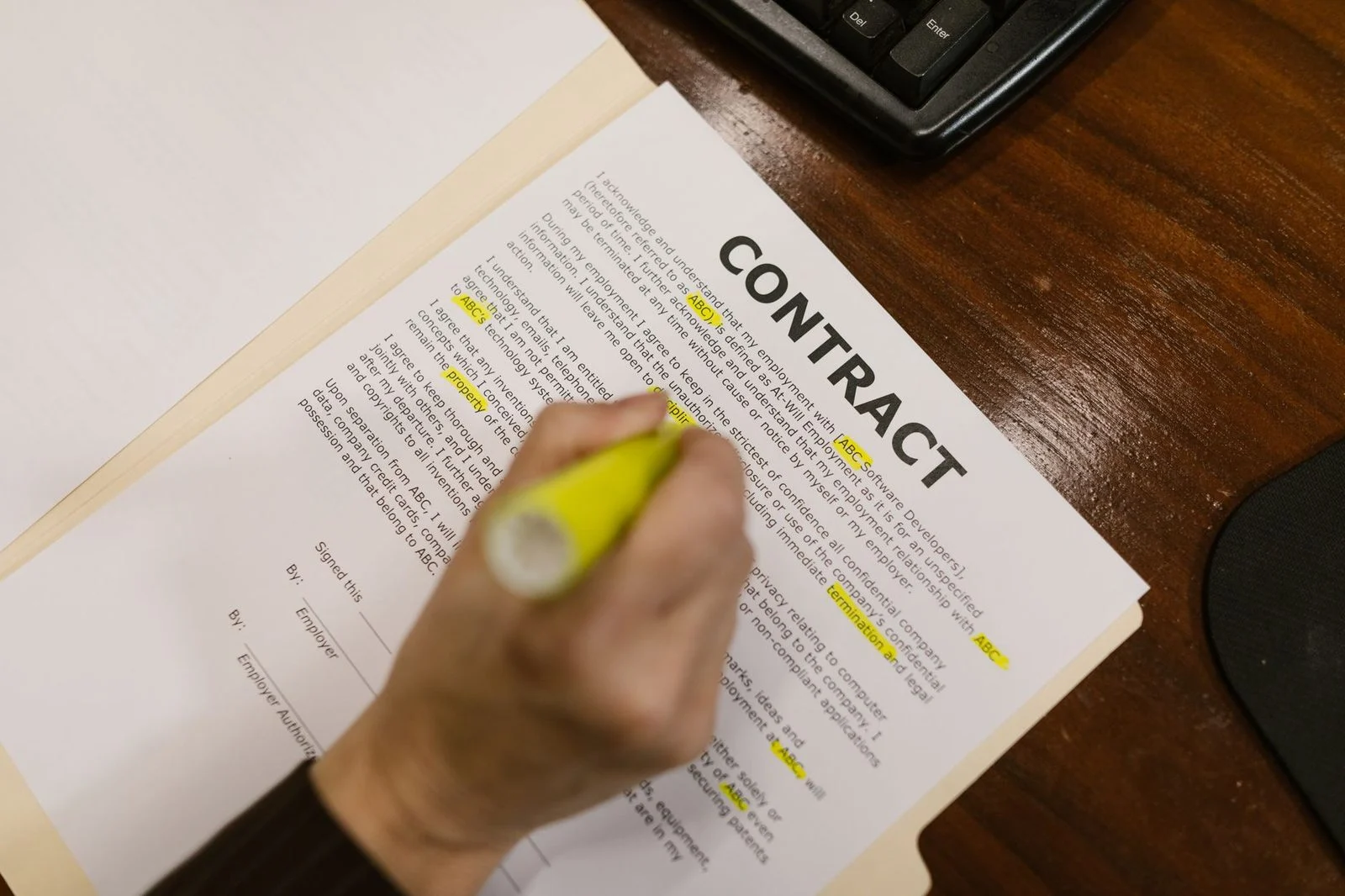
Talk Through Your Contract Dispute With KEW Legal
If a vendor, partner, or tenant has stopped performing, the first step is a clear look at the contract and the records. KEW Legal is a Florida business law firm with offices in Coral Gables and Sunny Isles Beach. It acts as outside general counsel for business owners and investors across Miami-Dade and South Florida.
Kristina E. Wilson is the responsible lawyer for this page. Our lawyers focus on partnership disputes, business contract and vendor disputes, commercial leases, and related business matters.
Picture a vendor that stopped delivering after you paid, a partner that held back capital it promised, or a demand letter about an agreement you believe was already performed. Each situation raises the questions covered above.
The first consultation is free, confidential, and comes with no obligation to continue. If this sounds like your situation, send us a message or call 305-990-2300 so our team can review your records with you.
This page has not been approved by The Florida Bar. Results depend on the facts of each matter, and no outcome is promised.
How KEW Legal Works With Business Owners
Outside general counsel
KEW Legal acts as outside general counsel for businesses, so contract questions can be handled alongside day-to-day operations.
Contract review
We review the agreement, the correspondence and the payment history together to show where the dispute stands.
Partner and vendor disputes
We focus on disagreements between business partners, vendors and clients across Miami-Dade and Broward County.
Practical next steps
We explain the options available in your situation, from negotiation to formal proceedings, so you can decide with clear information.
Start Gathering Your Records Now
Keep the signed contract, amendments, emails, invoices, receipts and any notices in one place. A complete record makes your first consultation more productive.
Contract Disputes We Handle
Partnership disputes
Disagreements over ownership, profit sharing, management duties and operating agreements between business partners.
Vendor and business contract disputes
Unpaid invoices, failed deliveries, disputed terms and performance problems with suppliers, clients or service providers.
Commercial leases
Lease terms, rent disputes and questions about obligations under a commercial lease for your business or investment property.
Commercial evictions
Commercial eviction matters for owners of investment property, including owners who live outside Florida.
Bring your contract questions to KEW Legal
Related practice areas
Request a Consultation
Fill out the short form and we will take it from there.