
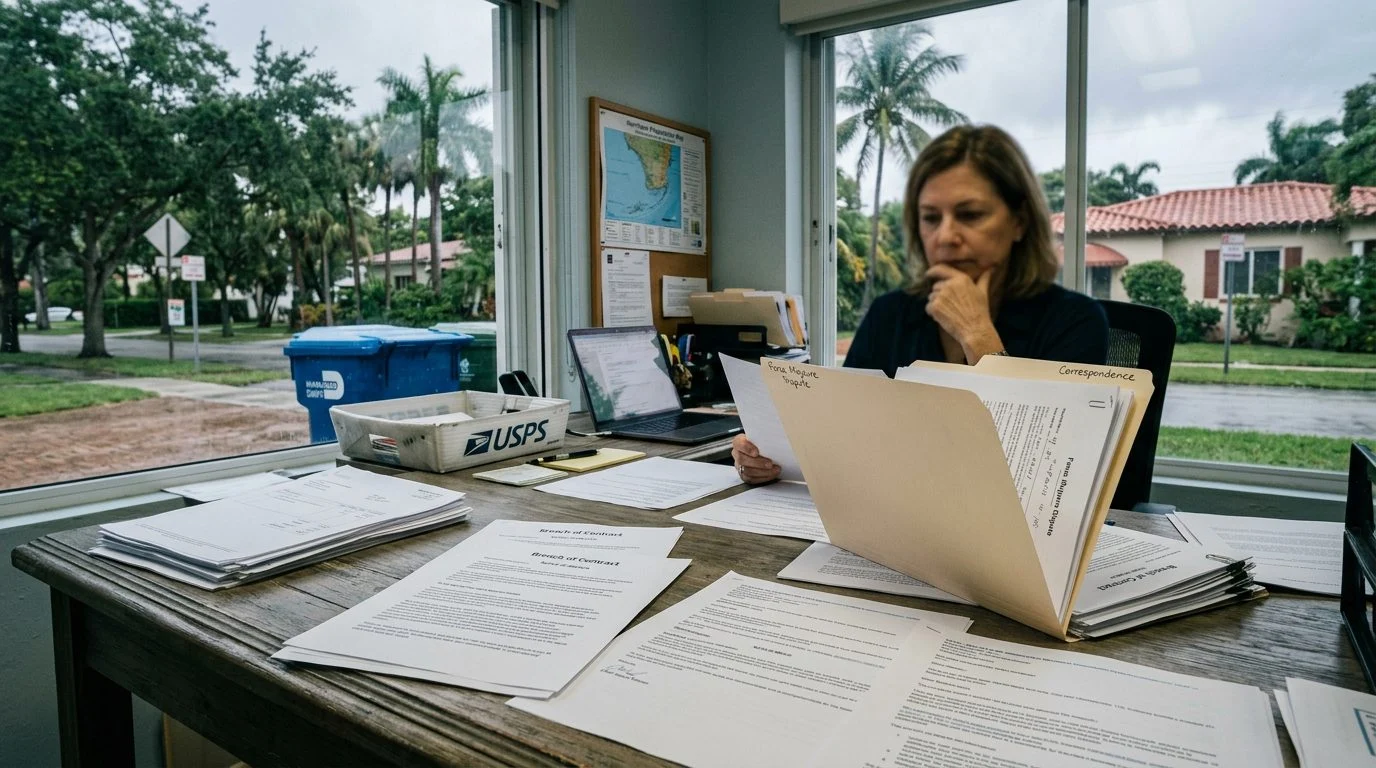
Business Contracts | Coral Gables and Sunny Isles Beach
When a Storm Hits, Does Your Vendor Contract Still Hold?
Here is how business owners can read that clause before a dispute begins.
By Kristina E. Wilson · Published November 26, 2026
Your vendor missed a deadline and blamed a hurricane. Now you’re reading your contract and asking whether that excuse holds up.
Whether a storm excuses a delay depends on the facts and on the terms of the contract.
Short answer: a hurricane may excuse a delay when the contract and the facts support it
Two questions matter most. Does the clause name storms, or use wording broad enough to cover them? Did the hurricane really prevent the vendor from performing?
Many business owners assume that any named disaster excuses every missed date. That isn’t how these clauses usually work. Read the exact words, because a clause can require written notice or excuse only part of the work.
Whether the vendor still owes the work after conditions return to normal depends on the contract’s terms. You can ask for a firm new date in writing.
Storms are a familiar risk for businesses across Miami-Dade and Broward County, so this question comes up often. This page takes the questions in order: what the clause is, which words decide the outcome, what applies when there is no clause, and what to do next.
If a vendor has blamed a storm for a missed deadline and you're not sure your contract allows it, we're glad to review the wording with you. Talk it through with our team — the first consultation is free, confidential, and carries no obligation.
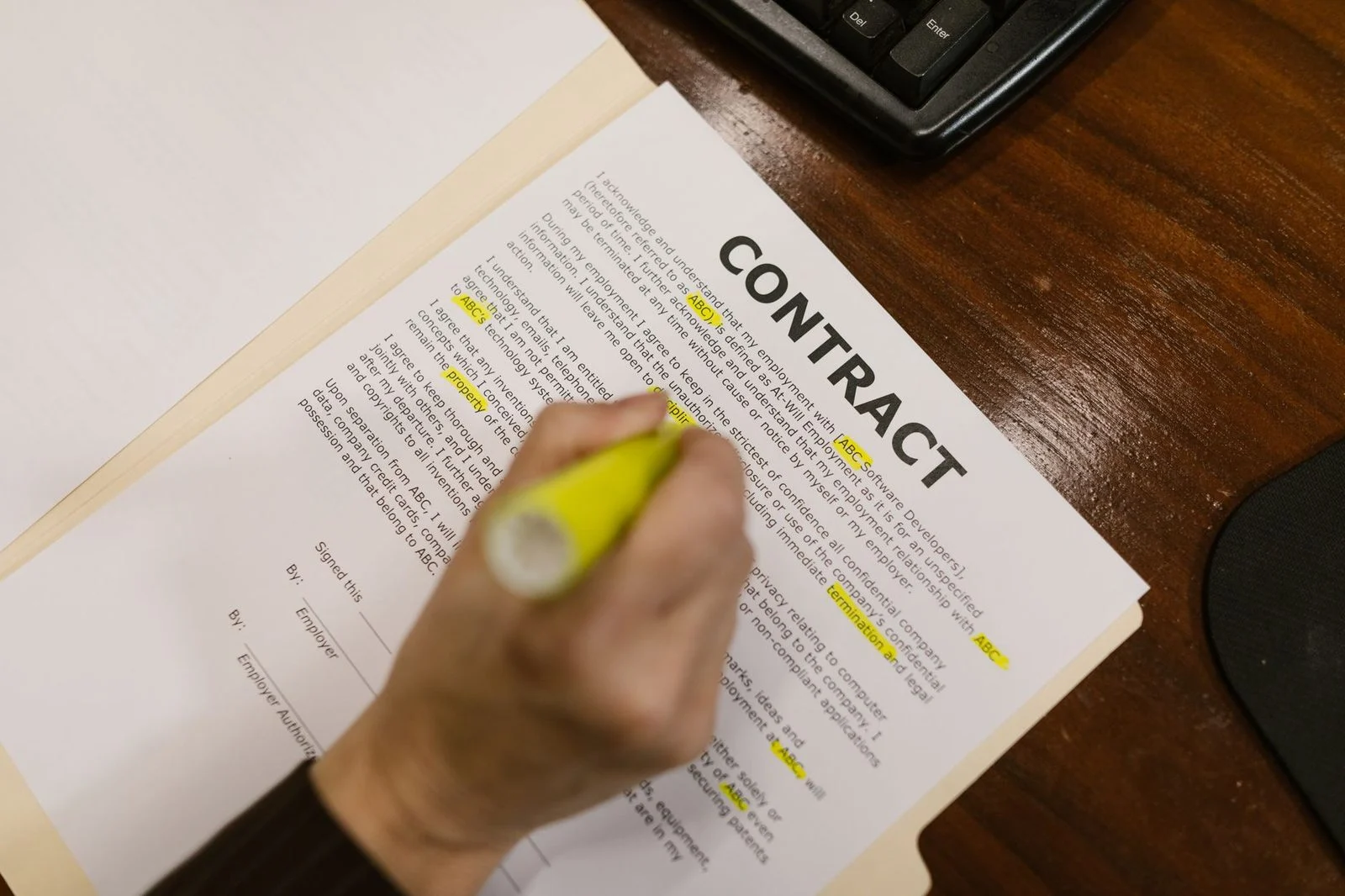
What a force majeure clause is and what counts as a majeure condition
A force majeure clause is a contract term that addresses events beyond the parties’ control.
The events a clause names or describes are its majeure conditions. Common examples include hurricanes, floods, fires, government orders, and labor strikes. Some contracts use “act of God” wording instead. Others use general phrases such as “events beyond reasonable control.”
Each version reaches a different set of events. A long list covers more situations than a short one. A general phrase can leave room for argument about whether a particular storm qualifies.
If you’re reviewing a contract before signing, look at this clause early. Make sure the events that worry you are in it, and that the wording matches how you want the risk shared.
The words in the clause that decide whether a hurricane qualifies
Start with the list. Does the clause name hurricanes or storms? A named storm is easier to connect to a delay. A general phrase leaves more room for dispute.
Next, look at cause. If the project was already behind before the storm, the storm may not be the real reason. Ask the vendor to show the link in its notice.
Notice is the third check. Many clauses require prompt written notice of the event and its expected effect. See Covelli Family, L.P. v. ABG5, L.L.C.. So the exact words of your clause decide how much a late notice matters.
Finally, check how long the excuse lasts. If a delay continues, a written request for a new completion date can help clarify expectations.
What applies when a Florida contract has no force majeure clause
A contract needs an offer, acceptance, consideration, and essential terms stated clearly enough.
Next, identify the kind of deal you have. Florida’s sale-of-goods rules in Fla. Stat. § 672.102 apply to transactions in goods. A services contract may not fall under that chapter, so the analysis changes.
Competing paperwork can complicate things. When you send a purchase order and the vendor sends its own terms, Fla. Stat. § 672.207 addresses whether the vendor’s additional terms become part of the deal between merchants. Our battle of the forms page covers that issue in more detail.
Past dealings also count. Under Fla. Stat. § 671.205, a course of dealing or usage of trade can help explain what the parties’ agreement means. If you’ve used this vendor before on the same terms, those earlier dealings may matter.
How a court would weigh a storm in that setting depends on the facts.
Can a tariff be treated as force majeure?
Whether a tariff falls under a force majeure clause depends on what that clause says, so it is worth reviewing the exact wording of your contract. Whether a particular tariff qualifies turns on that exact wording.
Many clauses were written with physical events in mind. A list that names only storms, fires, and floods may not reach a new import duty. A clause that expressly lists government action, changes in law, or import restrictions gives a much clearer basis.
Broader language reaches more events. A clause that covers storms and also government action or import restrictions gives you more to point to than one that covers weather alone.
Cost is a separate question. A vendor paying more for materials is in a different position from a vendor whose performance is blocked. Read whether your clause treats cost increases differently from events that stop the work. Ask the vendor to show what specifically changed.
Notice, records, and what the vendor still owes you
Ask for the vendor’s notice in writing. A useful notice gives the date it was sent, the specific event, and how that event affected the work. A vague line such as “due to conditions” gives you little to check.
Keep your own records. Save the original deadline, every message with the vendor, and any extra costs the delay causes, such as rush shipping or a backup supplier.
If goods arrived late or not as ordered, act promptly. Under Fla. Stat. § 672.607, a buyer who accepted goods must notify the seller of breach within a reasonable time after he or she discovers or should have discovered the breach, or be barred from any remedy.
If the vendor says in advance that it won’t perform, a written demand can matter. Under Fla. Stat. § 672.609, when reasonable grounds for insecurity arise about the vendor’s performance, you may demand adequate assurance in writing and, if commercially reasonable, suspend your own unpaid-for performance until you receive it. After a justified demand, failure to give adequate assurance within a reasonable time, not exceeding 30 days, is a repudiation of the contract. These rules cover sales of goods.
How Florida law applies to damages for an advance refusal depends on the facts of each dispute. See Ryan v. Landsource Holding Co..
For related contract-exit questions, see our pages on vendor auto-renewal contracts and getting files back after a contract ends. The full range of vendor issues is on our business contract and vendor dispute page.
Not sure what your next step is?
Talk it through with our team — the first consultation is free, confidential, and carries no obligation.
Next step: talk through your contract before the storm delay becomes a dispute
Before you accept the vendor’s explanation, check the clause wording, the vendor’s notice, and your own records against the facts.
You didn’t pick this delay. Trying to read a contract while a deadline has already slipped is stressful, and you don’t have to work it out alone.
Quick answers
Does a hurricane end a contract in Florida?
Whether a storm ends a contract turns on the clause and the facts.
Do I have to give notice?
Check your clause for a notice step. Follow any notice step the clause contains exactly as written.
Kristina E. Wilson, the lawyer responsible for this page, practices at KEW Legal’s Coral Gables office. Send the contract and the vendor’s notice, and we’ll review the wording with you. The initial consultation is free, confidential, and carries no obligation to continue. Call 305-990-2300 or send a message through our contact page.
What to review in a force majeure clause
The events listed
Start with the exact events the clause names. Hurricanes, floods and government orders may or may not appear, and general wording can be read in different ways.
What the clause excuses
Some clauses excuse delay, others excuse full performance. Confirm which obligations the language covers and which it leaves untouched.
Notice steps
Many clauses require written notice within a set period. Read any notice requirement word for word, and keep a record of when and how notice was given.
Remedies and limits
Look for language on termination, rescheduling, cost sharing and any exclusions that limit what the clause can do for either side.
Do not wait to act on a notice step
If your clause requires written notice, follow each step exactly as the contract describes it. A missed step can turn a storm-related delay into a dispute of its own.
Common questions about hurricanes and vendor contracts
Does a hurricane end a contract in Florida?
Whether a storm ends a contract turns on the clause and the facts. The same event can affect two contracts in very different ways.
Do I have to give notice?
Check your clause for a notice step. Follow any notice step the clause contains exactly as written, and keep copies of everything you send.
Who should review the clause?
Our lawyers at KEW Legal review force majeure language in vendor agreements, commercial leases and business sale contracts for owners across Miami-Dade and Broward County.
Have a vendor contract with force majeure language?
Talk with KEW Legal before a dispute grows.
Request a Consultation
Fill out the short form and we will take it from there.