
Business Contracts & Vendor Disputes | Coral Gables and Sunny Isles Beach
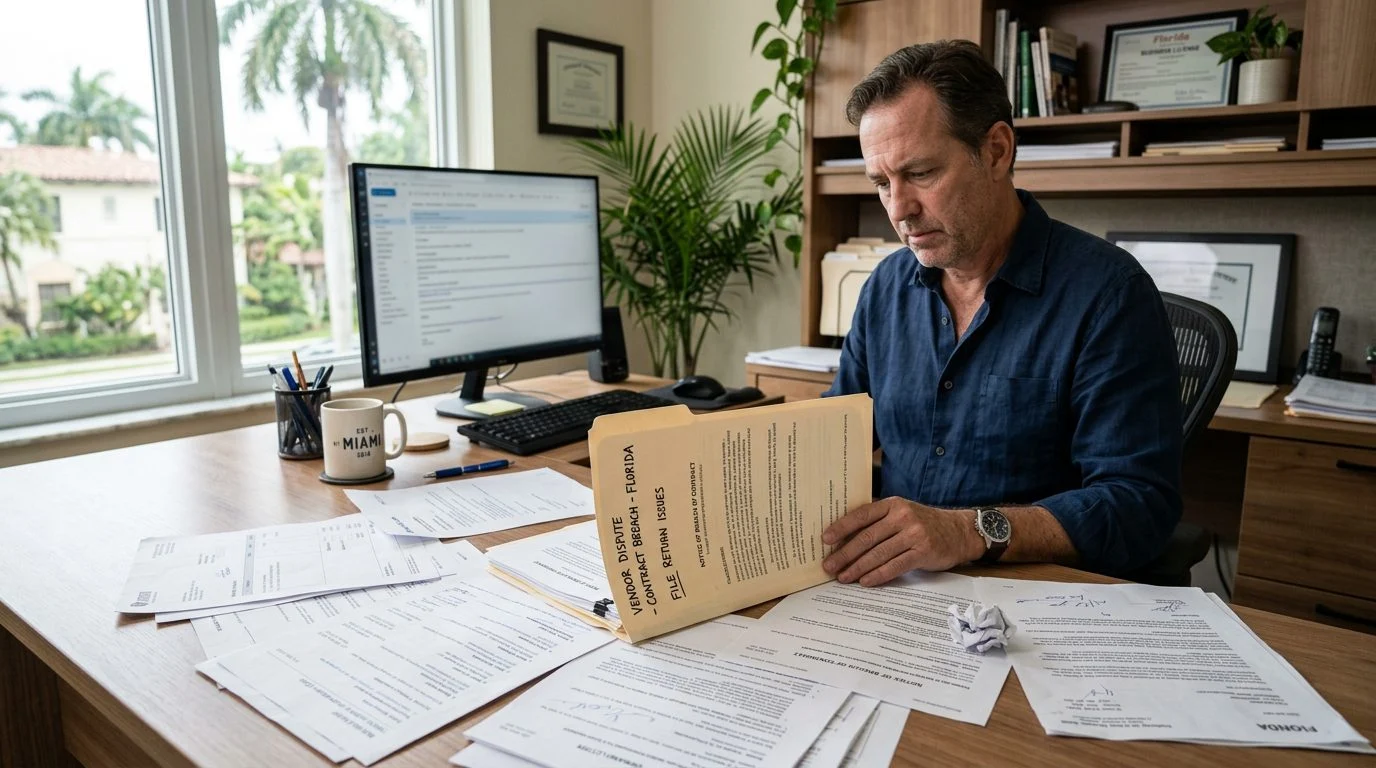
Vendor Won't Return Your Files After the Contract Ends?
Your records, customer data and business documents may be in another company's hands. Here is how to think through your options before you respond.
By Kristina E. Wilson · Published November 26, 2026
A vendor that won’t return your files after a contract ends can disrupt daily operations, customer service, and bookkeeping fast. In Florida, the practical answer is to work in order: read the contract’s return and termination terms, send a clear written demand, and avoid moves that could weaken your position.
This guide walks through each step for business owners and employers in Miami-Dade and Broward County. It also covers the formal options if the vendor still refuses.
What a Vendor Refusing to Return Your Files Usually Means
Usually, the holdup comes from an unpaid invoice, an unclear contract, or a fight over how the relationship ended. This happens with software providers, service vendors, and suppliers. The vendor still holds your business records, customer lists, or data, and it won’t release them.
The cause matters. A vendor may be using the files as leverage in a payment dispute. Or it may believe the contract lets it keep them. Each reason calls for a different response.
Timing matters too. Your business may need those records to run operations, serve customers, or close the books. Waiting while the vendor keeps them can make the problem harder to fix.
Before you send anything, sort out the facts. A demand built on guesses can give the vendor an argument to use against you. The steps below follow that order, starting with the contract.
Not sure what your next step is?
Talk it through with our team — the first consultation is free, confidential, and carries no obligation.

Start With the Contract’s Return, Data, and Termination Clauses
Your signed agreement is the first place to look, because its return and termination terms set the ground rules for your demand. Check these parts closely:
- Return of property: Does the contract say what must come back, and when?
- Data: Is there a clause on returning or deleting data, the export format, or transition help?
- Termination: What notice is required, and is there a cure period to fix a problem first?
- Dispute resolution: Does the contract require mediation, arbitration, or a notice of dispute before a lawsuit?
Florida courts generally do not favor conditions precedent, and they will not read a contract provision as one unless plain, unambiguous language or necessary implication requires that reading (Covelli Family). So the exact words of your contract matter.
A clear return clause makes your demand stronger. If the contract is silent, you’ll rely on ownership principles and on how both sides acted during the deal.
Who Owns the Files and Data Once the Contract Ends
Ownership turns on what the contract says and how both sides handled the files during the deal. Start with the ownership and confidentiality terms. Some contracts say the business owns its records. Others give the vendor only a license to use them while the deal runs.
Mixed situations need careful sorting. Proprietary software, vendor templates, and shared databases can hold both your information and the vendor’s own tools.
Separate those pieces in writing. List what belongs to you, who created each item, who paid for it, and where it’s stored. A precise list keeps your demand focused and harder to dispute.
Send a Written Demand and Preserve Your Evidence
A written demand creates a clear record of what you asked for, under which contract terms, and by when. Include these items:
- A description of the files or data, and the format you want.
- The date the contract ended and the sections you rely on.
- A reasonable deadline for return.
- Where and how the materials should be delivered.
- A request for written confirmation that the vendor has returned or deleted its copies.
Send the demand the way the contract allows. Email is not automatically valid notice. Florida’s Uniform Electronic Transaction Act applies only when both parties agreed to deal electronically. That is judged from context and conduct. So check the contract and how you’ve communicated before relying on email.
Gather the signed agreement and amendments, termination notices, invoices, payment records, emails, texts, and any earlier requests for the files. Keep copies of anything you can still reach. Don’t alter or delete records that may matter later.
Common Mistakes That Weaken a Business’s Position
The most costly mistakes are self-help moves that the contract may not allow.
- Withholding payment on unrelated invoices, or threatening to hold back money the contract doesn’t let you keep. This can hand the vendor a counterclaim.
- Sending vague threats in place of a clear demand, or skipping a notice-and-cure step the contract spells out.
- Logging into systems or accounts you don’t have the right to access. That can create new legal problems for your business.
- Waiting too long. Under Florida’s limitations statute, an action on a written contract must be brought within five years, and an action on an oral or other unwritten contract, including one for the sale of goods, within four years. A cause of action generally begins when its last element occurs, under § 95.031. Identify your claim type early.
- Signing a new agreement or partial release without review.
Options If the Vendor Still Refuses to Return the Files
If a clear demand doesn’t work, your options are a negotiated return, a formal demand from counsel, the contract’s dispute steps, or a lawsuit.
- Negotiated return. Put the format, timing, and written confirmation of return in a short agreement. Florida’s compromise rule generally keeps offers to compromise a disputed claim out of evidence used to prove liability.
- Demand letter from counsel. A formal letter sets out the contract basis, the deadline, and the consequences of non-compliance.
- Dispute steps. Florida’s arbitration statute makes arbitration agreements valid and enforceable, except on grounds that allow revoking a contract. Fla. Stat. § 682.02 reads: “(1) An agreement contained in a record to submit to arbitration any existing or subsequent controversy arising between the parties to the agreement is valid, enforceable, and irrevocable except upon a ground that exists at law or in equity for the revocation of a contract.” Under § 682.03, a court may not refuse to order arbitration because the claim lacks merit. Review the clause before you file.
- Court action. Under Florida’s venue statute, a case must be brought only in the county where the defendant resides, where the claim arose, or where the property in litigation is located. This section shall not apply to actions against nonresidents. Some claims can also carry damages.
- Fee exposure. If the contract lets the party who enforces it recover attorney’s fees, the court may also allow the other side reasonable attorney’s fees when it prevails. This subsection applies to any contract entered into on or after October 1, 1988. Claims the losing side knew or should have known were unsupported can also lead to fee awards under Florida’s fee statute.
The right remedy depends on the facts: the contract, the type of files, the vendor’s position, and how much time has passed.
Not sure what your next step is?
Talk it through with our team — the first consultation is free, confidential, and carries no obligation.
How the Review and Dispute Process Works
The process moves in steps: review first, then a written demand, then formal steps only if the vendor still refuses.
- Review. Read the signed agreement, termination notices, payment history, and communications about the files.
- Analysis. Assess your rights to the files, the vendor’s likely position, and the contract steps available to you.
- Demand or negotiation. Send a demand letter or negotiate a prompt return in an agreed format.
- Formal steps. If the vendor doesn’t comply, decide on the next move. That may include required pre-suit notice, mediation, arbitration, or a court filing.
Timing varies with the facts, the contract, and the vendor’s response. You’ll hear the expected steps before anything is filed.
Kristina E. Wilson is the responsible lawyer for this page. KEW Legal has offices in Coral Gables and Sunny Isles Beach. The firm’s lawyers handle business contract and vendor disputes for clients in Miami-Dade County and Broward County. The firm also provides outside general counsel to business owners and investors.

Talk Through Your Vendor Situation With KEW Legal
If a vendor is still holding your files, the next step is a conversation about your contract, the files at issue, and the options for getting them back.
Common Questions
Can I withhold payment until the vendor returns my files?
Not without checking the contract first. Holding back money the contract doesn’t allow can create a claim against you.
How long do I have to sue a vendor?
Deadlines vary by claim type. In Florida, you have five years to bring an action on a written contract and four years to bring one on an oral or unwritten contract.
Does an arbitration clause stop me from going to court?
It can. Florida generally enforces arbitration agreements, so review that clause before you file.
Which county should I sue in?
Venue generally follows where the defendant lives, where the claim arose, or where the property is located.
KEW Legal can review your contract, the files involved, and the steps that fit your goals. Call 305-990-2300 or send a message through the contact page. The initial consultation is free, confidential, and carries no obligation to continue. For related issues, see our page on vendor shut-off during payment disputes and our business contract and vendor dispute attorney page.
How KEW Legal Helps Business Owners Recover Their Files
Review the Contract First
We read the agreement's terms on termination, return of materials, records and data to identify what the vendor was required to do.
Written Demand and Negotiation
We prepare a clear written demand for return of your files and work to resolve the matter without unnecessary escalation.
Protecting Your Business Position
We advise on how to avoid withholding payment or taking steps that could expose your business to its own claim.
Outside General Counsel Support
Our team focuses on business contract and vendor disputes for owners and investors across Miami-Dade and Broward counties.
Think Before You Withhold Payment
Review the agreement with an attorney before you stop paying or make any demand.
Gather These Records Before You Contact the Vendor
The Signed Contract
Include any amendments, renewals, purchase orders and termination notices.
Payment and Invoice History
Keep records showing what was paid, what is owed and any disputed amounts.
Written Communications
Save emails, texts and letters that discuss the return of files, data or equipment.
An Inventory of What Is Missing
List the files, databases, accounts and materials you need back, and where they were stored.
The First Consultation Is Free, Confidential and Carries No Obligation to Continue
Related practice areas
Request a Consultation
Fill out the short form and we will take it from there.