
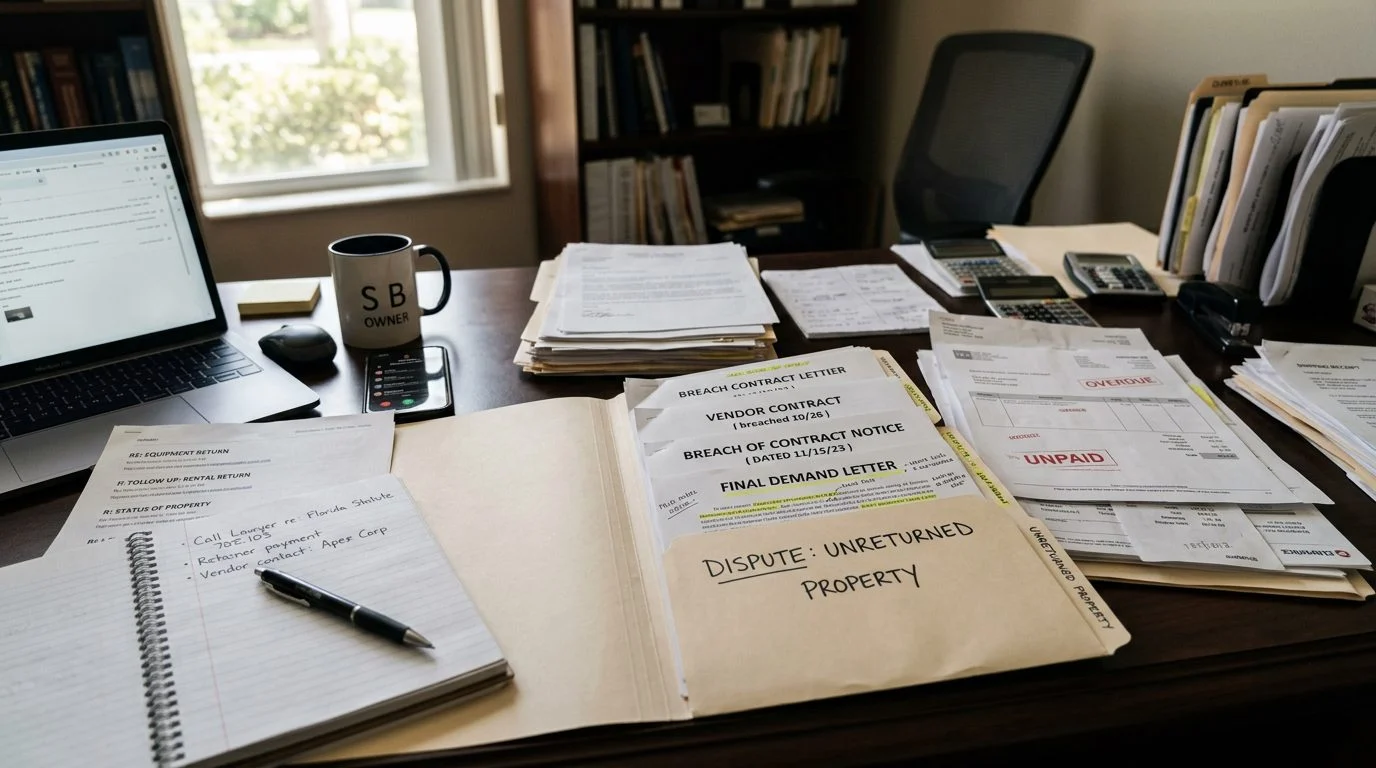
Business Contract & Vendor Disputes | Coral Gables and Sunny Isles Beach
Vendor Refuses to Return Your Business Property?
Outside general counsel for South Florida business owners and investors, working to protect your equipment, records and inventory.
By Kristina E. Wilson · Published November 10, 2026
If a vendor refuses to return business property, the first question is what your contract says. A former agency, freelancer or service provider may still hold your brand files, social media logins, domain or equipment after the work has ended.
The short answer: a written demand that names each item is usually the first formal step. The return-of-property and confidentiality terms in your contract decide what you can demand. Here is how that process works, in order.
When a Former Vendor Keeps Your Business Property
A written demand that lists each item is usually the first formal step when a former vendor still holds your business property.
This situation comes up after many kinds of work. Common examples for Florida businesses include:
- Design, marketing and brand files, such as logos and templates
- Admin rights to ad accounts, social media pages or email
- Website hosting and control of the domain name
- Point-of-sale or inventory equipment
- Customer lists and sales records
- A deposit or prepayment that was never refunded
This page is for owners, managing members and officers who need that property back to keep operating or to move to a new provider. Each item has a different path back. A login may need an admin handover, while a domain may need a registrar transfer. Waiting can make things harder, because accounts change hands and files can be deleted.
If a former vendor is holding your company's files, logins, domain or equipment, our team can review your contract with you and map out the next steps. Talk it through with our team — the first consultation is free, confidential, and carries no obligation.

Start With Your Contract’s Return-of-Property Terms
Your contract’s return-of-property and confidentiality terms set what you can demand, and how fast. Read the agreement before you send anything. Look for:
- A return-of-property clause. It should say what must go back when the work ends, and by when.
- Ownership language. Check who owns the work product, brand assets and data.
- Transition duties. Some agreements require handing over passwords or admin access during a transition period.
- Notice and cure terms. These set how you give notice and how long a party has to fix a problem.
- Dispute terms. An arbitration clause can change where and how a claim is raised.
- Deposit terms. Check how and when unused funds must be refunded.
Some vendor deals are verbal or loosely written. Florida courts still apply basic contract rules. An agreement needs an offer, an acceptance, consideration and enough detail on the essential terms, as the St. Joe Corp. v. McIver decision explains. Without a signed document, your emails and invoices become key evidence.
Build a Written Inventory of What the Vendor Holds
A written inventory turns a general complaint into a specific list the vendor must answer. Group the items into four categories:
- Files and folders. Note the location, such as a cloud drive, shared link or local machine, and the date of the latest version you have.
- Accounts and platforms. Record the platform, the username or account ID, who created the account, and who holds admin or owner rights.
- Domains. Record the registrar, the registrant name on file, and the account that pays the renewal.
- Equipment and money. List hardware with serial numbers, plus any deposit or payment owed or held.
Gather proof for each item. That includes paid invoices, account-creation emails, registration confirmations and the contract language on ownership. Keep a dated log of every request and every reply. That record supports your demand, any settlement and any later court filing.
Send a Written Demand That Names the Property
A demand letter works best when it names the contract, the termination date and every item you need back. Include:
- The contract, its date and the return-of-property clause you rely on, cited by section number
- The return deadline and the format for the return
- A request for written confirmation that the vendor has not deleted, altered or sold the property, and will keep it safe while the matter is open
- How each item should be delivered, such as an account ownership transfer, a registrar transfer, a file export or an equipment pickup
Send the letter in a way that creates a record, such as tracked delivery with proof, and keep a copy. Keep the tone measured. Threats you cannot support weaken your position. A clear letter is also easier to enforce if the matter reaches court.
Negotiating the Return: What a Settlement Can Cover
A settlement can spell out exactly how the property comes back, who does what and by when. A single written agreement can cover:
- A file export in a stated format
- Handover of admin rights or account ownership
- A domain or platform transfer
- Return of equipment, with a set pickup date
- A refund or offset of a deposit
The written terms should include the deadline, the exact items, and what happens if the vendor misses a step. If both sides want confidentiality or non-disparagement terms, put them in writing too.
Offers made during talks have legal limits. Under § 90.408, evidence of an offer to compromise a disputed claim, as well as any relevant conduct or statements made in negotiations concerning a compromise, cannot be used to prove liability or absence of liability for the claim or its value. Do not sign a release that covers more than the property issue until you know exactly which claims you give up.
When a Court Action May Be Needed
If a vendor refuses or ignores a documented demand, a lawsuit or arbitration may be needed to recover the property. That can involve several steps:
- Breach of contract. A claim that the vendor failed to follow the agreement’s return terms.
- Orders to keep property safe. A lawyer can ask the court to order the property preserved while the case moves forward.
Florida venue rules say actions shall be brought only in the county where the defendant resides, where the claim arose, or where the property is located, but this does not apply to actions against nonresidents. See § 47.011. See § 47.011. If your contract has an arbitration clause, a written agreement to arbitrate is generally valid and enforceable under § 682.02. If the other side opposes arbitration, the court generally orders it unless no enforceable agreement exists, under § 682.03.
If a contract entered into on or after October 1, 1988 contains a provision allowing attorney’s fees to a party when he or she is required to take action to enforce it, § 57.105 lets the court allow fees to the other side when that side wins. When an express contract covers the same subject, an unjust enrichment claim generally will not support recovery, as Williams v. Johnson explains. Time limits also apply to contract claims, so delay can cost you options.
Not sure what your next step is?
Talk it through with our team — the first consultation is free, confidential, and carries no obligation.

Why Work With KEW Legal on a Vendor Property Dispute
KEW Legal handles business contract and vendor disputes as part of its work as outside general counsel for business owners and investors in Miami-Dade and South Florida. The firm has offices in Coral Gables and Sunny Isles Beach. It serves clients in Miami, Aventura, Doral, Brickell, Fort Lauderdale and Broward County.
Kristina E. Wilson is the lawyer responsible for this page. Our team can review your contract, help build the inventory, draft the demand, negotiate the return, and assess whether a court or arbitration step is needed.
Can a vendor keep my files if I have not paid the final invoice?
It depends on the facts. The contract’s ownership and payment terms are the first place to look.
Do I have to stop using the vendor before I demand my property?
The contract’s termination steps guide that timing. Review them before you send a demand.
Will a demand letter be enough?
A documented demand can lead to a negotiated return. No outcome can be promised.
Where would a lawsuit be filed?
Florida law says actions shall be brought only in the county where the defendant resides, where the claim arose, or where the property is located, but this does not apply to actions against nonresidents.
Your first step is a free first consultation, which is confidential and carries no obligation to continue. If a former vendor still holds your company’s files, logins, domain or equipment, send us a message or call 305-990-2300 to get started.
Pause before you act
Withholding payment, cancelling the agreement or sending a demand can affect your position. Have the contract reviewed before you take these steps.
What to gather before you call
The written agreement
Contracts, purchase orders, statements of work and any amendments show who owns the property and how the relationship was supposed to end.
Invoices and payment records
Records of what has been paid, what is still owed and any disputed charges help explain the current position.
Correspondence
Emails, texts and letters about the property, deliveries or returns give a clear timeline of what was requested and what was said.
A list of the property
Serial numbers, photos, inventory logs and the location of each item make a demand specific and easier to enforce.
How KEW Legal handles vendor property disputes
Contract review
We start with the agreement to identify ownership, termination and return terms that bear on your property.
Strategy for your business
As outside general counsel, we consider how a dispute affects your operations, other vendors and ongoing relationships.
Written demand
We prepare clear correspondence that identifies the property and the steps you expect the vendor to take.
Next steps if needed
If the vendor does not cooperate, we discuss the available options with you and move forward only with your approval.
Your property matters. Talk to a business attorney today.
Related practice areas
Request a Consultation
Fill out the short form and we will take it from there.