
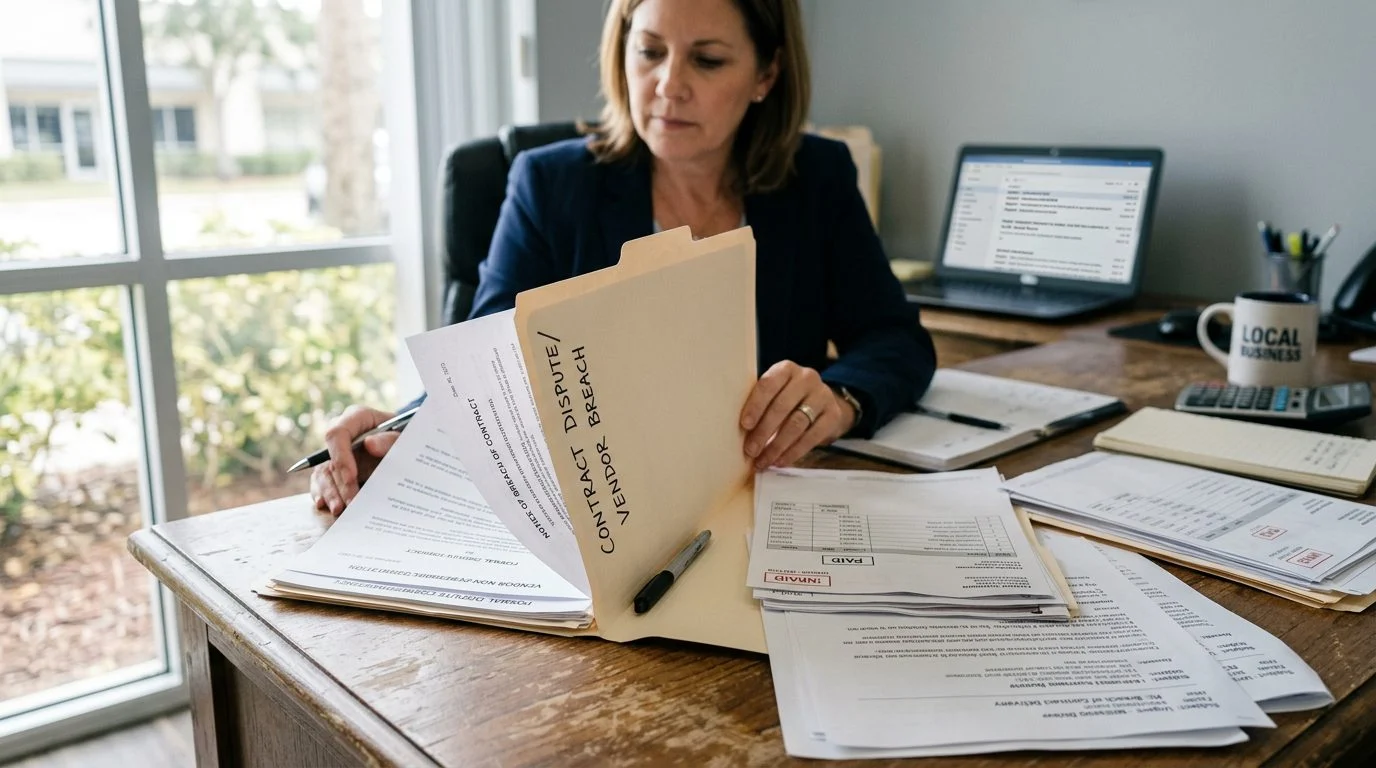
Business Contracts & Vendor Disputes | Coral Gables & Sunny Isles Beach
Vendor Stopped Delivering? Protect Your Money and Your Business
KEW Legal helps Miami-Dade and South Florida business owners respond when a vendor fails to perform, keeps payments it has not earned, or leaves a project stalled.
By Kristina E. Wilson · Published November 2, 2026
A vendor stopped delivering and you already paid? Here is what a Florida business should do first. Read the written deal, pin down the money and the dates, and put your position in writing. Those steps shape every option that follows, including whether a lawsuit makes sense.
This guide walks through those steps in plain language. It covers what to check in the agreement, how to build a record, how to handle payments, and why goods and services can follow different rules. It also covers notice, replacement purchases, and timing.
KEW Legal is a Florida business law firm with offices in Coral Gables and Sunny Isles Beach. The firm serves business owners and investors across Miami-Dade and South Florida, including vendor and contract disputes.
Start With the Agreement
The signed contract, purchase order, invoice terms, and email confirmations usually decide what happens next. Pull every document that describes the deal before you contact the vendor again.
Look closely at these clauses:
- Delivery dates and what happens when they are missed
- Deposit or advance payment terms, including whether the money is refundable, credited to the price, or kept
- Cancellation rights and any fee for cancelling
- Notice and cure provisions, which often require a written demand and time to fix the problem
- How the contract defines default or breach
- Late fee and added charge language
- Dispute, venue, and arbitration clauses
Some contracts set a fixed sum payable on breach, called liquidated damages (an amount agreed in advance). Whether a clause like that holds up depends on its exact wording, so read it closely.
Also check whether a contract formed at all. For sales of goods, under Fla. Stat. § 672.207, conduct by both parties that recognizes the existence of a contract is sufficient to establish a contract for sale even when the parties’ writings do not otherwise establish one. KEW Legal’s business contract and vendor dispute attorney page explains how these issues are handled.
If a vendor kept your deposit and stopped delivering, you don't have to work through the contract and timeline alone. Our team can review them with you. Talk it through with our team — the first consultation is free, confidential, and carries no obligation.

Document the Failure
Document the failure by building a dated timeline and collecting proof of every payment. Start with the original order, then add each promised delivery date, each missed date, and each follow-up.
Gather proof of payment. Bank statements, checks, card statements, and wire confirmations show the amount and date of each deposit. Keep receipts for every payment, even small ones.
Save every message. That includes texts, voicemails, and emails. After each phone call, write down the date, the time, and the name of the person you spoke with. Memory fades fast when a deal goes bad.
Record what your business needed and when it needed it. Note losses while you waited, such as missed sales, rescheduled jobs, or idle staff. Keep the vendor’s written promises and any revised estimates.
Confirm the vendor’s legal name too. The Florida Department of State, Division of Corporations (Sunbiz) provides registration and status information for Florida business entities. That helps you confirm exactly who you dealt with.
Be Careful With Payment
Stop sending money to a vendor that has not performed, and say so in writing. Paying more without a written reservation of rights can weaken your position later.
Send a short written notice that payments are on hold while the delivery failure is addressed. Keep the tone factual. State what was ordered, what was paid, and what has not arrived.
Be careful with partial or late deliveries.
Late fees and added charges deserve a close look. If the contract does not provide for them, the vendor’s extra charges may be open to challenge. Pay only what you can document.
Keep every payment conversation in writing. A short email that confirms what was agreed protects your record.
If Goods Are Involved, Act Carefully
When the deal is for goods, Chapter 672 of the Florida Statutes may control. Chapter 672 is Florida’s Uniform Commercial Code (UCC) for sales of goods. Deals for services usually fall outside it.
If you accepted the goods, you must notify the seller of any breach within a reasonable time after you discover it or should have discovered it. Under Fla. Stat. § 672.607, you may be barred from any remedy if you don’t. After acceptance, the buyer also carries the burden of proving the breach.
A seller may try to fix a failed delivery. Under Fla. Stat. § 672.508, if a nonconforming delivery is rejected and the time for performance has not yet expired, a seller may seasonably notify you it intends to cure and deliver conforming goods within the contract time. Your demand letter should account for that possibility.
Be careful with goods you already received. Using or reselling them can look like acceptance. Decide how to handle damaged or incomplete items before you touch them.
Don’t Forget Mitigation and Replacement Costs
Losing a vendor can affect day-to-day operations, so many business owners find it helpful to review their options early.
Document replacement purchases. Keep quotes, invoices, and a short note explaining why a substitute was needed and when you bought it.
The extra cost of a replacement, compared with the original contract price, is often central to the damages discussion. How much you can recover depends on the contract and the facts.
Keep receipts for rush shipping, rental equipment, overtime, and other costs the non-delivery caused. Label each one by project or order so it ties back to the failed delivery.
Acting promptly also helps show what the delay cost you. Record the date you began looking for a replacement and the date you secured one.
Telling the Vendor You No Longer Need Their Services
Send a written notice ending the relationship. Use the notice address and method your contract requires, and don’t rely on a phone call.
The notice should include the order or agreement reference, the missed delivery dates, the amount paid, a demand for a refund or performance, and a statement that your business reserves its rights.
Avoid casual replies that agree to a new schedule or accept late work without written terms. For sales of goods, under Fla. Stat. § 672.207, a written confirmation sent within a reasonable time can operate as an acceptance, even with terms that differ from those offered or agreed upon, unless acceptance is expressly made conditional on assent to the different terms. Fla. Stat. § 672.207 reads: “(1) A definite and seasonable expression of acceptance or a written confirmation which is sent within a reasonable time operates as an acceptance even though it states terms additional to or different from those offered or agreed upon, unless acceptance is expressly made conditional on assent to the additional or different terms.”
A termination letter is not the same as a demand letter. Sending a termination notice may or may not end the agreement. The answer depends on the contract’s termination terms and the facts of the situation. A demand letter sets out what is owed and by when. The two can go out together or separately.
Not sure what your next step is?
Talk it through with our team — the first consultation is free, confidential, and carries no obligation.
Demand Letter and Pre-Suit Options
A demand letter states the breach, the amount owed, a deadline to respond, and what comes next if the matter stays unresolved.
If the contract has a notice and cure clause, follow its steps exactly. Skipping a required step gives the vendor an argument that it never had a fair chance to fix the problem.
Common pre-suit paths include a negotiated refund, a payment plan, a partial delivery with written terms, or a settlement agreement with a release. Any agreement should be in writing and signed by both sides.
Keep the letter accurate. Don’t overstate what is owed. An inflated demand can hurt your credibility if the dispute later reaches a court.
If no enforceable contract covers the money, a claim may rest on unjust enrichment. In Pincus v. American Traffic Solutions, the Florida Supreme Court explained the claim. It requires a benefit conferred on the defendant, the defendant’s appreciation of that benefit, and the defendant’s acceptance and retention of it without paying fair value, under circumstances that make keeping it without payment inequitable.
When Suit Becomes the Question
Florida sets time limits for filing suit. The main timing rules are in Fla. Stat. § 95.11. Under Fla. Stat. § 95.031, a cause of action accrues when its last element occurs.
Waiting too long carries its own risk. Florida’s laches rule in § 95.11(7) can bar an action that is not brought within the time the law allows for the same subject matter, even if the vendor never knew you would sue.
Where you file matters too. Under Fla. Stat. § 26.012, circuit courts have exclusive original jurisdiction over actions at law not cognizable by the county courts.
Venue follows Fla. Stat. § 47.011. Suits must be brought only where the defendant resides, where the cause of action accrued, or where the property in litigation is located. That rule does not apply to actions against nonresidents, which matters when a vendor is out of state.
Check the dispute clause too. Which court fits your claim depends on the facts, including the amount at stake and where the vendor is located.
Can I sue a vendor for a deposit it kept without delivering?
Possibly. A claim may rest on the contract, or on unjust enrichment if no enforceable contract covers the money.
Does the UCC apply to every vendor failure?
No. Chapter 672 covers sales of goods, so a deal for services usually falls under general contract law.
How long do I have to sue?
Fla. Stat. § 95.11 sets filing deadlines for actions other than those to recover real property. A suit on a judgment or decree of a Florida court of record has twenty years. A suit founded on the design, planning, or construction of an improvement to real property falls in the statute’s four-year category. That period runs from whichever comes first: the date the authority having jurisdiction issues a temporary certificate of occupancy, a certificate of occupancy, or a certificate of completion, or the date construction is abandoned if it was never completed. For a latent defect, the period instead runs from when the defect is discovered or should have been discovered with the exercise of due diligence. Even then, the suit must be filed no later than 7 years after that earliest date, though counterclaims, cross-claims, and third-party claims arising out of the conduct, transaction, or occurrence in a pleading may be filed up to 1 year after that pleading is served, even if they would otherwise be time barred. Other kinds of actions are governed by other periods set out in the same section.
Talk Through Your Situation With KEW Legal
If a vendor took your money and went quiet, you may be handling this while running a company. You may also be handling it for an owner who lives out of state. Either way, the deposit is tied up and the work isn’t getting done.
Your next step is to gather the contract, the deposit records, and the vendor timeline. Bring those to one conversation so the situation can be reviewed as a whole.
KEW Legal is a Florida business law firm with offices in Coral Gables and Sunny Isles Beach. Kristina E. Wilson is the responsible attorney for this page. Our lawyers handle outside general counsel work and business contract and vendor disputes for owners and investors across Miami-Dade and South Florida.
If a vendor is holding your deposit, you don’t have to sort out the contract and timeline alone. We offer a free first consultation: confidential, with no obligation to continue. Call 305-990-2300 or send us a message to get started.
How KEW Legal Works With Business Owners
Outside General Counsel
We act as an ongoing legal resource for business owners and investors, so vendor problems are handled alongside the rest of your legal needs.
Contract-Focused Review
We start with your agreements, purchase orders, invoices and correspondence to identify what was promised and what remains owed.
Offices in Coral Gables and Sunny Isles Beach
We serve businesses throughout Miami-Dade County, Broward County and South Florida.
Free, Confidential First Consultation
Your first consultation is free, confidential and comes with no obligation to continue.
Before You Stop Paying or End the Contract
Acting too quickly can weaken your position. Gather the signed contract, every amendment, purchase orders, invoices, payment records and written communications with the vendor before you withhold payment, cancel or send a demand.
Common Vendor Problems We Address
Missed or Late Delivery
A supplier or contractor misses agreed dates and your operations, customers or projects are affected.
Deposits or Prepayments Not Returned
A vendor holds money paid in advance for goods or services it never provided.
Defective or Non-Conforming Work
Products or services do not match the agreement, and the vendor will not correct the problem.
Unresponsive or Abandoned Vendors
A vendor stops communicating, walks away from the job or refuses to explain the delay.
Get Clear Answers About Your Vendor Dispute
Request a Consultation
Fill out the short form and we will take it from there.