
Business Contract & Vendor Dispute Attorney | Coral Gables and Sunny Isles Beach
Facing a Vendor Shutoff Over a Payment Dispute?
Your vendor's threat may be a bargaining tactic, a contract breach, or a lawful step. Here is how to tell which, and what to do next.
What We Look at When a Vendor Threatens to Cut Service
The Contract Language
We review the payment, notice, suspension, and termination clauses to see what the agreement actually allows.
Notice and Cure Periods
Many agreements require written notice and a chance to fix the problem before service is suspended. We check whether those steps were followed.
Dispute Resolution Terms
Some contracts require negotiation, mediation, or another process before either side takes action. We look at how those terms apply to your dispute.
Operational Risk to Your Business
Loss of internet, utilities, software, or supplies can halt operations. We help you weigh that risk alongside your legal options.
Keep Records Before You Respond
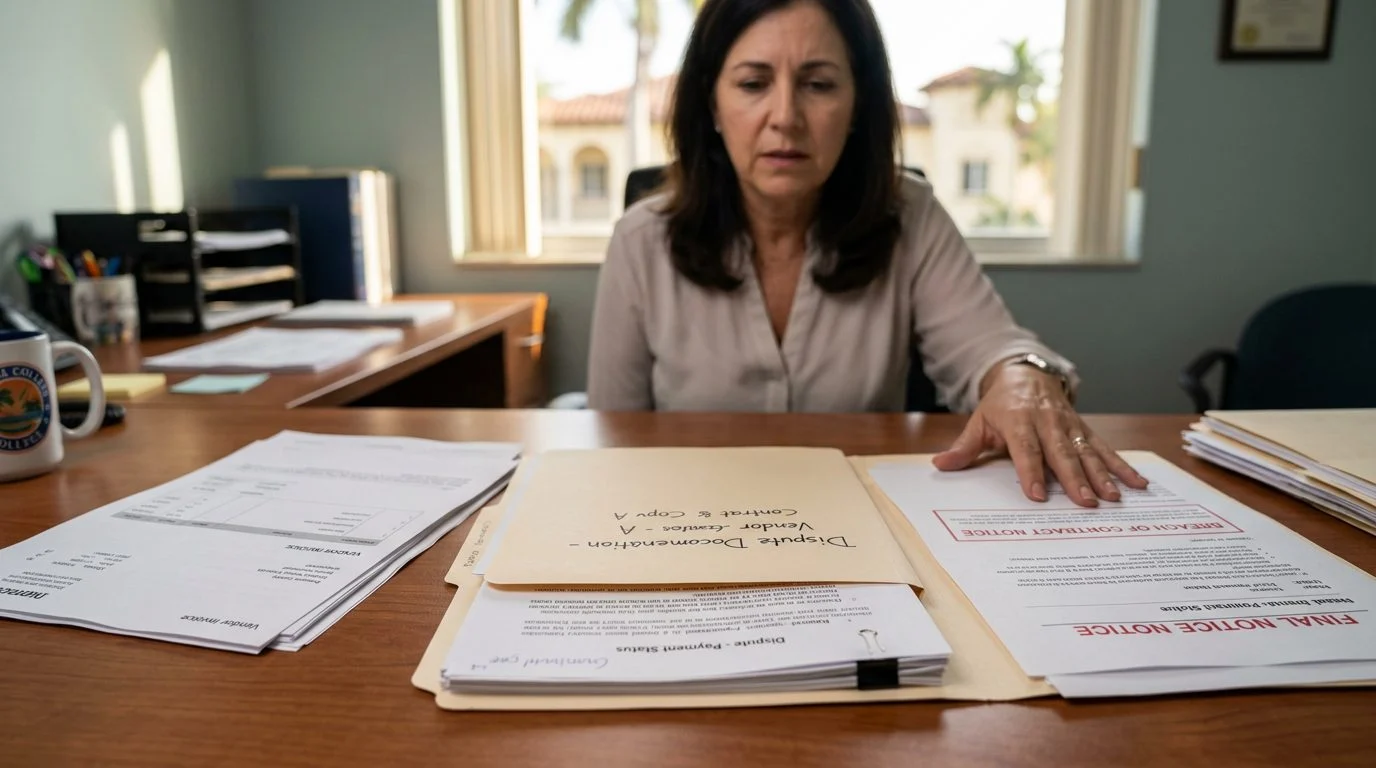
Save every invoice, payment record, notice, email, and text that relates to the dispute. Written records are often the most important evidence in a vendor disagreement, so gather them before you send any response.
How We Help Business Owners Respond
1. Review the Agreement
We read the contract, invoices, and correspondence together to identify what was agreed and what the vendor has actually done.
2. Evaluate the Dispute
We assess whether the invoice is correct, whether notice was given, and whether any contract conditions were met.
3. Respond in Writing
When appropriate, we prepare a written response that protects your position, addresses the vendor's demands, and keeps the door open to resolution.
4. Protect Continuity
Where service interruption is a real threat, we discuss options to keep your business running while the dispute is resolved.
By Kristina E. Wilson · Published November 17, 2026
Your vendor has cut off a service, supply or access, and you say the invoice is wrong. If a vendor has cut off your service, or threatened to, over a late or disputed payment, whether it may do so often depends on how your contract is read. Florida’s Fourth District Court of Appeal has said that courts generally disfavor treating a contract term as a condition precedent and will do so only when the contract’s plain, unambiguous wording or necessary implication calls for it (Covelli Family opinion).
This page explains how to check that answer, which records to pull, and what a written notice should do. It also covers where a dispute may end up.
Short Answer: Usually the Contract Controls
Start by reading what that agreement says, not what the vendor says it says.
Three kinds of clauses can change the answer. A suspension clause says whether service can end, and under what conditions. A notice clause says how and where you must be told. A cure period gives you time to fix the problem before any shutoff.
Florida’s sales-of-goods rules also address suspension. When a party has reasonable grounds for insecurity, the other party may demand adequate assurance of performance in writing. It may suspend any performance for which it has not already received the agreed return until it gets that assurance, if doing so is commercially reasonable (Fla. Stat. § 672.609). That statute covers sales of goods, so it may not reach a service contract.
Whether it is turns on the contract’s language.
Not sure what your next step is?
Talk it through with our team — the first consultation is free, confidential, and carries no obligation.
What Counts as a Vendor Dispute
A vendor dispute is a disagreement over whether an invoice is owed, or how much. Common reasons include incorrect charges, services never delivered, quality problems and billing errors. If you contest an invoice in good faith for reasons like these, you have a disputed invoice.
That is different from a plain refusal to pay a balance you agree you owe. Label each invoice accurately in your records and in every message. The rights a vendor has can differ between these two situations.
Put the dispute in writing early. A short email that names the invoice, the amount and the reason tells the vendor a dispute exists. Waiting until service is cut off makes the timeline harder to prove.
Three habits make disputes harder to prove. They are paying part of an invoice without saying the rest is disputed, ignoring the vendor’s notices, and arguing only by phone.
Start by Reviewing the Contract and Your Records
Start with the contract. Check for suspension or termination for non-payment, notice and cure periods, late fees, dispute resolution, mediation or arbitration, governing law, and any service levels the vendor must keep.
Then gather your records. Pull invoices, purchase orders, emails, delivery or usage logs, and proof of every payment already made. Write down the date of each item.
Read the notice clause closely. Some contracts require notice by mail to a set address, not by email. Missing a required step can weaken your position.
Whether a notice or cure step must happen first is a question of the contract’s words. Florida courts do not favor reading a term as a condition precedent. Courts generally do not favor conditions precedent, and they read a provision as one only when plain, unambiguous language or necessary implication requires it (Covelli Family, L.P.). A condition precedent is an event that must occur before there is a right to immediate performance (Land Co. of Osceola County).
For the broader framework, read our business contract and vendor disputes page.
When a Shutoff May Be a Breach of Contract
The contract gives no right to suspend. The contract requires written notice or a cure period, and none was given. The contract requires the parties to resolve the dispute first. Or the contract says certain services must continue during a dispute.
Florida’s goods statute covers a party that repudiates a contract. That means it refuses a performance not yet due, in a way that substantially impairs the contract’s value. The other side may then pursue its remedies for breach (Fla. Stat. § 672.610). Check whether that goods rule fits your service agreement.
A shutoff can also hurt your own operations. Lost access, supplies or service can affect sales, staff time and customer commitments. Keep a log of each date service ended and what it affected.
Whether a particular shutoff is a breach depends on the facts, including the contract’s words. A court or arbitrator would decide that question on the record.

Regulated Utilities and Consumer Debt Rules Work Differently
Check which rules govern the specific service before you assume a contract term controls.
Florida’s consumer collection rules are in Fla. Stat. § 559.72. They limit how collectors act. For example, they limit when a collector may contact the debtor’s employer before a final judgment. Fla. Stat. § 559.72 reads: “(4) Communicate or threaten to communicate with a debtor’s employer before obtaining final judgment against the debtor, unless the debtor gives her or his permission in writing to contact her or his employer or acknowledges in writing the existence of the debt after the debt has been placed for collection.”
Those rules apply to consumer debts. Under Fla. Stat. § 559.55, a consumer debt comes from a transaction whose money, property, insurance or services are primarily for personal, family or household purposes.
A commercial invoice your business owes usually falls outside that definition. So don’t assume these protections cover your vendor dispute. Check the definition first, especially when a vendor’s letter cites collection rules.
Send Written Notice and Follow the Contract’s Process
A clear written notice is the usual next step. It should identify the invoice, state why you dispute it, ask the vendor to restore or continue service, and reserve your rights.
Send it the way the contract requires. Use the notice address and method the contract names. If it names none, send it to the vendor’s listed contact and keep proof of delivery.
Florida’s goods rules require a demand for adequate assurance to be in writing. If the other side receives a justified demand and then fails to provide adequate assurance within a reasonable time not exceeding 30 days, that failure is a repudiation (Fla. Stat. § 672.609). Whether those goods rules reach your service contract is a separate question.
Under Florida’s goods rules, a buyer who has accepted goods must notify the seller of a breach within a reasonable time after discovering it, or should have discovered it, or be barred from any remedy (Fla. Stat. § 672.607).
Pay any undisputed amount on time where the contract requires it. That leaves the vendor fewer valid reasons to keep the shutoff in place. Keep copies of every message, and date each interruption and what it affected.
Not sure what your next step is?
Talk it through with our team — the first consultation is free, confidential, and carries no obligation.
Negotiation, Mediation, Arbitration and Court
Negotiation is usually the first step. Ask for a senior decision-maker, and follow up with a short written proposal that states the amount you accept and the terms.
Many business contracts require a step before a lawsuit. Check whether yours calls for mediation first. Florida law says a court must, on one party’s request, refer any filed civil action for monetary damages to mediation, unless an exception applies, provided the requesting party is willing and able to pay the costs of the mediation or the costs can be equitably divided between the parties. Exceptions include actions to collect a debt and actions where the parties agreed to binding arbitration (Fla. Stat. § 44.102). Read more in our mediation requirements guide.
Arbitration clauses carry weight too. Florida law makes a written arbitration agreement valid and enforceable, except on grounds that exist for revoking any contract (Fla. Stat. § 682.02). If a party sues anyway, the court must, on just terms, stay that lawsuit while it decides a motion to compel arbitration (Fla. Stat. § 682.03).
Venue matters too. Florida law says an action must be brought in the county where the defendant resides, where the cause of action accrued, or where the property in litigation is located (Fla. Stat. § 47.011). For a South Florida dispute, that could point to Miami-Dade or Broward County. That rule does not apply to actions against nonresidents.
If the vendor says the contract auto-renewed, read our auto-renewal guide. If the vendor cut off only one location, see our one-location guide.
If Your Vendor Has Already Shut Off Service
If a vendor has already cut off service over a disputed invoice, you may need to decide quickly whether the shutoff is allowed. Gather the contract, the disputed invoices and every notice exchanged before you respond.
Can a vendor shut off service for non-payment in Florida?
Usually, only if the contract or other applicable law gives it that right. A shutoff without that right may be a breach.
Does a disputed invoice change the answer?
It can, especially when the contract requires notice, a cure period or dispute resolution first. The contract’s wording usually decides that question.
Does a consumer debt law cover a business invoice?
Usually not. Florida’s consumer debt definition centers on personal, family or household purposes.
KEW Legal is a Florida business law firm with offices in Coral Gables and Sunny Isles Beach. It handles business contract and vendor dispute matters for owners in Miami-Dade and South Florida. Kristina E. Wilson is the responsible attorney for this page.
The initial consultation is free, confidential, and carries no obligation to continue.
If your vendor has shut off service over an invoice you dispute, reach us at 305-990-2300 or send us a message to talk through your contract and notices.
Talk With Kristina E. Wilson About Your Vendor Dispute. The Initial Consultation Is Free, Confidential, and Carries No Obligation to Continue.
Related practice areas
- Vendor Cut Off One Venue’s Supplies? Protect Other Locations
Request a Consultation
Fill out the short form and we will take it from there.