
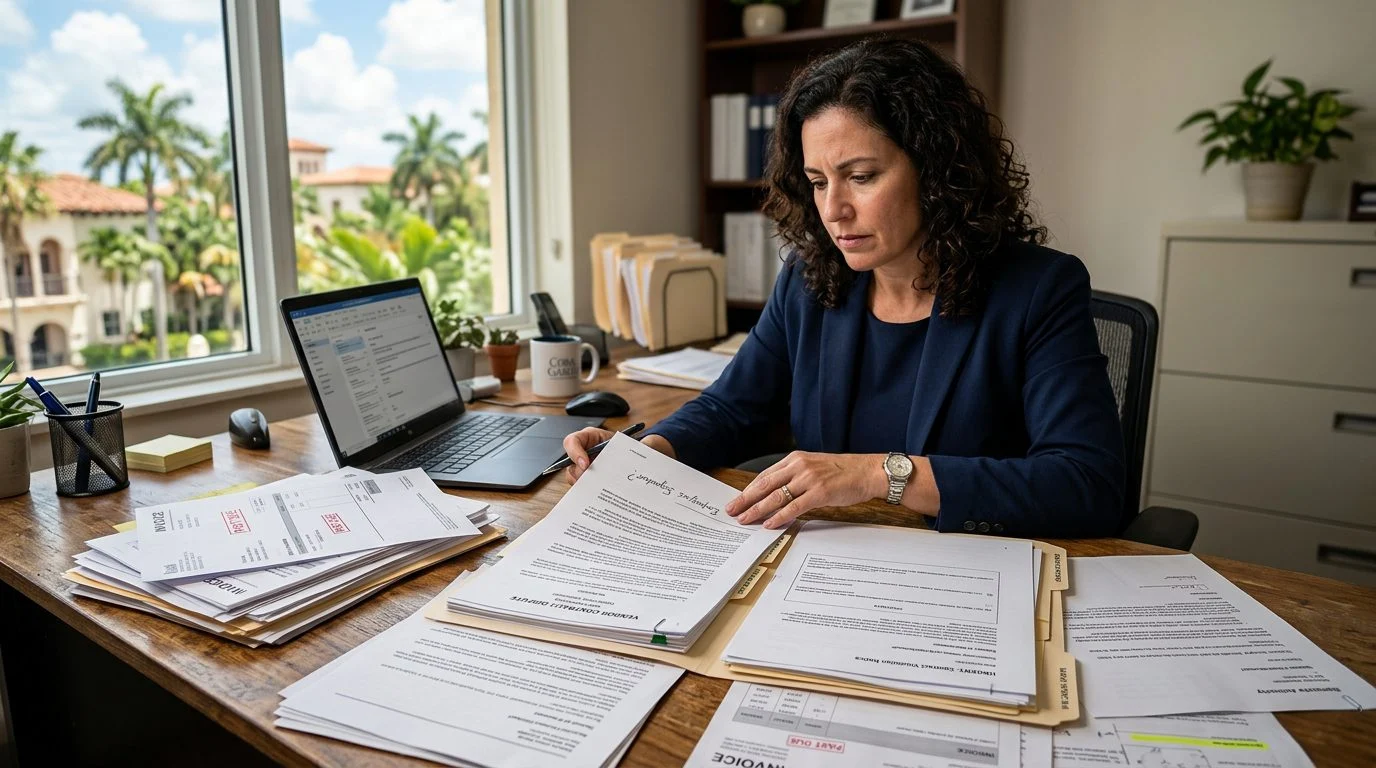
Vendor Contracts · Coral Gables and Sunny Isles Beach
Who Can Sign for Your Company? Employee Signatures on Vendor Contracts
Before your next vendor agreement is signed, know who holds the pen and what that signature can commit your business to.
By Kristina E. Wilson · Published November 14, 2026
You find a vendor contract in your files. An employee signed it without your authority, and you never approved it. Can your company still be held to it?
Often, the answer can be yes. Florida law looks at whether the employee had the power to sign, whether the vendor reasonably believed they did, and whether your company later acted as if the deal was its own.
Short Answer: Can an Employee’s Signature Bind Your Company?
Whether it does depends on the facts.
Owners should not assume a contract is void just because they never approved it personally. It also asks whether the vendor could fairly rely on that.
Start with the signature block, the vendor’s paperwork, and your internal records. Those documents show what the company appeared to allow.
If an employee signed a vendor agreement you never approved, your company's position may still be unclear, and you don't have to sort it out alone. Talk it through with our team — the first consultation is free, confidential, and carries no obligation.

How Florida Agency Law Decides Who Can Commit the Company
A company acts only through people. So the core question is whether the person who signed was acting as the company’s agent for that deal.
Florida’s entity statutes answer this for specific business forms. Under Fla. Stat. § 605.04074, in a member-managed LLC each member is an agent of the company. A member’s act binds the company when it is done for apparently carrying on in the ordinary course of the company’s business. Fla. Stat. § 605.04074 reads: “(b) An act of a member which is not done for apparently carrying on in the ordinary course of the limited liability company’s activities and affairs or activities and affairs of the kind carried on by the company, binds the company only if the act was authorized by appropriate vote of the members.” The exception is when the member had no authority and the other party knew or had notice of that.
In a manager-managed LLC, a member is not an agent just for being a member. Managers are agents, and the same ordinary-course rule applies to them. An act outside the ordinary course binds the LLC only if the members authorize it by appropriate vote.
Partnerships follow a similar pattern under Fla. Stat. § 620.8301. Each partner is an agent of the partnership. A partner’s act outside the ordinary course binds the partnership only if all the other partners authorize it, or a written partnership agreement does.
Three routes can bind a company, in plain words:
- Actual authority: the company gave the employee power to sign, through a job description, a written delegation, or a standing practice.
- Apparent authority: the company’s own words or conduct led the vendor to reasonably believe the employee could sign.
What Creates Apparent Authority in a Vendor Deal?
Apparent authority usually comes from what the company showed the vendor. It rarely comes from what the employee says about their own power.
A job title on a signature block, a business card, or an email signature can signal authority to an outside vendor. Vendors deal with what they can see, so those signals matter.
Prior dealings also count. If the company let the same employee sign similar agreements or place orders before, the vendor may reasonably rely on that history.
Practical facts carry weight too. Who negotiated price and terms, who asked for quotes, who received invoices, and who approved the first purchase order can all show what the company appeared to allow.
A common mistake is assuming the employee’s title settles the question. The full pattern of dealings usually matters more than one signature.
When a Vendor Cannot Reasonably Rely on Apparent Authority
A vendor usually cannot rely on apparent authority when it knew the signer lacked power to sign. The same is true when the vendor had notice of that limit.
Some warning signs can put a reasonable vendor on notice. Unusual terms, very large amounts, long commitments, or agreements far outside the employee’s normal duties can prompt a vendor to ask for confirmation. A vendor that ignores those signs may struggle to claim it relied on the signer’s authority.
Contract language matters as well. If the vendor’s own form requires an officer’s signature or written management approval, that requirement is relevant evidence.
The company’s response after signing matters too. A prompt, clear answer that the signer lacked authority is very different from silence or a vague reply.
Ratification: When Conduct Can Bind the Company After the Fact
Common examples include accepting deliveries, using the vendor’s services, paying invoices, or signing off on completed work. Each of those acts can signal that the company accepted the contract, even if no one approved the signature.
Florida courts have described this idea in other contract settings. In Flaherty v. Flaherty, the Second District explained that ratification occurs when a party entitled to rescind a voidable contract fails to do so after learning the facts.
For goods, the Uniform Commercial Code takes a related approach. Whether a seller’s response to a wrongful act counts as acceptance can depend on the facts, including whether the seller ratifies it.
Timing matters too. Under Fla. Stat. § 672.607, a buyer who accepted goods must notify the seller of a breach within a reasonable time after discovering it or should have discovered it, or be barred from any remedy.
Silence can matter. If you know about the deal and keep taking its benefits, that conduct can be read as acceptance. A timely written objection is important evidence that the company did not adopt the deal.
Steps Owners Should Take as Soon as They Learn of the Signature
Start by gathering the records, then review the deal before you speak with the vendor.
Collect the signed agreement, the signature block, related emails, purchase orders, invoices, and any notes showing who negotiated the deal. Then confirm the employee’s written duties, any signing policy, and what the company previously let that person do.
Next, check the payment and notice terms in your contract before you hold back money or halt deliveries. Notice requirements may apply, and a sudden pause can create its own problem. Keep the vendor informed in writing.
Watch the timing on goods deals. Under Fla. Stat. § 672.201, between merchants, a record confirming the contract that is sufficient against the sender, received within a reasonable time, and whose contents you have reason to know, can satisfy the record requirement against you unless you give notice in a record objecting to its contents within 10 days after it is received. The writing rule applies to goods priced at $500 or more.
Avoid informal assurances. Telling the vendor “we’ll sort it out and pay” can itself support a ratification argument. Hold those conversations until the facts are reviewed.
Not sure what your next step is?
Talk it through with our team — the first consultation is free, confidential, and carries no obligation.
Preventing Unauthorized Signatures in Your Business
A written signing authority policy is the simplest way to limit who can commit the company.
List who may sign which types of agreements, and set dollar limits for each. Name the approver for vendor contracts above those limits. Update the list whenever roles change.
Update vendor onboarding too. Give each vendor the list of authorized signers, and ask the vendor to confirm the signer’s authority before work begins. A short written confirmation at the start can prevent a dispute later.
Route new vendor agreements through a designated approver, and keep records of each approval. Those records show what the company actually allowed, which matters for the actual-authority question.
Review how titles, signature blocks, and email signatures are used. A manager’s title on an email can signal authority to a vendor even when no one intended that. Clean up any signature that suggests more power than the person has.
Related Contract Issues That Often Come Up Alongside Signing Disputes
Even when a contract binds your company, its own terms still control how it ends and how money changes hands.
Early termination fees and liquidated damages can apply even after a signing dispute is settled. For more on those provisions, see Is a Liquidated Damages Clause Enforceable in a Florida Business Contract?.
Delays caused by a hurricane may depend on the contract’s force majeure language. See Does a Force Majeure Clause Cover a Hurricane for a Miami Business?.
A vendor may also try an unjust enrichment claim instead of a contract claim. Where an express contract covers the same subject matter, a claim for unjust enrichment may be limited, and whether it applies depends on the facts. See Williams v. Johnson.
Before you withhold payment for defective work, review the notice and acceptance terms. See Can I withhold payment from a vendor for defective work in Florida?.
For a broader overview, see the business contract and vendor dispute attorney resource hub.

Talk With KEW Legal About the Agreement in Front of You
If an employee signed a vendor agreement and you’re unsure where that leaves your company, get the signed document reviewed before payments or deliveries settle the question for you.
KEW Legal is located in Coral Gables and Sunny Isles Beach. The firm works with business owners and investors across Miami-Dade and South Florida on contract and vendor disputes, among other matters.
Frequently Asked Questions
When an employee signs a vendor contract
Does an owner have to approve a vendor contract for it to bind the company?
Not always. Apparent authority and ratification can bind a company even without the owner’s personal approval.
Does an electronic signature count?
Generally yes. Under Fla. Stat. § 668.004, an electronic signature has the same force and effect as a written one, unless other law provides otherwise.
Facing a signed vendor deal you never approved? Call 305-990-2300 or send us a message to schedule a free first consultation, which is confidential and carries no obligation to continue.
This page is the responsibility of Kristina E. Wilson at KEW Legal, Coral Gables, Florida.
How KEW Legal Works With Business Owners
Outside general counsel
KEW Legal focuses on business law for owners and investors across Miami-Dade and South Florida, including vendor and contract matters.
Signing authority reviewed
We help companies review who may sign vendor agreements and how those signing practices are documented.
Offices in two cities
Our offices are in Coral Gables and Sunny Isles Beach. Kristina E. Wilson is the responsible attorney for this page.
Free first consultation
Your first consultation is free, confidential and comes with no obligation to continue.
Do not assume a signature is covered
A vendor agreement signed by an employee can raise questions about authority that surface only when a payment or delivery goes wrong. Review your signing policies before a dispute arises.
Topics Covered in This Guide
Apparent authority
How a vendor's reasonable belief about who could sign for the company can affect a contract dispute.
Ratification
How a company's conduct after a contract is signed can bear on whether it is bound.
Electronic signatures
How e-signatures are treated under Florida law and what owners should confirm before relying on them.
Written signing policies
Practical steps to define which employees may sign, for which amounts, and with what approvals.
Talk With KEW Legal About Your Vendor Contracts
Request a Consultation
Fill out the short form and we will take it from there.