
Business Contract & Vendor Disputes | Coral Gables and Sunny Isles Beach
Thinking About Holding Back a Vendor's Payment? Review Your Position First
A withheld payment can protect your business or become the basis for a claim against you. Knowing where you stand before you act makes the difference.
By Kristina E. Wilson · Published November 8, 2026
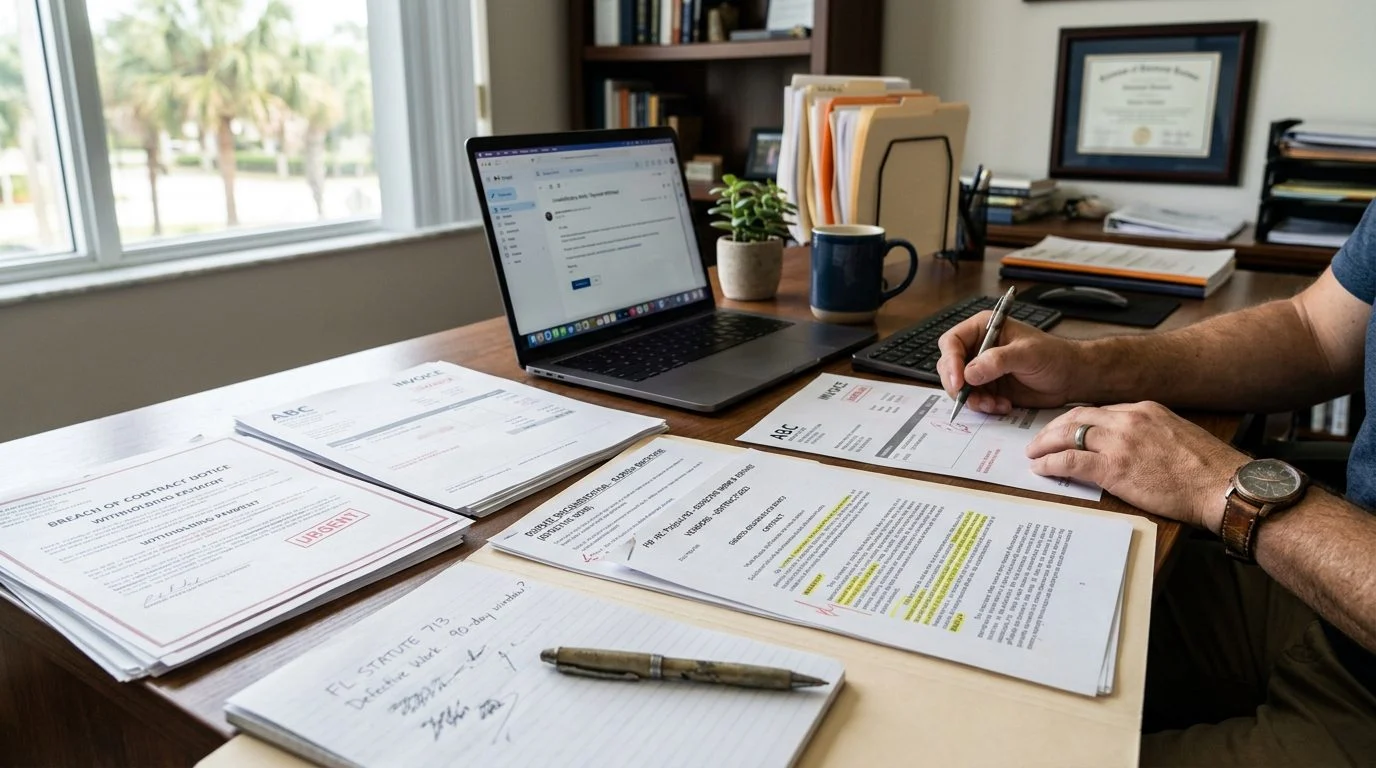
Your vendor’s work came back wrong, and you’re deciding whether to keep paying. In many cases you can hold back part of the money, but only if your contract allows it and the facts support it.
Can You Withhold Payment for Defective Work in Florida?
The agreement you made with the other party is often a key document to review when a business dispute arises. A defect alone doesn’t always give you the right to stop paying. If you hold money back without a basis, your vendor can call that a breach. Three questions decide most of these disputes: what the contract says, whether you followed its notice and cure steps, and whether you already accepted the work.
Florida’s sale-of-goods rules, in Chapter 672 of the Florida Statutes, cover contracts for goods. Florida courts hold that even an oral contract needs an offer, acceptance, consideration, and essential terms stated clearly enough. See St. Joe Corp. v. McIver.
For the bigger picture, read our business contract and vendor disputes page.
Not sure what your next step is?
Talk it through with our team — the first consultation is free, confidential, and carries no obligation.

Start With the Contract’s Payment and Withholding Terms
Your contract’s payment and withholding terms are the first place to look. Read the payment schedule first. Look for milestones or completion triggers that tie each payment to a specific step.
Then search for any clause that lets you withhold money or offset a charge against it. Read the warranty and inspection language too. It often defines what counts as conforming work.
If the contract says nothing about withholding, your position is harder to defend. You’ll rely on general contract principles and the facts. Write down exactly which term the vendor’s work fails to meet. That term becomes the center of your position.
Emails and text messages can matter too. Florida’s sale-of-goods rules say conduct by both sides that recognizes a contract can create one, even when the written papers don’t match. Check your inbox for confirmations you haven’t answered.
Notice and Cure Periods Before You Hold Back Money
Many contracts require written notice of the defect and a chance for the vendor to fix it before you hold back money. A cure period is the window the vendor gets to fix the problem after you give notice. It comes from your contract, so read the exact days and steps.
Whether Chapter 672 applies to a vendor’s work depends on whether the contract is for goods or for services. If you reject a nonconforming delivery while the time to perform is still open, the seller may tell you it plans to cure. It can then deliver conforming goods within the contract time.
A proper notice usually names the defect and the contract term it breaks. It states the fix you want and sets a deadline. Send it the way the contract requires, and keep proof that it arrived.
Skipping a required step can weaken your position, even when the defect is real. For goods you accepted, Florida law requires you to notify the seller of a breach within a reasonable time after you discover it or should have discovered it. Otherwise you can be barred from any remedy. Otherwise you can be barred from any remedy.
For more on this step, see our page on cure periods in a Florida business contract.
Final Payment, Acceptance, and the Argument That the Job Was Accepted
Accepting the work can limit your right to complain, so be careful with final payments and sign-offs. Vendors often argue that paying the final invoice, using the work, or signing a completion form means you accepted it. That argument carries real weight.
Under Florida’s sale-of-goods rules, acceptance happens after you’ve had a reasonable chance to inspect. It also happens when you tell the seller the goods conform, keep them despite a problem, or act like their owner.
Once you accept goods, you generally can’t reject them. Acceptance doesn’t by itself wipe out every other remedy, though. A defect claim can survive, but only if the buyer notifies the seller of the breach within a reasonable time after discovering or should have discovered it, or the buyer is barred from any remedy. See Fla. Stat. § 672.607.
Visible and hidden problems can be treated differently. The buyer has the burden of establishing any breach with respect to the goods accepted. A buyer who examined the goods can also lose claims for defects that examination should have revealed. Hidden defects raise different questions, and your contract’s wording controls.
Withholding Only What the Defect Justifies: Partial Withholding and Contra Charges
Hold back an amount tied to the defect, not the whole invoice. Start with the cost to correct the problem. Get a written repair quote. If a repair isn’t practical, use the reduced value of the work. Hold that number back, and keep paying the parts of the invoice that aren’t in dispute.
A contra charge is an offset. You deduct documented correction costs from what you still owe the vendor. Keep the math on one page: each invoice, each quote, each deduction, and the total held back. Clear math is easier to defend than a round number chosen in anger.
Withholding far more than the defect justifies is a common mistake. The dispute then shifts from the defect to your own payment.
When Withholding Payment Goes Wrong: Breach-of-Contract Exposure
If the contract doesn’t authorize your hold-back, the vendor can sue for the money it says you owe. That claim may seek the unpaid balance, interest, and attorney’s fees.
Florida sets judgment interest by statute. A written contract can set its own rate, and the statute leaves that rate in place. See Fla. Stat. § 55.03.
Fee clauses can cut both ways. If your contract, entered into on or after October 1, 1988, lets one party recover fees for enforcing it, a court may also allow fees to the other side when that side wins. See Fla. Stat. § 57.105.
A vendor may also claim unjust enrichment. That claim requires a benefit given to you, your awareness of it, and your keeping it in circumstances that make it unfair to keep it unpaid. See Pincus v. American Traffic Solutions.
Time limits for suing are set in Fla. Stat. § 95.11, and they vary by type of claim. Whether a hold-back was proper depends on the facts and the contract wording. The same withholding can be defensible in one case and not in another.
Not sure what your next step is?
Talk it through with our team — the first consultation is free, confidential, and carries no obligation.

Document the Defect and Talk to KEW Legal Before You Withhold
Before you hold back a dollar, document the defect and keep paying what isn’t in dispute. Gather dated photos or video, inspection reports, written notices with proof of delivery, vendor responses, repair estimates, and your invoices and payment records.
Paying undisputed amounts on time keeps the disagreement narrow. It also shows you’re acting in good faith.
Quick answers
Can I withhold payment from a vendor for defective work in Florida?
Sometimes. Your contract and the facts decide it, and holding back too much can create a claim against you.
Does final payment mean I accepted the work?
A vendor can argue it does. Read your acceptance and sign-off language before you pay the final invoice.
How long do I have to sue?
The time limits are set in § 95.11 and depend on the type of claim.
KEW Legal is a Florida business law firm with offices in Coral Gables and Sunny Isles Beach. We serve business owners and investors across Miami-Dade and Broward County. If a vendor’s defective work has you deciding whether to hold back payment, reach out before you act. We can review your contract, notice steps, and payment records with you. Your initial consultation is free, confidential, and comes with no obligation to continue. Call 305-990-2300 or send a message through our contact page.
Kristina E. Wilson is the responsible lawyer for this page. This page gives general information only, and no particular result can be promised.
How KEW Legal Works With Business Owners
Contract Review
We read the agreement, the scope of work and the payment terms with you so you understand what the contract actually says.
Strategy Before Action
Before you withhold anything, we talk through the options, the risks and the likely responses from the vendor.
Protecting Your Business
Our attorneys focus on keeping your business from taking on avoidable exposure while the dispute is resolved.
Clear Communication
We help you decide what to say to the vendor, and in what form, so your position stays consistent in writing.
Warning: Do Not Stop Payment Without Review
Withholding too much, or withholding without a clear basis in your contract, can create a claim against you. Review the agreement and the documentation before you stop a payment or send a demand.
Steps to Take Before You Withhold Payment
Read Your Contract
Check the scope of work, acceptance terms, payment schedule and any notice or dispute provisions.
Document the Defects
Photograph problems, save inspection reports and keep a record of when each issue was identified.
Put Concerns in Writing
Notify the vendor of the defects in writing and give them a fair opportunity to respond or correct the work.
Get Advice Before Final Payment
Signing off or paying the final invoice can affect your rights, so review that step with counsel first.
Talk With KEW Legal Before You Hold Back Payment. Your first consultation is free, confidential and carries no obligation to continue.
Request a Consultation
Fill out the short form and we will take it from there.