
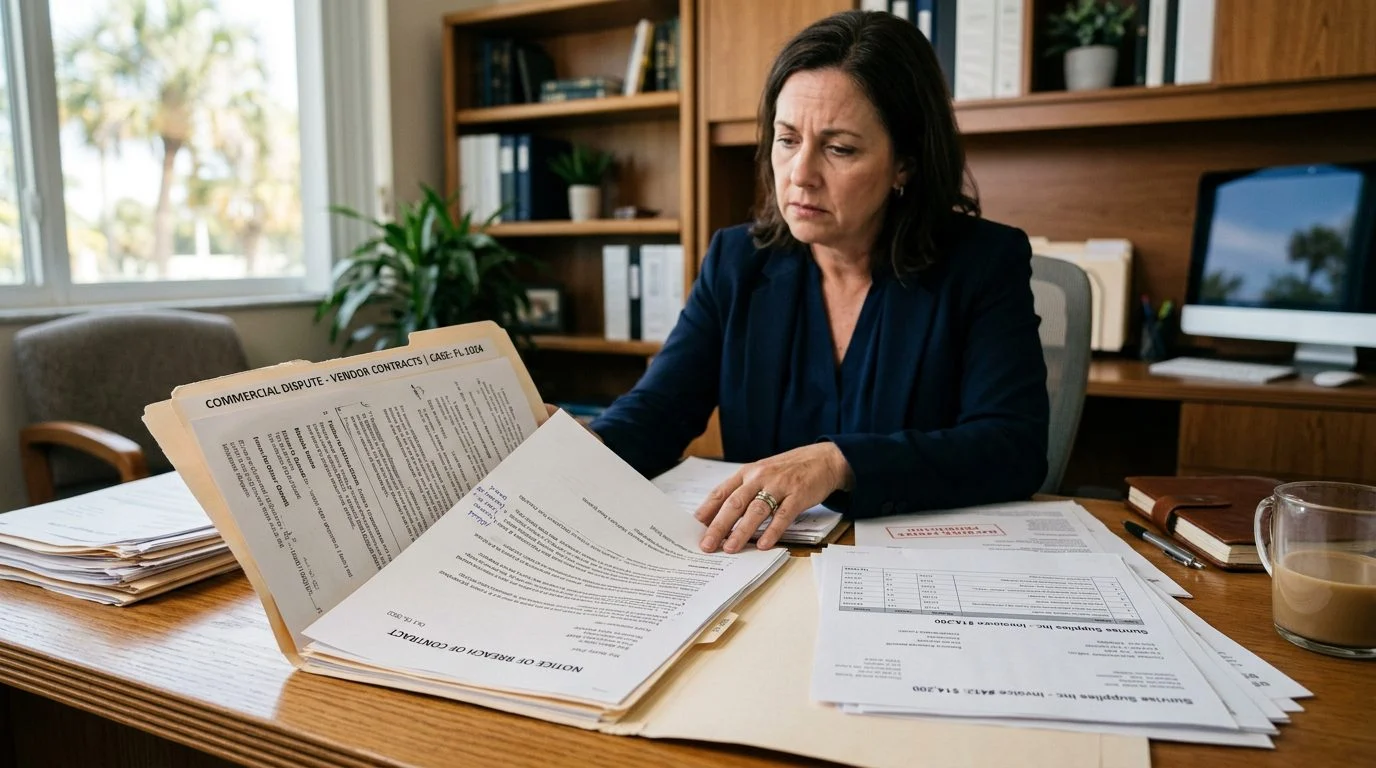
Commercial Contract Mediation | Coral Gables and Sunny Isles Beach
Work Through Commercial Contract Disputes Without Going to Court First
KEW Legal helps Florida business owners and investors address vendor, partner and contract disagreements through a structured, negotiated process.
By Kristina E. Wilson · Published November 8, 2026
Commercial contract mediation in Florida is a confidential negotiation led by a neutral mediator. The mediator helps business parties look for their own settlement and does not decide who is right. KEW Legal is a Florida business law firm with offices in Coral Gables and Sunny Isles Beach, serving owners and investors across Miami-Dade and Broward County.
What Commercial Contract Mediation Is and Who It Fits
Mediation is a structured negotiation that ends in a deal only when both sides sign. The mediator guides the talks, tests each side’s position, and helps find terms both can accept.
Once it’s signed, you can enforce it like any other contract.
Mediation tends to fit owners, partners, and investors who face:
- a breach claim over a written or oral business agreement
- unpaid invoices from a customer or vendor
- a partner who wants out and disagrees on the buyout price
- a landlord or tenant dispute over rent, repairs, or renewal terms
KEW Legal focuses on business law for owners and investors in Miami-Dade and South Florida. Our team works from offices in Coral Gables and Sunny Isles Beach.
Not sure what your next step is?
Talk it through with our team — the first consultation is free, confidential, and carries no obligation.

What Mediation Covers in a Florida Business Dispute
Mediation can address many commercial disputes that involve money, performance, or an ongoing business relationship. Common matters include:
- Contract breach: payment, delivery, deadlines, or the scope of work.
- Vendor disputes: pricing, quality, or ending a supply agreement.
- Partnership disputes: capital contributions, decision-making, and exit terms. Florida partnership law in Chapter 620 sets the framework for these disagreements.
- Commercial leases: rent, repairs, and renewal terms, short of a court filing to remove a tenant.
- Sales and acquisitions: purchase price adjustments and disputes over promises made in a sale agreement.
In a mediated matter, we review the agreement and correspondence. We prepare a written position summary, outline what each side stands to gain or lose, and draft the settlement term sheet and final agreement.
Budget for three kinds of cost: mediator fees, attorney time, and any court filing costs if a case is already open. Under the American Rule in Price v. Tyler, each side generally pays its own attorney’s fees unless a contract or statute says otherwise.
How Mediation Works: Step by Step
A typical mediation moves from a first conversation to a signed settlement in six steps. Timing depends on the facts. A simple dispute can fit in one session, while a dispute with several parties and many documents takes longer.
- Free first consultation. You describe the dispute, the contract, and your goals. The consultation is free, confidential, and comes with no obligation to continue.
- Contract review. We read the dispute-resolution, notice, and mediation clauses. We check whether a mediation step must happen before a lawsuit or arbitration.
- Mediator and date. The parties agree on a neutral mediator, a date, and a format, in person or by video.
- Preparation. We prepare a confidential position statement and your settlement goals. That includes the terms you would accept and the terms you would not.
- The session. The mediator may meet everyone together, then talk with each side in private. Sessions can run for several hours.
- Documentation. If the parties agree, they sign a term sheet first. A full settlement agreement then covers payment, releases, confidentiality, and what happens if a party fails to perform.
Mediation, Arbitration, and Litigation Compared
In mediation, the parties shape the outcome. In arbitration or litigation, a decision-maker does. Each path carries different rules and risks.
- Mediation: the parties control the terms, sessions are confidential, and nothing binds you until a settlement is signed.
- Arbitration: a private decision-maker rules. Under Florida’s arbitration statute, a written agreement to arbitrate is valid, enforceable, and irrevocable, except on grounds that allow any contract to be revoked. Fla. Stat. § 682.02 reads: “(1) An agreement contained in a record to submit to arbitration any existing or subsequent controversy arising between the parties to the agreement is valid, enforceable, and irrevocable except upon a ground that exists at law or in equity for the revocation of a contract.”
- Litigation: a public court case moves through discovery and motions. A judge or jury decides the case if it doesn’t settle.
Mediation’s benefits include privacy, control over terms, flexible payment structures, and room to protect a working relationship. Its risks are real. A failed session adds cost and time. Florida also sets time limits for contract claims, so talks should not run out the clock.
ADR Clauses and Court-Ordered Mediation in Florida
Many commercial contracts include an alternative dispute resolution (ADR) clause. That clause can require mediation or arbitration before a lawsuit. Read it early, because skipping a required step can lead to a fight over the case’s path.
Florida courts can also send cases to mediation. On one party’s request, a court must refer a filed civil action for monetary damages to mediation, if the requesting party is willing and able to pay the costs of the mediation or the costs can be equitably divided between the parties, unless the case falls under an exception, such as a landlord and tenant dispute without a personal injury claim or an action to collect a debt. The court referral statute excludes several cases, including a landlord and tenant dispute without a personal injury claim. That exception means a commercial eviction is not automatically sent to mediation under this rule.
Settlement offers carry their own rules. § 45.061 does not apply to causes of action that accrue after the effective date of the act. KEW Legal can review whether your claim falls under it. For a claim the section still covers, a written offer is served on the other side rather than filed with the court, at any time more than 60 days after the summons and complaint were served but not less than 60 days (or 45 days for a counteroffer) before trial, and it remains open for 45 days unless withdrawn sooner by a writing served before acceptance. Under § 44.102(5), when a court refers a case to mediation, the response periods for offers under § 45.061, or for offers or demands for judgment under § 768.79, pause until the mediator declares an impasse or reports that no agreement was reached; § 45.061 itself does not apply to causes of action that accrued after its effective date, and it does not apply to any class action or shareholder derivative suit or to matters relating to dissolution of marriage, alimony, nonsupport, eminent domain, or child custody.
Courts also test contract terms. Florida courts assess unconscionability by considering both unfair deal-making and unfair terms, as discussed in Basulto v. Hialeah Automotive.
Why Work With KEW Legal on a Business Dispute
KEW Legal handles business disputes as part of its outside general counsel work for owners and investors. That focus shapes how we approach a contract or partnership problem.
- Business-first practice: we handle partnership, vendor, contract, and commercial lease disputes for businesses and the people who own them.
- Responsible lawyer: Kristina E. Wilson is the responsible lawyer for this page. Natalie Martinez is also a lawyer at the firm.
- Offices: Coral Gables and Sunny Isles Beach. We serve clients across Miami-Dade, Broward County, Aventura, Doral, Brickell, and Fort Lauderdale.
- One team, start to finish: the same firm can review the contract, prepare for mediation, and draft the resulting agreement. If mediation doesn’t resolve the matter, we can talk through arbitration or litigation options.
- Referral disclosure: if your matter falls outside our practice areas or needs a different lawyer or firm, we will tell you.
Not sure what your next step is?
Talk it through with our team — the first consultation is free, confidential, and carries no obligation.

Common Questions About Commercial Mediation in Florida
Is mediation required before I can sue?
A contract clause or a court order can require it. Check your agreement first.
How mediated settlements work
Who pays the mediator?
The parties agree on how to split the mediator’s fees. In a court referral, the requesting party must be able to pay, or the costs must be divided equitably.
Who pays attorney fees?
Each side generally pays its own, unless a contract or statute says otherwise.
If an unpaid vendor invoice, a stalled partner buyout, or a lease dispute is heading toward court, you don’t have to face it alone. Send us a message or call 305-990-2300 to talk through whether mediation fits your situation.
Contract disagreements we help resolve in mediation
Vendor and supplier disputes
Payment disagreements, delivery problems and disputed invoices that have stalled a working relationship.
Partnership and shareholder conflicts
Disagreements over buyouts, capital contributions, profit distributions and duties under an operating or shareholder agreement.
Commercial lease disagreements
Conflicts over rent calculations, maintenance obligations, renewal terms and other lease provisions.
Acquisition and sale agreement issues
Disputes over purchase price adjustments, representations, earn-outs and closing conditions.
How our mediation work is organized
Contract review first
We read the agreement, notices and correspondence together so you know what the document says before any session begins.
Options laid out clearly
We help you weigh settlement terms, business priorities and the costs of continuing the dispute.
Direct, organized communication
We prepare your position in writing and present it to the mediator and the other side in a measured way.
Protection of your business relationships
Our approach focuses on resolving the disagreement while protecting the interests that matter most to your company.
Check your agreement before you respond
Dispute-resolution, notice and cure provisions in your contract can affect how you should respond to a demand letter. Do not sign a settlement or send a written response until you have reviewed those terms.
Discuss your commercial contract dispute with Kristina E. Wilson
Related practice areas
Request a Consultation
Fill out the short form and we will take it from there.