
Business Contracts | Miami-Dade
Review Your Contractor Agreement Before You Sign
A contractor agreement decides who performs, who gets paid and who carries the risk when something goes wrong. Here is what to look for.
By Kristina E. Wilson · Published November 12, 2026
Construction Attorney to Draft Contractor Agreement in Miami
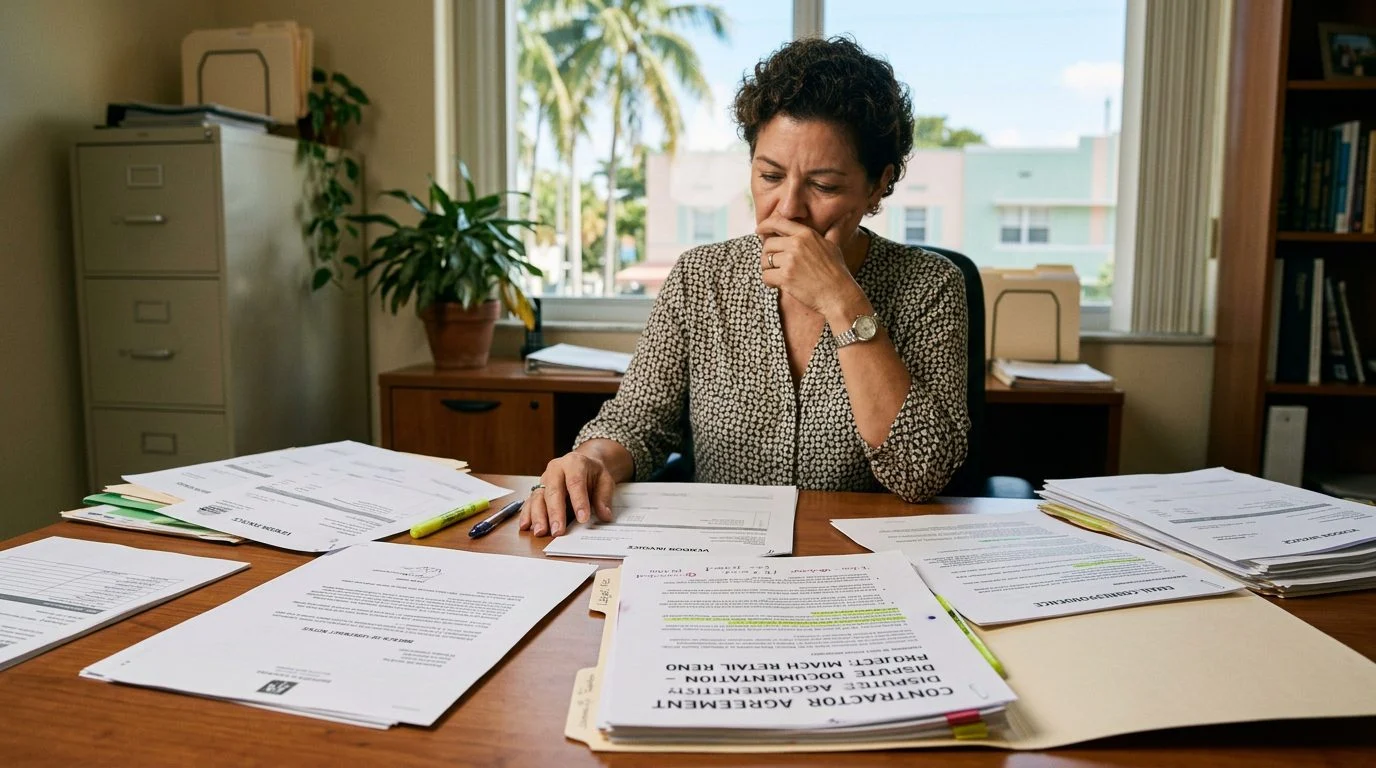
You’re about to sign a contractor agreement, or someone handed you one for a build-out or renovation in Miami. You want to know what it should say before the work begins.
A construction attorney can draft the agreement around your goals, or review the form the contractor sent you. The goal is a written contract that covers scope, price, timing, changes, and disputes. Here is how that process works.
If you're about to sign a contractor agreement you didn't write, we can talk through its terms with you before the work begins. Talk it through with our team — the first consultation is free, confidential, and carries no obligation.

What a Contractor Agreement Does on a Miami Construction Project
A contractor agreement is the written contract between the owner or business and the contractor who performs the work. It sets the scope, price, schedule, and each side’s duties. When something changes or goes wrong, this is the document everyone returns to.
Miami-Dade projects often involve permits, inspections, and subcontractors. Each one raises a question. Who pulls the permit? Who schedules the inspection? Who pays a subcontractor if the contractor falls behind? A written agreement answers those questions before the first crew arrives.
Hiring a construction attorney to draft a contractor agreement in Miami starts with how the project will actually run. The attorney looks at the parties, the work, the timeline, and the flow of money. Then those facts become terms clear enough to follow on a busy job site. Terms that seemed clear in a bid can mean different things once construction is underway.
When a Written Contractor Agreement Is Needed
A written contractor agreement is needed whenever a project involves real money, a firm deadline, or more than one party. Common examples include commercial build-outs, renovations of rental or investment property, and tenant improvements in leased space.
Relying on a verbal deal or a bid sheet alone creates gaps. A bid sheet usually lists prices. It rarely says who approves changes, when payments are due, or what happens if the work runs late. Two people can read the same bid and expect different results.
The person coordinating the work is often not the person who signs. A family member, business partner, or property manager may find the contractor and manage the schedule. If you’re the one signing, read the contract yourself. Confirm it says what you agreed to, not just what was discussed. A signed contract controls what happens next, so the words on the page matter more than the conversations behind them.
Key Terms a Drafted Contractor Agreement Typically Addresses
A drafted contractor agreement usually covers scope, payments, changes, timing, insurance, permits, and how disputes are handled. Each term should match the deal the parties actually reached.
- Scope of work: what the contractor will build or fix, tied to plans and specifications.
- Payment schedule: what triggers each payment, and any retainage held back until the work is finished.
- Change orders: how added or altered work is approved, and how it affects price and schedule.
- Completion and delays: completion dates and what happens when the schedule slips.
- Insurance, licensing, and permits: who carries coverage, holds licenses, and pulls permits.
- Lien waiver terms: what the contractor gives up in exchange for each payment.
- Dispute resolution: whether disputes go to mediation or arbitration, and how the agreement ends.
Florida generally allows four years to sue over the design, planning, or construction of an improvement to real property, subject to the start-date rules and exceptions in §95.11. For most claims, the start date is the earliest of the temporary certificate of occupancy date, the certificate of occupancy date, the certificate of completion date, or the date construction was abandoned, but for a latent defect the time runs from when the defect is discovered or should have been discovered with due diligence. Fla. Stat. § 95.11 reads: “(3) WITHIN FOUR YEARS.— … (b) An action founded on the design, planning, or construction of an improvement to real property, with the time running from the date the authority having jurisdiction issues a temporary certificate of occupancy, a certificate of occupancy, or a certificate of completion, or the date of abandonment of construction if not completed, whichever date is earliest; except that, when the action involves a latent defect, the time runs from the time the defect is discovered or should have been discovered with the exercise of due diligence.”
For a hidden defect, the clock starts when the defect is discovered or should have been. Even then, the suit must generally be commenced within seven years of the earliest certificate or abandonment date, though related counterclaims, cross-claims, and third-party claims may be brought up to one year after the pleading they relate to is served, even if otherwise time barred. For work within the scope of a duly issued building permit and certificate, correcting or repairing completed work does not extend the filing deadline.
Drafting a New Agreement Versus Reviewing a Contractor’s Form
Drafting starts from your goals. Reviewing starts from the contractor’s language. Those two starting points lead to different questions.
When you draft, the attorney asks what the project must do, which risks you want to avoid, and which terms you can trade. When you review a form, the attorney reads each clause for the risk it moves. An indemnity clause that puts most of the risk on the owner, or a payment term that requires money before any work, are common examples.
Two Florida rules matter when you read a form. A contract provision that sets a shorter time to bring a claim than the statute allows is void §95.03.
Words must also match the deal. The right approach varies with the project and the parties.
How the Drafting Process Typically Works
The process usually runs in four stages: intake, a first draft, revisions, and a final review before signing.
Intake comes first. You share the project description, any bid or proposal, the plans, and your business goals. The attorney asks who does what, what is already agreed, and where you’re most worried about risk.
Next comes a first draft built around the scope and risk allocation. It should describe the work clearly enough that someone outside the project can tell what’s included and what isn’t.
Revisions follow with you. Where it makes sense, the draft also goes to the contractor or the contractor’s side. Track every change in writing so no one relies on memory. Keeping the file organized from the start saves time.
The final review happens before anyone signs. After signing, keep records of approved change orders and payments. Those records matter if a dispute comes up later.
Not sure what your next step is?
Talk it through with our team — the first consultation is free, confidential, and carries no obligation.
What Affects the Time and Cost of Drafting
Project size, the number of parties, the complexity of the scope, and the number of revision rounds usually drive the work. A single-building renovation with one contractor is simpler than a multi-phase build-out with several subcontractors and owners.
Each extra party adds terms to negotiate. Each extra revision round adds time. Scope that is vague at the start can add rounds later.
Miami-Dade County publishes amended standard construction general contract conditions for its projects. That is a county-project form, not a general Florida rule for private contracts.
Time and cost depend on the facts of each project. Bringing the documents you already have, such as bids, plans, and any draft contract, helps the review move along. Gathering them early keeps the first meeting focused on your goals rather than missing paperwork.
Warning Signs in a Contract That Deserve a Lawyer’s Review
Vague scope, large upfront payments, no change-order process, and one-sided risk language are the signs to watch for.
- Vague scope: no reference to plans or specifications, or a line that just says “complete the build-out.”
- Large upfront payments: a big deposit with no milestones tied to finished work.
- No change-order process: nothing says how added work gets approved or priced.
- One-sided risk: indemnity or waiver language that moves most of the risk to one side.
- Dispute clauses: Florida treats a written arbitration agreement as valid, enforceable, and irrevocable, except on grounds that allow revoking any contract §682.02. Fla. Stat. § 682.02 reads: “(1) An agreement contained in a record to submit to arbitration any existing or subsequent controversy arising between the parties to the agreement is valid, enforceable, and irrevocable except upon a ground that exists at law or in equity for the revocation of a contract.”
- Attorney’s-fee clauses: a fee clause can cut both ways. If a contract entered into on or after October 1, 1988 lets one side recover fees for enforcing it, the court may also allow reasonable fees to the other side when that side prevails §57.105.
Some construction disputes fall outside KEW Legal’s practice. If a matter may be better handled by another lawyer or firm, we will say so.

Talking Through Your Project Before You Sign
If you’re reviewing a contract you didn’t draft, you may be under deadline pressure. The start date may be close, or a relative or partner may have already agreed to terms you haven’t read.
Should I hire a construction attorney to draft a contractor agreement in Miami?
A lawyer can draft the agreement from your goals or review a form the contractor gave you. Either way, the written terms should match the deal you reached.
Can a contract shorten the time to sue in Florida?
No. A contract provision that sets a shorter time to bring a claim than the statute allows is void.
Does a construction dispute go to mediation in Florida?
Under §44.102, a court, under rules adopted by the Supreme Court, must, upon request of one party, refer to mediation any filed civil action for monetary damages, provided the requesting party is willing and able to pay the costs of the mediation or the costs can be equitably divided between the parties, unless the action is a landlord and tenant dispute that does not include a claim for personal injury, is filed for the purpose of collecting a debt, is a claim of medical malpractice, or is governed by the Florida Small Claims Rules; the court determines that the action is proper for referral to nonbinding arbitration under that chapter; or the parties have agreed to binding arbitration, to an expedited trial pursuant to s. 45.075, or to voluntary trial resolution pursuant to s. 44.104. Fla. Stat. § 44.102 reads: “(2) A court, under rules adopted by the Supreme Court: (a) Must, upon request of one party, refer to mediation any filed civil action for monetary damages, provided the requesting party is willing and able to pay the costs of the mediation or the costs can be equitably divided between the parties, unless: 1.”
If a contractor agreement is on your desk, call 305-990-2300 or send us a message through our contact form to talk through the terms before you sign. Your first consultation is free, confidential, and carries no obligation to continue. This page is the responsibility of Kristina E. Wilson, and KEW Legal has offices in Coral Gables and Sunny Isles Beach.
How KEW Legal Works With Business Owners
Contract Review
We compare the scope, payment terms and deliverables in a contractor agreement against the deal you actually reached.
Drafting From Your Goals
We can draft an agreement based on what you need, or review a form the contractor gave you and suggest clearer terms.
Outside General Counsel
KEW Legal focuses on business law for owners and investors in Miami-Dade and South Florida, and can advise on contracts as part of ongoing business matters.
Vendor Dispute Support
When a contractor or vendor relationship breaks down, we help you understand your position and respond in a measured way.
Do Not Sign a Form You Have Not Read Closely
Contractor forms are often written with the contractor's interests in mind. Have the written terms checked against the deal you reached before you sign or make a payment.
Key Terms to Review Before You Sign
Scope of Work
Confirm that the description of the work, the materials and the finished result match what you discussed.
Payment Terms
Review the amounts, the schedule and the conditions tied to each payment so there are no surprises.
Change Orders
Check how added or revised work is requested, priced and approved in writing.
Termination and Disputes
Look closely at how either side can end the agreement and how disagreements are handled.
Get a confidential, no-obligation review of your contractor agreement.
Request a Consultation
Fill out the short form and we will take it from there.