
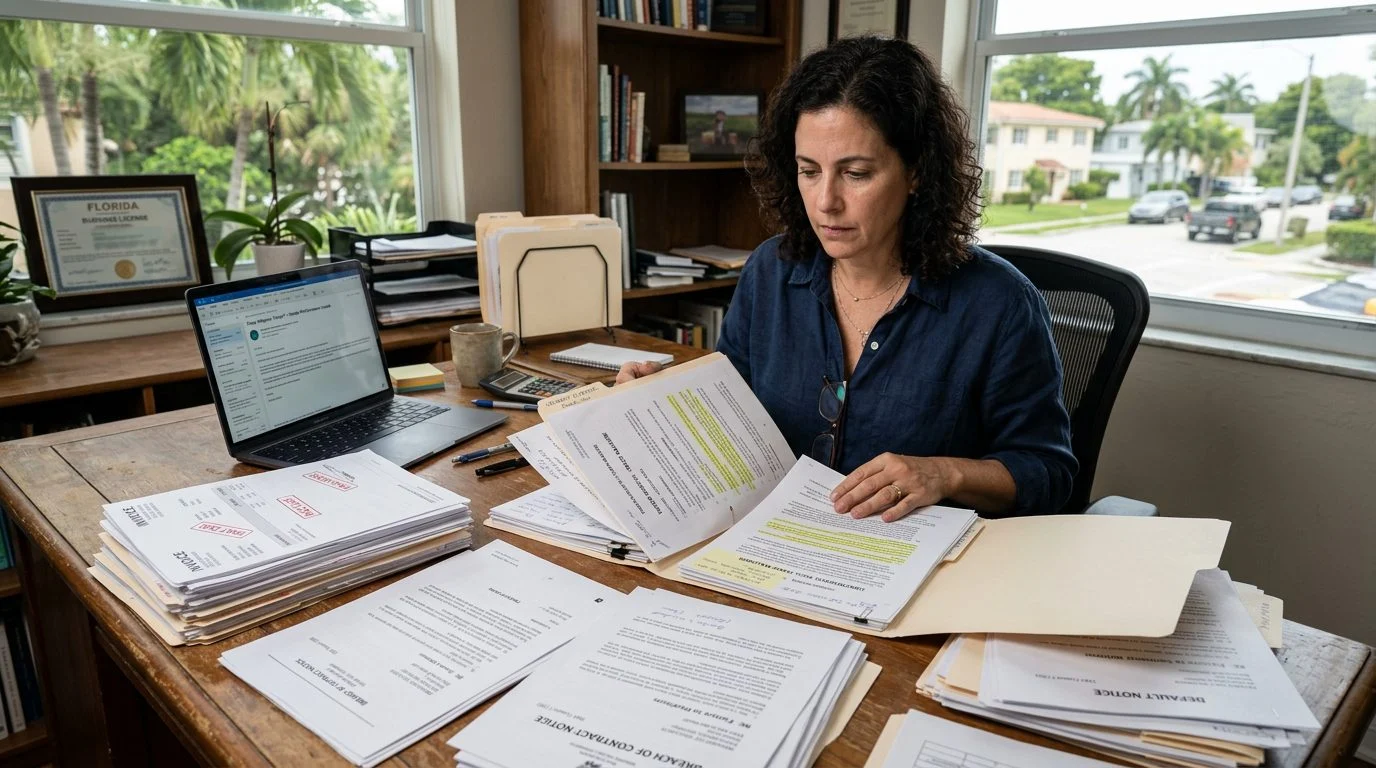
Business Contracts | Coral Gables and Sunny Isles Beach
A Shortage Hit Your Supply Chain. Can Your Vendor Walk Away?
Before you pause payments or take the next step with a supplier, see how your contract's force majeure language is written and what your options look like.
By Kristina E. Wilson · Published November 22, 2026
Your vendor has stopped shipping, and it says a shortage is the reason. You want to know whether the contract lets it stop, or whether you can hold it to the deal.
Sometimes a vendor can stop, but only if the contract’s words reach the shortage and the vendor followed the steps those words require. A force majeure clause is the usual place to look in a vendor contract. This page explains what that clause does and what makes a shortage qualify.
What a Force Majeure Clause Does in a Business Contract
A force majeure clause excuses or pauses a party’s performance when a listed event beyond its control gets in the way. The parties write it into the contract ahead of time to decide who carries certain risks.
The clause is not a general rule that covers every deal. Its reach comes from the parties’ own words. Two contracts in the same industry can treat the same event very differently.
The heading may not say “force majeure.” Look for language about events beyond a party’s control that delay or prevent performance. That language is the clause, even under another label.
In most clauses, the event suspends specific duties while it lasts. It seldom erases the whole contract. You may still owe some things, and the vendor may still owe others. That is why the first step is reading the clause itself, not relying on what the vendor says it means.
If your supplier went quiet after citing a shortage, you don't have to read the contract alone. Talk with our team about your situation. Talk it through with our team — the first consultation is free, confidential, and carries no obligation.

Does a Supply Shortage Qualify?
A supply shortage qualifies only if the clause names it or uses wording broad enough to reach it. A shortage is not covered just because it is inconvenient or unexpected.
Clauses differ a lot. One may list shortages of materials, components, or supplies. Another may list only natural disasters, war, or government action. Under the second kind, the vendor must show that its shortage fits one of those listed events.
A shortage the vendor caused is a separate problem. If it didn’t order in time, didn’t pay its own supplier, or didn’t plan its stock, the event may not be beyond its control. The contract’s wording decides how much that matters.
Ask three questions. Did the clause name shortages? Did the shortage come from something outside the vendor’s control? Could reasonable planning have prevented it? Your answers point you to the language that matters most.
Why the Wording of the Clause Decides the Question
The exact words in the clause decide whether a shortage qualifies. Read the definition, the list of events, any exclusions, and any language about price or cost of supply.
Watch three phrases in particular. “Beyond the reasonable control of the party” asks who had the power to prevent the event. “Prevents or delays performance” asks whether the event stopped the delivery or only slowed it. “Foreseeable” asks whether the shortage was already visible when you signed.
The clause usually ties the excuse to the event. Expect the key question to be whether the shortage actually caused the missed delivery. A tight market in general is a different question.
Past dealings can help explain what the words mean. Florida law treats a course of dealing or usage of trade as relevant to an agreement’s meaning. Under Florida law, if the express terms of an agreement and a course of dealing or usage of trade cannot reasonably be construed as consistent with each other, the express terms prevail.
Pull these items from your contract: the definition, the listed events, the exclusions, the notice terms, and the price language.
Notice and Mitigation Requirements a Vendor Often Must Meet
A vendor that wants the clause’s protection often has to meet its notice steps first. Many clauses require prompt written notice of the event, its expected length, and the steps the vendor is taking.
Florida courts do not favor reading a notice step as a condition that must happen first. As a general rule, conditions precedent are not favored, and courts will not construe provisions to be such, unless required to do so by plain, unambiguous language or by necessary implication (Covelli Family). The contract’s words control.
The idea matters because a condition precedent is an act or event that must occur before a party has a right to immediate performance (Land Co. of Osceola County v. Genesis Concepts). A missed notice step can matter a great deal.
Some clauses also require the vendor to look for other sources or to resume as soon as it can. Read for those words too, and check whether the vendor’s actions match them.
Write down the dates and content of every notice. Note when it arrived, what it said about cause and duration, and whether it offered substitute supply. These details often matter when you test a vendor’s claim.
When the Clause Is Silent: Impossibility and Impracticability
When a contract has no force majeure clause, or its list does not reach the shortage, a vendor may make other arguments. Some vendors argue that performance became impossible or impracticable.
Those arguments rest on the facts, not just on the clause. The outcome turns on how the shortage happened, what alternatives existed, and what the contract says.
If your contract is for goods, Florida’s sales rules in Chapter 672 may give you options that do not depend on a force majeure clause. When reasonable grounds for insecurity arise, you may demand adequate assurance of performance in writing (Fla. Stat. § 672.609). Until you get it, you may suspend any performance for which you have not already received the agreed return, if that is commercially reasonable.
After a justified demand, if the vendor does not give adequate assurance within a reasonable time, no more than 30 days, that failure is a repudiation of the contract (Fla. Stat. § 672.609).
A repudiation can sometimes be taken back. Fla. Stat. § 672.611 reads: “(1) Until the repudiating party’s next performance is due he or she can retract his or her repudiation unless the aggrieved party has since the repudiation canceled or materially changed position or otherwise indicated that he or she considers the repudiation final.”
Why Force Majeure Clauses Are Hard to Draft Well
Clauses are hard to draft because the parties must predict events that haven’t happened yet. They also must decide who carries each risk. Every word then becomes something someone has to interpret later.
Common gaps show up in disputes. Catch-all phrases can be vague. Some clauses have no notice deadline. Others don’t say whether delay or partial performance is excused. Many say nothing about an event that lasts a long time.
These gaps often surface only after a dispute starts. That is why the wording you already signed is the starting point. Don’t rely on memory or on the vendor’s summary of what the contract says.
Our business contract and vendor dispute attorney page covers related vendor contract questions in more detail.
Not sure what your next step is?
Talk it through with our team — the first consultation is free, confidential, and carries no obligation.
What a Vendor Stopping Performance Can Mean for Your Damages
If the vendor’s excuse doesn’t hold, its failure to deliver may be a breach. Your losses then become the basis of a claim, and what you can prove decides how strong that claim is.
To recover damages for an anticipatory breach, you must show that you were able to perform when the breach occurred (Ryan v. Landsource Holding Co.). Keep proof that your side was ready, such as funds for payment, open orders, and purchase records.
Keep these documents: invoices, purchase orders, delivery logs, the vendor’s notices, and records of any substitute supply you bought. They help show what you lost and what you did to limit the loss.
A liquidated damages clause sets a fixed amount for certain breaches. It can change how losses are measured. Whether that clause holds up is a separate question. Our liquidated damages clause article covers it.
Timing matters too. A clause that shortens the time to sue below the period the statute allows is void (Fla. Stat. § 95.03).
Deciding Whether a Breach Claim Is Worth Pursuing
Whether a breach claim is worth pursuing depends on the facts of your contract and your relationship with the vendor. Weigh the size of the loss, the contract’s remedy terms, and whether you still need this vendor.
Also weigh the cost of a dispute and how strong your notice and causation facts are. Each factor can shift the answer.
Fee terms matter. If a contract allows attorney’s fees to a party that must act to enforce it, the court may also allow reasonable fees to the other party when that party prevails. This applies only to contracts entered into on or after October 1, 1988 (Fla. Stat. § 57.105).
Check for an arbitration clause before you file anything. Florida law makes a written agreement to arbitrate valid and enforceable, except on grounds that apply to any contract (Fla. Stat. § 682.02).
Many business owners start with a written demand, a cure notice, or a short interim supply arrangement. Check whether the contract requires a dispute step first. Before you send a demand, confirm the vendor’s exact legal name in the Florida Division of Corporations records.
Frequently Asked Questions
Can a vendor stop delivering because of a shortage?
A vendor may point to the clause when the contract’s words reach the shortage and the vendor meets the clause’s steps. The wording and the facts decide it.
Can I demand written assurance from a supplier?
If your contract is for goods, Florida law lets you demand adequate assurance in writing when you have reasonable grounds for insecurity (Fla. Stat. § 672.609).
Can a contract shorten the time to sue?
A contract clause that sets a shorter period than the statute allows is void (Fla. Stat. § 95.03).
Talk Through Your Vendor Situation with KEW Legal
When a vendor cites a shortage and then goes quiet, the uncertainty can make orders, payroll, and customers harder to manage. That is a hard spot for any business owner.
Bring your contract, every notice from the vendor, and a timeline of expected and missed deliveries. Kristina E. Wilson, the responsible lawyer for this page, can review those with you at the firm’s Coral Gables office. You can also call 305-990-2300 or send us a message.
La consulta inicial es gratuita, confidencial y sin compromiso de continuar. In English, the initial consultation is free, confidential, and carries no obligation to continue.
How KEW Legal Approaches Vendor Disputes
Start With the Contract
We read the force majeure clause word by word, along with the definitions, notice terms, and any related performance provisions.
Test the Facts Against the Wording
We compare what happened, when it happened, and what the vendor did in response against what the clause actually says.
Plan Your Communications
We help you decide what to say to the vendor, in what form, and when, so your position stays clear.
Protect Your Business Interests
We focus on keeping your operations, payments, and remedies in view while the situation is resolved.
Review Before You Act
Do not stop your own performance or withhold payment until you have reviewed the clause's wording and any notice steps with counsel. A decision made too quickly can affect your position.
Questions to Bring to Your Consultation
Does the clause cover this event?
Bring the full contract, including any amendments, purchase orders, and the vendor's written communications.
What notice did the vendor give?
Gather emails, letters, and delivery records so we can review the timing and form of every notice.
What is the impact on my business?
Document lost sales, added costs, and any alternative supply sources you have explored.
What are my next steps?
We discuss options for responding to the vendor, negotiating, or pursuing remedies under your agreement.
Speak With Kristina E. Wilson and Our Team in Coral Gables or Sunny Isles Beach. The First Consultation Is Free, Confidential, and Carries No Obligation to Continue.
Request a Consultation
Fill out the short form and we will take it from there.