
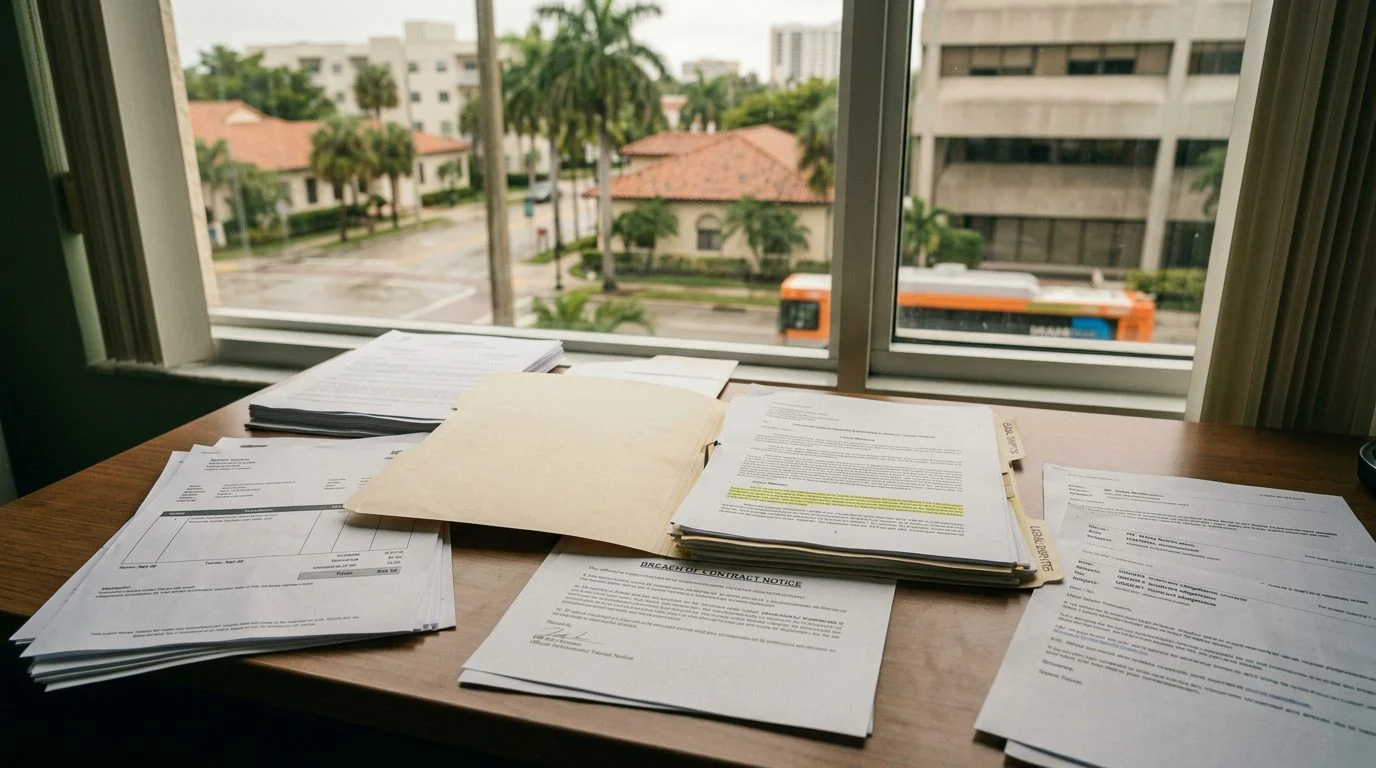
Business Contracts | Coral Gables and Sunny Isles Beach
Does a Hurricane Excuse a Vendor's Delay?
Storm season can stall deliveries, crews, and projects. Learn how to read the force majeure language in your contract before you decide what comes next.
By Kristina E. Wilson · Published November 21, 2026
Your vendor missed a delivery, and a hurricane hit that same week. Can the storm excuse the delay? When a storm delays a vendor’s work, the key question is whether your force majeure clause excuses the delay.
This guide explains how these clauses work in Florida, what to check in your own contract, and where the questions usually get hard. The example is hypothetical.
What a Force Majeure Clause Is
A force majeure clause is a contract term that can excuse or pause a party’s performance when certain events outside its control occur. The parties write it into the agreement. It is not a default rule that applies to every contract.
If it does, the clause’s own words set the limits of the excuse.
Clauses often list events such as hurricanes, floods, fires, government orders, and labor strikes. Others use broad wording or list only a few items. Your contract may list none of these, so read the actual text.
Most clauses excuse delay or non-performance while the event lasts. They do not always end the contract or cancel payment. Some allow termination, while others only suspend the duty.
If your deal is for goods, such as a food supply agreement, Florida’s sales-of-goods rules may apply. Those rules cover transactions in goods, so the type of deal matters.
Not sure what your next step is?
Talk it through with our team — the first consultation is free, confidential, and carries no obligation.
Why Florida Courts Read the Exact Wording
The exact words in your clause carry the most weight. Small differences in wording can change how the excuse works.
Compare two clauses. One lists hurricanes, named storms, and government orders. The other covers “events beyond the reasonable control of the parties.”
The first is narrow, so a storm must fit one of its listed items. The second is broader, but the event still has to fit its general language and cause the delay.
Words like “act of God,” “natural disaster,” “hurricane,” and “storm” are not interchangeable. A clause that names hurricanes gives you a clearer test than one that uses only “act of God.” Read every term, and check the definitions section too, since a defined word can change how the clause works.
A disruption does not excuse every duty under the contract. The excuse reaches only what the wording covers. Duties the clause never mentions usually stay in place.
Does a Hurricane Count, and Did It Cause the Delay?
Start with scope. Does the clause name hurricanes or storms, or does its general language reach them? If not, the storm may not qualify, however severe it was.
Then check causation. A storm that merely hit in the same week is not enough.
Suppose a vendor’s delivery trucks ran on schedule, but its own supplier had been out of stock for weeks before the storm. The storm did not cause that shortage, so the delay may not be excused.
A vendor’s own problems can weaken this argument. Poor planning, an existing shortage, or a failure to try another source can all count against it.
Check the standard too. Some clauses require performance to be impossible. Others reach performance that becomes impracticable or delayed. A vendor that can still deliver at higher cost may not meet a strict impossibility clause. The difference matters, so read the exact wording.
Notice Requirements That Can Decide the Outcome
Many force majeure clauses require written notice within a set number of days after the event. Missing that step can cost the excuse.
Check four points. Who must receive the notice? How must it be delivered, by email, mail, or another method? What must it describe? Must it state how long the delay may last?
Whether a notice step must be completed first depends on the contract’s words. Florida courts do not favor reading a term as a condition precedent. They treat one that way only when plain, unambiguous language or necessary implication requires it. See Covelli Family, L.P. v. ABG5, L.L.C.
Do not plan around that outcome. Your clause’s own wording decides.
Florida’s sales-of-goods rules also set a notice duty. If you accept a delivery that turns out to be defective, you must notify the seller of the breach within a reasonable time after you discover it or should have discovered it. Otherwise you may be barred from any remedy. See Fla. Stat. § 672.607
Keep dated copies of every message about the storm, the delay, and any new delivery date.
Supply-Chain Disruptions and Labor Shortages
A supply-chain delay is excused only if your clause reaches it. Look for language about shortages, transportation problems, or a failed supplier.
Be careful with broad phrases. A clause that lists “acts of God” may not automatically include a vendor’s shortage of materials or staff.
The key question is whether the covered event caused the shortage. Two points often decide it. First, was the supplier’s problem itself caused by a covered event? Second, could the vendor reasonably have bought the goods elsewhere under the contract?
Some clauses cover a “failure of a supplier,” but only for suppliers that are not the vendor’s own affiliates or sole-source providers. Check the definitions.
Florida’s sales-of-goods rules offer another tool. When reasonable grounds for insecurity arise, you may demand adequate assurance of performance in writing. Until you get it, you may, if commercially reasonable, suspend your own performance for which you have not received the agreed return. See Fla. Stat. § 672.609
If the vendor fails to give adequate assurance within a reasonable time after a justified demand, that failure is a repudiation of the contract. The statute caps that reasonable time at 30 days. Between merchants, the reasonableness of grounds for insecurity and the adequacy of any assurance offered are determined according to commercial standards.
An Example of a Vendor Delivery Claim
In a hypothetical case like this one, the outcome turns on the clause, the storm’s effect on delivery, and the notice record.
Imagine a restaurant owner in Miami-Dade County and a food distributor with a written supply agreement. The clause lists hurricanes and government orders. It requires written notice within fourteen days after the event begins.
A weekly delivery falls during the week a storm makes landfall. Roads close, and an evacuation order is issued. The distributor does not deliver that week. It sends a notice nine days later, with a new delivery date.
A court would ask four questions. Does the hurricane fall within the clause? Did it actually prevent delivery? Was the notice timely? Did the distributor keep performing where it could, such as shipping a partial order from another warehouse?
Change one fact, and the answer can change. A notice sent on day twenty may fail under this wording. A distributor that could have shipped from another warehouse may have a harder time explaining the miss. The same facts under different wording could lead to a different result. This example is invented for illustration only.
Not sure what your next step is?
Talk it through with our team — the first consultation is free, confidential, and carries no obligation.
Related Remedies and Contract Terms to Review
Start by reading the force majeure, notice, termination, and payment terms in your own contract.
Look at the termination language. Can you end the deal if the delay runs long? Does the payment term let you hold money for goods you never received? These terms can matter as much as the excuse itself.
Check the attorney-fee provision too. A prevailing-party clause can affect who pays legal costs in a dispute, so read how it works before you act.
A smaller dispute may fit Florida’s small claims process, and the contract terms above still shape it.
For the wider range of contract issues we handle, see our business contract and vendor dispute services page.
Talk With KEW Legal About Your Vendor Delay
A storm excuse is tested against the actual clause and the notice record, so start there.
Picture this: your supplier missed a delivery after a hurricane, and now it says the contract excuses the delay. You need to know whether the clause covers the storm. You also need to know what you must do on your side to protect your rights. A short review of your contract can show which deadlines and steps apply to you now.
Contact KEW Legal’s Coral Gables office by calling 305-990-2300 or by sending a message through our contact form. Kristina E. Wilson, one of the firm’s lawyers, is responsible for this page.
The initial consultation is free, confidential, and carries no obligation to continue.
What to review in your contract
Which events are named
Check whether the clause lists storms, hurricanes, or similar weather events, and whether it covers the vendor's own supply chain or staffing problems.
How notice is given
Review what the clause requires a party to send, to whom, and in what form. Notice language often matters as much as the event itself.
What records you keep
Save the vendor's communications, delivery schedules, weather-related updates, and any changes to the work plan so the timeline is easy to reconstruct.
How the delay affects the rest of the deal
Look at payment terms, completion dates, and remedies for late performance, since a delay can touch several parts of the agreement at once.
Read the exact wording first
Do not rely on a storm as an excuse for delay, and do not accept one from a vendor, until you have read the full clause. Whether it applies depends on the words in your contract and the facts of the delay.
How KEW Legal supports business owners
Contract review
We review commercial agreements and vendor terms, including force majeure, notice, and remedy provisions.
Vendor dispute handling
We address delays, nonperformance, and disputed claims with business owners across Miami-Dade and Broward County.
Outside general counsel
We serve as ongoing legal counsel for business owners and investors who need advice before problems escalate.
Clear next steps
We explain your options in plain language so you can decide how to respond to the vendor and protect your project.
Facing a vendor delay? Start with a free, confidential consultation, with no obligation to continue.
Related practice areas
Request a Consultation
Fill out the short form and we will take it from there.