
Business Contract & Vendor Disputes | Coral Gables and Sunny Isles Beach
Enforce Your Business Contract With a Florida Attorney Who Knows Commercial Deals
KEW Legal helps business owners and investors across Miami-Dade and Broward County enforce agreements with vendors, partners and customers. Call 305-990-2300 or schedule a free, confidential first consultation with no obligation to continue.
By Kristina E. Wilson · Published October 25, 2026
To enforce a business contract in Florida, you can ask a court for money damages. You can also ask it to order the other side to do what the agreement requires. The right path depends on the contract’s terms, the harm you face, and how fast you need action.
KEW Legal is a Florida business law firm that acts as outside general counsel for business owners and investors across Miami-Dade and South Florida. This page explains your options, the steps involved, and the contract terms that shape the outcome.
What Enforcing a Business Contract Means in Florida
Enforcing a contract means making the other side perform what it promised. It can also mean making it pay for the harm when it doesn’t. Collecting money is only one form of enforcement. Sometimes you need the delivery, the signed transfer, or the access the deal promised.
Common situations include:
- A vendor that stopped delivering materials or services on schedule
- A partner who ignores the operating or buy-sell agreement
- A tenant or other counterparty who skips key terms and stalls the deal
This page is written for owners, managers, and investors in Miami-Dade and Broward whose business depends on the other side doing what the contract says.
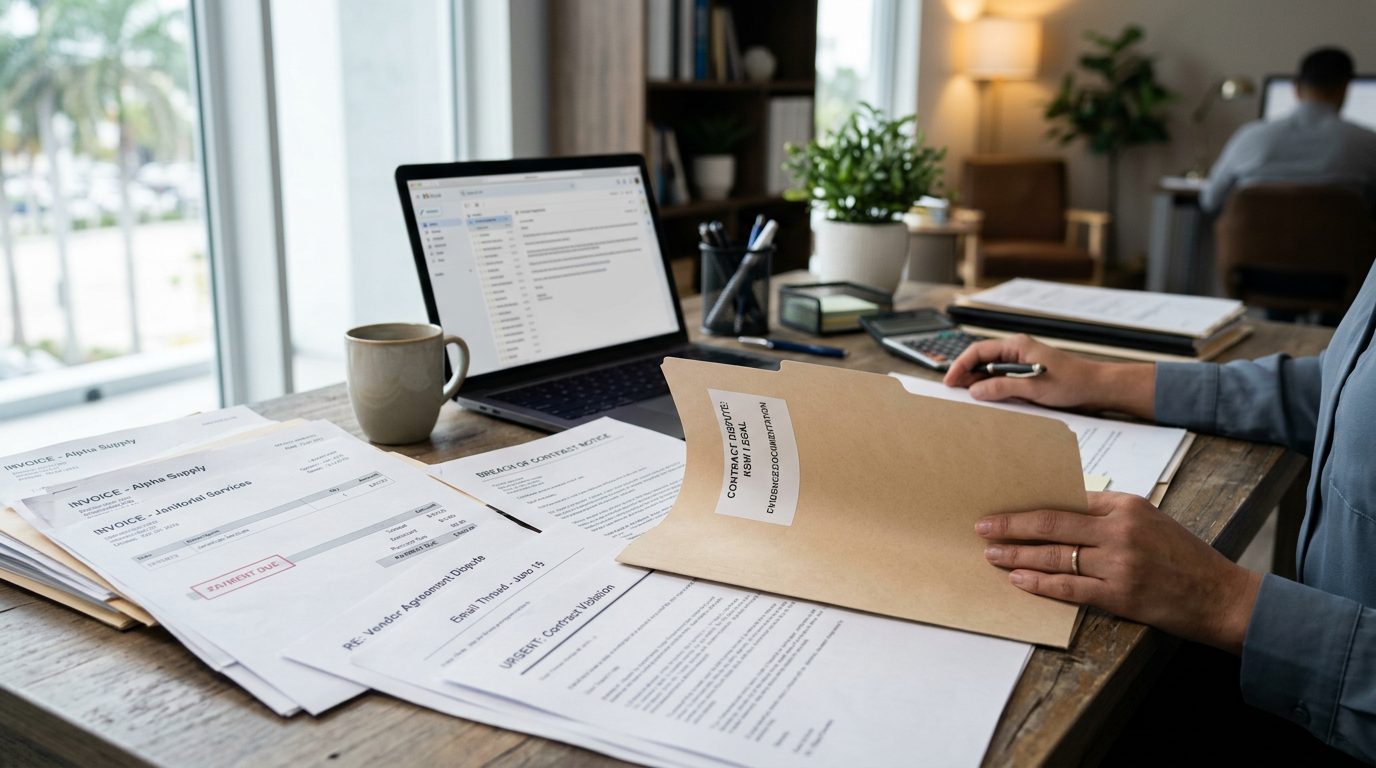
Oral deals raise a different question. Whether an oral agreement can be enforced depends on the facts and on what you can prove. Emails, texts, invoices, and payment records often decide how strong the claim is.
If a vendor or partner has stopped doing what your agreement requires, you may have a claim worth reviewing, and our team can look at it with you. Talk it through with our team — the first consultation is free, confidential, and carries no obligation.

When a Florida Court Can Order a Party to Perform
A Florida court can order a party to carry out a contract in some cases, but it is not automatic. This remedy is called specific performance. The court directs the breaching party to do what it promised, instead of only paying damages.
No lawyer can promise how a court will rule in any particular case.
A temporary injunction is a separate tool. The party asking must meet the court’s standard.
The contract’s own remedy and fee terms can shape which path makes sense, so we read them first.
What Our Contract Enforcement Work Covers
Our contract enforcement work starts with a review of the agreement. Then we move to the steps that fit the facts. We handle:
- Contract review: finding the main obligations, notice and cure terms, dispute resolution clauses, and attorney fee provisions
- Demand letters: formal notice of the breach, the performance required, and the deadline to cure
- Negotiated resolution: settlement terms, payment schedules, and written agreements that end the dispute
- Mediation: pre-suit or court-ordered mediation when the contract or the court requires it
- Litigation: filing breach of contract, specific performance, and temporary injunction claims in Florida state court, including discovery and hearings
Timing matters. Florida sets time limits for suing on contracts, and the limits differ for written and oral agreements. We check the start date of your claim at intake. A contract clause cannot shorten that time below what the statute allows. Under Florida’s contract shortening statute, such a provision is void.
How the Enforcement Process Works, Step by Step
Enforcement usually moves from review, to a written demand, to negotiation. Court comes only if the matter stays unresolved. Here is the typical sequence.
- Initial consultation. You share the agreement, the correspondence, and what you need the other side to do.
- Document review. We review the contract and write an assessment of the claim, the remedies available, and the evidence still needed.
- Notice and demand. A written notice names the breach and sets a cure deadline. Some disputes end here, but many do not.
- Negotiation or mediation. If a mediation clause applies, the parties follow it. Under the Florida mediation statute, a court must refer a filed damages case to mediation when one party asks, provided the requesting party is willing and able to pay the mediation costs or the costs can be equitably divided between the parties. There are exceptions, including landlord-tenant disputes without a personal injury claim, actions filed to collect a debt, small claims, and cases where the parties agreed to binding arbitration. Fla. Stat. § 44.102(2)(a) requires a court, on one party’s request, to refer a filed civil action for monetary damages to mediation if the costs can be paid or equitably divided. This does not apply to certain actions, including landlord-tenant disputes without a personal injury claim, debt collection actions, small claims, and cases the parties agreed to submit to binding arbitration.
- Filing. If the dispute continues, we file the complaint and any motion for a temporary injunction. Then come service, responses, and discovery.
- Hearings and trial. The timeline depends on the court’s calendar and how contested the facts are.
You make the decisions at each step. We report costs and options before major steps.
Why Business Owners Work With KEW Legal
KEW Legal is a Florida business law firm that works as outside general counsel for business owners and investors. We focus our practice on business matters across Miami-Dade and South Florida. That includes partnership disputes, vendor disputes, employment issues, leases, and business sales.
We have offices in Coral Gables and Sunny Isles Beach. We serve clients in Miami, Aventura, Doral, Brickell, Fort Lauderdale, and Broward County.
Kristina E. Wilson is the responsible lawyer for this page. Natalie Martinez is also a lawyer at the firm. Our lawyers work together on partnership, vendor, employment, lease, and acquisition matters.
The outside general counsel model helps here. The team that reviews your contract at the start can also handle the lease, employment, or succession questions that often follow a dispute. The facts stay in one place.
If a matter falls outside our practice areas or needs a lawyer licensed elsewhere, we will say so. We may refer it to another lawyer or firm.
Common Questions Before You Enforce a Business Contract
Most owners ask whether a court can order performance, how long they have to act, and who pays fees. Here are short answers.
Can a court make my vendor perform?
Sometimes. Whether it makes sense to ask a court to require the other side to go through with the deal depends on the facts of your situation, which is something our lawyers can review with you.
How long do I have to sue?
Florida sets time limits by statute, and they differ for written and oral deals. We check the start date at intake. See the Florida limitations statute.
Does the losing side pay the winner’s fees?
Not automatically. Under the Florida attorney fee statute, a court may allow fees to the other party when it prevails on a contract with a fee clause.
Can I stop a vendor from walking away mid-project?
The answer depends on the facts of your contract and situation.
Are settlement offers usable in court?
Under the Florida settlement evidence statute, offers to compromise a disputed claim, as well as relevant conduct or statements made in negotiations about a compromise, are not admissible to prove liability or absence of liability for the claim or its value.
Where do I file?
Under the Florida venue statute, a case goes in the county where the defendant resides, where the claim arose, or where the property is located. Out-of-state parties need a separate review. A party that breaches a contract by failing to perform acts the contract requires to be performed in Florida can be sued here, for claims arising from that breach, under the Florida long-arm statute.
Not sure what your next step is?
Talk it through with our team — the first consultation is free, confidential, and carries no obligation.

Talk to KEW Legal About Your Agreement
Our initial consultation is free, confidential, and carries no obligation to continue.
If a vendor has gone quiet on a deal your business depends on, or a partner keeps ignoring the agreement, you may have a claim worth reviewing. You don’t have to sort out the contract alone. Call 305-990-2300 or send us a message.
How We Approach a Contract Dispute
Review the Agreement First
We read the contract, amendments, purchase orders, invoices and correspondence together to understand what was promised and what was actually done.
Weigh Your Options Practically
Demand letters, negotiation, mediation, or litigation each carry different costs and risks. We explain the choices so you can decide what fits your business.
Clear, Regular Communication
You receive plain-language updates on where the dispute stands and what happens next, so you are never left guessing about your position.
Protecting Your Business Relationships
Our goal is to resolve the problem in a way that keeps your operations moving, whether that means recovering payment, enforcing terms or ending the arrangement cleanly.
Act Before the Problem Grows
Do not ignore a breach, a missed delivery or an unpaid invoice, and avoid signing anything new with the other side until you understand your rights under the existing contract. Early review often leads to more options.
Contract and Vendor Disputes We Handle
Breach of Contract
When a vendor, partner or customer fails to perform as the agreement requires, we evaluate the breach and the remedies available under your contract.
Unpaid Invoices and Payment Disputes
We review payment terms, delivery records and communications to pursue amounts owed to your business.
Service and Supply Failures
Late, defective or incomplete deliveries can disrupt your operations. We help you address nonconforming performance and document your losses.
Demand Letters and Negotiation
Many disputes are resolved through a firm, well-drafted demand. We prepare and send correspondence that puts your position clearly on record.
Talk With KEW Legal About Your Contract
Related practice areas
- Business Contract And Vendor Dispute Attorney
- Independent Contractor Classification Review Florida
Request a Consultation
Fill out the short form and we will take it from there.