
To start a business in Florida, file Articles of Organization on Sunbiz for a Florida LLC, get an EIN, register with the Department of Revenue, add a local business tax receipt, and calendar the May 1 annual report. A missed filing or the wrong entity rarely shows at formation. It surfaces later, as a late fee or a tax bill.
KEW Legal® handles these filings for founders across Miami-Dade. You send names, owner details and addresses.
How Do You Start A Business In Florida?
You start a business in Florida in seven steps, and the order is fixed because each step needs the one before it. Skipping ahead creates rework, such as an EIN issued to a name that Sunbiz later rejects.
1. Name check: search Sunbiz and confirm the name is distinguishable from existing records.
2. Articles of Organization: file on Sunbiz with a registered agent at a Florida street address (Fla. Stat. 605.0113). Online filings are typically processed within a few business days, and the Articles can carry a delayed effective date of up to 90 days (605.0206).
3. Operating agreement: the members sign it, and it is never filed with the state. A one-owner Florida LLC needs one too.
4. EIN: apply with the IRS once the entity exists. The online application issues the number immediately for applicants with an SSN or ITIN.
5. Department of Revenue: file Form DR-1 for sales tax and open a reemployment tax account. Both ask for the EIN.
6. Local approvals: obtain the local business tax receipt and the certificate of use or zoning approval before opening.
7. Bank account: open it last, because the bank asks for the EIN and the filed Articles.
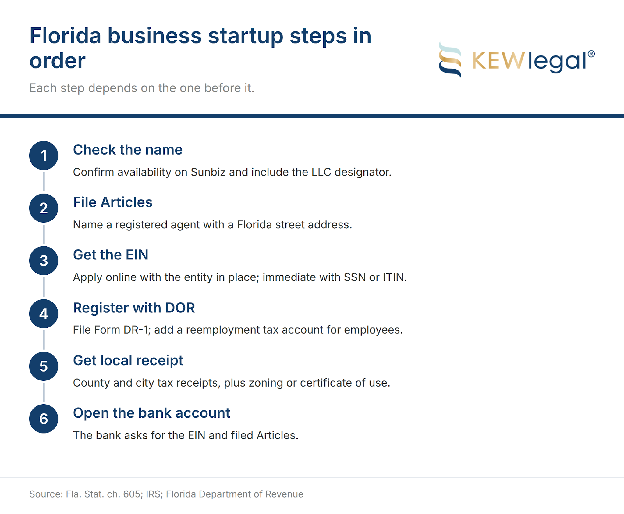
Figure 1: File the entity first; the EIN, tax registration and bank account all depend on it. Source: Fla. Stat. ch. 605; IRS; Florida Department of Revenue.
Two steps cannot move earlier. The EIN needs the entity, and the bank needs both the EIN and the Articles. When a launch date depends on how long LLC formation takes, the delayed effective date lets you file now and start the entity on a chosen day.
Which Florida Entity Should You Choose?
A Florida LLC fits most owner-run startups, because pass-through taxation means no Florida corporate income tax. A C-corp owes 5.5% on taxable income above a $50,000 exemption under Fla. Stat. ch. 220.
A C-corp, or an LLC electing C-corp status, with $200,000 of taxable income owes (200,000 − 50,000) × 5.5% = $8,250. A Florida LLC taxed as a sole proprietorship or partnership, or an S corporation, generally owes none of it.
The decision rule has three steps, and our guide to comparing business structures goes deeper:
1. Default: form a Florida LLC.
2. S election: elect S status when salary and distribution planning saves more in payroll tax than running payroll costs.
3. C-corp: choose it when outside investors or multiple classes of stock require it.
Sole proprietorships and general partnerships need no Sunbiz entity filing, but neither shields the owner from business debts.
What Does A New Florida Business Owe?
A Miami-Dade Florida LLC formed in 2027 owes $125 to Sunbiz, $0 for the EIN and DR-1, a local business tax receipt that varies by city and category, and a $138.75 annual report. The annual report falls due in the year after formation.
The year-one calendar for a Florida LLC formed in March 2027 has five dates:
- March 2027: file Articles of Organization on Sunbiz ($125), then get the EIN ($0) and file DR-1 ($0).
- Before opening: obtain the Miami-Dade County and city local business tax receipts (fees vary by city and category).
- October 1, 2027: the local business tax receipts renew.
- January 1 to May 1, 2028: file the first annual report ($138.75).
- After May 1, 2028: the $400 late fee attaches.
How Much Do Sunbiz Filings Cost?
Sunbiz filings cost $125 to form a Florida LLC ($100 filing plus $25 registered agent designation) and $138.75 for each annual report. A corporation pays about $70 to file and $150 for the annual report.
A report filed after May 1 adds a $400 late fee, which takes the LLC’s bill that year to $538.75.
A fictitious name registration is a separate $50 filing, valid for five years. These figures follow the Sunbiz fee schedule in effect at publication.
What Taxes Apply To Startups?
Three Florida taxes can apply to startups, and personal income tax is not one of them, because Florida has none. A new business registers on Form DR-1 for sales tax and opens a reemployment tax account once it has employees.
- Sales tax (ch. 212): 6% state rate plus the county surtax, registered on DR-1.
- Reemployment tax (ch. 443): new employers pay 2.7% on the first $7,000 of each employee’s wages.
- Corporate income tax (ch. 220): applies only to C-corps and entities taxed as corporations, as in the $8,250 example above.
Florida repealed its sales tax on commercial rent effective October 1, 2025. Older guides still list it.
Which Licenses Does A Florida Business Need?
A Florida business needs no general state business license, but nearly every business needs a local business tax receipt. Regulated trades and professions add state licenses.
Run five checks:
1. State level: Florida has no general business license.
2. Local business tax receipt: issued by the county and the city under Fla. Stat. ch. 205.
3. Regulated activity: DBPR or another agency licenses contractors, real estate and alcohol.
4. Licensed profession: the entity must be a PLLC or professional corporation.
5. Home-based: Fla. Stat. 559.955 limits local regulation of qualifying businesses.
How Does The Local Tax Receipt Work?
The local business tax receipt is a tax under Fla. Stat. ch. 205, not a regulatory license. The county and the city each issue one, and both renew annually on the October 1 cycle.
A business in Miami pays Miami-Dade County and the City of Miami. A business in Coral Gables or Sunny Isles Beach pays the county and its own city. Fees vary by city and business category.
Before the receipt issues, the city checks zoning or a certificate of use for the location. The receipt never covers alcohol sales, so a bar or restaurant also confirms when a liquor license applies.
Who Needs DBPR Or PLLC Licensing?
DBPR or PLLC licensing applies to four groups. Contractors, real estate brokers and alcohol sellers need state licenses, and licensed professionals must form a PLLC or professional corporation under ch. 621.
- Contractors: ch. 489, licensed through DBPR.
- Real estate brokers: ch. 475, licensed through DBPR.
- Alcohol sellers: ch. 561, licensed through DBPR’s Division of Alcoholic Beverages and Tobacco.
- Licensed professionals: ch. 621 and the professional-services provisions of ch. 605.
Law, medicine and accounting are the standard ch. 621 examples. A plain Florida LLC is the wrong vehicle for them.
Do Home Businesses Need Licenses?
Yes, home businesses usually need a local business tax receipt, but Fla. Stat. 559.955 limits how local governments may regulate qualifying home-based businesses. To qualify, the business must meet the statute’s conditions on employees, parking and residential appearance.
The city still checks zoning or a certificate of use before the receipt issues. Each city applies its home business zoning rules within the statute’s limits.
What Happens If You Miss The Annual Report?
If you miss the annual report, a $400 late fee attaches after May 1, and Sunbiz administratively dissolves the entity later in the year if it remains unfiled. LLCs fall under Fla. Stat. 605.0713 and corporations under ch. 607.
1. January 1 to May 1: the report window.
2. After May 1: the $400 late fee attaches.
3. Later in the year: administrative dissolution if still unfiled.
4. Reinstatement: filed under 605.0714 with every back-year report and fee.
Dissolution means the entity loses its active status, and its name can be taken by others. Lenders and title companies check active status before a closing.
We reinstate the entity, then set a January 1 calendar entry so the gap does not recur.
Can Creditors Foreclose A Florida Single-Member LLC?
Yes, creditors can foreclose a Florida single-member LLC interest under Olmstead v. FTC, 44 So. 3d 76 (Fla. 2010), and Fla. Stat. 605.0503. Against a multi-member LLC interest, the charging order is the exclusive remedy.
A charging order (a court order diverting the member’s distributions to the creditor) leaves the creditor waiting for payouts. Foreclosure transfers the interest itself. Under 605.0503, a court orders it for a single-member LLC when the charging order will not satisfy the judgment within a reasonable time.
A one-owner LLC still shields personal assets from business debts. It protects the business interest less against the owner’s personal creditors.
The workable path is a real second member with a genuine stake, with drafting the operating agreement to reflect that ownership. A token member added only for protection invites a court to look past the arrangement. Florida has no series LLC statute, so that structure is not an option here.
Which Florida LLC Mistakes Cost The Most?
Five Florida LLC mistakes cost the most, and each has a concrete consequence.
1. Unregistered DBA: under Fla. Stat. 865.09, the business cannot sue in Florida courts until it registers the fictitious name.
2. Missing designator: Sunbiz rejects a name without “LLC,” “L.L.C.” or “Limited Liability Company,” and dropping it from contracts blurs who signed.
3. Out-of-state agent address: Sunbiz rejects a registered agent without a Florida street address, and a P.O. box does not qualify.
4. Commingled funds: personal and business money in one account weakens the liability shield.
5. Assuming BOI applies: FinCEN’s March 2025 interim final rule exempts domestic U.S. companies, so a Florida LLC files nothing. Only foreign reporting companies file.
How Do Foreign Founders Get A Florida EIN?
Foreign founders get a Florida EIN by filing IRS Form SS-4 by fax or phone, naming the Florida entity as the applicant. No SSN is needed, and the EIN costs $0.
The EIN opens the bank account, DR-1 registration and payroll. A Florida LLC with foreign owners is still a domestic company, so it falls within the BOI exemption.
For international founders, we prepare the SS-4 and handle the IRS contact. You send passport details, each owner’s name and address, and the entity’s Florida address.
Frequently Asked Questions
What Are The Four LLC Types?
The four types usually listed are single-member, multi-member, professional and series, a list that mixes legal forms with ownership counts. Florida recognizes the standard LLC and the PLLC, and it has no series LLC statute. Tax classification is separate: disregarded entity, partnership, S corporation or C corporation.
How To Register A Small Business?
A sole proprietor registers a small business in Florida without filing Articles. Get a local business tax receipt, register on DR-1 if you sell taxable goods, and file a fictitious name under 865.09 if you trade under any name other than your own. Liability protection requires a Florida LLC.
Have KEW Legal® File And Calendar Your Entity
We form the entity, draft the operating agreement, obtain the EIN and calendar the May 1 annual report. You send owner names, addresses and ID details.
We send back filed Articles and your EIN. Our attorneys are admitted to the bars of Florida, New York and Washington, D.C.
Send the entity name and owner details to start forming your entity. This post is general information, not legal advice, and reading it does not create an attorney-client relationship.