
Florida Amendment 3 (2026) helps investors through the non-homestead assessment cap, which drops from 10% to 5% on non-school taxes, not through the non-school homestead exemption. The amendment changes Article VII, Section 4 of the Florida Constitution, and coverage places the first affected cycle in the 2027 tax year. If you are buying an investment property this year, confirm both points against the final ballot text.
Most published savings estimates skip LLC ownership, lease pass-throughs and the buyer’s reset tax. Those three decide what you keep, and they are where our real estate team at KEW Legal® starts every review.
What Does Amendment 3 Change For Investors?
Amendment 3 raises the non-school homestead exemption and lowers the non-homestead assessment cap from 10% to 5%. Only the cap applies to investment property. School taxes sit outside both changes.
According to Jacksonville Today (October 20, 2026), the Florida Legislature voted in a June special session to put the amendment on the ballot. It raises the homestead exemption for all non-school taxes to $150,000 in 2027 and $250,000 in 2028, with inflation adjustments after 2028. That exemption reaches homestead property only.
Jacksonville Today also reported that Amendment 3 needed 60% of the vote to pass. Early returns showed it passing on November 3, 2026, and the state certifies results after the election.
Three terms matter, because the cap limits assessed value:
- Just value: the property appraiser’s estimate of what the property would sell for on January 1.
- Assessed value: just value after any cap is applied.
- Taxable value: assessed value minus exemptions, the number millage is charged against.
Which Properties Get The 5% Cap?
Four classes of investment property get the 5% cap, on non-school levies only. They are non-homestead residential of 9 or fewer units (s. 193.1554, Fla. Stat.), residential of 10 or more units and non-residential property (s. 193.1555), rented condo units, and vacant land.
Condo units follow their use. A unit you live in as your homestead keeps Save Our Homes.
A rented unit takes the non-homestead cap, whatever the condo unit ownership documents say about the building. Save Our Homes portability is a separate homestead benefit and has nothing to do with the investor cap.
| Class | Exemption | Cap | School taxes | LLC |
|---|---|---|---|---|
| Homestead | Yes, larger | 3% or CPI | Still taxed | Cannot qualify |
| Non-homestead, 9 or fewer units | No | 5% non-school | Just value | Can hold title |
| 10+ units and commercial | No | 5% non-school | Just value | Can hold title |
Figure 1: Investment property gets the lower cap, not the homestead exemption. Source: Fla. Const. art. VII, s. 4; ss. 193.1554, 193.1555, Fla. Stat.
Do Rentals And LLCs Qualify For Homestead?
No. The owner must hold title and live in the home on January 1, and an LLC generally cannot meet that test. Rentals and second homes get no exemption.
Certain trusts can qualify where the resident holds the beneficial interest. An LLC cannot, so check how entities hold title before you move a home into one. Deeding a homesteaded home to an LLC, or renting it out, can end homestead.
The application is due March 1 with the county property appraiser. You will see “close by December 31, 2026” as shorthand, but the real test is ownership and residence on January 1, 2027.
Homestead does not remove school taxes either. Florida TaxWatch notes, as reported by Jacksonville Today, that homesteaded owners will still pay school property taxes under Amendment 3.
How Much Does The Cap Save In Miami-Dade?
The 5% cap saves about $2,719 over three years in our Miami-Dade example, even with a flat market. The cap slows how fast assessed value catches up to just value, so any existing gap produces savings.
Assume a just value of $1,000,000 that never moves, an assessed value of $700,000, and 11.74 non-school mills. The millage is illustrative. Your TRIM notice shows your actual rate.
1. Year 1: the 10% cap lifts assessed value to $770,000, the 5% cap to $735,000, saving about $411.
2. Year 2: $847,000 against $771,750, saving about $883.
3. Year 3: $931,700 against $810,337.50, saving about $1,425.
The claim that the cap does nothing in a flat market is wrong. The saving comes from the $300,000 gap, not from price growth.
Can County Millage Increases Erase The Savings?
Yes. Local governments set millage each year, and a rise of about 4.8% wipes out the year-1 saving in our example.
At the 10% cap, the year-1 non-school bill is about $9,040 ($770,000 x 11.74 / 1,000). At the 5% cap, it is about $8,629. If millage moves from 11.74 to about 12.30, the $411 is gone.
Budget pressure makes that move realistic. According to Jacksonville Today, Florida TaxWatch projects Amendment 3 would cut local property taxes by $45.8 billion over five years. Local governments could lose $4.9 billion in year one, and TaxWatch cites the Revenue Estimating Conference saying that could reach $11.8 billion by fiscal year 2031-32.
Read your TRIM notice (s. 200.065) for two figures: the proposed millage and the rolled-back rate, which is the rate that would raise the same revenue as last year. A proposed rate above it is a tax increase, and the notice lists the hearing date to object.
What Dates Matter For The 2027 Tax Cycle?
Six dates drive the 2027 tax cycle, starting January 1, 2027 and ending April 1, 2028. Confirm each against the implementing language once it is published.
1. January 1, 2027: status date for assessment and homestead (owned and residing).
2. March 1, 2027: homestead application deadline.
3. Mid-August 2027: TRIM notice with proposed millage.
4. 25 days after the TRIM mailing: Value Adjustment Board petition deadline (s. 194.011).
5. November 2027: bills issue, with a 4% discount if paid in November.
6. April 1, 2028: unpaid bills become delinquent.
What Resets The Non-Homestead Assessment Cap?
A change of ownership or control resets the cap, and assessed value jumps to just value. For entities, that includes a cumulative transfer of more than 50% of the interests. A reset erases every dollar of accumulated cap savings.
Miami investors who hold property in LLCs hit this when they move a building between entities, admit a new member or buy out a partner. The transfer looks internal. The property appraiser treats it as a sale.
Which Transfers Trigger A Reset?
Three transfers trigger a reset under ss. 193.1554 and 193.1555, Fla. Stat.:
- Deed sale: reset, as a transfer of legal or beneficial title.
- Foreclosure: reset, as a transfer of title.
- Transfer of more than 50% of LLC interests, counted cumulatively: reset, as a change of control.
Two exceptions apply under the current statutes:
- Certain transfers between spouses: no reset.
- Transfers that do not change beneficial ownership or control: no reset.
Both exceptions stay unsettled for 2027 until the implementing language is read alongside the new 5% figure. Review your operating agreement terms on transfers and new members before any membership change. We sequence the entity change and the property review together, so the cap is checked before you sign.
How Should Buyers Underwrite The Reset?
Underwrite the reset tax, not the seller’s bill. In our example, the seller’s year-3 non-school bill at the 5% cap is about $9,513 ($810,337.50 x 11.74 / 1,000). Your bill after the reset, at $1,000,000 just value, is about $11,740.
That is a gap of about $2,227 per year before school taxes. A 5% cap leaves a wider gap between assessed value and just value, so the pro forma error grows after Amendment 3. Ask the seller’s broker for the just value, not the current bill.
Who Keeps The Savings Under Commercial Leases?
The lease decides. Under NNN or escalation clauses, tenants usually get the savings through lower pass-throughs. Under gross leases, the landlord keeps them.
How lease types allocate taxes sets your starting point. Before the November 2027 bills, check four clauses: tax pass-through language, base-year or escalation terms, who may contest assessments, and who keeps tax savings. Fix any gaps at renewal with a commercial lease review.
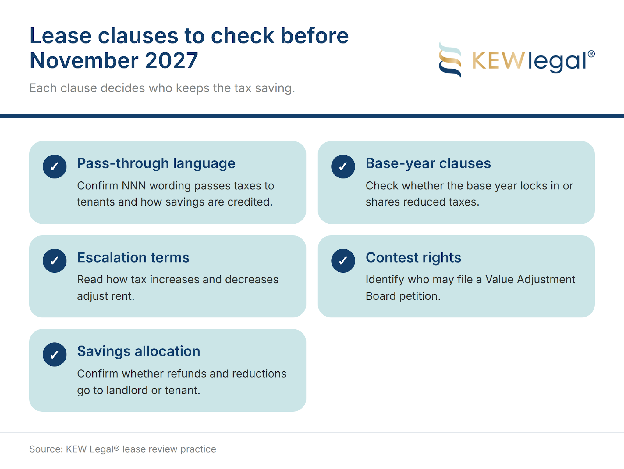
Figure 2: Four clauses decide whether the landlord or tenant keeps the saving. Source: KEW Legal® lease review practice.
Frequently Asked Questions
Should You Convert Rental To Homestead?
It can work, if you own and live in the home on January 1 and file by March 1. Homestead brings the larger non-school homestead exemption and the Save Our Homes cap, but it ends rental use. Run both bills before you decide.
Does Save Our Homes Portability Apply?
Yes. Portability lets a homestead owner carry the assessment difference to a new homestead. It is separate from the non-homestead cap and does not transfer to rental property.
Schedule A Review Before The 2027 Tax Cycle
Schedule a review of each property before the 2027 tax cycle, and send your latest tax bill, entity documents and leases. Our team maps each one by property class, owner entity, reset risk and lease pass-through. Founder Kristina E. Wilson previously served as Associate/Deputy General Counsel at Trump Dezer Development, so we read entity and title changes from the developer’s side of the table.
Schedule a consultation about a real estate closing review before your next purchase or membership change. This content is general information, not legal advice, and it does not create an attorney-client relationship.