
You sell commercial property in Florida by signing a seller-protective commercial purchase and sale contract, delivering due diligence documents on a fixed clock, and closing with tax costs priced in advance. KEW Legal® acts as seller-side sale counsel from letter of intent through closing, the day the deed and money change hands. A closing date 12 days out leaves little room for a title problem, so we start title review, the check of the ownership record the buyer will insure, the day the contract is signed.
Documentary stamp tax on a $5,000,000 Miami-Dade commercial deed is $52,500. The sections below follow deal order: contract, due diligence, closing costs, federal tax, then foreign-seller and entity-sale cases.
What Goes In A Florida Commercial Contract?
A Florida commercial purchase and sale contract must fix six terms: price, deposit, inspection period, closing date, default remedies and as-is language. The Florida Realtors/Florida Bar commercial contract form is the usual starting point.
It is separate from the residential FR/BAR contract and is built to be rewritten, so the seller’s draft should carry the rewrites. Name the broker and the commission terms, because an unpaid commission becomes a lien risk at closing. Deposit timing, default remedies and as-is language carry most of the seller’s risk.
Deposit And Inspection Period Terms
The buyer’s deposit becomes non-refundable when the inspection period ends. Until then the buyer can cancel and recover it, so the length of that window is your main exposure.
An escrow agent holds the deposit. State the exact date and hour the inspection period expires, for example 5:00 p.m. Eastern on a named day.
Allow extensions only for defined events, such as late estoppels, and tie closing to a fixed calendar date. Give any financing contingency its own deadline.
Default Remedies Decide What You Keep
If the buyer defaults, the seller keeps the deposit as liquidated damages or pursues specific performance or actual damages, depending on the remedy the contract names. Pick one on purpose.
Deposit-only is fast and certain. Specific performance keeps the sale alive but means litigation.
Seller default usually gives the buyer a deposit refund or specific performance. Cap the buyer’s remedies in your draft. Add notice-and-cure periods, such as 5 business days, so a missed date does not become a default.
As-Is Clauses Do Not Excuse Fraud
No. An as-is clause shifts condition risk to the buyer, but fraud, active concealment and false statements in the contract or estoppels still create seller liability.
Johnson v. Davis, 480 So. 2d 625 (Fla. 1985), imposes a duty to disclose known material latent defects in residential sales.
Commercial sellers generally rely on as-is terms instead, but that clause does not protect a seller who hid a problem or misstated a fact in writing. Disclose three items in writing anyway:
- Pending code violations and open permits.
- Known environmental conditions, including prior reports.
- Lease disputes, rent defaults and tenant claims.
Qualify every representation by your actual knowledge and a stated date.
What Will Buyer Due Diligence Examine?
Buyer due diligence examines seven areas: leases, financials, title, survey, environmental condition, permits and the seller’s authority to sell. It is the buyer’s inspection window to verify what you represented. The buyer prices the property from net operating income (NOI) and a cap rate, so rent documents come first.
Deliver everything in one indexed data room on day one of the inspection period. Every gap the buyer finds becomes a price cut request.
Buyers Request These Seller Documents
Sellers deliver eight document groups:
- Certified rent roll matched to every lease and amendment.
- Leases with all amendments.
- Tenant estoppels and SNDAs.
- CAM reconciliations and service contracts.
- Certificates of occupancy and an open permit report.
- Phase I ESA under ASTM E1527-21, viable for 180 days.
- ALTA survey.
- Entity authority, Sunbiz good standing and a no-lien affidavit.
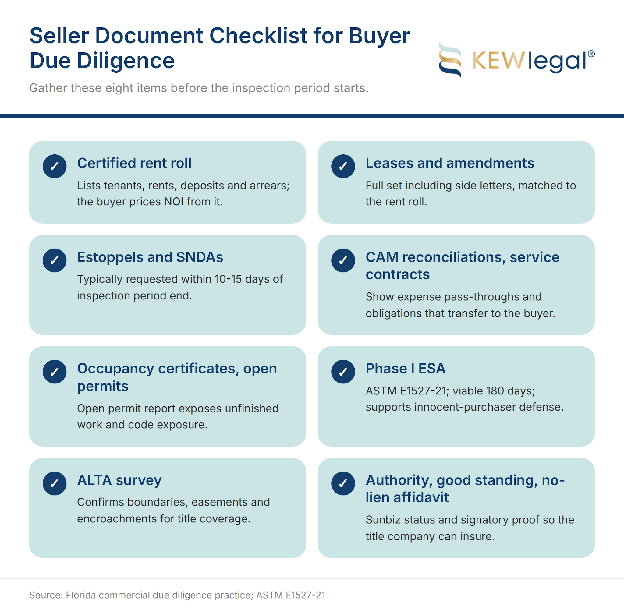
Figure 1: Delivering all eight items on day one keeps the buyer from reopening price. Source: Florida commercial due diligence practice; ASTM E1527-21.
The buyer reprices NOI against any rent roll mismatch. A current Phase I supports the buyer’s CERCLA innocent-purchaser defense. Good standing, signatory authority and the no-lien affidavit let the title company insure.
Tenant Estoppels Confirm Lease Terms
A tenant estoppel is a signed statement confirming lease terms, rent paid, deposits and defaults. An SNDA subordinates the lease to the buyer’s lender and protects the tenant from foreclosure.
Buyers typically request estoppels within 10 to 15 days of the end of the inspection period, so send requests early. Set the closing condition by share of rent covered, such as 75% of base rent, so one holdout cannot stall closing.
An estoppel that disagrees with the rent roll reopens price. A misstatement on your side is liability.
Liens Can Delay A Florida Closing
Three lien types block Florida closings. Payoff from proceeds clears most, while recent work and open violations need escrow or a bond.
- Broker commission liens: the Commercial Real Estate Sales Commission Lien Act, Fla. Stat. 475.700-475.707, lets an unpaid broker record a lien. Pay the commission at closing from proceeds and obtain a recorded release.
- Construction liens: chapter 713 protects unpaid contractors on recent work tied to the notice of commencement. Collect final releases, escrow the disputed amount, or transfer the lien to a bond.
- Code enforcement liens: pay off at closing. Open violations can require an escrow holdback until the work is done.
We review the title commitment at contract signing so these surface weeks before closing.
Which Closing Costs Come Out Of Proceeds?
The seller customarily pays four costs: documentary stamp tax on the deed, the broker commission, title costs as the contract allocates them, and the seller’s share of prorated taxes and rents. The owner’s title policy insures the buyer’s ownership, so allocate who pays for it in the contract.
Estimate net proceeds from these line items before you negotiate price.
Miami-Dade Documentary Stamp Tax Costs More
A Miami-Dade commercial deed pays $1.05 per $100, against $0.70 per $100 in a county without the surtax. On a $5,000,000 sale that is $52,500 versus $35,000.
The worked figures, as an illustration:
1. Miami-Dade: $0.60 per $100 plus the $0.45 surtax on deeds other than single-family residences under Fla. Stat. 201.031, total $1.05, equals $52,500.
2. Broward: $0.70 per $100 under Fla. Stat. 201.02 equals $35,000.
3. Difference: $17,500 on the same price.
The seller customarily pays this tax, but the contract can reallocate it. Settle it at the letter of intent stage.
Property Tax Proration And Reassessment Risk
Property tax prorations favor the buyer because Florida bills in arrears in November, so the seller credits the buyer for the days the seller owned the property. A sale also resets non-homestead assessed value under Fla. Stat. 193.1555.
Example: closing June 15, 2027, annual tax $60,000. You owe January 1 through June 14, which is 165 days, so $27,123.29 is credited to the buyer.
After reassessment to market value, the buyer’s real bill can exceed that figure. Choose a re-proration or no-re-proration clause on purpose. Sellers usually want no re-proration.
Which Federal Taxes Apply To The Gain?
Three federal tax layers hit the gain: the long-term capital gain rate, up to 25% on unrecaptured Section 1250 gain, and the 3.8% net investment income tax above income thresholds. The top long-term federal capital gain rate is 20%. Florida adds no state income tax on the gain for individual owners.
Bring your CPA the depreciation schedule before the contract is signed.
Depreciation Recapture Raises The Federal Rate
Depreciation recapture taxes the depreciation you claimed at up to 25% as unrecaptured Section 1250 gain, instead of the lower capital gain rate. Cost-segregated personal property components fall under IRC 1245 and are taxed as ordinary income.
IRC 1411 adds 3.8% on gain above the thresholds. Cost segregation done in prior years raises the ordinary-income share, so run it before you set price.
A 1031 Exchange Needs Contract Language
A 1031 exchange defers the gain only if the contract protects it. You must identify replacement property within 45 days and close within 180 days of the relinquished-property closing, through a qualified intermediary. Put four clauses in the contract:
1. Exchange cooperation: the buyer agrees to cooperate with your exchange.
2. Assignment: you may assign the contract to a qualified intermediary.
3. No delay: the exchange cannot move the closing date.
4. No cost: the buyer bears no cost or liability from the exchange.
The common mistake is signing the contract and engaging the intermediary after closing. Once you touch the proceeds, the exchange is gone. Align the inspection period and closing date so both exchange clocks start from a known date.
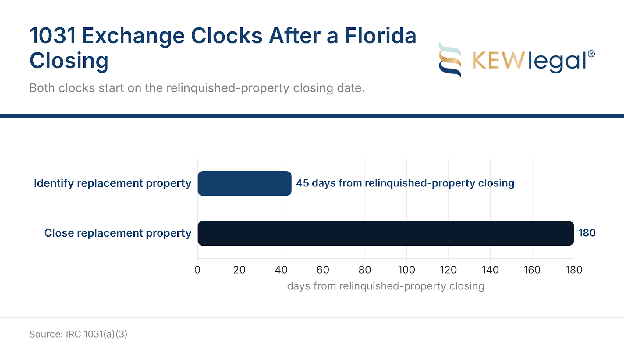
Figure 2: Identify replacement property by day 45 and close by day 180. Source: IRC 1031(a)(3).
Do Foreign Sellers Face FIRPTA Withholding?
Yes. A foreign seller faces 15% withholding on the amount realized under IRC 1445 unless the IRS issues a withholding certificate before closing.
On a $5,000,000 amount realized, $750,000 is withheld at closing and reported on Forms 8288 and 8288-A within 20 days of transfer. The only way to reduce it is a Form 8288-B withholding certificate application filed before closing, so start it at contract signing.
Florida has no state withholding. U.S. sellers sign a non-foreign affidavit so the buyer does not withhold.
Does Selling LLC Interests Avoid Stamp Tax?
Sometimes. Selling entity interests can avoid deed documentary stamp tax, but a change of control still triggers reassessment under Fla. Stat. 193.1555.
Fla. Stat. 201.02 has a three-year look-back. If the property was deeded into the entity within the prior 3 years and control transfers, doc stamp tax can apply to the interest sale. Buyers diligence the entity itself, so you give broader representations on its liabilities.
If an operating business sells with the property, Fla. Stat. 212.10 makes the buyer liable for unpaid sales tax. Obtain Department of Revenue clearance before closing.
Frequently Asked Questions
How Long Does A Sale Take?
Timing runs on the contract dates, not a fixed period. The inspection period, estoppel delivery, title clearance and the closing date set the schedule. A 1031 exchange adds fixed 45-day and 180-day clocks from closing.
Deed Signing Requirements For Florida Sales
Fla. Stat. 689.01 requires two subscribing witnesses, and the deed is acknowledged before a notary. An entity seller also supplies proof that the signer has authority. The title company checks that proof against Sunbiz.
Send Us The Contract And Rent Roll
We act for the seller. Our team reviews the commercial purchase and sale contract, runs the due diligence delivery, clears title and prices the closing taxes.
Send us the signed contract or letter of intent, the rent roll, the leases, the title commitment and the entity documents. If foreign ownership or a 1031 exchange is involved, say so up front.
Kristina E. Wilson, our founder, holds a title agent certification and a real estate license. This content is general information, not legal advice, and does not create an attorney-client relationship. Schedule a closing consultation about your commercial property sale.