
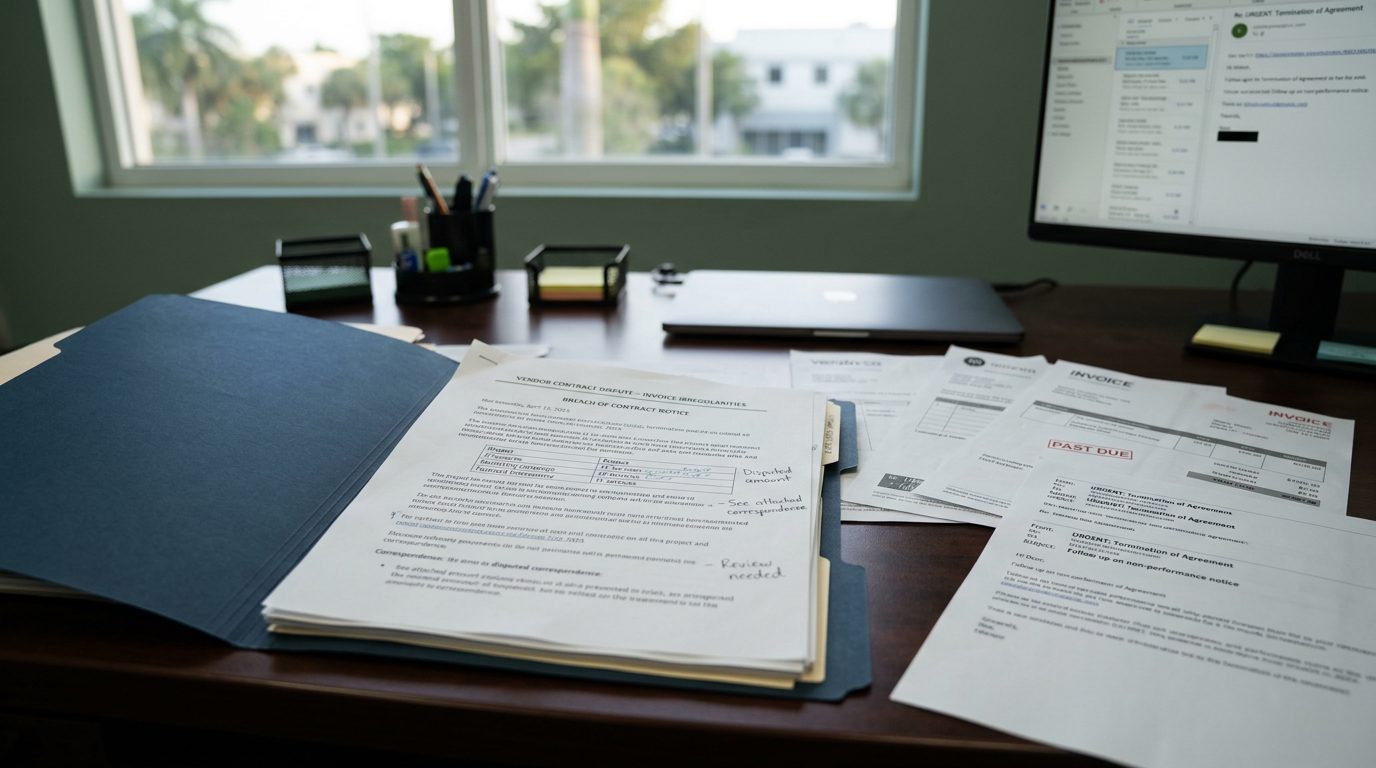
Vendor Contract Termination | Miami-Dade
Ending a Vendor Contract? Review Your Options Before You Act
KEW Legal helps Miami-Dade business owners review termination clauses, notice requirements and fee claims before they end a vendor relationship.
Why Businesses Contact KEW Legal
Free
Confidential first consultation with no obligation to continue
2
Offices in Coral Gables and Sunny Isles Beach
Miami-Dade
Outside general counsel for South Florida business owners
By Kristina E. Wilson · Published October 22, 2026
Vendor contract termination is the process of ending a supplier, service or distribution agreement under the contract’s own rules. Done well, it follows the notice, cure and renewal terms in the agreement, so your business avoids a breach claim. This page explains how a vendor contract termination attorney in Miami-Dade reviews an exit before any notice goes out.
What Vendor Contract Termination Covers and Who It Is For
Vendor contract termination ends a supplier, service, vendor or distribution agreement before it expires or at its natural end. It is built for Miami-Dade business owners, operators and managers who need to stop buying from or selling through another company.
Common triggers include:
- Poor performance or missed deliveries
- A dispute over pricing or invoices
- A change in business direction
- A sale or restructuring of the company
- A vendor that wants to exit
KEW Legal is a Florida business law firm with offices in Coral Gables and Sunny Isles Beach. The firm handles vendor exits as part of its outside general counsel work for business owners across Miami-Dade and South Florida. When a related issue overlaps, such as a commercial lease or a buy-sell agreement, we review it together with the exit.
If your vendor contract no longer fits your business and a wrong notice could cost you money, we can review the exit terms with you before anything is sent. Talk it through with our team — the first consultation is free, confidential, and carries no obligation.

What We Review Before You Send Any Notice
The exit rules live in your contract, so that is where we start. A careful review answers most timing questions before anything is sent.
Key terms to check:
- Termination for convenience: whether you can end the deal without a fault finding, and what notice period and form apply.
- Termination for cause: how the contract defines breach, and any written cure period (time to fix a problem) the vendor must receive first.
- Auto-renewal and non-renewal deadlines: a missed date can lock your business into another term.
- Money terms: minimum purchases, exclusivity, early termination fees and liquidated damages (an agreed amount owed on breach).
- Notice rules: the address, delivery method and person who must receive notice.
- Forum terms: governing law, venue, arbitration and jury waiver clauses.
- Survival clauses: duties that continue after the contract ends, such as confidentiality, data return and non-solicitation.
Florida law adds some limits. A contract clause that sets a shorter time to start a lawsuit arising out of the contract than the applicable statute of limitations allows is void (Fla. Stat. § 95.03). If the agreement requires arbitration, Florida law treats that promise as valid, enforceable and irrevocable, except upon a ground that exists at law or in equity for the revocation of a contract (Fla. Stat. § 682.02).
Florida also limits where suits are filed. Actions must be brought in the county where the defendant resides, where the claim arose or where the property is located (Fla. Stat. § 47.011). That rule does not apply to suits against nonresidents, so out-of-state vendors need separate review.
Common Termination Routes and the Risks in Each
Each exit route has its own notice rules and its own risks. Choosing the wrong route can turn a clean exit into a dispute.
- Termination for convenience ends the deal without a fault finding. It takes effect as the contract’s notice terms state, so early ending can leave fees owed.
- Termination for cause depends on proof of a serious breach. Without clear records, the vendor may claim you ended the deal wrongly.
- Non-renewal works only when notice arrives before the contract’s deadline.
- Mutual rescission is a signed agreement that ends the contract. It should spell out release language, final payments and transition duties.
For sales of goods, Florida’s commercial code sets a notice rule for buyers. Where a tender has been accepted, a buyer must, within a reasonable time after discovering or when it should have discovered any breach, notify the seller of the breach or be barred from any remedy (Fla. Stat. § 672.607). A seller may also recover the price of goods the buyer accepted but did not pay for (Fla. Stat. § 672.709).
Watch for these risks:
- Unpaid invoices on either side
- Claims for lost profits
- Promises made out loud, with no written record
- Continued use of the vendor’s systems or materials after the end date
A vendor may respond with a demand letter, a damages claim or a request to keep performing. Each response changes your next move, so we map those options before you reply.
How the Termination Process Works, Step by Step
Most exits move through seven stages, from the first meeting to the final close-out. Keeping the steps in order protects notice and payment issues.
- Free first consultation. The first consultation is free, confidential and carries no obligation to continue.
- Document collection. Gather the signed agreement, amendments, purchase orders, invoices, performance records, emails and prior notices.
- Written analysis. We review the termination routes, notice requirements, cure periods and your exposure.
- Notice drafting. We prepare the notice to match the contract’s delivery method, timing and content.
- Negotiation. We discuss a transition agreement, mutual release or payment resolution with the vendor.
- Transition and close-out. Materials and data are returned, final invoices are settled, and replacement timing is set.
- Dispute resolution. If the vendor objects, the matter follows the forum and procedure the contract names.
Timing depends on the notice period in your contract, the vendor’s response and whether the matter settles. The stages stay the same either way.
Protecting Your Business While the Contract Winds Down
Keep performing your own duties until termination takes effect. Stopping early can create a breach claim against you, even if you believe the contract is ending.
- Put every termination communication in writing, sent through the method the contract names.
- Avoid saying the contract is over before the notice is properly delivered.
- Plan the replacement vendor and transition period, so operations don’t stop on the end date.
- Track amounts owed in both directions and settle them in the close-out papers.
- Keep records of the vendor’s performance, since they support any later claim or defense.
Why Work With KEW Legal on Vendor Contract Termination
KEW Legal reviews vendor exits alongside the rest of your company’s legal picture. The firm focuses on business contracts, partnership and vendor disputes, employment matters, commercial leases and business transactions.
Our lawyers work as outside general counsel. That means a contract exit connects to ownership, leases and employee issues rather than standing alone. Kristina E. Wilson is the responsible lawyer for this page, and Natalie Martinez is also one of the firm’s lawyers.
You keep control of the decisions. We explain your options and risks in writing before any notice goes out. Each exit turns on its own contract, so we review yours before giving advice.
Not sure what your next step is?
Talk it through with our team — the first consultation is free, confidential, and carries no obligation.
Common Questions About Ending a Vendor Contract
Most vendor exits turn on the notice, renewal and fee terms in the contract.
Can I end a vendor contract without a reason?
Only if the contract has a termination for convenience clause. Its notice period and form control the timing.
What if the vendor says I owe a termination fee?
Fees depend on the contract language. We review the amount and the clause against the actual agreement.
What if I send notice too late?
A missed non-renewal or auto-renewal date can extend the term. That can mean another period of payments.
Do I have to keep paying after I send notice?
Payment duties usually continue until termination takes effect under the contract. Check the notice clause for the effective date.
Can the vendor sue me after termination?
A vendor can bring a claim. The contract’s forum terms, Florida’s five-year period for written contracts, and your records all shape that exposure.

Talk Through Your Vendor Contract With KEW Legal
If a supplier or service agreement no longer fits your business, a wrong notice can cost you money. Call 305-990-2300 or send us a message to start the conversation. We will review your contract with you from our Coral Gables or Sunny Isles Beach office before anything goes out.
How We Approach a Vendor Termination
Contract Review
We read the full agreement, including the termination, renewal, notice and dispute resolution sections, before any notice is sent.
Notice and Cure Analysis
We look at what the contract requires for notice, the form of delivery and any opportunity to correct a problem.
Fee Exposure Assessment
We review any termination fee or payment obligation the vendor claims against the actual contract language.
Vendor Communication
We help you decide what to say to the vendor and prepare written communications that match your contract and goals.
Exit Planning
We help you plan transition steps, data and property return, and timing so the business keeps running during the change.
Pause Before You Stop Performance
Stopping payments, withdrawing services or ignoring the contract terms without a review can give the vendor grounds for a dispute. Talk with us before you send a termination notice.
Common Vendor Termination Questions
Termination for Convenience
Some contracts let either party end the agreement without a stated reason. The notice period and required form are set by the contract itself.
Termination for Cause
Contracts often allow termination after a material breach. Whether the vendor's conduct fits the contract's definition is a fact-specific question we review.
Termination Fees and Penalties
If a vendor claims a fee, we compare the amount and the clause with the agreement, along with any related invoices or payment terms.
Disputed Terminations
When a vendor disagrees with your termination, we evaluate the options available under your contract and how to respond.
Talk to KEW Legal Before You Send the Notice
Related practice areas
Request a Consultation
Fill out the short form and we will take it from there.