
Business Contract & Vendor Dispute Attorney | Coral Gables & Sunny Isles Beach
Your Vendor Didn't Deliver. Let's Work Out Your Next Move.
KEW Legal helps business owners and investors across Miami-Dade and Broward County address vendors who fail to deliver paid-for goods, from reviewing the contract and payment records to deciding how to respond to the vendor.
By Kristina E. Wilson · Published October 29, 2026
If a vendor failed to deliver goods you paid for, the answer starts with your paperwork. Florida’s sale-of-goods law frames your options, and the details of your order decide which ones fit.
A Florida lawyer handling a vendor failed to deliver goods matter starts with these same questions. This page explains that framework in plain terms. It does not predict how any dispute will end.
When a Vendor Doesn’t Deliver: What It Means for Your Business
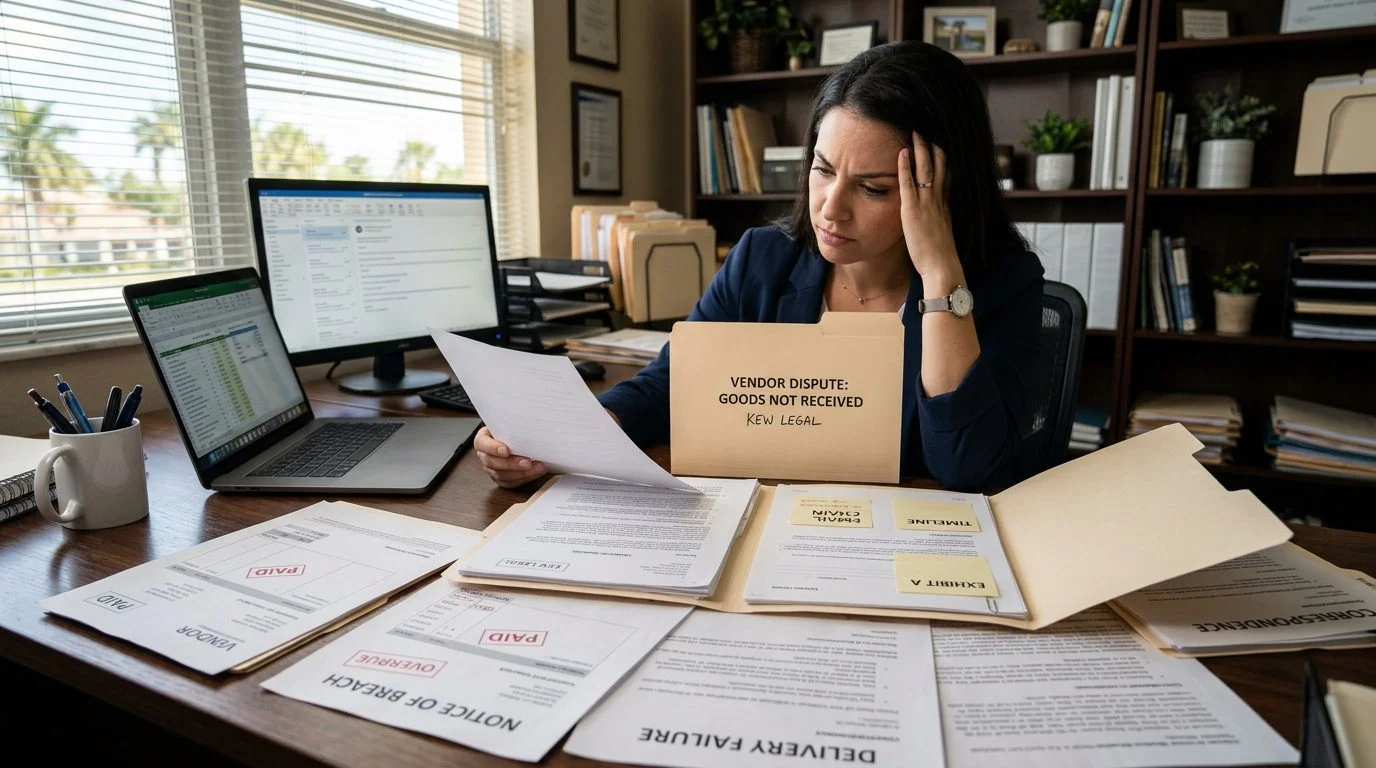
A non-delivery dispute starts when a supplier takes your order or payment but doesn’t ship what was agreed, on time. The damage goes beyond one missing shipment. Operations stall, customer orders go unfilled, and deposits sit with the vendor while cash flow tightens.
Owners aren’t the only ones who face this. Managers handle daily purchasing, and investors often learn about it after the money is gone. Some owners live abroad and rely on someone in Florida to run the company. That person needs to know what the contract says and what to do next.
This page covers the framework and your options. It does not predict how a specific dispute will end, because every case turns on its own written terms, payment records, and the vendor’s responses.
Not sure what your next step is?
Talk it through with our team — the first consultation is free, confidential, and carries no obligation.
Non-Delivery, Late Delivery, Defective Goods, or Fraud: Which One Is Yours?
Your situation falls into one of four groups, and each group follows different rules.
- Non-delivery: The goods never arrive, or the vendor goes silent after you pay.
- Late or partial delivery: The goods arrive after the agreed window, or only part of the order arrives.
- Nonconforming or defective goods: Items arrive, but they don’t match the specifications, quality, or quantity you ordered.
- Fraud: The vendor misstated its capacity, inventory, or identity to win your order or payment.
The category decides which notices and evidence matter. Once you accept goods, Florida’s notice rule applies. Under Fla. Stat. § 672.607, a buyer who accepted goods must notify the seller of a breach within a reasonable time after discovering or should have discovered it, or be barred from any remedy. Acceptance has its own test under Fla. Stat. § 672.606. Fraud claims may also raise Florida’s deceptive practices statute, which bars unfair or deceptive acts in trade or commerce.
How KEW Legal Handles a Vendor Failed to Deliver Goods Claim
KEW Legal starts with the documents, then fits the response to what your business needs. A review usually covers the purchase order, quotes, invoices, emails and texts with the vendor, payment records, and any written terms or delivery schedule. Those records show what was promised and when.
Next, the firm assesses whether the vendor breached, whether you gave the right notice, and which remedy fits. From there, the work may include:
- Sending a demand letter that sets out the breach, a deadline, and the remedy you want.
- Negotiating a refund, replacement goods, a credit, or a payment plan when a business fix makes sense.
- Pursuing litigation or arbitration if a settlement can’t be reached.
- Coordinating the dispute with your broader legal needs as outside general counsel.
- Advising on future protection, such as delivery dates, deposit terms, and remedy clauses.
What to Expect: Steps and Timeline in a Florida Non-Delivery Dispute
Most vendor disputes move through five stages, and the pace varies with how the vendor responds.
- First consultation. You share the documents and a timeline, and the firm explains your options.
- Fact review. Proof of the order, payment, promised delivery date, and vendor messages gets organized.
- Demand. A written demand usually sets a short window for the vendor to deliver or refund.
- Resolution attempt. Negotiation, mediation, or a settlement agreement.
- Formal action, if needed. A lawsuit or arbitration, followed by discovery and possible trial or settlement.
Deadlines run alongside every stage. Florida law addresses legal or equitable actions on a contract, obligation, or liability not founded on a written instrument, including actions for the sale and delivery of goods, wares, and merchandise, and on store accounts. Florida also voids any contract clause that sets a shorter time to sue than the statute allows, under Fla. Stat. § 95.03. Deadlines for other contracts depend on how the deal was made, so raise the timing question early.
Remedies Florida Law May Make Available to a Buyer
Florida’s sale-of-goods rules give buyers several points to check, and each one turns on the contract.
- Implied warranty. Unless excluded or modified, Florida law implies a warranty that goods a merchant sells are merchantable, which includes being fit for the ordinary purposes for which such goods are used and conforming to promises or affirmations of fact made on the container or label.
- “As is” language. Under Fla. Stat. § 672.316, words like “as is” or “with all faults” can exclude implied warranties, unless the circumstances indicate otherwise.
- Under Fla. Stat. § 672.508, where a buyer rejects a nonconforming delivery and the time for performance has not yet expired, a seller may seasonably notify you it intends to cure and make a conforming delivery within the contract time.
- Written proof. Under Fla. Stat. § 672.201, a sale of goods priced at $500 or more is not enforceable without a signed record, with limited exceptions. Between merchants, a written confirmation received within a reasonable time, by a party who has reason to know its contents, can satisfy the writing requirement against that party unless they object in writing within 10 days after receiving it.
- Overlapping claims. Florida courts generally decline to allow unjust enrichment claims where an express contract covers the same subject, although recognized exceptions apply; see Williams v. Johnson. A deposit claim may need to rest on the contract itself.
Why Businesses Work with KEW Legal on Vendor and Supply Disputes
KEW Legal is a business law firm with offices in Coral Gables and Sunny Isles Beach. It acts as outside general counsel for owners and investors across Miami-Dade and South Florida. Kristina E. Wilson is the responsible lawyer for this page. Our lawyers include Kristina E. Wilson and Natalie Martinez.
The firm focuses on business matters: partnership disputes, business contracts and vendor disputes, employment matters for employers, business acquisitions and sales, succession planning, commercial leases, real estate investment, and commercial evictions. It also handles matters for owners who live abroad, including commercial evictions.
Outside general counsel work goes beyond one dispute. The firm can review purchase terms before the next order goes out, so a future vendor problem is easier to manage. Our team explains each option in plain language before you decide what to do next.
Not sure what your next step is?
Talk it through with our team — the first consultation is free, confidential, and carries no obligation.
Frequently Asked Questions About Vendor Non-Delivery in Florida
Short answers to common questions appear below.
Can I recover a deposit if the vendor never shipped?
Possibly. The answer depends on the contract, your payment records, and the vendor’s response, and the first consultation is where those get reviewed.
Do I have to accept late goods?
Acceptance and rejection turn on timing and the contract’s terms. Once you accept, the notice rule in Fla. Stat. § 672.607 applies.
Can I buy from another supplier and bill the first vendor?
That question is worth raising early. The answer turns on the contract and the timing of your notice, and the firm reviews both in a first consultation.
What if the vendor is out of state or overseas?
Florida courts can reach a party that breaches a contract by failing to perform acts the contract requires in Florida, under Fla. Stat. § 48.193. Jurisdiction and collection questions are reviewed in the first consultation.
Can a contract send my dispute to arbitration?
A written arbitration agreement in a vendor’s terms can be valid and enforceable under Fla. Stat. § 682.02, except on grounds that exist to revoke any contract.
How much does a first consultation cost?
The first consultation is free, confidential, and without obligation to continue.
Should I send a demand letter first?
A written demand often matters, so check the timing before you send anything.

Talk With KEW Legal About Your Vendor Dispute
Right now, you may be waiting on goods you already paid for while the business absorbs the cost and decides its next move. You don’t have to sort through the vendor’s messages and contract terms alone. Share your purchase order, payment records, and vendor messages with KEW Legal. Reach the firm through the contact page to schedule a consultation or send a message, or call 305-990-2300.
What We Review in a Non-Delivery Dispute
The Contract and Purchase Terms
We start with the purchase order, the agreement, and any terms that address delivery dates, specifications, and remedies.
Your Payment Records
Deposits, invoices, wire confirmations, and receipts show what was paid, when, and to whom.
Communications With the Vendor
Emails, texts, and messages often show promises made, delays acknowledged, and how the vendor has responded to your requests.
The Delivery Timeline
We map out agreed dates, missed deadlines, and any partial shipments so you understand where the dispute stands.
Protect Your Position Early
Keep every purchase order, invoice, payment receipt, and message with the vendor. Before you sign a new agreement, accept a partial shipment, or send a demand, speak with counsel so your choices don't weaken your position.
How We Handle Your Vendor Dispute
1. Confidential Review
You share your contract, payment history, and correspondence with our team in a private, confidential setting.
2. Options Analysis
We explain the possible paths, such as a demand letter, negotiated resolution, or formal proceedings, and the factors that bear on each.
3. Vendor Communication
When appropriate, we communicate with the vendor on your behalf to seek delivery, a refund, or a negotiated resolution.
4. Clear Next Steps
You receive a practical plan and an honest view of your situation, with no pressure to proceed.
Get Clear Answers About Your Vendor Dispute
Related practice areas
- Outside General Counsel For Businesses
- Outside General Counsel for Vendor Contracts in Miami-Dade
Request a Consultation
Fill out the short form and we will take it from there.