
Business Contracts | Miami
Review Your Vendor Agreement Before You Sign
KEW Legal helps Miami-Dade business owners understand what a vendor contract commits them to, spot risky terms, and propose changes while the draft is still open.
By Kristina E. Wilson · Published October 25, 2026
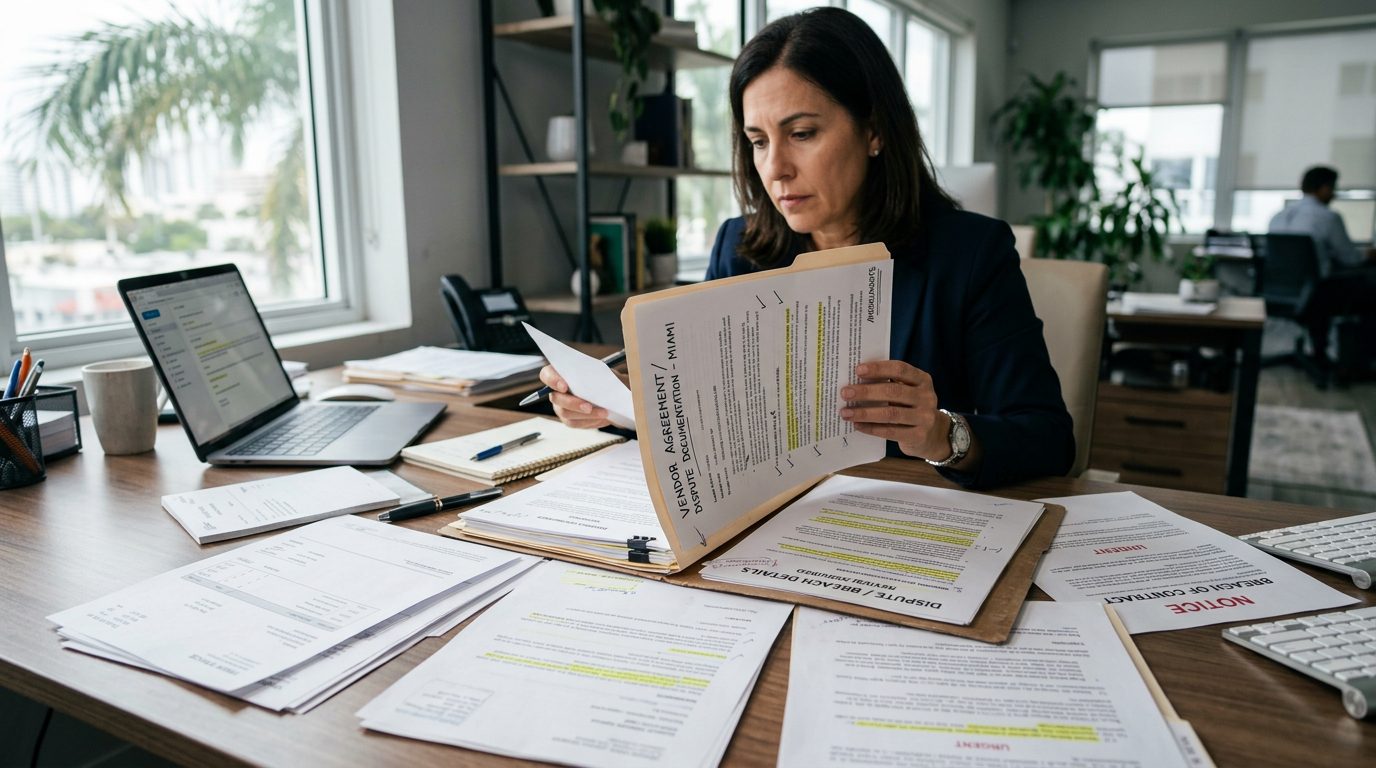
Reviewing a vendor agreement before you sign is the point where most terms can still change. A business lawyer reads the draft, flags clauses that often cause later disputes, and proposes changes before the deal is final. This page explains what that review covers and how it works for owners and managers in Miami-Dade and Broward.
What a Pre-Signing Vendor and Supplier Agreement Review Covers
A pre-signing review is a lawyer’s read of a vendor or supplier contract before anyone signs. The lawyer finds risks and gaps, then recommends specific changes.
There are two common situations. Some businesses receive a draft the vendor wrote. Others need a contract built around their own deal. A review tests the draft you were handed. Drafting starts with your deal and writes the terms to fit it.
This service fits owners, managers, and investors who buy goods or services on a recurring basis or in large amounts. It also fits co-owners who sign for a company and may carry risk personally if the deal goes wrong.
Timing matters. Terms agreed before signature are usually easier to change than terms you argue about after a late delivery or a payment dispute. KEW Legal serves businesses as outside general counsel, so vendor review often fits within ongoing contract support. You can read more about vendor agreement drafting services.
If a vendor's draft has a signing date you're watching, we can talk it through with you before you commit, so call 305-990-2300 or send us a message. Talk it through with our team — the first consultation is free, confidential, and carries no obligation.

Core Terms a Vendor Agreement Should Cover
A sound vendor agreement sets out scope, term, pricing, risk, governing law, transfer rights, and notice. Each term can decide who pays when something goes wrong.
- Scope and deliverables. What the vendor supplies, the specifications, performance standards, and what happens when it falls short.
- Term and renewal. Start and end dates, automatic renewal windows, notice periods, and how either side can exit.
- Pricing and payment. Price changes, invoice rules, payment deadlines, late fees, and any costs beyond the stated price.
- Indemnity, liability, and insurance. Who pays third-party claims, whether liability is capped, and what insurance the vendor must carry.
- Governing law and venue. Which state’s law applies and where a dispute can be heard.
- Assignment and change of control. Whether the vendor can transfer the contract, and whether your business can do the same if it is sold.
- Notice and dispute steps. How formal notices must be delivered and whether a required step must come before a lawsuit.
Should Every Vendor Contract Be Reviewed by a Lawyer Before Signing?
Not every vendor contract needs a lawyer, but larger and longer deals usually do. Small, short purchase orders carry less risk than multi-year, exclusive, or auto-renewing agreements.
Florida’s sale-of-goods rules can change what a vendor’s form means. Between merchants, if within a reasonable time a written confirmation sufficient against the sender is received and the receiver has reason to know its contents, it satisfies the signed-record requirement against the receiver unless they give notice of objection within 10 days after receiving it (Fla. Stat. § 672.201). A definite and seasonable expression of acceptance, or a written confirmation sent within a reasonable time, operates as an acceptance even though it states terms additional to or different from those offered or agreed upon, unless acceptance is expressly made conditional on assent to the additional or different terms (Fla. Stat. § 672.207).
Electronic signatures count. Under Florida law, an electronic signature may be used to sign a writing and has the same force and effect as a written signature, unless another law provides otherwise (Fla. Stat. § 668.004).
Under Third District law, which covers Miami-Dade, a contract needs agreement on every essential term (Sandalwood v. Estevez). Whether a particular contract needs review depends on the facts.
How the Review Works: From Document to Advice
A review moves from intake, to written findings, to proposed changes. Most files follow six steps.
- Initial consultation. You describe the vendor, the deal, and any signing deadline.
- Document intake. You send the draft, order forms, any policies or statements of work it includes, and recent emails about the deal.
- Review. The terms are checked against how your business will operate and what it could lose.
- Written findings. Key risks are explained in plain language and ranked by how much they matter.
- Proposed revisions. Specific replacement language goes to the vendor, with advice on which points to hold and which to give up.
- Final check. Before signing, the agreed changes must appear in the final version, and nothing new should be added.
Turnaround depends on the length of the document and how fast the vendor replies. Raise any deadline on the first call so the schedule fits the signing date.
Warning Signs That a Vendor Agreement Needs a Closer Look
Vague scope, short renewal windows, one-sided indemnity, and price changes by email are common warning signs. Spot them before you sign, not after.
- Vague scope. Services described only as “as needed,” with no performance standard.
- Auto-renewal with short exits. Cancellation windows that close before you notice, or cancellation fees.
- One-sided indemnity. Your business covers the vendor’s losses, but the vendor does not cover yours.
- Unilateral changes. The vendor can change prices or terms by posting an update or sending an email.
- Lopsided assignment. The vendor can transfer the contract, but you cannot do the same if you sell.
- Shortened deadlines. A clause that cuts the time to sue. Florida voids a contract term that sets a period shorter than the statute of limitations (Fla. Stat. § 95.03).
- “As is” language. Words like “as is” can exclude implied warranties unless the circumstances show otherwise (Fla. Stat. § 672.316).
- Unfair terms. A court can refuse to enforce an unconscionable clause or limit it (Fla. Stat. § 672.302). Florida courts weigh both how the deal was made and how unfair the terms are (Basulto v. Hialeah Automotive).
- Pressure to sign. A deadline pushed before the final version is shared.
Why Work With KEW Legal on Vendor Agreements
KEW Legal is a Florida business law firm with offices in Coral Gables and Sunny Isles Beach. The firm focuses on business owners and investors across Miami-Dade and South Florida.
The firm acts as outside general counsel for businesses. Its work includes vendor and partner disputes, contracts, commercial leases, employment issues, and business sales and succession. A single vendor agreement often touches several of these areas.
Kristina E. Wilson is the responsible lawyer for this page. Natalie Martinez is also one of the firm’s lawyers. Our lawyers review a draft with the business’s long-term position in mind. A supply deal can affect a partnership, a lease, or how the company is sold later.
Not sure what your next step is?
Talk it through with our team — the first consultation is free, confidential, and carries no obligation.
Questions Owners Ask Before Signing a Vendor Agreement
Most questions come down to what can change, what counts as binding, and what the first call costs.
Can you modify a contract before signing?
Yes. Most terms in a draft can be proposed for change before signature. Some terms are easier to negotiate than others, and the review shows which ones.
Can I use ChatGPT or another AI tool to review a contract?
AI tools can help you organize your questions. They do not know your other contracts or how Florida law applies to your deal.
How much do attorneys charge to review contracts?
The first consultation is free, confidential, and carries no obligation to continue. Fees come up on that call, and the scope of work follows the document.
What if the vendor has already started work?
Raise this early, because it can limit your options.
What if we have a dispute after signing?
A careful review reduces the chance of fights over unclear terms. The firm can also advise you if a dispute starts.

Talk Through Your Vendor Agreement Before You Sign
You may be reading this with a supplier’s draft in front of you and a signing date approaching. You may be signing for a company you co-own or manage, and not yet sure what is at stake. Talk through the draft before you commit. Call 305-990-2300 or send us a message.
Why review the agreement before signing
Signing sets the terms
Once a vendor agreement is signed, its payment, performance and exit terms generally govern the relationship. Reviewing the draft first keeps your options open.
Identify exposure early
Liability caps, indemnity language and insurance requirements can shift financial risk onto your business. We flag these clauses so you can decide what to accept.
Understand renewal and exit
Auto-renewal clauses, notice periods and termination fees can be easy to overlook. We explain how each one would work in practice.
Propose changes in the draft
Most terms in a draft can be proposed for change before signature. We help you prioritize which requests matter most to your business.
Check before you sign
Do not sign a vendor agreement you have not read in full, and do not assume standard form language fits your business. Once signed, changing or challenging a term can be far more difficult.
Key terms we review
Scope and deliverables
We confirm that the services or products described match what your business actually needs and what the vendor has promised.
Payment and pricing
We review payment schedules, late fees, price escalators and any charges that may apply beyond the quoted amount.
Liability and indemnity
We look at who bears responsibility for losses, damages and third-party claims, and whether the allocation is balanced.
Termination and dispute resolution
We examine how the agreement can end, what notice is required, and where and how disputes would be resolved.
Have a vendor agreement waiting for your signature? Let's review it together.
Related practice areas
- Outside General Counsel for Partner Information Rights and Financial Access in Florida LLCs
- Business Succession Planning Questions for Owners Before a Key Partner Leaves
Request a Consultation
Fill out the short form and we will take it from there.