
Business Contract Disputes · Miami-Dade County
Business Contract Dispute in Miami-Dade: Which Court Hears It?
KEW Legal advises business owners and investors in Coral Gables, Sunny Isles Beach and across South Florida on where a contract dispute belongs and what to do next.
By Kristina E. Wilson · Published November 2, 2026
Short Answer: The Amount in Dispute Usually Decides the Court
If you’re asking which court handles business contract dispute Miami-Dade cases, start with the dollar amount. County courts take most actions at law where the amount in controversy, exclusive of interest, costs, and attorney fees, is $50,000 or less, for suits filed on or after January 1, 2023 (Fla. Stat. § 34.01). Larger claims go to circuit court, which covers Miami-Dade through the Eleventh Judicial Circuit of Florida.
Two other questions can change the answer. The first is where the parties are located and where the events happened. The second is what the contract says, because it may require arbitration or name a place for suits. This page walks through each step in order.
Not sure what your next step is?
Talk it through with our team — the first consultation is free, confidential, and carries no obligation.

Circuit Court: Where Larger Business Contract Claims Are Heard
Circuit court is where most larger business contract claims end up in Miami-Dade. Florida law gives circuit courts exclusive original jurisdiction over actions at law that county courts cannot hear (Fla. Stat. § 26.012). Circuit courts also hear equity cases and can issue injunctions.
The injunction power matters in some fights. If a former partner is moving customers or assets in breach of an agreement, a party may ask the court for an order to stop it.
A circuit court case usually starts with a complaint that states the claim and the amount sought. Motions and discovery, the exchange of documents and testimony, often follow. Each case moves at its own pace.
The amount in the complaint matters. Under the county court limit, interest, costs, and attorney fees are left out of the measure. Those add-ons don’t decide which court hears the case.
County Court and Small Claims: Smaller Contract Disputes
County court is the usual home for smaller business contract claims in Miami-Dade. For suits filed on or after January 1, 2023, county courts hear actions at law, except those within the exclusive jurisdiction of the circuit courts, where the amount in controversy is $50,000 or less, not counting interest, costs, and attorney fees (Fla. Stat. § 34.01). It can also hear equity matters within that same amount. Fla. Stat. § 34.01 reads: “(4) Judges of county courts may hear all matters in equity involved in any case within the jurisdictional amount of the county court, except as otherwise restricted by the State Constitution or the laws of Florida.”
Smaller claims may fall under Florida’s small claims rules, which have their own limit and a simpler process. Check which set of rules applies before you file.
Before you file, add up the unpaid invoice or deposit. Leave out interest, costs, and fees. Then compare that number to the county court limit. If the figure sits near the line, get it right in the complaint from the start.
One common mistake is adding charges to push a claim into a different court. Interest and fees don’t count toward the limit, so adding them doesn’t change the court.
Federal Court: An Option That Depends on the Parties
Federal court is sometimes an option for a business contract dispute. Whether it is depends on the facts. Whether a dispute belongs in federal or state court depends on the facts involved.
A dispute with an out-of-state or foreign vendor may raise this question. Both the amount involved and the parties’ locations can matter. Ask the question early, before you send a demand letter or pick a filing location.
When the Contract Sends the Dispute to Arbitration or a Chosen Forum
A signed arbitration clause can move a business dispute out of court. Florida law says an agreement to arbitrate is valid and enforceable, unless a legal ground exists to revoke a contract (Fla. Stat. § 682.02).
Say the other side refuses to arbitrate and opposes your motion. The court decides whether an agreement to arbitrate exists, but an arbitrator decides whether a condition precedent has been fulfilled and whether the contract containing a valid agreement to arbitrate is enforceable. If it does, the court orders arbitration and must pause the court case on that claim. It cannot refuse arbitration just because the claim seems weak (Fla. Stat. § 682.03).
A contract term can still be challenged. A Florida court refuses to enforce a term as unconscionable only when both procedural and substantive unfairness are present. They can differ in degree, but both must exist (Basulto v. Hialeah Automotive).
Venue rules also matter. Under Florida law, an action against a domestic corporation must be brought only in the county where the corporation has, or usually keeps, an office for its customary business, where the cause of action accrued, or where the property in litigation is located. A common mistake is filing suit before reading the dispute clause, which may require arbitration or a notice step first.
How the Claim Amount Is Counted
The claim amount is the money in dispute. For the county court limit, interest, costs, and attorney fees are not counted. That gives you a clear first number to test.
After a judgment, the interest rate is set each quarter by the Chief Financial Officer. It averages the New York Federal Reserve discount rate for the prior 12 months and adds 400 basis points. The rate adjusts each January 1 until the judgment is paid (Fla. Stat. § 55.03). A written contract can set its own rate, and that rate still controls.
Attorney fee clauses can cut both ways. If a contract entered into on or after October 1, 1988 lets a party recover fees for enforcing it, a court may award reasonable fees to the other side when that side prevails (Fla. Stat. § 57.105). Read the fee clause before you file.
Keep the signed agreement, amendments, invoices, payment records, and key emails together. Clear records make the amount easier to prove.
Not sure what your next step is?
Talk it through with our team — the first consultation is free, confidential, and carries no obligation.

Before You File or Send a Demand Letter
Before you file or send a demand, confirm four things. Those are the amount, where the parties are located, the forum and arbitration terms, and any notice steps the contract requires. Those answers point to which court handles business contract dispute Miami-Dade matters.
Check the other company’s registration with the Florida Division of Corporations, known as Sunbiz. It publishes registration and status information for Florida business entities. Use the exact registered name in your demand.
Once a case is filed for money damages, the court must refer it to mediation when one party requests it, provided the requesting party is willing and able to pay the costs of the mediation or the costs can be equitably divided between the parties (Fla. Stat. § 44.102). Fla. Stat. § 44.102 reads: “(2) A court, under rules adopted by the Supreme Court: (a) Must, upon request of one party, refer to mediation any filed civil action for monetary damages, provided the requesting party is willing and able to pay the costs of the mediation or the costs can be equitably divided between the parties, unless: 1.” Exceptions apply, including debt collection cases and cases where the parties agreed to binding arbitration. When a court orders mediation, deadlines to respond to a settlement offer pause until the mediator declares an impasse or reports no agreement (Fla. Stat. § 44.102).
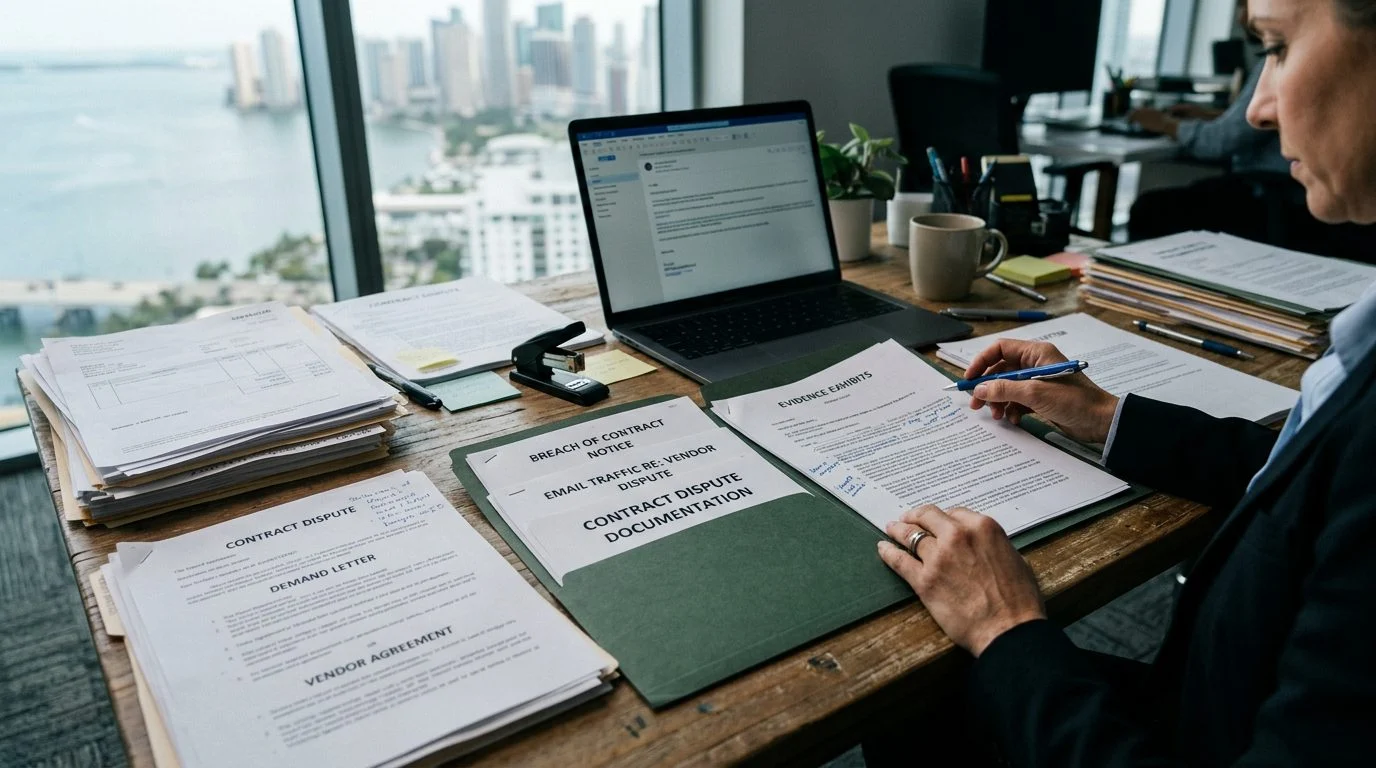
Picture a vendor that takes your deposit, stops delivering, and goes silent. The contract requires written notice first. Pull the contract, the payment proof, and the dispute clause before you send anything. Then ask two questions. Does the amount fall under the county court limit? Does an arbitration clause apply?
If a vendor took your deposit and stopped delivering, KEW Legal can review the contract, the amount at stake, and the likely court with you. Our free first consultation is confidential and carries no obligation to continue. You can contact KEW Legal or call 305-990-2300.
Responsible attorney: Kristina E. Wilson, KEW Legal, Coral Gables, Florida.
Frequently Asked Questions
Which court handles business contract dispute Miami-Dade claims above $50,000?
Circuit court generally hears those claims. County court covers actions at law, except those within the exclusive jurisdiction of the circuit courts, in which the matter in controversy does not exceed, exclusive of interest, costs, and attorney fees, $50,000 for suits filed on or after January 1, 2023.
Can an arbitration clause keep a business dispute out of court?
Florida law generally enforces a written arbitration agreement.
Florida’s arbitration statute, § 682.02, contains no debt-collection exception; the debt-collection exclusion in § 44.102(2)(a)2. governs court-ordered mediation.
How KEW Legal Helps With Contract Disputes
Contract Review
We read the full agreement, including its forum, venue, arbitration and notice provisions, before you decide how to respond.
Protecting Your Position
We help you understand your options so you can take measured steps rather than reacting under pressure.
Outside General Counsel
For business owners who need ongoing legal guidance, we act as outside general counsel on vendor, partner and commercial matters.
Clear Communication
We explain the court options, likely next steps and practical considerations in plain language.
Check the Contract Before You Act
Many commercial agreements name a specific court, require arbitration, or set notice steps that must be followed. Sending a demand or filing a suit without reviewing these terms can affect your options. Bring the full contract to your consultation.
Common Forums for Business Contract Disputes
Circuit Court
Circuit court generally hears larger business contract claims. Whether a case belongs there depends on the amount in controversy and the claims being brought.
County Court
County court handles many actions at law within its jurisdictional limits. The amount at stake and the type of relief sought both matter in deciding where a case is filed.
Arbitration
Some contracts require disputes to be resolved through arbitration instead of litigation. Whether a clause applies, and how it affects your claims, is a question we review with you.
Get a Free, Confidential First Consultation
Related practice areas
- Business Contract And Vendor Dispute Attorney
Request a Consultation
Fill out the short form and we will take it from there.