
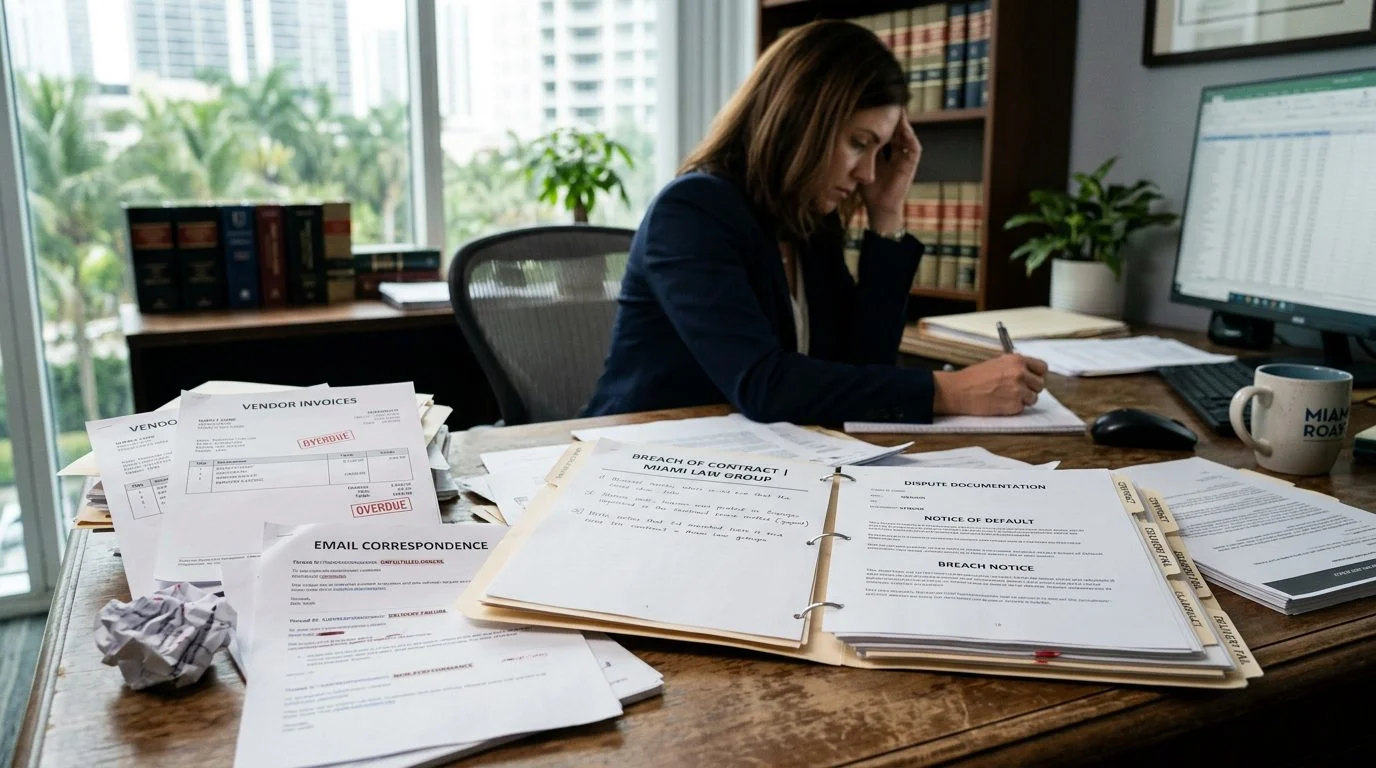
Business Contract & Vendor Dispute Attorney | Miami-Dade
Vendor Not Delivering? Get Clear Answers on Your Options
KEW Legal works as outside general counsel for business owners in Coral Gables, Sunny Isles Beach and across South Florida, helping you decide what to do next when a vendor falls short.
By Kristina E. Wilson · Published November 8, 2026
A vendor took your payment or your deadline and never delivered what it promised. That can stall a project, leave customers waiting, and strain payroll.
Acting early matters. Notice rules and deadlines can limit what you can recover later. This guide explains how Florida law generally treats a failed delivery, the options a business usually has, and the mistakes that weaken a claim.
When a Vendor Doesn’t Deliver: What This Situation Means for Your Business
Non-delivery means the vendor did not provide what the contract required, on time, in the right condition, or at all.
It takes several forms:
- Late delivery: goods or services arrive after the agreed date.
- Partial delivery: only part of the order arrives.
- Defective delivery: goods arrive but don’t match the agreed description or quality.
- Missed milestones: a contractor skips or delays a required phase of work.
- Never delivered: the vendor takes payment and performs nothing.
This guide is for business owners, managers, and investors. It also helps a partner or family member who is handling the matter for the business.
The first weeks matter. Deposits may be at risk, and some contracts require written notice within a set time. Waiting too long can cost you options you would otherwise have.
Not sure what your next step is?
Talk it through with our team — the first consultation is free, confidential, and carries no obligation.

Before You Can Win a Breach Claim, There Has to Be a Contract the Law Will Enforce
Florida’s sale-of-goods rules allow a contract to be made in any manner that shows agreement, including conduct by both sides (§ 672.204). Some terms can be left open if both sides meant to make a deal and there is a reasonably certain basis for a remedy.
Writing matters for larger deals. For a sale of goods priced at $500 or more, the contract generally must be in a record signed by the party you are trying to enforce against or by that party’s authorized agent or broker, but there are exceptions, including for goods that have been paid for and accepted or received and accepted (§ 672.201). Whether an email, text, or purchase order meets that test depends on the facts.
Deadlines start early. Under Florida’s limitations statute, an action on a legal or equitable contract, obligation, or liability founded on a written instrument must be commenced within five years, while an action on a contract, obligation, or liability not founded on a written instrument must be commenced within four years. A contract clause that sets a shorter suing period is void (§ 95.03).
Before you act, review the contract for:
- Notice clauses that say how and when you must report a breach
- Cure periods that give the vendor time to fix a problem
- Limitation of liability clauses that cap what you can recover
- Governing-law and arbitration clauses that affect where a dispute goes
Material Breach vs. Minor (Partial) Breach
A material breach is a failure that goes to the heart of the deal. A minor breach is a smaller shortfall that usually leaves the contract in place.
A late shipment of a few boxes is different from a vendor that never delivers the core product.
Florida’s sale-of-goods rules add a timing point for buyers. Once you accept goods, you must notify the seller of a breach within a reasonable time after you discover it or should have discovered it, or you may be barred from any remedy (§ 672.607). Acceptance can occur when you keep goods after a reasonable chance to inspect them (§ 672.606).
Sellers have a cure right in some cases. If a nonconforming delivery is rejected while time remains, the seller may notify you it intends to cure (§ 672.508). That is why how you label the problem in your notice matters.
Anticipatory Breach: When a Vendor Says It Won’t Perform
Anticipatory breach happens when a vendor clearly signals, before the due date, that it will not perform.
Each path carries different risks, so review the timing and the contract terms before choosing.
Save the evidence. Keep the vendor’s emails, texts, and voicemails, and note the date of each statement. Written records make it easier to show what the vendor said and when.
Be careful about acting too fast. Walking away or hiring a replacement without written notice can create disputes of its own.
Your Remedies: Money Damages, Cover, and Equitable Relief
Most vendor claims seek money. A court can order other relief in narrower cases.
- Incidental and consequential damages: extra costs tied to the breach, and some lost profits if they were foreseeable and can be proven.
- Florida’s sale-of-goods chapter applies to transactions in goods unless the context otherwise requires. It does not apply to transactions that only create a security interest, and it does not impair statutes regulating sales to consumers, farmers, or other specified classes of buyers (§ 672.102).
Unless the contract excludes it, a merchant’s sale of goods carries an implied warranty of merchantability (§ 672.314).
Clauses that limit damages are read closely.
What to Do Next: Steps, Timeline, and Common Mistakes
Start by organizing the paper trail, checking deadlines, and sending written notice before you hold back money or walk away.
- Gather the contract, purchase orders, invoices, delivery records, and all messages in date order.
- Check the notice and cure terms, and calendar each deadline.
- Send a written notice or demand letter that names the breach, the contract term, the cure period, and the remedy you reserve.
- Evaluate negotiation, a payment hold the contract allows, or termination and replacement.
- If the matter doesn’t resolve, file suit in the right Florida court, or pursue arbitration if the contract requires it.
The right court turns on the amount in dispute. The Miami-Dade Clerk’s civil court guidance explains civil filing procedures and fees. Timing varies with the contract, the vendor, and the court.
Common mistakes:
- Withholding payment without a contractual basis
- Missing a notice deadline
- Accepting partial goods without a written reservation of rights
- Deleting texts, emails, or voicemails
Not sure what your next step is?
Talk it through with our team — the first consultation is free, confidential, and carries no obligation.
How KEW Legal Helps Miami Businesses Resolve Vendor Failures
KEW Legal focuses on business contract and vendor dispute matters for owners and investors in Miami-Dade and South Florida. The firm has offices in Coral Gables and Sunny Isles Beach.
Kristina E. Wilson is the responsible lawyer for this page. Our lawyers, including Natalie Martinez, can review a vendor dispute with you and explain the options that fit your contract.
The firm’s work in this area includes:
- Business contract and vendor dispute matters, including demand letters and negotiation
- Litigation support when a matter cannot be resolved without a court
- Outside general counsel for ongoing business relationships
A vendor problem rarely stays inside one contract. Payroll, customers, and other agreements can all feel the effect, and the firm addresses those connections when it reviews the matter.

Frequently Asked Questions About Vendor Non-Delivery in Florida
Withholding payment from a vendor
How long do I have to sue a vendor?
For a written contract, Florida’s general period is five years under Florida’s limitations statute.
Do I need a lawyer to send a demand letter?
A written demand is common, and its wording can affect later remedies. Talk with a lawyer first if the contract has notice or cure terms.
Review the clause early.
Can an arbitration clause keep my dispute out of court?
Under Florida’s arbitration statute, a written agreement to arbitrate is generally valid and enforceable. Check the clause’s exact wording.
If a vendor failed to deliver and you’re deciding your next step, KEW Legal can review the contract with you. Your first consultation is free, confidential, and carries no obligation to continue. Call 305-990-2300 or send us a message.
How KEW Legal Approaches Vendor Disputes
We Start With Your Contract
We review the agreement, its scope, payment terms, and any notice or cure provisions before recommending a course of action.
We Plan Your Communications
A written demand can shape later options, so we help you decide what to say to the vendor and when.
We Protect Your Business Interests
We focus on keeping your operations moving while we work to resolve the dispute.
We Explain Your Options Clearly
You will know the possible paths, from negotiation to formal proceedings, before you commit to one.
Check Your Contract Before You Respond
Notice requirements, cure periods, and dispute resolution clauses can affect your rights. Talk with a lawyer before sending a demand or ending the relationship with the vendor.
Common Vendor and Contract Issues We Address
Missed or Late Deliveries
When goods or services do not arrive on time or as specified, we review the agreement and your options for a response.
Defective Work or Products
We help evaluate whether the vendor met the contract standards and how to document the problem.
Payment Disputes
Whether you have paid in full, withheld payment, or been billed for work you did not approve, we help clarify the terms.
Termination and Replacement
We advise on ending a vendor relationship properly and transitioning to a new provider with minimal disruption.
Get Your Free, Confidential First Consultation. No Obligation to Continue.
Related practice areas
Request a Consultation
Fill out the short form and we will take it from there.