
Partnership Disputes | Coral Gables and Sunny Isles Beach
When Your Joint Venture Partner Breaks the Deal
KEW Legal helps Miami-area business owners and investors evaluate what their joint venture agreement requires, what the other side has done, and which steps to consider next.
By Kristina E. Wilson · Published November 8, 2026
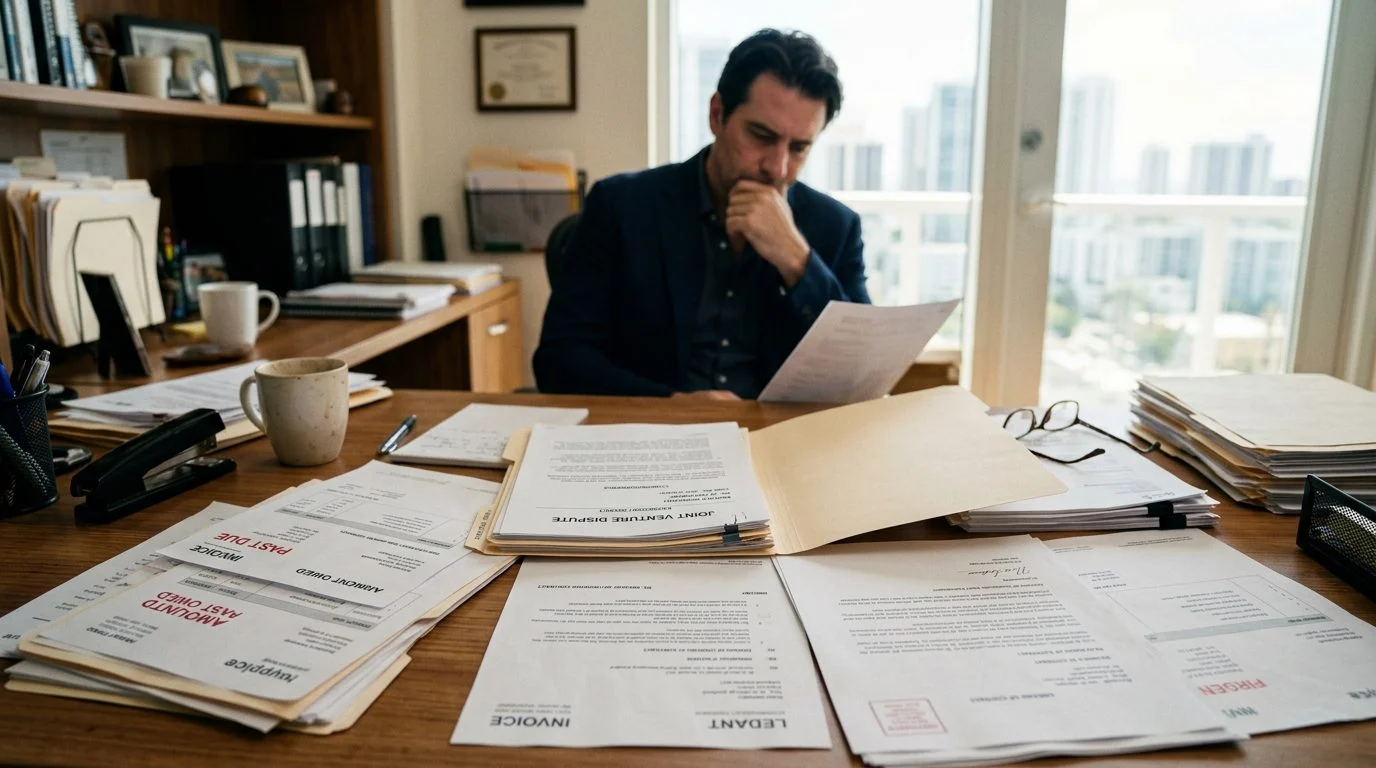
Your joint venture partner has stopped funding, walked away from a closing, or moved property or money outside the LLC. The deal you built is now at risk. The first steps are to secure the documents, preserve the evidence, and protect the deals that can’t pause.
A joint venture agreement breach attorney in Florida starts with the operating agreement, because that document sets the rules between partners. This page walks through those first steps and what Florida law says about LLC agreements.
When Your Joint Venture Partner Breaches a Deal You Built
A joint venture partner breach happens when a partner fails to do what the agreement or the deal requires. Brokers often feel this harder than other owners. Many are moving from commissions to owning rentals and development projects, and they often form several LLCs quickly.
A closing attorney handles the closing. A partner dispute is a different job. It needs someone who reads the operating agreement, checks the LLC records, and watches every open deal while the dispute runs.
This page covers joint venture and LLC partner breaches that affect South Florida real estate holdings and development projects. For the wider category, see our business contract and vendor dispute page.
If your joint venture partner has stopped funding a deal or moved property out of the LLC, you don't have to sort it out alone. Contact KEW Legal to talk through your options. Talk it through with our team — the first consultation is free, confidential, and carries no obligation.

What a Joint Venture Breach Dispute Covers
A breach dispute covers any failure by a partner to meet a duty set by the agreement or filled in by Florida law. In real estate deals, common breaches include:
- Missed or short capital contributions that the agreement requires.
- A sale, loan, or lien on property without the approval the agreement requires.
- Rent or sale proceeds sent somewhere other than the LLC’s accounts.
- Missed reports, accountings, or distributions.
- A refusal to sign closing or title documents the deal needs.
Governance fights are common too. These include deadlock between members, disputed manager authority, buy-sell triggers, and control of bank accounts and company records.
Documents usually reviewed include the operating agreement, side letters, amendments, closing statements, loan documents, and the LLC’s formation filings. The Florida Department of State’s Sunbiz records show filing and status information for Florida business entities.
The work can include demand letters, negotiation, mediation, and litigation if needed. No outcome is promised.
The First Steps to Take Before You Respond
Before you answer your partner, secure the documents, preserve the evidence, and list the deals that cannot pause.
- Gather the governing papers. Pull the operating agreement, every amendment and consent, and the capital account records. Under Chapter 605 of the Florida Statutes, the Florida Revised Limited Liability Company Act, a limited liability company must keep certain records at its principal office or another location, including a current list of the full names and last known business, residence, or mailing addresses of each member and manager, copies of its federal, state, and local income tax returns and reports, if any, for the 3 most recent years, and copies of its financial statements, if any, for the 3 most recent years.
- Preserve everything. Keep emails, texts, call logs, bank statements, and closing files. Don’t delete or edit anything.
- Avoid self-help. Don’t change locks, bank signers, or property access on your own. Don’t sign new documents in your partner’s absence without advice.
- Slow down written accusations. Review the agreement’s notice terms before you send a threat. A harsh message can end up as evidence in the dispute.
- List the deals that can’t pause. Note pending closings, contractor draws, and lender or tenant deadlines.
Reading the Agreement: Notice, Cure Periods, and Dispute Clauses
The operating agreement controls the relationship between members and the company. Chapter 605 fills in what the agreement leaves out.
Florida law says the operating agreement governs relations among members and between members and the LLC. A person who becomes a member is bound by the agreement, even without signing it (Fla. Stat. § 605.0106).
Look for these terms:
- Default and notice. Does the agreement require written notice before a breach counts? Who must receive it?
- Cure period. How long does the partner have to fix the breach? Read more about what a cure period means.
- Dispute steps. Does the agreement require mediation or arbitration first? A written agreement to arbitrate is valid and enforceable, except on grounds that allow any contract to be revoked (Fla. Stat. § 682.02).
- Remedies. Look for buyout rights, forced sale terms, removal of a managing member, and rights to information.
- Limits. An operating agreement cannot remove the duty of good faith and fair dealing. It also cannot excuse bad faith or willful misconduct (Fla. Stat. § 605.0105).
Whether an email from your partner changes the deal is a separate question. See whether an email is enough to bind a business contract.
Protecting Active Deals, Payments, and Escrow
A partner dispute can stall active deals. Protect closings, payments, and deposits first.
- Vendor payments. Withholding a contractor payment carries its own risk. See whether you can withhold payment from a vendor for defective work.
- Contractor draws and liens. A partner dispute can delay draws and lead to lien claims. Both can hurt the project and any construction loan.
- Recorded claims. A notice of lis pendens is recorded in the county where the property sits. Fla. Stat. § 48.23 reads: “(1)(a) An action in any of the state or federal courts in this state operates as a lis pendens on any real or personal property involved therein or to be affected thereby only if a notice of lis pendens is recorded in the official records of the county where the property is located and such notice has not expired pursuant to subsection (2) or been withdrawn or discharged.” Under Fla. Stat. § 48.23, a notice of lis pendens is not effectual for any purpose beyond 1 year from the commencement of the action and will expire at that time, unless the relief sought is disclosed by the pending pleading to be founded on a duly recorded instrument or on a lien claimed under part I of chapter 713 against the property involved, except when the court extends the time of expiration on reasonable notice and for good cause. Exceptions include a relief tied to a duly recorded instrument or a lien claimed under part I of chapter 713, or an extension the court grants on reasonable notice and for good cause (Fla. Stat. § 48.23). A recorded notice also tells buyers and lenders that a lawsuit involves the property.
- Property moved to a new entity. A transfer can be challenged if it was made to hinder or defraud a creditor. Florida law considers factors such as a transfer to an insider and whether the debtor kept control (Fla. Stat. § 726.105).
- Escrow and deposits. Keep each deal’s deposits apart from disputed LLC money. Confirm who holds which funds before any closing.
Take these points to your consultation. The facts of each deal decide which steps fit.
How the Process Works: From Consultation to Resolution
The process moves from a first consultation to document review, protective steps, negotiation, and then mediation, arbitration, or court if needed.
- Initial consultation. Our team reviews the situation, your partner’s conduct, and the deals in motion.
- Document review. We read the operating agreement, amendments, and closing files. We then assess notice, cure, remedy, and dispute terms in writing.
- Protective steps. Where appropriate, we coordinate closings and communications with lenders, title companies, and contractors.
- Demand or negotiation. We send a demand letter or negotiate, often toward a documented cure, buyout, or accounting.
- Mediation, arbitration, or litigation. These come into play when the agreement requires them or talks don’t resolve the breach. Florida law requires a court, on the request of one party and under the Supreme Court’s rules, to refer to mediation many filed civil actions for monetary damages, provided the requesting party is willing and able to pay the costs of the mediation or the costs can be equitably divided between the parties, unless an exception applies, including when the parties have agreed to binding arbitration (Fla. Stat. § 44.102).
Timelines depend on the agreement’s terms, your partner’s response, and court or arbitration schedules. No speed or result is promised.
Not sure what your next step is?
Talk it through with our team — the first consultation is free, confidential, and carries no obligation.
Why Work With KEW Legal on a Partner Dispute
KEW Legal focuses on business and commercial matters. These include partnership disputes, business contract and vendor disputes, commercial leases, and real estate investment matters.
- Outside general counsel. Our lawyers provide ongoing business-law support for owners and investors, not only a single dispute.
- Two offices. KEW Legal has offices in Coral Gables and Sunny Isles Beach. We serve clients across Miami-Dade and South Florida.
- Responsible lawyer. Kristina E. Wilson is the responsible lawyer for this page. Natalie Martinez is also one of the firm’s lawyers.
- Fees. The first consultation is free, confidential, and carries no obligation to continue.
- Referrals. If your matter needs another lawyer or firm, we will say so.
Common Questions Before You Call
Can I keep operating the property during the dispute?
Florida treats an LLC as member-managed unless its operating agreement or articles say otherwise (Fla. Stat. § 605.0407). Your agreement can make the company member-managed or manager-managed; if it does not say otherwise, the company is member-managed and management is vested in the members. Check it before you change anything.
Will a partner dispute affect my brokerage license?
A dispute can raise license questions, so raise that concern early. Keep deposits and records clean from the first day.
Do I have to sue right away?
Often you don’t. Many agreements require notice, a cure period, or mediation first, so check those terms before you file.
What will this cost?
We review costs during your consultation so you know the terms before you decide.

Talk to KEW Legal About Your Joint Venture Breach This Week
If your partner has stopped funding, moved property, or stalled a closing, deals in motion need a plan now. Contact KEW Legal to schedule your consultation, call 305-990-2300, or send us a message through the contact form.
How KEW Legal Approaches Joint Venture Disputes
Agreement-first review
We start with your joint venture agreement, operating documents and communications to map what each party promised and what has actually happened.
Protecting your position
We look at how to safeguard your capital, records and business relationships while the dispute is evaluated.
Outside general counsel perspective
Our attorneys work with business owners and investors across Miami-Dade and South Florida on partnership, vendor and contract matters, so disputes are viewed in the context of the wider business.
Clear, direct communication
You will get straightforward answers about your options, the likely next steps and the information we need from you.
Before You Act, Check Your Agreement
Withholding payments, changing bank access, locking out a partner or moving company funds can create new problems. Review your joint venture agreement and speak with counsel before you take any step that could be used against you.
Common Joint Venture Breaches We Review
Missed capital contributions
A partner agrees to fund the venture and does not deliver the money or property it promised, leaving the project short.
Unauthorized decisions
One partner signs contracts, takes on debt or changes the business direction without the approval the agreement requires.
Diverted revenue or assets
Profits, equipment or customer relationships are redirected to a partner's own company or account.
Withheld information
A partner refuses to share financial statements, books or records that the other owners are entitled to review under the agreement.
Talk to KEW Legal About Your Joint Venture Dispute
Request a Consultation
Fill out the short form and we will take it from there.