
Business Contract & Vendor Disputes | Coral Gables and Sunny Isles Beach
Vendor Charged a Late Fee Your Contract Never Mentioned?
Before you pay or push back, it helps to know which documents control the bill and how to protect your position in writing.
By Kristina E. Wilson · Published November 9, 2026
Why a Surprise Late Fee on a Vendor Invoice Is Worth Checking Now
A late fee that appears nowhere in the signed agreement is not automatically owed. If a vendor charged late fees not in contract, the first question is what the signed paperwork actually says.
You may have opened an invoice and found a charge you don’t remember agreeing to. Maybe you manage the account for your company. Maybe an office manager passed the bill to you. Either way, the charge deserves a close look before it gets paid or ignored.
Small charges can grow into bigger problems. An unanswered invoice can strain cash flow, stall a vendor relationship, or lead to a demand letter. Checking the facts early keeps the record clear.
This page covers commercial relationships between businesses and their vendors or suppliers. It does not cover consumer billing. It explains the Florida rules, where extra charges usually come from, how a fee may be challenged, and the steps to take now. The information is general and is not legal advice for your situation.
If a late charge you don't remember agreeing to is sitting on a vendor invoice, we can review the signed paperwork with you and walk through your options. Talk it through with our team — the first consultation is free, confidential, and carries no obligation.
Can a Vendor Charge a Late Fee That Is Not in the Written Contract?
Usually not, unless the business agreed to the fee in a way Florida law recognizes. A contract for sale of goods can be formed “in any manner sufficient to show agreement,” including conduct by both sides that shows a contract exists. See Fla. Stat. § 672.204.
That rule works in both directions. A vendor may argue a deal was formed by conduct, even if the late fee never made it into writing. Silence alone does not settle the question.
The key distinction is this. A fee written into the agreement is one thing. A fee the vendor adds later on its own invoice is another. The second usually needs a basis, such as an agreed change to the terms. Whether that basis exists turns on what you signed, whether the contract changed, and how both sides acted over time.
Where Late Fees Often Come From: Invoices, Renewals, and Course of Dealing
Late fees usually come from three places: printed invoice terms, renewal or purchase order updates, and the way the two companies have dealt with each other.
Invoice terms are the most common source. Under Fla. Stat. § 672.207, a definite and seasonable expression of acceptance, or a written confirmation sent within a reasonable time, can act as an acceptance even if it adds different terms, unless acceptance is expressly made conditional on assent to the additional or different terms. Between merchants, those added terms become part of the deal unless the original offer limited acceptance to its own terms, the new terms materially change the deal, or the business objected in time.
Compare the version you signed with the version the vendor now cites. A renewal with a new late-fee line may not be the version your business accepted.
Course of dealing is the third source. If both sides act as though a contract exists, the terms can include the terms the writings agree on, plus supplementary terms the code provides. A late fee that appears only on one side’s paperwork may not be among them.
Emails and texts matter too. A vendor may point to a message that says “we’ll add late fees” as proof of agreement. Keep every written message. Verbal promises are much harder to prove.
Chapter 672 covers sales of goods. Confirm whether the vendor sold goods or services before you rely on these rules.
When a Late Fee May Be Challenged as an Unenforceable Penalty
A late fee written into a contract can still be challenged if a court finds it unfair. Under Fla. Stat. § 672.302, a court that finds a clause unconscionable when made may refuse to enforce it, enforce the rest of the contract without it, or limit the clause.
The Florida Supreme Court held that procedural and substantive unfairness must both be present, though not to the same degree. See Basulto v. Hialeah Automotive. That case involved an arbitration agreement, so the court applied general contract law.
When this issue comes up, the parties can present evidence about the commercial setting, purpose, and effect of the clause. See § 672.302(2) in the same statute link above.
A fee that is out of proportion to the deal may draw closer review. The wording and the surrounding facts both matter. A history of late payments does not, by itself, settle whether a particular new fee was agreed to.

Steps to Take When a Vendor Adds a Late Fee You Did Not Agree To
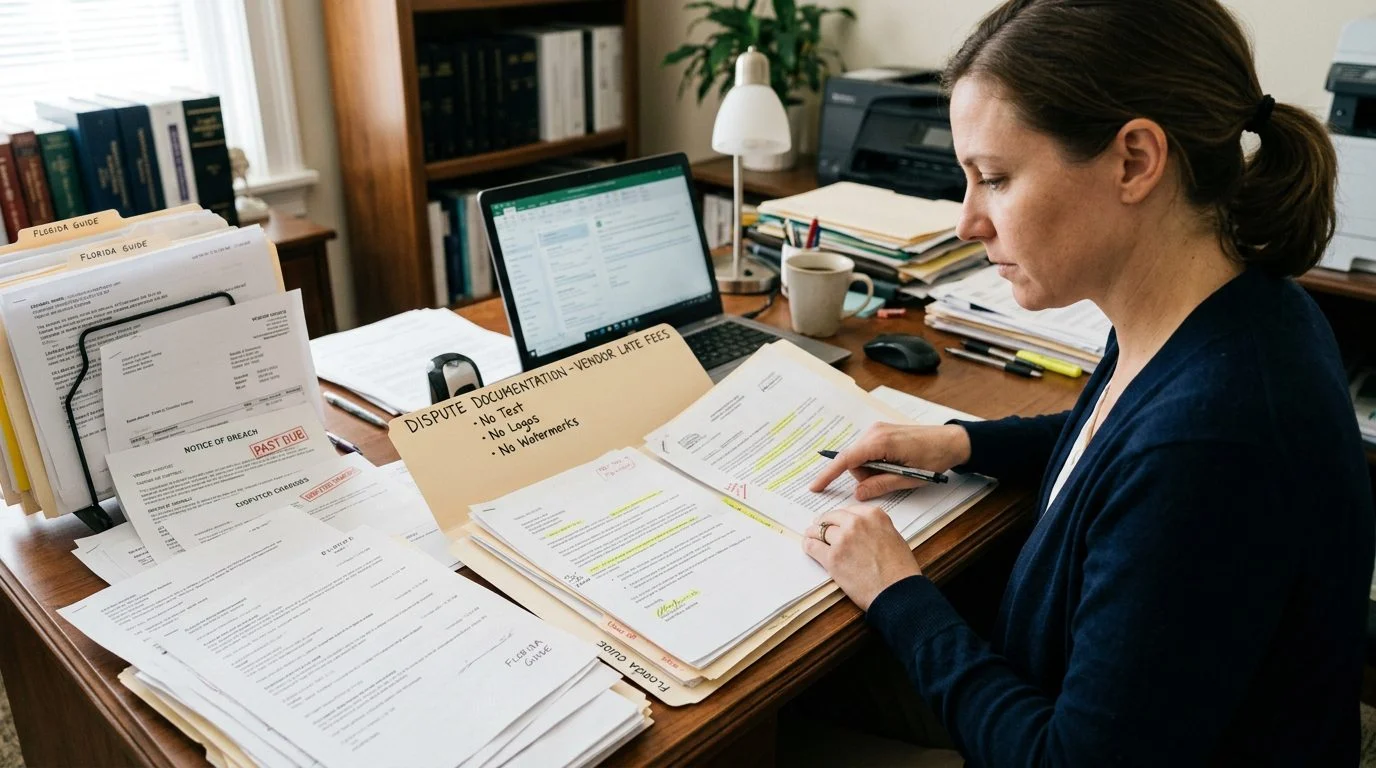
Start by gathering the paperwork, building a dated timeline, and putting your objection in writing.
- Gather the records. Collect the signed contract, every amendment, purchase orders, prior invoices, and related emails and texts.
- Build a timeline. Note when each invoice was issued, when payment was due, and when and how your business paid.
- Find the source. Ask the vendor to identify the exact language behind the fee. Then compare that language to what you signed.
- Object in writing. Identify the invoice, state why the fee is disputed, and ask for the contract section the vendor relies on. Written objection. For a contract for the sale of goods for the price of $500 or more, which generally is not enforceable unless there is a signed record, there is a rule between merchants: if within a reasonable time a record confirming the contract, sufficient against the sender, is received and the party receiving it has reason to know its contents, that record satisfies the writing requirement against that party unless notice of objection to its contents, given in a record, is given within 10 days after it is received (Fla. Stat. § 672.201). See Fla. Stat. § 672.201. See Fla. Stat. § 672.201.
- Pay carefully. Keep paying amounts you do not dispute. If you pay a disputed fee, say in writing that you are paying under protest. How a payment affects your rights turns on the facts.
- Watch the notice rule. For goods already accepted, a buyer must notify the seller of a breach within a reasonable time after he or she discovers or should have discovered it, or be barred from any remedy. See Fla. Stat. § 672.607. The buyer also carries the burden of proving the breach.
Fla. Stat. § 672.607(5)(b) addresses infringement claims and reads: “(b) If the claim is one for infringement or the like (s. 672.312(3)) the original seller may demand in writing that his or her buyer turn over to him or her control of the litigation including settlement or else be barred from any remedy over and if he or she also agrees to bear all expense and to satisfy any adverse judgment, then unless the buyer after seasonable receipt of the demand does turn over control the buyer is so barred.” Early, clear written records make every later step easier.
Breach of Contract, Unjust Enrichment, and What a Vendor May Argue
A vendor that collects a fee the contract does not allow may face a breach of contract claim. A business that was overcharged may have claims of its own.
Vendors sometimes use it as a fallback. But when an express contract covers the same subject, claims from that relationship generally cannot support unjust enrichment. See Williams v. Johnson. If the signed agreement addresses late payments, that fallback may not work.
Vendors often argue that you accepted the goods or services, kept ordering, or saw the fee on the invoice. Each argument is weighed on its facts. Buyers generally must pay the contract rate for goods they accept. See Fla. Stat. § 672.607. Accepting goods precludes later rejection of them, and if you accepted with knowledge of a nonconformity you cannot revoke that acceptance because of it, unless you accepted on the reasonable assumption that the nonconformity would be seasonably cured, though acceptance does not by itself impair other remedies the code provides for a nonconformity.
Your own payment history and communications can shape how the facts look. Keep records of all of it, including the messages where you raised concerns.
Not sure what your next step is?
Talk it through with our team — the first consultation is free, confidential, and carries no obligation.
Common Questions About Disputing Vendor Late Fees in Florida
Here are short answers to the questions people ask most often. Each is a general point, not a prediction.
Can a vendor add a late fee to an invoice after the work is done?
A fee usually needs a basis in the signed agreement or an accepted change.
Does paying the invoice waive my right to dispute the late fee?
Not automatically. Put your objection in writing when you pay, so the record is clear.
Is interest on an overdue account the same as a late fee?
No. Florida sets statutory judgment interest each quarter under Fla. Stat. § 55.03. That section does not change a rate set by written contract.
How quickly should I object?
Object in writing promptly.
Can my business owe attorney’s fees if a contract dispute goes to court?
Possibly, if the contract has a fee clause. A court may allow reasonable fees to the other party that prevails on the contract. Under Fla. Stat. § 57.105(7), if a contract lets one party recover attorney’s fees for enforcing it, the court may also allow reasonable attorney’s fees to the other party when that party prevails, whether as plaintiff or defendant, for contracts entered into on or after October 1, 1988. See Fla. Stat. § 57.105.
Talk Through the Late Fee Before It Becomes a Larger Dispute
Reviewing the signed paperwork early is a sensible first step. The facts are easiest to pin down while they’re fresh.
KEW Legal, based in Coral Gables and Sunny Isles Beach, works with business owners and investors across Miami-Dade and South Florida on vendor and contract disputes. If you’re handling a vendor invoice for your company, bring the signed contract, any amendments, the disputed invoice, and the related messages. Kristina E. Wilson, a lawyer at KEW Legal, is responsible for this page. For more on vendor disputes, see our vendor contract breach attorney page.
If a late charge you don’t remember agreeing to is on a vendor invoice, call 305-990-2300 or send us a message. The first consultation is free, confidential, and carries no obligation to continue.
How KEW Legal Supports Business Owners
Contract Review
We read the signed agreement, purchase orders, and invoice history together to see whether a late fee has a basis in the deal you actually made.
Protecting Your Position
We help you respond to unexpected charges in a way that keeps your objection documented while your operations continue.
Outside General Counsel
KEW Legal acts as outside general counsel for business owners and investors across Miami-Dade and South Florida, so vendor questions reach a lawyer who knows your business.
Early Attention
Raising a billing dispute early tends to keep options open and the paper trail clear.
Warning: Do Not Pay in Silence
Paying a disputed late fee without a written note can make your objection harder to prove later. When you pay, state in writing that you dispute the charge and why.
Four Steps to Take Before You Pay
Pull the Signed Agreement
Find the contract, purchase order, and any amendments. Check whether late fees, interest, or payment terms are written into them.
Review the Invoice History
Compare the disputed charge with past invoices, emails, and approvals to see how the vendor has billed you before.
Put Your Objection in Writing
Send a short, factual message that identifies the invoice, the amount in question, and the reason you dispute the fee.
Talk to a Business Lawyer
A consultation can help you decide how to respond, whether to negotiate, and what to do if the vendor refuses to adjust the bill.
Have a vendor invoice you are not sure about? Schedule a free, confidential first consultation with KEW Legal. There is no obligation to continue.
Related practice areas
Request a Consultation
Fill out the short form and we will take it from there.