
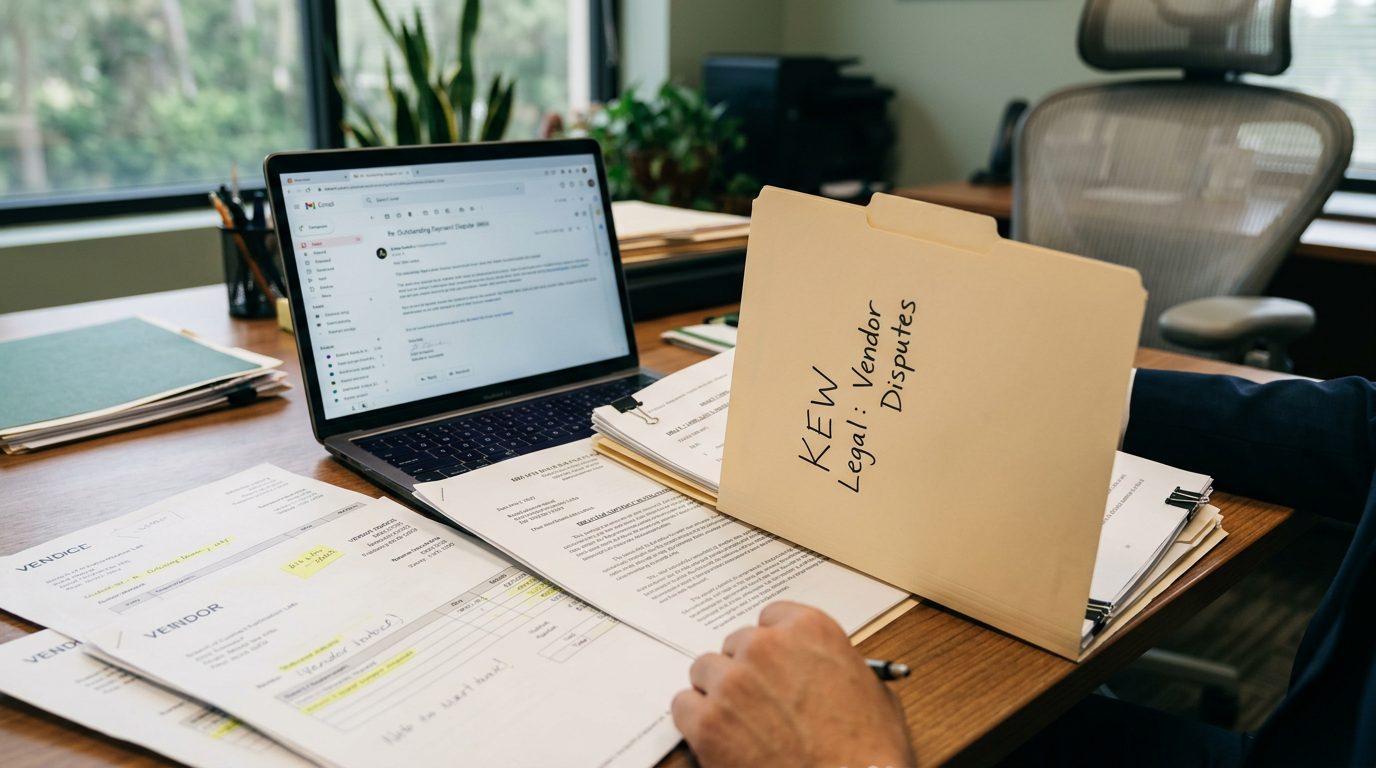
Business Contract & Vendor Dispute Attorney | Coral Gables and Sunny Isles Beach
Vendor Payment Withholding Attorney in Florida
KEW Legal helps business owners across Miami-Dade and Broward decide whether withholding a vendor payment is defensible, and how to respond before a payment dispute escalates. Free first consultation, confidential and without obligation.
By Kristina E. Wilson · Published October 22, 2026
A vendor payment withholding dispute attorney in Florida looks at two things first: what the contract allows, and what the paper trail proves. Without that support, the business that stops paying can become the party in breach. This page explains the difference. It also covers what KEW Legal reviews before any payment is held.
What is a vendor payment withholding dispute?
A vendor payment withholding dispute starts when a business holds back all or part of an invoice. The business believes the vendor’s work or billing falls short. The vendor believes it is owed the money.
Common triggers include:
- Poor, incomplete or defective work
- Overbilling, or charges nobody approved in writing
- Missed deadlines or milestones
This page is written for owners, managers and investors who pay contractors, suppliers and service providers across Miami-Dade and South Florida, including Broward County. Many owners stop paying first and read the contract later. That order is where most of the trouble starts.
If you're deciding whether to hold back a vendor's invoice over poor work or overbilling, we can review your contract and paper trail with you before any money moves. Talk it through with our team — the first consultation is free, confidential, and carries no obligation.

When can withholding payment be defensible under a Florida contract?
The contract is the starting point. Read these terms first:
- Payment terms and when invoices are due
- Scope of work and acceptance criteria
- Change-order rules
- Any right to offset or hold back money
Some contracts require written notice and a chance to fix the problem before any hold-back. These notice-and-cure clauses change what you can do and how you must do it.
For goods a buyer has accepted, Florida law puts the burden on the buyer to prove any breach. See Fla. Stat. § 672.607. Service contracts may follow different rules, so check which framework fits your deal. Whether a particular hold-back is supportable depends on the facts of each relationship.
What are the risks of withholding without a clear contract basis?
Withholding without a contract or legal basis can itself be a breach. That can expose your business to a claim for the unpaid balance. Under Fla. Stat. § 672.709, a seller may recover the price when a buyer fails to pay for goods it accepted.
Other risks include:
- Demand letters and lawsuits. A vendor may send a demand or file a collection case.
- Interest. Where interest accrues without a special contract rate, the rate follows Fla. Stat. § 687.01, which points to the rate in § 55.03.
- See Fla. Stat. § 57.105. That same section requires courts to award attorney’s fees, paid in equal amounts by the losing party and its lawyer, where they knew or should have known that a claim or defense was not supported by the material facts or by then-existing law. But fees for a claim or defense unsupported by then-existing law may not be awarded against a represented party, or where it was a good-faith argument to change the law with a reasonable expectation of success. Fees also may not be awarded against a lawyer who acted in good faith on the client’s representations about the facts.
- Lost leverage. Vague, late or misdirected notices weaken your position in negotiation.
- Disruption. A dispute can slow projects, supply or operations you still need.
What documents support a set-off, and what should you gather?
The strongest files pair the contract with dated proof of the problem. Gather these before you send any dispute notice:
- The contract, purchase orders, scope of work, specifications, and signed amendments or change orders
- Invoices, payment history, and any charge you did not approve in writing
- Inspection reports, photos, test results, delivery records and punch lists
- Emails, texts and meeting notes showing what was requested, promised and reported
- A simple timeline of deadlines, missed milestones and your responses
Write the timeline in plain facts. Dates matter more than adjectives. Florida also sets time limits for suing on a contract. A clause that tries to shorten them is void under Fla. Stat. § 95.03, so don’t assume a contract term controls the clock.
How does KEW Legal assess the position and the notice?
KEW Legal reviews the contract and the record first. Then it sizes any hold-back to what the documents support. The usual steps are:
- Review the payment, withholding, notice, cure and dispute-resolution terms.
- Compare the documented problem with the amount being held, so the hold-back does not exceed the record.
- Draft or review the written notice. It should name the specific defect, the contract provision relied on, and the cure or response required.
- Advise on the payment choice: pay under protest, pay part, escrow the disputed amount, or hold the balance pending resolution.
- Plan the next step if the vendor disagrees. That may mean negotiation, mediation, arbitration or litigation, depending on the contract. A written agreement to arbitrate is generally enforceable under Fla. Stat. § 682.02, except on grounds that exist to revoke a contract.
Silence can carry risk too. Put any objection in writing when you pay.
Why do business owners work with KEW Legal on vendor payment disputes?
KEW Legal acts as outside general counsel for business owners and investors across Miami-Dade and South Florida. Vendor payment withholding disputes are part of that work. The firm has offices in Coral Gables and Sunny Isles Beach.
Kristina E. Wilson is the responsible lawyer for this page. The firm’s lawyers include Kristina E. Wilson and Natalie Martinez. Our team can also help with related matters:
- Business contract and vendor disputes
- Commercial leases
- Partnership disputes
- Employment law for employers, when a vendor issue overlaps with staffing
Vendor problems often connect to other business problems, so one review can cover both. The first consultation is free, confidential, and carries no obligation to continue. You can review your position before you decide what to do with the money.
Not sure what your next step is?
Talk it through with our team — the first consultation is free, confidential, and carries no obligation.

Frequently asked questions about vendor payment withholding in Florida
Can I withhold payment if the vendor’s work is poor?
Withholding without that basis can itself be a breach.
Can I offset what a vendor owes me against an invoice?
What if the vendor missed a deadline?
A missed deadline matters most when the contract ties payment or remedies to the schedule. Check the timing terms and any notice rules first.
Does paying an invoice without objection waive my dispute?
Paying without a written objection can weaken your position. Put any objection in writing at the time you pay.
How do I reach KEW Legal?
Call 305-990-2300 or send a message through the contact page. KEW Legal has offices in Coral Gables and Sunny Isles Beach.
If you’re deciding whether to hold back a vendor payment over poor work or overbilling, contact KEW Legal and we’ll review your contract and paper trail with you before any money moves.
How KEW Legal approaches vendor payment disputes
Contract review first
We start with the agreement, the statement of work, payment terms and any notice provisions, so decisions rest on what the contract actually says.
Protecting your position
We help you avoid steps that could expose your business to a counterclaim, including how to hold back funds and document your reasons.
Clear communication with vendors
We help you draft written notices and responses that set out your concerns clearly and keep the relationship on record.
Outside general counsel
Our team works alongside business owners as ongoing outside general counsel, so vendor issues are handled with the rest of your company's legal needs in view.
Timely attention
Payment disputes move quickly. We prioritize prompt review so you understand your options while the facts are still fresh.
Withholding payment can create its own liability
Review the contract and any notice requirements before you stop payment.
Common reasons vendor payments get withheld
Poor or incomplete work
Whether defective or unfinished work supports holding payment depends on the contract terms and the facts. We review both with you before any step is taken.
Missed deadlines
A late delivery matters most when the contract ties payment or remedies to the schedule. We check the timing terms and notice rules first.
Disputed invoices
When you question charges, we help you separate undisputed amounts from disputed ones and document your objections in writing.
Next steps with a vendor
From a demand letter to negotiating a resolution, we help you choose a response that fits your contract and your ongoing business needs.
Speak with Kristina E. Wilson at KEW Legal about your vendor payment question. Call 305-990-2300 or send us a message for a free first consultation, confidential and without obligation.
Related practice areas
Request a Consultation
Fill out the short form and we will take it from there.