
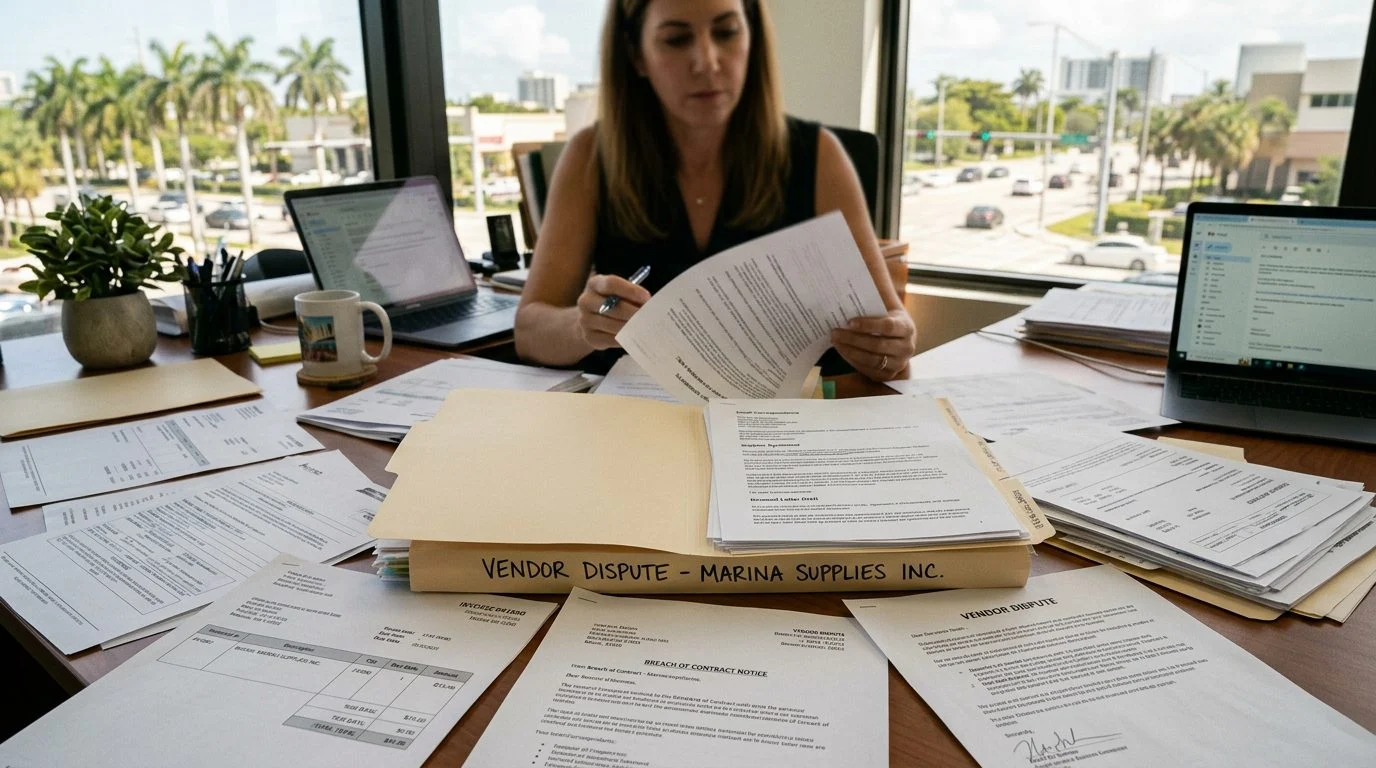
Vendor and Contract Disputes | Miami-Dade County
Vendor Demand Letter Attorney in Miami: Put Your Position in Writing First
KEW Legal helps business owners in Coral Gables, Sunny Isles Beach and across South Florida draft demand letters that state the problem clearly and leave room for a resolution.
By Kristina E. Wilson · Published November 27, 2026
A supplier that missed deliveries or stopped paying can stall your operations and drain your cash flow. You need a clear next step before the dispute grows.
A vendor demand letter is a formal written notice from your business to the supplier. It names the breach, the contract that applies, the fix you want and the deadline. It is often the first step before any lawsuit.
What a Vendor Demand Letter Is and When You Need One
A vendor demand letter is a written notice that states the supplier’s breach, the contract basis, the cure you require and a response deadline. It fits business owners, managers and employers whose supplier delivered late, sent goods that do not match the order, billed incorrectly, or stopped performing.
A letter matters for a practical reason. It puts the dispute in writing and shows the supplier exactly what you claim. If your contract requires notice before you can take a remedy, the letter may be the step that meets that requirement.
Florida law adds a timing point for goods you have already accepted. You must notify the seller of a breach within a reasonable time after you discover, or should have discovered, the breach, or you may be barred from any remedy.
A demand letter is not a lawsuit, and it does not replace one. Under Fla. Stat. § 672.607(5)(b), where the buyer is sued on an infringement or similar claim that the seller is answerable over, the original seller may demand in writing that the buyer turn over control of the litigation, including settlement, or else be barred from any remedy over, if the seller also agrees to bear all expense and to satisfy any adverse judgment. If the seller also agrees to bear all expense and to satisfy any adverse judgment, the buyer is barred from any remedy over unless the buyer turns over control after seasonable receipt of the demand. If the supplier refuses, the letter still frames your claim for any later case.
Not sure what your next step is?
Talk it through with our team — the first consultation is free, confidential, and carries no obligation.

What a KEW Legal Demand Letter Covers
Each letter is built from your contract and your records, and it states a specific demand the supplier can answer. A typical letter includes:
- The parties, the agreement, its date, and the key terms: scope, price, delivery, warranties and payment.
- A timeline of performance, with the failures, dates, invoices, purchase orders and messages that support the claim.
- The contract clauses you rely on, such as notice-and-cure terms, warranty language, limits on liability and any attorney’s fee provision.
- The exact demand: cure, refund, replacement, credit, payment of an amount due, or return of property.
- A response deadline and a plain statement of what happens if the supplier does not respond.
- A preservation request asking the supplier to keep emails, texts, shipping records and invoices.
- A reservation of rights, so the letter does not give up claims you may pursue later.
Warranty language matters too. Under Fla. Stat. § 672.316, words such as “as is” can exclude implied warranties, unless the circumstances indicate otherwise. Read the warranty terms before you assume a claim exists.
How the Process Works, Step by Step
The process runs in six steps, from your first call to a decision about next steps.
- Initial consultation. You describe the relationship, the contract or the lack of one, the breach and your losses.
- Document review. We review the agreement, purchase orders, invoices, delivery records, emails and texts, and match each failure to a contract term.
- Drafting and your approval. We draft the letter for your review. Nothing goes out until you approve the facts and the demand.
- Delivery. The letter goes out by the method the contract requires, such as certified mail or a named notice address. We keep a copy for the file.
- Response window. Most letters set a deadline measured in days or weeks, based on the contract. We track replies and advise on any counter-offer.
- Next steps. If the supplier does not resolve the dispute, we discuss options such as a second letter, a settlement proposal, mediation where the contract requires it, or a lawsuit. We cover the cost, timing and risk of each. Mediation is a structured process guided by a neutral mediator, as described in American Arbitration Association mediation resources.
Before You Send: Checks That Shape the Letter
Before you send anything, check the notice clause, the dispute terms and your own performance.
- Notice clause. Confirm who must receive notice, at what address, by what method, and within what cure period.
- LLC suppliers. If the supplier is a Florida limited liability company, notice may go to a member or manager, to the registered agent at its Florida registered office, or to another Florida address that is in fact its principal office. See Fla. Stat. § 605.0117.
- Dispute terms. Look for an arbitration clause. Florida makes a written agreement to arbitrate valid, enforceable, and irrevocable, except upon a ground that exists at law or in equity for revoking a contract, as set out in Fla. Stat. § 682.02.
- Time limits. Under Fla. Stat. § 95.11, if your claim rests on an oral or other unwritten contract, including a sale and delivery of goods, you have four years to file it. A contract cannot shorten that period, under Fla. Stat. § 95.03.
- Your own performance. Suppliers often answer a demand by pointing to unpaid invoices on your side. Pull your payment records first.
- Evidence and talk. Stop deleting messages, photograph defective goods, and keep packaging. Avoid casual admissions on calls or texts.
Why Work With KEW Legal on a Supplier Dispute
KEW Legal focuses on business contract and vendor disputes for owners and investors across Miami-Dade and South Florida. Our business contract and vendor dispute attorney work covers letters like this one.
- Kristina E. Wilson is the responsible lawyer for this page. Natalie Martinez is also a lawyer at the firm.
- Our lawyers also serve business clients as outside general counsel, which means they review contracts and vendor relationships on an ongoing basis.
- Our offices are in Coral Gables and Sunny Isles Beach, Florida. We serve business owners across Miami-Dade and Broward County.
- Each letter is drafted from your agreement and your records, not from a generic template.
- Ongoing counsel lets the same firm review your next supplier agreement, so notice, warranty and remedy terms are clearer from the start.
- Results depend on the facts, the contract and the other side’s position. No one can promise an outcome. What we offer is a clear assessment and a plan.
Frequently Asked Questions About Vendor Demand Letters
Here are short answers to the questions owners ask most often before sending a demand.
Do I have to send a demand letter before suing a supplier?
Not always. Many contracts require written notice and a chance to fix the problem, and a letter often makes your claim clear.
How long does the supplier have to respond?
The deadline appears in the letter. It usually follows the contract’s cure period or a reasonable time for the problem.
Does a demand letter stop the statute of limitations?
A letter is not a lawsuit, so it does not start one. Florida’s time limits keep running, so review them at the start.
Do I need a written contract?
Not always. Purchase orders, invoices and emails can support a claim. For a sale of goods priced at $500 or more, Fla. Stat. § 672.201 generally requires a signed record.
Can you help if the supplier is out of state?
Possibly. Where your business is, where the contract was performed and the facts of your dispute all shape the approach.
Not sure what your next step is?
Talk it through with our team — the first consultation is free, confidential, and carries no obligation.

Talk to KEW Legal Before the Supplier Hears From You
If a supplier has missed deliveries, shipped defective goods or stopped paying, talk with KEW Legal before you choose between a demand letter and a lawsuit. Call 305-990-2300 or send us a message to schedule your consultation. The initial consultation is free, confidential, and carries no obligation to continue.
What a Well-Drafted Demand Letter Can Do
State the problem clearly
A letter identifies the agreement, the failure or breach, and what your business needs the supplier to do to address it.
Protect your written record
A dated, formal notice creates a record of your position that can be relied on if the dispute later moves forward.
Open a path to resolution
Many vendor disputes are settled after a supplier receives a clear letter from counsel, without the cost of litigation.
Set up your next steps
The letter can frame the remedies you are seeking and prepare the ground for negotiation, mediation or a lawsuit if needed.
Check Your Contract Before You Send Anything
Some supply agreements require written notice in a specific form, to a specific address, or with an opportunity to correct the problem. A letter that ignores those terms can weaken your position, so review the agreement with counsel first.
How We Prepare Your Vendor Demand Letter
Review the contract
We read the agreement's terms, notice provisions, cure periods and dispute clauses to confirm what the letter must address.
Gather the record
We organize invoices, purchase orders, delivery records, emails and any prior correspondence about the performance issue.
Draft a clear demand
We write a firm, professional letter that describes the breach, the losses your business has incurred and the response you require.
Plan the follow-up
We discuss with you how to respond if the supplier cures, disputes the claim or does not reply, and what options remain available.
Call 305-990-2300. The first consultation is free, confidential, and carries no obligation to continue.
Request a Consultation
Fill out the short form and we will take it from there.