
Business Contracts & Vendor Disputes | Coral Gables and Sunny Isles Beach
Vendor Failed to Perform? Know Your Florida Contract Options
Missed deliveries, substandard work and stalled projects can put a business's plans at risk. Here is how to protect your position.
By Kristina E. Wilson · Published November 18, 2026
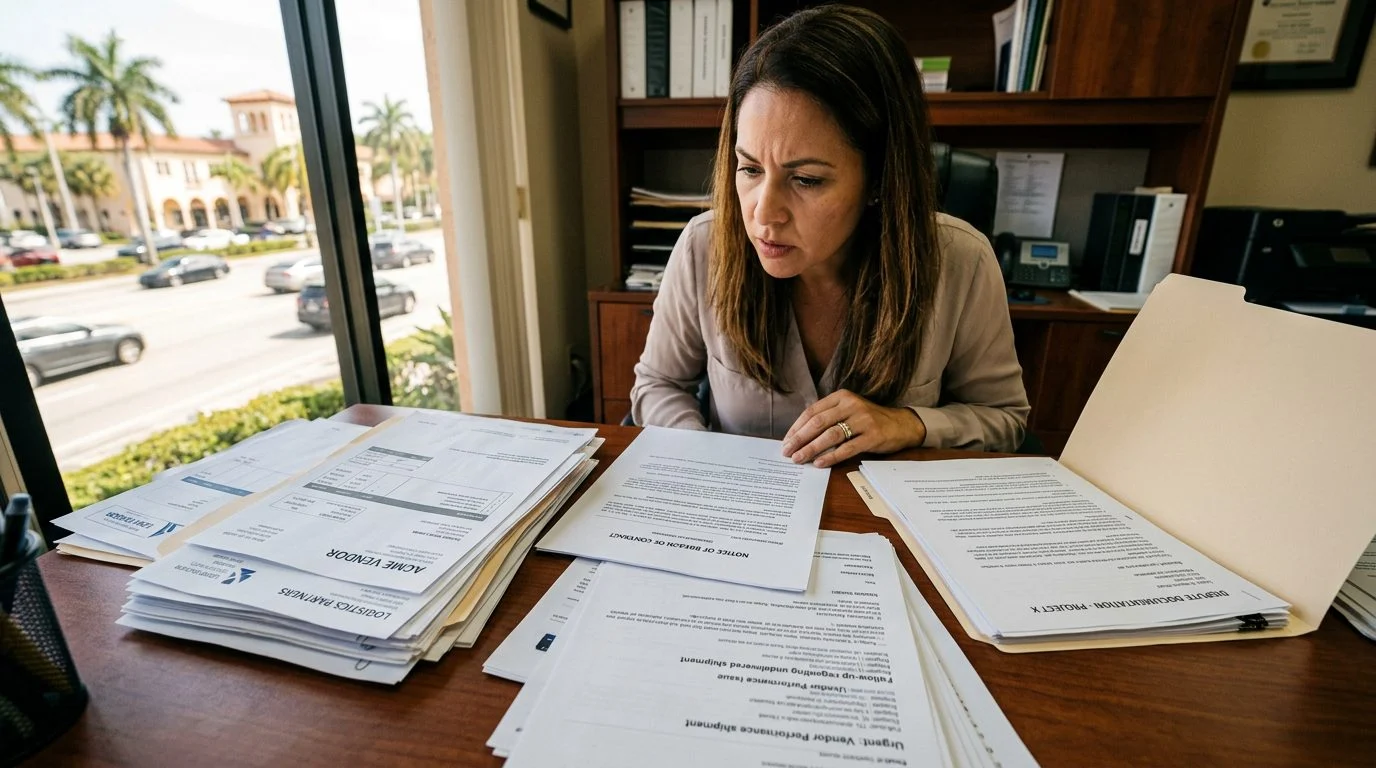
A vendor took your deposit and never delivered, or delivered work that misses what you signed for. Your contract wording, your written notice, and your records decide which route fits.
When a Vendor Falls Short Under a Florida Contract
A vendor falls short when it does not perform what the contract requires. That happens in two main ways.
- Non-delivery: the goods or services never arrive.
- Defective performance: the work arrives but misses the agreed specs, quality, or schedule.
Not every miss carries the same weight. A material breach goes to the core of the deal, like equipment that cannot do its job. A minor breach may be a small lapse that does not defeat the purpose of the deal.
Your written agreement, purchase orders, statements of work, and change orders set the standard. Under Fla. Stat. § 672.201(1), except as otherwise provided in that section, a contract for goods priced at $500 or more is not enforceable by way of action or defense unless there is a record showing that a contract for sale was made between the parties, signed by the party against whom enforcement is sought or by that party’s authorized agent or broker, and the contract is not enforceable beyond the quantity of goods shown in the record. If the deal is for goods, Chapter 672 of the Florida Statutes, the sales-of-goods rules, applies.
If a vendor took your payment and never delivered, or delivered work that misses your contract, we can review your records and talk through your options with you. Talk it through with our team — the first consultation is free, confidential, and carries no obligation.
Remedies Florida Law Makes Available
The right remedy depends on the breach and the contract, and each one has its own proof rules.
- A claim for specific performance has a one-year limit under Fla. Stat. § 95.11.
- Rescission and restitution: canceling the deal and recovering what you paid. Florida courts list what a rescission claim must include: notice of rescission, an offer to return benefits you received, and no adequate remedy at law, as the Waterside at Boynton ruling explains.
For goods, warranties matter too. If a merchant sold you goods, a warranty that they are merchantable is implied unless the contract excludes or changes it, under Fla. Stat. § 672.314. A promise about the goods that becomes part of the deal can create an express warranty, under Fla. Stat. § 672.313.
Your contract may also cap liability or require notice and a cure period.
Withholding Payment and Stopping Service Before You Sue
- Read first. Review the payment, notice, and dispute terms before you hold back any money.
- Match the amount. A hold-back far larger than the problem invites a fight of its own.
- Follow notice steps closely. Florida courts do not favor reading a notice step as a condition unless plain words or necessary implication require it, so the exact wording matters (Covelli Family ruling).
- Pay for goods you kept. If you accepted goods, you must pay the contract rate for them. If you don’t, a seller can sue for the price of goods accepted.
Whether a vendor can stop service during an invoice dispute turns on what your contract says.
Documenting the Failure So Your Claim Can Be Proven
Your claim is only as strong as the records behind it. Start collecting them now.
- The contract, pricing schedules, specifications, and change orders.
- Invoices, payment records, delivery slips, and inspection reports.
- Emails, texts, and meeting notes showing what was promised and when.
- Dated photos of each defect, plus a written list of specific failures.
- A running timeline of missed deadlines, cure requests, and vendor replies.
Avoid written admissions or promises to pay until someone reviews your claim.
For goods, the buyer carries the proof. Under Fla. Stat. § 672.607, the buyer must establish any breach with respect to goods it accepted.
Written records matter for the contract itself. Under Fla. Stat. § 672.201, a contract for goods priced at $500 or more is generally not enforceable without a signed record. Between merchants, a written confirmation can satisfy that rule against you if it arrives within a reasonable time and you have reason to know its contents, unless you object in writing within 10 days after you receive it.
How a Vendor Contract Dispute Typically Proceeds
A vendor dispute can move through several steps, though not every case reaches each one.
- Review. Check the contract, payment history, and documents to identify the breach and the remedies.
- Notice and demand. Send written notice that states the breach, the contract provision, the cure you want, and a deadline.
- Talks or mediation. On one party’s request, a Florida court must refer any filed civil action for money damages to mediation, provided the requesting party is willing and able to pay the costs or the costs can be equitably divided between the parties, with listed exceptions (Fla. Stat. § 44.102).
- Suit and venue. A case is brought where the defendant resides, where the cause of action accrued, or where the property is located, but this rule does not apply to actions against nonresidents (Fla. Stat. § 47.011). For South Florida businesses, that could mean Miami-Dade or Broward County.
- A written offer under Fla. Stat. § 45.061 stays open for 45 days unless withdrawn, but that section does not apply to causes of action that accrue after its effective date. Fla. Stat. § 45.061 reads: “The offer shall remain open for 45 days unless withdrawn sooner by a writing served on the offeree prior to acceptance by the offeree.” If no one accepts it in that time, it is deemed rejected.
Timing matters. Other claims can have shorter periods, so move promptly.
Attorney Fee Clauses and Who Pays Legal Costs
A prevailing-party fee clause can shift legal fees to the losing side, but only as its exact words allow.
- Under Fla. Stat. § 57.105, if a contract contains a provision allowing attorney’s fees to a party when he or she is required to take any action to enforce the contract, the court may also allow reasonable attorney’s fees to the other party when that party prevails in any action, whether as plaintiff or defendant, with respect to the contract. This subsection applies to any contract entered into on or after October 1, 1988.
- Sanctions. A court must award a reasonable attorney’s fee to the prevailing party, paid equally by the losing party and its attorney, when they knew or should have known that a claim or defense, when first presented to the court or at any time before trial, was not supported by the material facts or would not be supported by then-existing law. No sanction for lack of support in existing law may be awarded for a good faith argument to change the law with a reasonable expectation of success, or against a represented party. No sanction for a claim or defense lacking support in the material facts or existing law may be awarded against the losing party’s attorney who acted in good faith, based on the client’s representations about the existence of those material facts. A sanctions motion must be served first, and the other side then has 21 days to withdraw or correct the challenged claim before it can be filed.
No one can promise a fee award in advance. Whether a fee clause applies to your claim turns on its wording, the claims you bring, and how the case ends.
Not sure what your next step is?
Talk it through with our team — the first consultation is free, confidential, and carries no obligation.
How KEW Legal Handles Vendor Performance Disputes
KEW Legal is a Florida business law firm with offices in Coral Gables and Sunny Isles Beach. It acts as outside general counsel for business owners and investors across Miami-Dade and South Florida, including Broward County.
Our lawyers focus their business contract and vendor dispute work on non-delivery and defective performance. Kristina E. Wilson is the responsible lawyer for this page, and Natalie Martinez is also a lawyer at the firm.
Our team starts with the contract, the payment history, and your documents. Then we explain which remedies may fit your facts and what each one would require. Some matters may be referred to another lawyer or firm, and we will tell you if yours is one of them. The initial consultation is free, confidential, and carries no obligation to continue.
Common Questions About Vendor Non-Performance in Florida
Here are short answers to common questions about vendor non-performance.
Can I withhold the final payment if the work is incomplete?
Only within what your contract allows. Check the payment and dispute terms first, because a hold-back with no contract basis can invite a claim for the price.
Do I have to give the vendor a chance to fix the problem?
If your contract requires notice and a cure period, follow it closely. For goods, a seller whose delivery was rejected may notify you it intends to cure within the contract time, under Fla. Stat. § 672.508.
Can I get back what I paid if the vendor never delivered?
It may be possible through rescission and restitution. A rescission claim must allege a rescission notice, an offer to return benefits you received, and no adequate remedy at law.
Do I need a written contract?
Not always, but for goods priced at $500 or more, a signed record is generally required. Emails and oral terms can still matter, though they are harder to prove.
Talk Through Your Vendor Problem With KEW Legal
If a vendor took your payment and never delivered, or delivered work that misses what you signed for, you may have a claim worth reviewing. Bring your contract, invoices, payment records, and any emails or photos. Call 305-990-2300, send us a message, or schedule a consultation.
Common Vendor Performance Problems
Late or Missed Deliveries
A vendor misses a deadline or never ships the goods or services your business was counting on.
Work That Does Not Match the Contract
Materials, specifications or quality fall short of what the agreement describes.
Stalled or Abandoned Projects
A vendor stops work partway through, leaving your operations, budget and timeline exposed.
Payment and Invoice Disputes
You and the vendor disagree about what is owed, what was delivered or whether a credit applies.
How KEW Legal Helps Business Owners
Contract Review
We read your agreement's performance, notice, payment and dispute terms to map out the options available to you.
Protecting Your Position
We advise on steps that preserve your rights, so you avoid actions that could create exposure of your own.
Communication With the Vendor
We help you respond to the vendor in writing and pursue a practical resolution where one is available.
Outside General Counsel
Our team stays available as your ongoing business law advisor, not only when a dispute arises.
Be Careful Before You Withhold Payment
Holding back money or ending a contract without a basis in your agreement can invite a claim against your business. Review the notice and payment terms with counsel before you act.
Your first consultation is free, confidential, and carries no obligation to continue.
Related practice areas
Request a Consultation
Fill out the short form and we will take it from there.