
Vendor Contract Disputes | Coral Gables and Sunny Isles Beach
Vendor Contract Disputes Across Multiple Locations
When a supplier or service provider falls short at one site or at every site, a clear plan keeps operations moving and your options open.
By Kristina E. Wilson · Published November 12, 2026
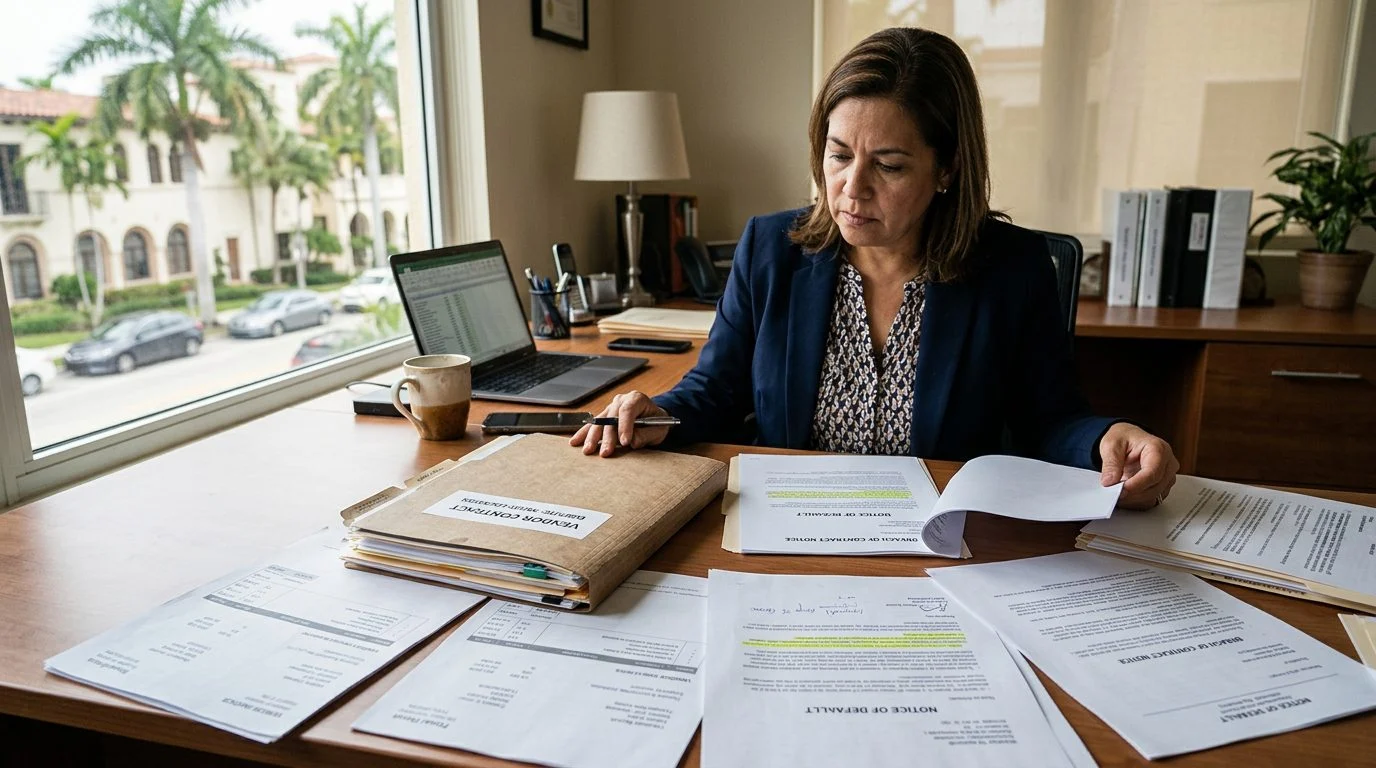
If one supplier serves several of your venues, a problem at one location can reach all of them. Shared vendors, master agreements and cross-default clauses can tie separate locations to the same fight. The safest first step is to map which entity signed each contract before you terminate, withhold payment or answer a demand.
KEW Legal is a Florida business law firm with offices in Coral Gables and Sunny Isles Beach. The firm works with business owners and investors across Miami-Dade and South Florida. This page explains how a multi-location vendor contract dispute spreads and how to keep it contained.
How one supplier problem spreads across a multi-venue business
A supplier dispute spreads when the paperwork for separate venues connects back to one contract or one term. That link is often hidden until the supplier points to it.
- Shared vendors. One supplier may serve every location under a master supply agreement.
- Purchase orders that look separate. Each venue may place its own orders, yet every order may follow the master agreement’s pricing, notice and termination rules.
- Cross-default language. Some agreements treat a breach under one contract as a default under another. Read those clauses first.
- Pressure on unpaid invoices. A supplier may try to use one location’s unpaid balance as leverage over the whole account.
Not sure what your next step is?
Talk it through with our team — the first consultation is free, confidential, and carries no obligation.

What a multi-location vendor contract dispute can cover
A multi-location vendor contract dispute can cover payment, delivery, pricing and termination disagreements. These fights arise under supply, distributor and service agreements, and the rules differ by type.
Supply and distributor deals for goods fall under Florida’s sale-of-goods rules in Chapter 672. Under the action for the price statute, a seller may recover the price when a buyer fails to pay as it becomes due for goods accepted. Under the notice of breach statute, a buyer that accepted goods must notify the seller of a breach within a reasonable time after it discovers or should have discovered the breach, or be barred from any remedy.
Service and maintenance contracts work differently. Common disputes include disputed invoices, late or short deliveries, claims that a location missed a minimum purchase amount, and fights over exclusivity or rebates. Ask who signed, too. The contracting party may be a subsidiary, not the parent brand you think of as the owner. Our distributor and supplier dispute page covers these agreements in more detail.
Mapping which entity signed what before anyone takes a position
Start by matching each agreement to the entity that signed it, the location it serves and the terms that link them. This map guides every later step.
- Named party and signing authority. Confirm each entity’s legal name and who signed for it. The Florida Division of Corporations (Sunbiz) lists registered business entities.
- Affiliates and assignments. Check whether an affiliate is bound. Check whether assignment or change-of-control clauses apply as you add hotels or new entities.
- Governing law. Under the choice-of-law statute, parties may agree which state’s law governs when a deal bears a reasonable relation to both Florida and another state.
- Under the venue statute for actions, suits must be brought only in the county where the defendant resides, where the cause of action accrued, or where the property in litigation is located, but this section does not apply to actions against nonresidents. The corporate venue statute adds rules for suits against corporations.
- Terms in emails and invoices. Under the additional terms statute, between merchants, added terms do not become part of the contract if the offer expressly limits acceptance to its terms, the terms materially alter it, or notification of objection has already been given or is given within a reasonable time after notice of them is received.
How the process works, step by step
The process starts with a consultation and moves through document review, notice review and a contained response. Timing turns on the contracts involved and on whether the dispute resolves early.
- First consultation. Describe the supplier, the venues affected and the paper trail you have.
- Document and entity review. We map which contracts, notices and payments connect to each location.
- Notice and termination review. We identify any written notice and cure period the contract requires before you end the deal or stop paying.
- Demand or negotiation. We aim the response at the agreement and location where the dispute arose. Fla. Stat. § 45.061 reads: “The offer shall remain open for 45 days unless withdrawn sooner by a writing served on the offeree prior to acceptance by the offeree.”
- Filing or defense, if needed. Under the arbitration validity statute, a written agreement to arbitrate is generally enforceable. Under the arbitration proceedings statute, a court may not refuse to order arbitration because the claim lacks merit.
Protecting your position before you act
Before you terminate or stop paying, review each contract’s notice and cure terms and keep the full record. Acting at several venues at once can widen the dispute you’re trying to contain.
- Don’t act everywhere at once. Stopping payment or ending a deal at several locations without reviewing each contract can create new exposure.
- Preserve the record. Keep emails, texts, invoices, delivery records and signed amendments for each location.
- Check indemnity and insurance terms. Know which party answers for losses before a claim arrives.
- Know when a writing is required. Under the statute of frauds for goods, a contract for the sale of goods for $500 or more is not enforceable by way of action or defense unless there is a record sufficient to indicate that a contract for sale was made between the parties and signed by the party against whom enforcement is sought or by that party’s authorized agent or broker, although the statute’s listed exceptions can make a contract enforceable even without such a signed record. Between merchants, a written confirmation sufficient against the sender, received within a reasonable time by a party with reason to know its contents, can satisfy that rule against that party unless the receiver objects in a record within 10 days after receiving it.
- Watch for errors in the paper. Whether a mistake in a signed contract can affect the deal depends on the facts and the contract’s own terms, so our lawyers review how the error arose and what the paper actually says before you decide on a next step. A scrivener’s error that says something other than what the parties agreed is one kind of mutual mistake.
- Keep messages factual. Route significant positions through counsel.
Why owners work with KEW Legal on multi-venue supplier disputes
KEW Legal works as outside general counsel for business owners. A supplier dispute is reviewed alongside your contracts, leases and entity questions, so one problem is not handled in isolation.
- KEW Legal serves business owners and investors across Miami-Dade, Broward and South Florida from offices in Coral Gables and Sunny Isles Beach.
- Kristina E. Wilson is the lawyer responsible for this page. Natalie Martinez is also a lawyer at the firm.
- The firm focuses on business contracts and vendor disputes. Related work includes commercial leases, business sales and succession planning.
- If a matter arises in a state where the firm is not licensed, the matter may be referred to another lawyer or firm. The firm will tell you that before you engage it.
Not sure what your next step is?
Talk it through with our team — the first consultation is free, confidential, and carries no obligation.

Questions owners ask before a multi-venue supplier dispute
Is a handshake deal with a supplier enforceable?
Florida generally requires a signed record for a sale of goods priced at $500 or more, with some exceptions. See the statute of frauds for goods.
Can I end a supplier relationship at every location at once?
The answer turns on each contract’s terms and notice requirements. Review them location by location first.
Will one dispute affect my other venues?
It can, through shared vendors, master agreements and cross-default language. Mapping the documents is the first step to limiting that spread.
Do I have to keep paying while I dispute an invoice?
The answer turns on what each agreement says and how notice was given. Bring every invoice and notice to the consultation.
What does the first consultation cost?
The first consultation is free, confidential, and comes with no obligation to continue.
If a supplier at one of your venues has sent a termination notice or a payment demand that could reach your other locations, call 305-990-2300 or send us a message to schedule your consultation before you respond.
How KEW Legal Approaches Multi-Location Vendor Disputes
Contract-by-Contract Review
We read each vendor agreement, amendment and purchase order that touches your locations so the full picture is clear before any decision is made.
Location-Level Analysis
Some agreements apply differently to each site. We map performance problems, notices and payments location by location.
Outside General Counsel Support
Our team works with business owners and investors as ongoing outside general counsel, so vendor issues are handled with the rest of your legal needs.
Clear Communication
We explain your options in plain language and help you decide how to respond to the vendor, from a firm written demand to negotiation or formal proceedings.
Check Before You Cut Off a Vendor
Review each contract's notice and cure terms before you act, and speak with counsel first.
Steps to Take When a Vendor Relationship Breaks Down
Gather the Documents
Collect every contract, amendment, invoice, delivery record and written communication tied to each location involved.
Document the Problem
Record what failed, where it failed, when you noticed, and what you did in response. Organized records make every later conversation easier.
Review Notice Requirements
Check how each agreement requires notice, cure periods and dispute resolution. Acting outside those terms can weaken your position.
Plan Your Response
With counsel, decide whether to send a demand, negotiate a transition, replace the vendor or pursue a claim, and apply the same approach consistently across locations.
Talk With KEW Legal Before You Act at Every Location
Related practice areas
Request a Consultation
Fill out the short form and we will take it from there.