

Business Contracts | Coral Gables and Sunny Isles Beach
Who Pays the Lawyer When a Business Agreement Ends Up in Court?
Fee-shifting terms appear in more business paperwork than many owners expect. Here is what they mean for your company and how to review them before a disagreement begins.
By Kristina E. Wilson · Published November 21, 2026
A business contract can decide who pays the lawyers if a dispute ends up in court. That is what a prevailing party attorney fees clause in Florida does. The side that wins may recover its reasonable attorney’s fees and costs from the other side under a fee clause in the contract or under certain Florida statutes.
If you own a business, invest in property or employ people in South Florida, you may already have a contract with this clause. Here is how it works, what Florida law adds, and what to check before a dispute starts.
What a Prevailing Party Attorney Fees Clause Does
A prevailing party attorney fees clause says the party who wins a dispute under the agreement can collect its reasonable attorney’s fees and costs from the other party. It is a term you agree to when you sign the contract.
The clause only reaches disputes the contract covers. If the agreement says nothing about fees, the clause is missing, and Florida’s general rule applies instead.
These clauses appear in vendor agreements, service contracts, commercial leases and partnership agreements. Partnership disputes also have a statutory home. Fla. Stat. § 620.8405 allows a partnership to bring an action against a partner for breach of the partnership agreement or for violating a duty to the partnership that causes harm, and allows a partner to bring an action against the partnership or another partner to enforce that partner’s rights.
The clause may sit in the main body of the agreement or in a separate dispute-resolution section. Read the whole contract, not just the payment terms. Search every section for “attorney’s fees,” “costs” and “prevailing party.”
If you're holding a vendor contract with a fee clause and can't decide whether to pay, withhold or negotiate, our team can talk it through with you. Talk it through with our team — the first consultation is free, confidential, and carries no obligation.
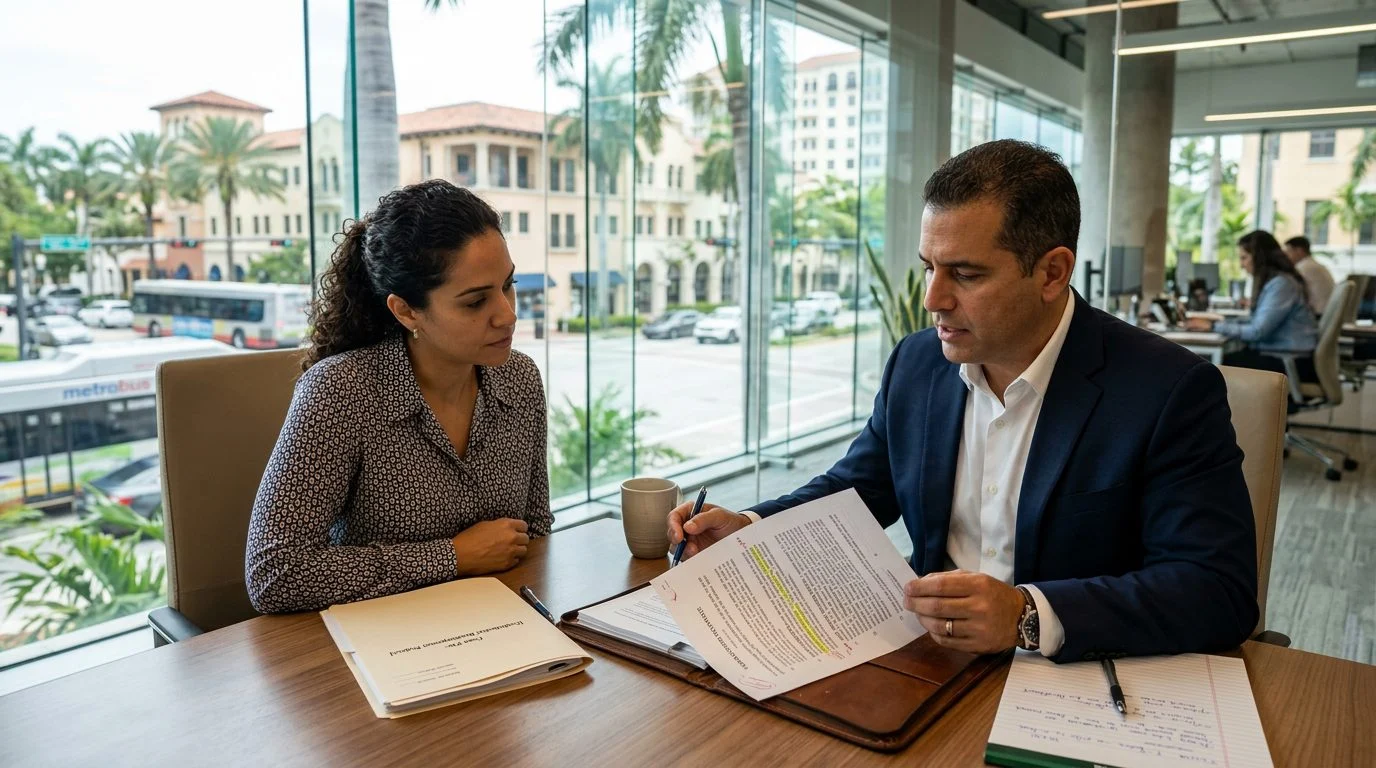
The Default Rule: Each Side Usually Pays Its Own Lawyer
Each side generally pays its own lawyer in Florida, unless a contract or a statute provides otherwise.
That default matters in business disputes. In a smaller dispute, legal fees can outweigh the amount in question. A fee clause changes that math, because it can move the winning side’s legal costs onto the losing side.
Without a clause, a party that wins a contract fight in Florida usually still pays its own legal bill. That is why the wording you sign now can matter as much as the deal itself.
Fee clauses cut both ways. The clause that protects you as the party owed money can also apply if you are the one who loses.
How Florida Statute 57.105(7) Can Make a One-Sided Clause Reciprocal
If a contract lets one party recover fees for enforcing it, Florida law may let the other side recover fees too. The statute says the court “may also allow reasonable attorney’s fees to the other party when that party prevails in any action, whether as plaintiff or defendant, with respect to the contract.”
The key word is “may.” The court decides whether to make the award, and it is not automatic. The statute applies to contracts entered into on or after October 1, 1988.
The practical effect is simple. A clause written to favor only one side can still give the other side a fee claim if it prevails on a claim or defense about the contract.
Scope still matters. The statute reaches claims and defenses “with respect to the contract,” so the clause’s wording and the issues in the case both count.
Who Counts as the Prevailing Party
A party can win one claim and lose another, and that mix can make the answer less clear.
A dispute can end with mixed results, and the court may view that outcome in different ways. That is why a clause with no definition can leave room for argument.
If the contract defines “prevailing party,” read that definition closely. It is the starting point for reading the term.
Florida also has a separate fee rule for weak positions. Under Fla. Stat. § 57.105(1), if the court finds that the losing party or its attorney knew or should have known that a claim or defense, when initially presented to the court or at any time before trial, was not supported by the material facts or by then-existing law, a reasonable attorney’s fee, including prejudgment interest, shall be awarded to the prevailing party. Subsection (3) bars monetary sanctions in certain circumstances: for example, sanctions under paragraph (1)(b) may not be awarded if the claim or defense was presented as a good faith argument for extending, modifying, or reversing existing law with a reasonable expectation of success, and may not be awarded against a represented party. That award is paid in equal amounts by the losing party and the losing party’s attorney. Whether a party prevailed depends on the facts of the dispute.
How Fee Exposure Affects Settlement Value in a Vendor Dispute
Fee exposure changes how a settlement offer looks, because each side weighs its own legal costs against what the other side could recover.
Under Florida’s offer-of-judgment statute, Fla. Stat. § 768.79, a defendant who files an offer of judgment that the plaintiff does not accept within 30 days is entitled to recover reasonable costs and attorney’s fees incurred pursuant to a policy of liability insurance or other contract from the date of filing of the offer if the judgment is one of no liability or the judgment obtained by the plaintiff is at least 25 percent less than that offer. A plaintiff’s demand for judgment works in the reverse direction: if the defendant does not accept it within 30 days and the plaintiff recovers a judgment at least 25 percent greater than the demand, the plaintiff shall be entitled to recover reasonable costs and attorney’s fees incurred from the date the demand was filed.
Courts also look at whether an offer was made in good faith. Under § 768.79(8)(a), if a party is entitled to costs and fees under this section, the court may, in its discretion, determine that an offer was not made in good faith and disallow the award.
Under Florida’s offer-of-judgment statute, Fla. Stat. § 768.79, fee shifting in a civil action for damages turns on a written offer or demand that is not accepted within 30 days. A defendant who made the offer is entitled to reasonable costs and attorney’s fees if the judgment is one of no liability or is at least 25 percent less than the offer, and a plaintiff who made the demand is entitled to them if the judgment is at least 25 percent greater, with the motion due within 30 days after the entry of judgment or after voluntary or involuntary dismissal, though the court may disallow the award if it decides the offer was not made in good faith.
Fee Clauses in Smaller Disputes
Lower-value disputes may follow a different court process than larger civil lawsuits, so the fee question can look different. Weigh the amount in dispute against what it would cost to pursue it. That comparison can shape your next step.
A small dollar amount does not change what the contract says. If the clause covers the dispute, its fee terms still apply.
Timing matters in fee fights too. Under Fla. Stat. § 57.105(4), a motion for sanctions must be served first. It may not be filed unless, within 21 days after service, the challenged paper, claim, defense or contention is not withdrawn or appropriately corrected.
Keep the signed contract in front of you when you compare options. The fee term is one piece of that picture.
Not sure what your next step is?
Talk it through with our team — the first consultation is free, confidential, and carries no obligation.
Contract Review Points to Check Before a Dispute Starts
Before a dispute starts, check whether the fee clause is mutual, one-sided or silent on fees. Four points deserve a close look.
- Does the clause cover both claims and defenses?
- Does the contract define “prevailing party”?
- Does it mention costs, interest, arbitration or mediation?
- Does it require notice or a chance to fix a problem before a party can end the deal or sue?
The last point needs care.
Use this list as a practical starting point when you read the agreement.
Frequently asked questions
Who pays attorney’s fees in a Florida business contract dispute?
Each side generally pays its own, unless the contract or a statute says otherwise.
Does a prevailing party attorney fees clause work both ways in Florida?
It can. Under Fla. Stat. § 57.105(7), for a contract entered into on or after October 1, 1988 that has a provision allowing attorney’s fees to a party required to take action to enforce it, a court may also allow reasonable fees to the other party when that party prevails, though the award is discretionary.
Can a court make a losing party pay attorney’s fees for a weak claim?
Under Fla. Stat. § 57.105(1), at any time during a civil proceeding, if the court finds that the losing party or its attorney knew or should have known that a claim or defense was not supported by the material facts or by then-existing law, a reasonable fee, including prejudgment interest, shall be awarded to the prevailing party, paid in equal amounts by the losing party and its attorney.

Talk Through Your Contract With KEW Legal
A vendor agreement or commercial lease with a fee clause can leave you unsure whether to pay, withhold, negotiate or sue.
KEW Legal is a Florida business law firm with offices in Coral Gables and Sunny Isles Beach. The firm acts as outside general counsel for business owners and investors across Miami-Dade and South Florida. Kristina E. Wilson is the lawyer responsible for this page.
The initial consultation is free, confidential, and carries no obligation to continue. La consulta inicial es gratuita, confidencial y sin compromiso de continuar. Responsable de esta página: Kristina E. Wilson, de KEW Legal, con oficinas en Coral Gables y Sunny Isles Beach, Florida. (The initial consultation is free, confidential and carries no obligation to continue.)
If you’re holding a vendor contract with a fee clause and can’t decide whether to pay, withhold or negotiate, our team can talk it through with you. Call 305-990-2300 or send us a message.
How KEW Legal Helps Business Owners Review Fee Clauses
Contract review
We read partnership agreements, vendor contracts and commercial leases to find fee-shifting language and explain how it would work in practice.
Risk planning
We help you weigh the cost of a dispute against the value of the deal before you sign, so the terms match your business goals.
Outside general counsel
Our team serves as ongoing legal counsel for business owners and investors, from employment questions to lease and vendor matters.
Local focus
Our offices in Coral Gables and Sunny Isles Beach serve business owners and investors across Miami-Dade and Broward counties.
Review the Fee Clause Before You Sign
A fee clause can work for either side. Before you sign a partnership agreement, vendor contract or commercial lease, ask a lawyer how the clause would apply if a dispute reached court.
Where Fee Clauses Commonly Appear
Partnership and operating agreements
Co-owners often agree on how disputes between partners will be handled, including who covers legal fees if a dispute goes to court.
Vendor and business contracts
Supply, service and distribution agreements may include fee terms that apply when a payment or performance dispute arises.
Commercial leases
Landlords and tenants may agree that the prevailing side can recover fees, which can affect how a lease dispute or eviction is approached.
Investment property and employment
Purchase agreements, property management contracts and employment documents can contain fee provisions that matter when a conflict escalates.
Kristina E. Wilson and our team are ready to review your contract in Coral Gables or Sunny Isles Beach. The first consultation is free, confidential and comes with no obligation to continue.
Related practice areas
- Business Contract And Vendor Dispute Attorney
- Can I Take a Vendor to Small Claims Court in Florida for a Contract Dispute?
Request a Consultation
Fill out the short form and we will take it from there.