
Business Contract & Vendor Disputes | Coral Gables & Sunny Isles Beach
Purchase Order Disputes, Handled by Business Lawyers
KEW Legal helps business owners across Miami-Dade and South Florida resolve disputes over purchase orders, vendor terms, and unpaid supplier invoices. Start with a free, confidential first consultation.
By Kristina E. Wilson · Published October 29, 2026
A purchase order dispute is a disagreement about what was ordered, what was delivered, and who owes what. If your Florida business has a late, defective, rejected, or unpaid shipment, a purchase order dispute attorney can review the paperwork and explain your options. These deals fall under Chapter 672 of the Florida Statutes, the sale-of-goods part of the Uniform Commercial Code (UCC). Timing matters, and some rules can bar a claim if you miss them.
What a Purchase Order Dispute Involves
A purchase order dispute is a fight over whether a deal was made and whether it was kept. A purchase order (PO) is a buyer’s written order for goods. It becomes part of a contract once the seller accepts it, and sometimes when both sides simply act as if a deal exists.
Florida law is flexible here. A contract for sale of goods can be made “in any manner sufficient to show agreement, including conduct by both parties which recognizes the existence of such a contract” (Fla. Stat. § 672.204).
Chapter 672 covers transactions in goods. In a mixed deal of goods and other things, the whole chapter applies if the sale-of-goods aspects predominate; if they do not, only the provisions relating primarily to the sale-of-goods aspects apply (Fla. Stat. § 672.102).
This page is for three kinds of readers:
- Buyers whose delivery is late, short, or defective.
- Sellers whose orders were cancelled or left unpaid.
- Owners who received conflicting terms on order forms and acknowledgments.
When a buyer’s PO and a seller’s acknowledgment list different terms, the paperwork can clash. Florida treats a definite and seasonable expression of acceptance, or a written confirmation sent within a reasonable time, as an agreement even when it states additional or different terms, unless the acceptance is expressly made conditional on assent to those terms (Fla. Stat. § 672.207). For more on these deals, see our vendor dispute attorney page.
If a delivery arrived wrong or an invoice is going unpaid, you may have a claim, and our team can review those records with you. Talk it through with our team — the first consultation is free, confidential, and carries no obligation.

Common Purchase Order and Sale of Goods Disputes We Handle
Most purchase order disputes fall into a few patterns. The goods are wrong, late, damaged, or never paid for.
- The buyer rejects goods that don’t match the order’s specs, quantity, or delivery date.
- The seller delays or refuses shipment after accepting the order.
- The seller delivers, and the buyer withholds payment for goods it kept.
- The vendor swaps in a different product or grade without agreement.
- Defective goods lead to warranty claims.
- Price changes, freight charges, or cancellation fees become the sticking point.
Warranty claims often turn on what the seller promised. When a seller is a merchant for goods of that kind, Florida law implies a warranty that the goods are merchantable, unless the parties exclude or change it (Fla. Stat. § 672.314).
A common mistake is assuming that an “as is” term ends every claim. Under Florida law, “as is” language can exclude implied warranties, but only unless the circumstances indicate otherwise (Fla. Stat. § 672.316).
Key Florida Rules That Affect a Claim
The biggest timing trap is notice. After a buyer accepts goods, it must tell the seller about a breach within a reasonable time after it discovers or should have discovered the breach, or lose any remedy for it (Fla. Stat. § 672.607).
Several rules work together here:
- Acceptance. Acceptance happens after a reasonable opportunity to inspect, when the buyer signifies that the goods conform or that it will keep them despite defects, fails to make an effective rejection, or does any act inconsistent with the seller’s ownership; but if that act is wrongful as against the seller, it is an acceptance only if ratified by the seller (Fla. Stat. § 672.606).
- Rejection ends. Acceptance precludes rejecting the accepted goods. Accepting with knowledge of a defect usually bars revoking acceptance for it. Acceptance alone doesn’t cut off other remedies (Fla. Stat. § 672.607).
- Payment. A buyer must pay the contract rate for goods it accepted.
- Cure. A seller whose delivery was rejected as nonconforming, while the time for performance has not yet expired, may seasonably notify the buyer it intends to cure, then deliver conforming goods within the contract time (Fla. Stat. § 672.508).
- An action on an oral or unwritten contract, including one for the sale and delivery of goods, must be brought within four years (s. 95.11(3)(j)). Whether the deal is in writing matters. A contract clause that shortens the period is void (Fla. Stat. § 95.03).
- Unfair terms. A court may refuse to enforce an unconscionable clause, or limit it (Fla. Stat. § 672.302). Under Fla. Stat. § 672.302(1), if the court as a matter of law finds the contract or any clause of the contract to have been unconscionable at the time it was made, the court may refuse to enforce the contract, enforce the remainder of the contract without the unconscionable clause, or limit the application of any unconscionable clause to avoid any unconscionable result.
How KEW Legal Handles a Purchase Order Dispute
We start with the paperwork and the timeline. Then we decide, with you, whether a demand, negotiation, or a formal step makes the most sense.
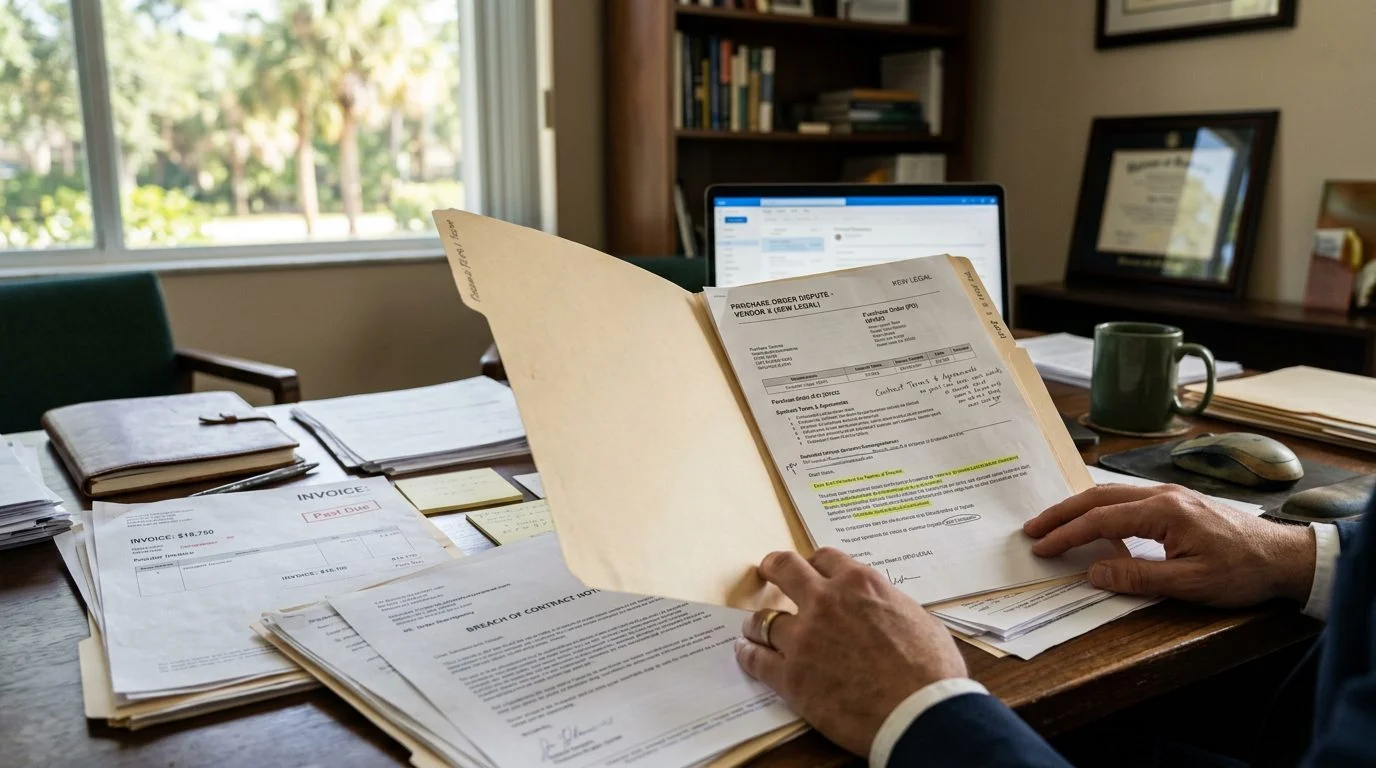
- Gather the documents. That means the PO, the vendor’s acknowledgment, invoices, shipping and receiving records, inspection notes, photos, and the email trail.
- Map the timeline. List each delivery, rejection, notice, payment, and cure attempt. This shows which notice and filing dates may matter.
- Review the governing terms. Check any conflicting forms and explain which terms are likely to control under Chapter 672.
- Send a written demand. A demand letter states the facts, the contract basis, the amount or relief sought, and a response deadline.
- Negotiate or settle. A payment arrangement or other deal may fit your goals. If talks fail, we discuss formal dispute options.
Timing varies with the facts and the other side’s response. We set expectations after the first review, not before.
Steps to Protect Your Position Early
Put every complaint in writing, keep proof of sending, and be careful about accepting goods you don’t want.
- Send rejections, complaints, and demands in writing. Keep proof of when and how each was sent.
- Don’t accept nonconforming goods without a written reservation of rights. Acceptance limits later rejection and revocation (Fla. Stat. § 672.607).
- Review the contract before you stop payments or shipments. A rushed stop can create a breach on your side.
- Preserve samples, packaging, lot numbers, photos, and test results before goods are returned, resold, or thrown out.
- Keep emails and calls factual. Avoid admissions about fault.
Why Work With KEW Legal
KEW Legal focuses its practice on business law. We act as outside general counsel for business owners and investors in Miami-Dade and South Florida. Our offices are in Coral Gables and Sunny Isles Beach.
- Kristina E. Wilson is the responsible lawyer for this page. Natalie Martinez is also one of the firm’s lawyers.
- Our lawyers handle vendor and contract matters alongside partnership, employment, sale, lease, and property issues.
- We work with businesses in Miami, Doral, Brickell, Aventura, Broward County, and Fort Lauderdale.
- The first consultation is free, confidential, and carries no obligation to continue.
- This matter may be referred to another lawyer or firm when that fits the facts better.
Not sure what your next step is?
Talk it through with our team — the first consultation is free, confidential, and carries no obligation.
Frequently Asked Questions About Purchase Order Disputes
Is a purchase order a binding contract in Florida?
Often, yes. Under Fla. Stat. § 672.207, conduct by both parties that recognizes the existence of a contract is sufficient to establish a contract for sale, even though the parties’ writings do not otherwise establish one.
What if the seller’s acknowledgment has different terms?
Florida can treat a matching acceptance as an agreement even when terms differ. Which terms end up in the deal turns on the rules in Fla. Stat. § 672.207.
How long do I have to bring a claim?
A contract clause cannot shorten that period.
Can I withhold payment for defective goods?
Goods you accepted must still be paid for at the contract rate. Notice of the breach still matters, so act quickly once you find a problem (Fla. Stat. § 672.607).
Do I need a lawyer for a small order?
Small orders can still carry notice and payment issues. A short review can help you decide your next step.

Talk Through Your Purchase Order Situation
A late shipment or an unpaid invoice can stall a project while the paperwork piles up. You may be dealing with goods that arrived wrong, a vendor that stopped answering, or a bill that keeps growing while the product sits. Contact us through our contact page or call 305-990-2300 to schedule a consultation. Bring your purchase order and delivery records so we can start with the timeline.
How We Approach Your Purchase Order Dispute
Review the paper trail
We look closely at the purchase order, the vendor's acknowledgment, invoices, delivery records, and related emails to see where the parties' terms line up and where they do not.
Practical options
We discuss the realistic paths available, from direct negotiation and demand letters to formal dispute resolution, so you can decide what fits your business.
Protecting your business
Our goal is to safeguard your cash flow, supplier relationships, and day-to-day operations while the dispute is resolved.
Outside general counsel
For many owners, purchase order disputes are one part of a broader need for steady legal support. We act as outside general counsel, so you have one team that knows your business.
Keep Your Records Organized
Save every purchase order, vendor acknowledgment, invoice, delivery receipt, and related email or text message in one place. Clear, complete records make it much easier to evaluate a dispute quickly.
Common Purchase Order Disputes We Handle
Conflicting terms
Your purchase order and the vendor's acknowledgment or invoice contain different prices, quantities, delivery dates, or conditions.
Late or nonconforming delivery
Goods or services arrive late, incomplete, or not as specified, and the vendor or your business disagrees about what happens next.
Invoice and payment disagreements
A vendor demands payment you believe is incorrect, or your business is withholding payment and the vendor is pushing back.
Cancellations and returns
Orders are canceled, changed, or returned, and the parties disagree about costs, refunds, or obligations already accepted.
Facing a Purchase Order Dispute?
Talk to KEW Legal. Your First Consultation Is Free, Confidential, and Comes With No Obligation to Continue.
Related practice areas
Request a Consultation
Fill out the short form and we will take it from there.