
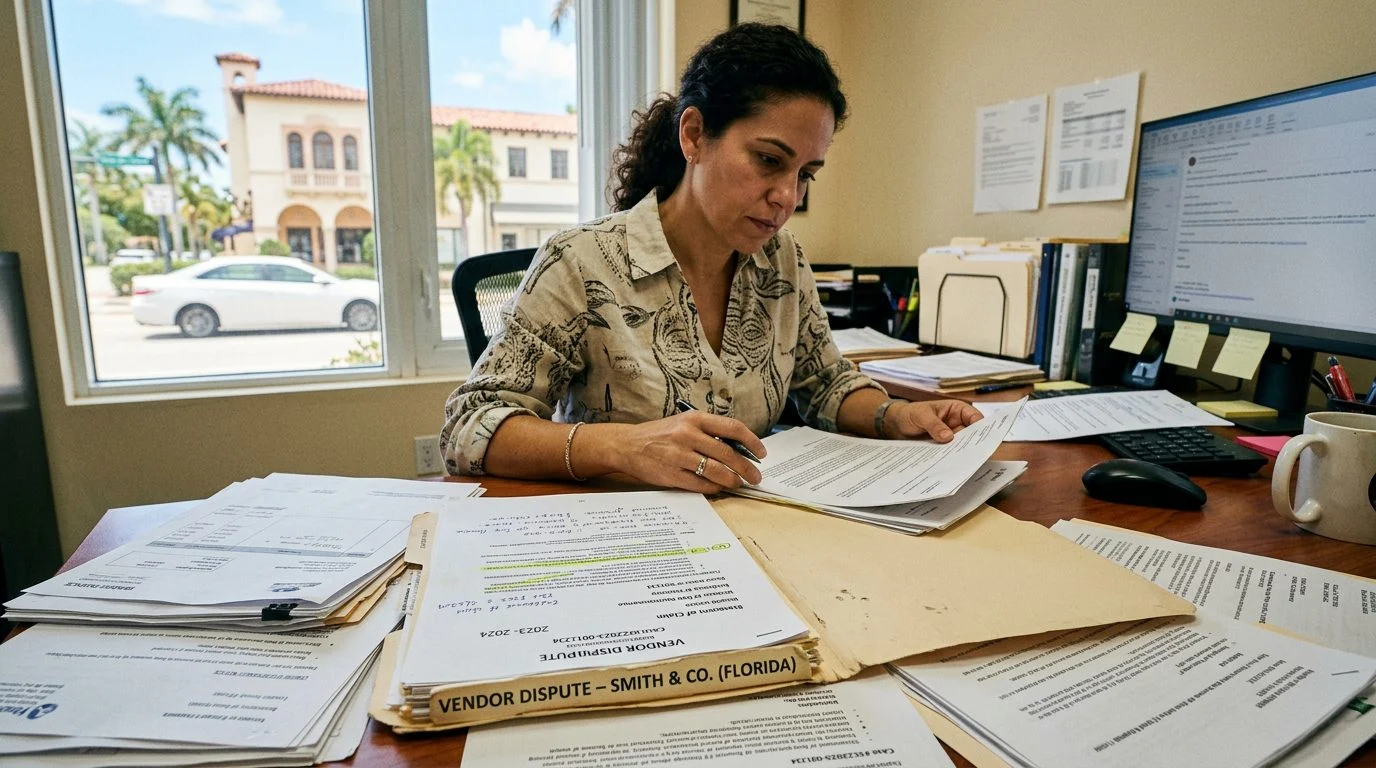
Vendor & Contract Disputes | Coral Gables and Sunny Isles Beach
Owed money by a vendor? Know your options before you file.
A small claims case can be a practical route for some vendor disputes, but the contract, the amount at stake and the facts all shape the right choice. Talk with KEW Legal before you decide.
By Kristina E. Wilson · Published November 21, 2026
If a vendor took your payment and never delivered, you may be wondering whether small claims court is a fast way to get your money back.
Short Answer: Can You Take a Vendor to Small Claims Court in Florida?
Yes, if three checks line up: the amount, the relief you want, and what the contract says. Small claims handles money claims within the limit. Unpaid invoices, deposits that were never returned, and paid-for services that were never performed often fit when the dollar value is small enough.
Start with three questions. Is the total you’re claiming within the small claims limit? Do you want money, or do you need the court to order something else? Does the contract contain terms, such as arbitration or a set place to sue, that control where the case can go? If any answer points the other way, a county or circuit court case may be the better fit.
This page covers the limit, the deadline, the steps before filing, and what changes when your business is the one being sued.
If a vendor stopped paying you or never delivered what you ordered, we can review the contract and the amount with you before you choose a court. Talk it through with our team — the first consultation is free, confidential, and carries no obligation.

What Is the Florida Small Claims Dollar Limit?
Which court hears your claim depends on the amount you ask the court to award, not on the size of the vendor.
Add up every amount you’re demanding and compare the full total to the limit. Don’t split one dispute into smaller claims to fit under it.
County court is the next step. Under Fla. Stat. § 34.01, county courts hear civil actions where the amount in controversy does not exceed $50,000 for actions filed on or after January 1, 2023, not counting interest, costs, and attorney fees. Larger matters, and those within circuit court’s exclusive jurisdiction, go to circuit court.
Small Claims vs. County Court vs. Circuit Court for Vendor Disputes
Small claims is the simplest route for a money claim within the limit. Its procedures are simpler than those used in larger cases, which is why it’s often the first option for a small unpaid bill.
It doesn’t follow which side has the better paperwork. A strong set of invoices still can’t move a claim into the wrong court.
Where you file matters too. Under Fla. Stat. § 47.011, actions are brought only in the county where the defendant resides, where the cause of action accrued, or where the property in litigation is located. That rule does not apply to actions against nonresidents, so a vendor based outside Florida needs a separate look. If you have two or more defendants in different counties, Fla. Stat. § 47.021 allows suit in any county where one of them resides.
When a Vendor Dispute Needs More Than Small Claims
A vendor dispute usually needs county or circuit court when the amount is over the limit, when you want something besides money, or when the contract terms control the case. Those terms are where many business owners get surprised.
Check these clauses before you file. A limitation of liability clause can cap what you can recover. An indemnity provision decides who covers certain third-party claims. A notice and cure requirement can add a step before you terminate or sue. Governing law and venue clauses pick the state law and the place for a case. Dispute resolution clauses can require a different process altogether.
Arbitration deserves special attention. Fla. Stat. § 682.02 reads: “(1) An agreement contained in a record to submit to arbitration any existing or subsequent controversy arising between the parties to the agreement is valid, enforceable, and irrevocable except upon a ground that exists at law or in equity for the revocation of a contract.” The court decides whether such an agreement exists. A clause like this can move the fight out of small claims, so review the contract before you file.
If your dispute is about ending an ongoing service agreement, it may involve more than one unpaid invoice. Terms about ending the relationship, future payments, and notice can turn one bill into a broader contract question.
Before You File: Check the Deadline and the Contract
You generally have five years to sue on a written contract in Florida. In Florida, an action on an oral or other unwritten contract, obligation or liability, including an action for the sale and delivery of goods, wares and merchandise, must be brought within four years under Fla. Stat. § 95.11, subsection (3)(j).
The start date is the part people most often miss. Identify the date of the breach early, and build your timeline around it.
Pull together the signed contract, purchase orders, invoices, delivery records, emails, payment records, and any written notices. Put them in date order so the breach shows on one timeline.
If the vendor sold you goods, Florida’s sales rules apply. Under Fla. Stat. § 672.607, a buyer who has accepted goods must notify the seller of a breach within a reasonable time after he or she discovers or should have discovered it. Otherwise the buyer is barred from any remedy. Waiting too long can cost you a claim.
Send a Written Demand Letter Before Filing
Sending a written demand letter before you file is a practical step, and it should follow the contract’s notice terms. The letter tells the vendor what you’re owed, why, and by when.
A clear letter names the parties and the contract date. It states the specific obligation, the amount, the date of the breach, and the deadline to respond. Attach the supporting documents, and keep the amount accurate. A claim the court finds unsupported by the material facts can draw a fee award under Fla. Stat. § 57.105 if the losing party or its attorney knew or should have known it was unsupported.
Be careful with the contract’s notice terms. Under Florida courts’ approach, a step is treated as a condition only when the contract’s words plainly require it.
If the vendor is a Florida LLC, Fla. Stat. § 605.0117 allows a notice or demand to go to the registered agent at the registered office. It also allows delivery to another Florida address that is in fact the company’s principal office. The letter also creates a record of your request and the vendor’s reply.
Not sure what your next step is?
Talk it through with our team — the first consultation is free, confidential, and carries no obligation.
How to File a Small Claims Case in Florida
To file, you complete the small claims forms, file them with the clerk of court in the proper county, and pay the filing fee the clerk sets. Pick the county using the venue rules covered above.
The court then sets the hearing schedule.
At the hearing, bring the contract, invoices, proof of payment or non-payment, and delivery records. Bring any witnesses who saw the work or the delivery. Organize your documents in order, and bring copies for the judge and the other side.
The choice is yours.
What Happens If Your Business Is the One Being Sued
A claim above that amount belongs in a higher court.
Check the papers for the hearing date, and keep them in one file.
You can raise defenses based on the contract. Examples include a payment you made, work performed as agreed, or a term that limits what the vendor can collect. Bring your records to the hearing.
Who Pays the Costs in Small Claims?
Check your vendor contract for a fee clause before you file. If the contract, for contracts entered into on or after October 1, 1988, lets a party recover fees for enforcing it, Fla. Stat. § 57.105 allows the court to award reasonable fees to the other side when that side prevails. Fee clauses can cut both ways.
The Miami-Dade Clerk small claims page covers how costs, interest, and attorney’s fees are treated in small claims.
Under Fla. Stat. § 55.03, the interest rate on a money judgment is established when the judgment is obtained, and it is adjusted annually on January 1 in accordance with the rate the Chief Financial Officer has set, but this does not affect an interest rate set by a written contract. Collecting a judgment after you win is a separate step, and it depends on the vendor’s assets.
Frequently Asked Questions
What should a business know about small claims court in Florida?
Larger claims belong in county or circuit court.
How long do you have to sue a vendor over a contract in Florida?
For a written contract, the general period is five years. In Florida, a lawsuit on an oral or other unwritten contract, including one for the sale and delivery of goods, has to be filed within 4 years (s. 95.11(3)(j)).
Does the loser pay attorney fees in Florida?
Generally not, unless a contract or statute provides for fees. Check the contract for a fee clause.
County court hears civil claims up to $50,000 for suits filed on or after January 1, 2023, not counting interest, costs, and attorney fees.

Talk With KEW Legal About Your Vendor Dispute
KEW Legal helps business owners sort out whether a vendor dispute fits small claims, county court, or circuit court. The answer starts with the amount, the contract terms, and the deadline.
If a vendor has stopped paying an invoice, left a delivery undone, or ended a service agreement, and the amount or contract terms leave you unsure which court fits, reach out. We can review the contract, the amount, and the deadline with you.
The initial consultation is free, confidential, and carries no obligation to continue.
Call 305-990-2300 or send a message through our contact page. KEW Legal has offices in Coral Gables and Sunny Isles Beach.
For more on contract and vendor disputes, see our vendor dispute attorney page.
Kristina E. Wilson is responsible for this page.
How KEW Legal supports business owners in vendor disputes
Contract review
We read the purchase order, service agreement and invoices to see what each side agreed to and where the gaps are.
Protecting your position
We help you organize records, correspondence and payment history so your side of the dispute is clear.
Clear options in plain language
We explain the paths available, including small claims court, county or circuit court and negotiated resolution.
Outside general counsel
For businesses that handle vendor issues regularly, we act as ongoing outside general counsel on contracts and disputes.
Before you file, pause
Filing in the wrong court or on the wrong claim can cost your business time and money. Review the contract and the vendor's paperwork with a lawyer before you start a case.
Questions to answer before you file
What does the contract say?
Look at the written terms, delivery and payment terms, and any limits on remedies or venue.
What can you prove?
Gather invoices, emails, delivery records and notes from calls. Organized evidence supports every option.
How much is at stake?
The amount in dispute and the cost of pursuing it help determine whether small claims, a higher court or a negotiated settlement fits best.
What is the relationship worth?
Some vendors can be brought back to the table. We help you weigh the business impact before you take a formal step.
Talk with KEW Legal about your vendor dispute. The initial consultation is free, confidential and carries no obligation to continue.
Related practice areas
Request a Consultation
Fill out the short form and we will take it from there.