
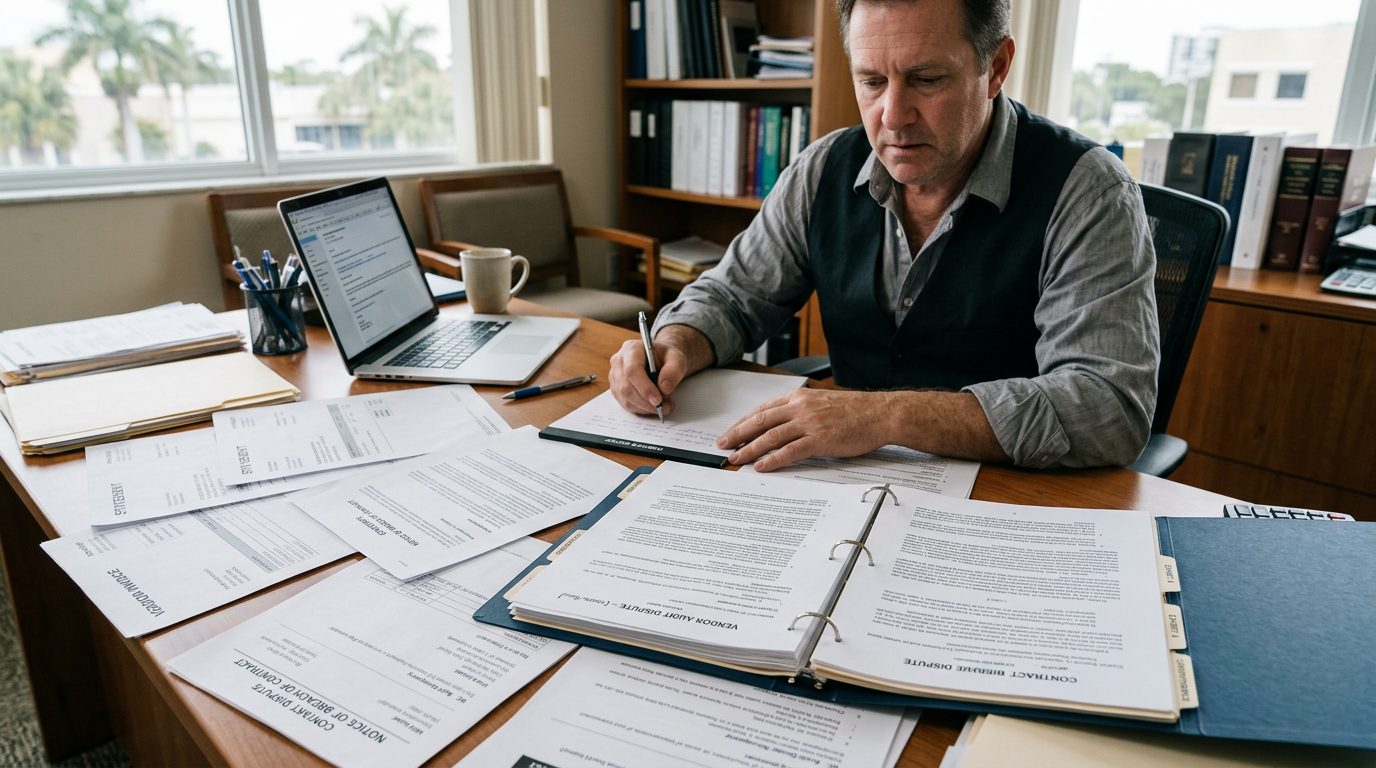
Vendor Audit Clause Disputes | Coral Gables & Sunny Isles Beach
Vendor Audit Clause Disputes, Reviewed Before You Act
KEW Legal helps Florida business owners understand what their vendor contract's audit clause requires, what it allows, and how to respond when a vendor audit turns into a dispute. Kristina E. Wilson leads the review.
By Kristina E. Wilson · Published October 25, 2026
A vendor audit clause lets a business check a supplier’s invoices, pricing, and records against the signed contract. If the bills don’t match what you agreed to pay, that clause is often the first tool to review. This page explains how these disputes move in Florida, what to check first, and where a pre-suit demand fits. The responsible lawyer for this page is Kristina E. Wilson of KEW Legal.
What a Vendor Audit Clause Does and Who It Helps
A vendor audit clause is a contract term that lets one party examine the other’s invoices, pricing, usage, or records. It matters most to owners, operators, and investors who pay recurring supplier or service bills.
Typical problems include:
- Fees that do not appear in the signed pricing schedule.
- Rates higher than the rates the contract sets.
- Charges that keep coming after the agreement should have ended.
The audit right comes from the contract itself. The exact wording controls what you can review, how far back you can reach, and how you must ask. Read the clause before you act, because vague wording can leave you with less room than you expected.
If your vendor's bills no longer match the contract you signed, our team can review the audit clause and the charges with you by phone or in person. Talk it through with our team — the first consultation is free, confidential, and carries no obligation.

What the Engagement Covers
The engagement covers contract review, billing review, and the written steps that follow, all under one relationship. The work includes:
- Review of the full agreement, including the audit clause, pricing schedules, amendments, purchase orders, and renewal terms.
- Review of invoices and payment history against the contracted rates and the vendor’s billing method.
- Drafting a written audit request that follows the notice method and timing the contract requires.
- Preparing a pre-suit demand letter that identifies the disputed charges, the provisions relied on, and the amount claimed.
- Negotiating with the vendor or its counsel toward a documented repayment, credit, or corrected billing arrangement.
- Handling breach of contract litigation as a separate step, if the vendor refuses to comply or repay.
Litigation is used only when the earlier steps do not resolve the matter.
How the Process Works, Step by Step
The process starts with a confidential review and moves through a written audit and demand before any suit is considered. Here is the usual sequence:
- Initial review. We review the contract and recent invoices in a confidential consultation at our Coral Gables or Sunny Isles Beach office, or by phone.
- Written analysis. We review the audit clause, the billing gap, and the notice, dispute, and deadline terms.
- Audit notice. We send notice in the form the contract requires and request the records the clause allows you to examine.
- Record review. We compare the vendor’s records against the contracted terms and document the findings.
- Demand and negotiation. We send a pre-suit demand and discuss resolution. This is often where settlement talks begin.
- Filing review. If the matter is not resolved, we review filing options with you before any suit is started.
Timing depends on how fast the vendor produces records and responds, so no fixed timeline can be set in advance. To begin, send your contract and recent invoices through our contact page.
Contract Terms and Deadlines to Check Before You Act
Check the notice, look-back, cost, records, dispute, and deadline terms before you send any demand. Each one can change your next move.
- Notice. Many clauses require written notice by a set method within a set period. Missing that step can weaken your position.
- Look-back. Some clauses limit how far back an audit can reach, which limits how much overbilling you can document.
- Cost shifting. Some contracts say who pays audit costs, sometimes tied to a stated amount of overbilling.
- Records. Check how long the vendor must keep records and where you can examine them.
- Dispute steps. Negotiation, mediation, or arbitration clauses control the path to court. Florida generally enforces a written agreement to arbitrate, under Fla. Stat. § 682.02.
- Deadlines. Florida’s time limits for actions on a written contract are in Fla. Stat. § 95.11. A contract clause that shortens the time to sue is void under Fla. Stat. § 95.03.
If a dispute goes to arbitration, the clock can pause. Florida law says pending arbitration tolls, or pauses, the running of the limitations period for that dispute under Fla. Stat. § 95.051. Confirm the dates early rather than assuming.
Options Before Filing Suit
Most billing disputes move through a written demand and negotiation before any lawsuit is filed. The main paths are:
- Informal billing inquiry. This can fix simple errors, but put it in writing so you have a record.
- Formal audit under the contract. This produces a factual record of what was billed versus what the contract allows.
- Demand letter and settlement. This sets out the disputed charges, the provisions relied on, and the amount claimed.
- Contractual mediation or other steps. Use these when the agreement requires them.
- Litigation. This is the last step, after the vendor refuses to comply or repay.
Florida law makes an offer to compromise a disputed claim inadmissible to prove liability or its value, under Fla. Stat. § 90.408. Under Fla. Stat. § 47.011, a suit must be brought where the defendant resides, where the cause of action accrued, or where the property in litigation is located, but this section does not apply to actions against nonresidents.
Florida courts must also refer many money-damage suits to mediation on request, provided the requesting party is willing and able to pay the costs of the mediation or the costs can be equitably divided between the parties, with listed exceptions, under Fla. Stat. § 44.102. Each side generally pays its own lawyer unless a contract or statute says otherwise, as the Price v. Tyler decision explains. If the contract lets one party recover attorney’s fees for enforcing it, Fla. Stat. § 57.105 lets a court also allow reasonable fees to the other party when that party prevails, for contracts entered into on or after October 1, 1988.
Why Work With KEW Legal on This Matter
KEW Legal is a Florida business law firm with offices in Coral Gables and Sunny Isles Beach. It acts as outside general counsel for business owners and investors across Miami-Dade and South Florida.
Kristina E. Wilson is the responsible lawyer for this page. The firm’s lawyers include Natalie Martinez. The firm focuses on business contracts, vendor and partnership disputes, employment matters for employers, commercial leases, and business transactions.
Because the firm acts as outside general counsel, a vendor billing issue can be reviewed alongside renewal terms and other contract questions. The initial consultation is free, confidential, and without obligation to continue.
Not sure what your next step is?
Talk it through with our team — the first consultation is free, confidential, and carries no obligation.

Frequently Asked Questions
Can we withhold payment while the audit is pending?
Possibly, but only if the contract’s payment and dispute terms allow it. Review them before you hold back any payment.
Must the audit finish before we can sue?
Some contracts require audit, negotiation, or mediation steps first. Check the dispute clause.
Who pays for the audit?
The audit clause decides this. Some clauses shift the cost to the vendor when overbilling passes a stated amount.
Can we review invoices from prior years?
The clause’s look-back limit controls how far back an audit reaches.
How long do we have to sue a vendor in Florida?
Florida’s time limits for written contracts are set in Fla. Stat. § 95.11. A contract clause that shortens them is void under Fla. Stat. § 95.03.
Who pays attorney’s fees in a Florida contract case?
Each side generally pays its own lawyer unless a contract or statute provides otherwise.
If your vendor’s invoices have moved past the rates in your signed agreement, bring the contract and recent bills to a confidential review. Call 305-990-2300 to set up your initial consultation at our Coral Gables or Sunny Isles Beach office.
How KEW Legal Approaches Audit Clause Disputes
Contract-First Review
We start with the audit, notice, payment, and dispute provisions in your vendor agreement, along with any amendments and related correspondence.
Protecting Your Position
Before you withhold payment, refuse access, or respond to an audit demand, we help you weigh the contract terms and the practical risks.
Clear Communication
We explain your options in plain language and help you decide how to respond to the vendor, whether through negotiation, a formal notice, or other steps the contract requires.
Outside General Counsel
For business owners in Miami-Dade and Broward, we serve as outside general counsel, so vendor audit issues are handled alongside your other contract and business needs.
Read Before You Withhold Payment
Stopping a vendor payment or ignoring an audit request can create problems of its own. Review your contract's payment and dispute terms with counsel before you hold back any money or refuse a request.
Common Questions About Vendor Audit Clauses
Can we withhold payment during an audit?
That depends on what your contract's payment and dispute provisions allow. We review those terms with you before any payment decision is made.
Must the audit finish before we can sue?
Some contracts require audit, negotiation, or mediation steps first. We check the dispute clause so you understand the sequence before taking action.
Who pays for the audit?
Audit cost language varies by contract. We examine how your agreement addresses audit expenses and any adjustments that may follow.
What if the vendor's audit seems overbroad?
We look at the scope, notice, and access language in the clause and help you respond in a way that protects your records and your position.
Get a Clear Read on Your Vendor Audit Clause
Related practice areas
Request a Consultation
Fill out the short form and we will take it from there.