
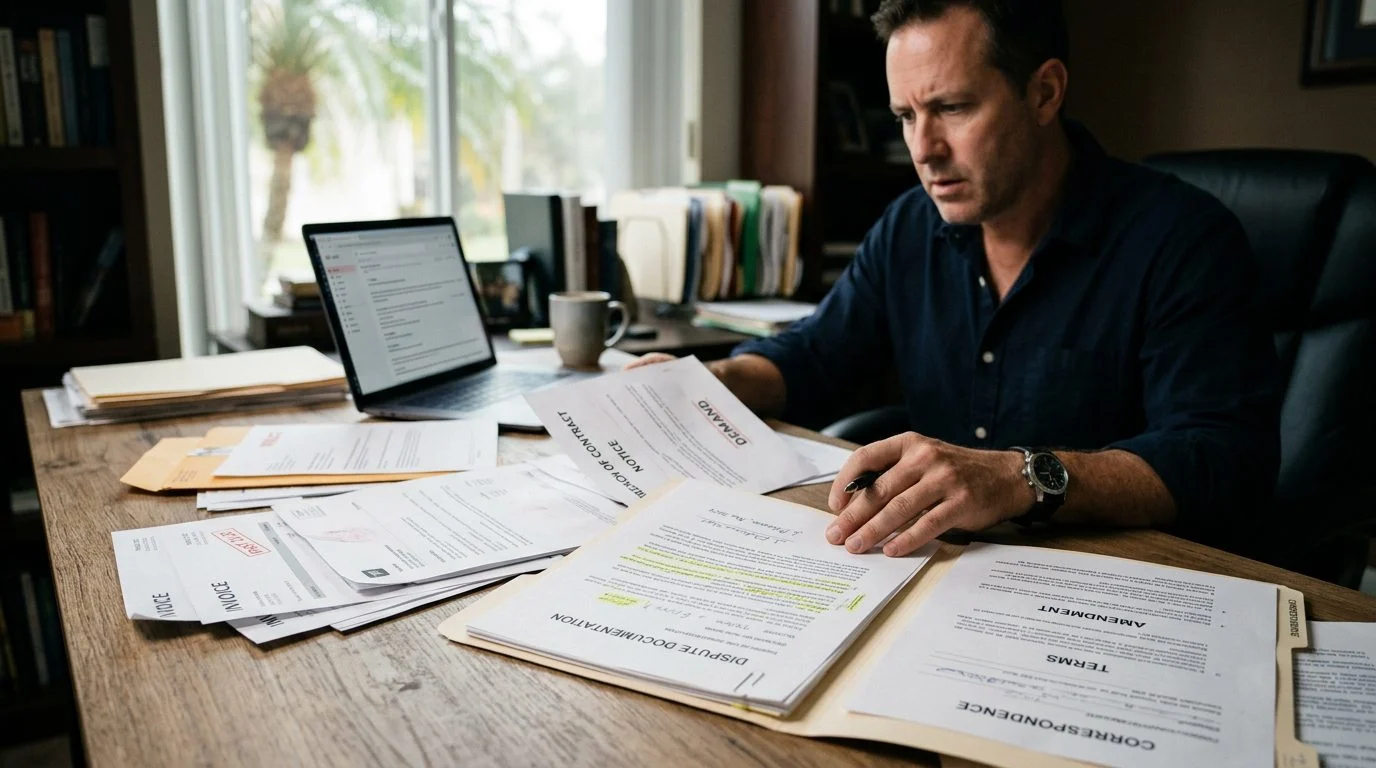
Vendor Contract Amendment | Coral Gables and Sunny Isles Beach
Changing a Vendor Contract the Right Way
Clear, signed changes protect your business when pricing, scope or terms need to shift.
Why Business Owners Contact KEW Legal
2
Offices in Coral Gables and Sunny Isles Beach
Free
Confidential first consultation with no obligation
By Kristina E. Wilson · Published November 6, 2026
A vendor sends a renewal notice, a price increase, or a change order, and someone asks whether to sign. A vendor contract amendment, change order, or renewal changes a deal you already made. If you are asked to sign an amendment, review it with the same care as the original contract.
Business owners and investors in Miami-Dade, Broward, and South Florida can have KEW Legal draft and review these documents.
What a Vendor Contract Amendment, Change Order, or Renewal Is
An amendment, change order, or renewal is a document that changes an agreement you already have.
- Amendment: a written change to the terms of an existing agreement.
- Change order: a change to scope, price, or schedule, common in construction and service contracts.
- Renewal: an extension of the contract’s term, with the same terms or new ones.
Each one can shift cost, liability, and your right to exit. Owners, operations managers, and purchasing staff usually handle these papers first. Family members or managers who run a business for an owner who lives abroad often do too. Anyone with authority to sign for the company should read them before signing.
If a renewal notice or change order from a vendor is waiting on your desk, we can review it with you before anything is signed. Talk it through with our team — the first consultation is free, confidential, and carries no obligation.

What These Documents Usually Change
Most amendments touch price, scope, term, or risk. The change often looks small on the page.
- Scope: added or removed work, and who decides what counts as extra.
- Price: rate increases, payment schedules, and late-fee terms.
- Term and renewal: the length, notice deadlines, and termination rights.
- Liability and insurance: indemnity and limitation-of-liability wording can move in a quick renewal.
- Governing law and signing authority: which state’s rules apply, how disputes are handled, and who signs for each side.
Check these terms even when the change seems to affect only one line.
How Florida Law Treats Changes to Vendor Agreements
A clear, signed amendment is the safer path. Start by checking whether your contract requires changes to be in writing and signed by both sides. That clause sets the starting point.
For a sale of goods priced at $500 or more, the contract generally is not enforceable unless there is a record sufficient to indicate that a contract for sale was made and it is signed by the party against whom enforcement is sought. § 672.201 addresses contracts for the sale of goods.
Conduct matters too. Under Fla. Stat. § 672.204, a contract for sale of goods may be made in any manner sufficient to show agreement, including conduct by both parties that recognizes the existence of such a contract. Under § 672.204, a contract for the sale of goods can be formed through any means that demonstrates the parties agreed, including conduct by both sides that recognizes that a contract exists. § 672.207 Acting on an unsigned change can therefore create a dispute.
Vendor confirmations matter as well. Between merchants, extra terms in a confirmation can become part of the deal. Fla. Stat. § 672.207 reads: “Between merchants such terms become part of the contract unless: (a) The offer expressly limits acceptance to the terms of the offer.” The exceptions include a timely objection, so read every acknowledgment the vendor sends.
Time limits matter too. § 95.11 A contract term that tries to shorten that period is void. § 95.03
Renewal Traps: Auto-Renewals, Notice Windows, and Price Increases
A renewal can bind your business to another term if you miss a notice window the contract sets. Silence can mean renewal under an automatic clause. The notice language matters most.
- Read the renewal clause first. Is it automatic, and what notice period applies?
- Work out the deadline from the contract’s date rules, not from when the renewal letter arrived.
- Send notice to the address and by the method the contract names.
- Check whether the contract authorizes a price escalator before you pay a higher invoice. A vendor’s letter alone doesn’t settle it.
- Watch for renewals that add minimum purchases, exclusivity, or wider scope.
Vague Terms That Lead to Vendor Disputes
Disputes often start where the contract says nothing about how changes get approved or priced. Watch for these gaps:
- No written approval step for change orders.
- No pricing method for added work.
- No time limit for approving a request.
- Work that starts before the change is signed, leaving both sides to argue about authority and cost.
- A purchase order and a vendor invoice that say different things.
Mistakes in signed papers need quick attention. Rescission for mutual mistake may be available when both sides made the same mistake about a fact central to the deal. A mistake is mutual when the parties agree to one thing, but a scrivener’s error or inadvertence puts something different in writing. Waterside at Boynton decision If you learn of a problem and keep accepting the benefits, you may lose the right to undo the document. Ratification occurs when a party entitled to rescind fails to do so after discovering the facts. Flaherty v. Flaherty
How KEW Legal Handles Amendments, Change Orders, and Renewals
We review the paperwork first. Then we draft or mark up the change so it matches what your business agreed to.
- Gather the file. Collect the original contract, prior amendments, purchase orders, invoices, emails about the change, and the vendor’s proposed document.
- Review the key clauses. Check modification, notice, term, pricing, liability, governing law, and signing authority.
- Find the gaps. Look for unclear scope, a missing notice address, or a renewal trigger. Then list the terms to request.
- Draft or mark up the document. This covers the amendment, change order form, or renewal letter. Confirm signing authority on both sides.
- Keep the signed version. Set reminders for notice and renewal dates.
Timing depends on the length of the document and how fast the other side responds. The firm gives an estimate after it reviews the paperwork.
Kristina E. Wilson is the responsible lawyer for this page. Natalie Martinez is also a lawyer at the firm. KEW Legal has offices in Coral Gables and Sunny Isles Beach. It advises businesses across Miami-Dade County, Broward County, and South Florida.
Not sure what your next step is?
Talk it through with our team — the first consultation is free, confidential, and carries no obligation.
Questions Owners Ask Before Signing an Amendment or Renewal
Most of these questions turn on what the contract says and what both sides actually did.
Is an email enough to change a vendor contract?
Emails can show what both sides meant, but a signed amendment is the clearer record. An electronic signature has the same effect as a written one unless another law provides otherwise. § 668.004
My vendor says the renewal is automatic, and I missed the notice date. What now?
The contract’s notice language decides the next step. Prompt review matters for that reason.
Can I sign for my company if I’m not the owner?
Confirm signing authority under the company’s own governing documents before anyone signs.
Is a change order binding if the work already started?
For goods, conduct by both sides can show a contract. § 672.204 Written approval is the safer route.
Who pays the lawyers if a vendor dispute goes to court?
Each side generally pays its own attorney’s fees unless a contract or statute provides otherwise. Price v. Tyler If the contract allows fees for enforcing it, the court may also allow fees to the other side when that side prevails.
Can the firm help if I live outside Florida?
Yes. KEW Legal works with owners who live abroad, as well as owners in South Florida.

Talk With KEW Legal About Your Vendor Paperwork
If a renewal notice, change order, or amendment is waiting for your signature, you don’t have to sort it out alone. Owners often receive these papers in the middle of running a business, sometimes while traveling or living abroad.
Call 305-990-2300, send us a message, or schedule a consultation. The first consultation is free, confidential, and carries no obligation to continue. Our offices are in Coral Gables and Sunny Isles Beach.
How We Help With Vendor Contract Amendments
Reviewing the Current Contract
We read the original agreement, its amendment clause, notice terms and renewal language before any change is proposed.
Drafting a Clear Amendment
We write amendment language that identifies the changed terms, the effective date and which provisions remain in force.
Protecting Your Position
We help you document what was agreed so that emails, side arrangements and verbal promises do not leave gaps.
Negotiating With Your Vendor
We guide negotiations on price, scope, timing and service levels, and we explain the trade-offs in plain terms.
Act Early When a Vendor Asks for Changes
Renewal notices, price increase letters and scope requests often carry their own response requirements. Review the notice language as soon as it arrives, before you agree to anything by email or in conversation.
Common Vendor Amendment Situations
Price and Fee Changes
Adjusting rates, adding surcharges or tying pricing to an index, with the terms written into a signed amendment.
Scope and Service Updates
Adding, removing or redefining services, deliverables and performance standards as your operations change.
Renewal and Term Adjustments
Extending, shortening or restructuring a contract term, including how automatic renewal language is handled.
Disputes Over Informal Changes
Sorting out what was agreed when changes were made by email, text or phone without a formal amendment.
Need a Vendor Contract Reviewed Before You Agree to Change It?
Related practice areas
- Business Contract And Vendor Dispute Attorney
- Limitation of Liability and Liquidated Damages Clause Review for Florida Businesses
Request a Consultation
Fill out the short form and we will take it from there.