
What If a Vendor Breaches Your Venue? Multi-Location Owner
By Kristina E. Wilson · Published November 16, 2026
Picture a contractor who walks off a job at one of your venues while your other locations keep running. You need to know what happens next, and you need to know it before you respond. For a multi-location owner in Florida, a vendor breach at one location starts as a contract question. The signed paperwork and the company that signed it set the first answers, and Florida law sets the outer limits.
When a Vendor Fails at One of Your Venues
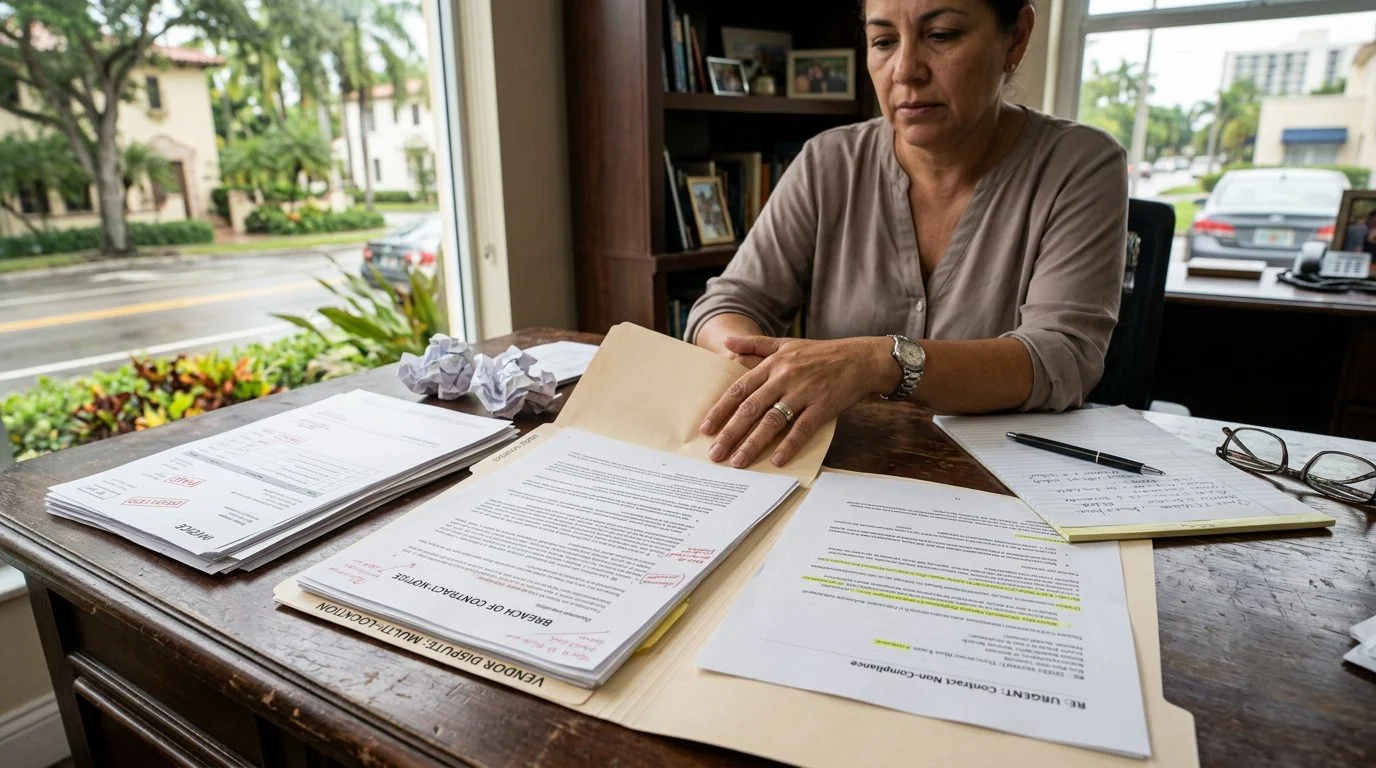
A vendor that stops performing at one venue may be in breach, and your first job is to learn what the contract promised. Common triggers are concrete. A renovation crew leaves a project half-finished. A food or beverage delivery never shows up. A security, staffing or maintenance service lapses on a busy weekend. Each one can shut down a room or a whole floor while the other sites carry on.
The harder part is the desk. Decisions, contracts and entity setup still run through you, and the failure lands on a site where you aren’t standing. The site manager may want a quick fix. Before you agree to one, read the contract, because a quick fix can change your rights.
Start a written log before you call the vendor. Record the date work stopped, what was missing, who at the venue saw it and what the vendor said. That record matters later, and it’s easy to lose when a site is in trouble.
Start With the Paper Trail: Which Contract and Which Entity
The governing document and the signing entity decide who holds rights and duties at a single venue.
Look for the document first. A master services agreement may cover every site you run. A purchase order often covers one site. Invoice terms printed on a vendor’s form can add conditions of their own. A master agreement and a site order may point to different remedies, so check which one says it controls.
Then read the signature block. If the operating company for one venue signed, that company is usually the party bound. If a parent company or shared management company signed, the picture changes. Multi-venue groups often have paperwork that points to one entity while the bank account and invoices point to another.
Finally, pull the dates. Gather every amendment, change order and written notice. A dispute often turns on what was agreed in writing and when. A later email that changes scope can matter as much as the original signed page. For more on vendor contract disputes, see our vendor contract dispute overview.
What a Breach Generally Gives a Business Owner in Florida
Direct losses often include the extra cost of hiring a replacement vendor. Lost revenue and other indirect losses depend on how the contract words its remedies, so read that section before you count on them.
If the vendor sold goods rather than services, Florida’s sales-of-goods rules can apply. When reasonable grounds for insecurity arise about the other side’s performance, a party may demand adequate assurance in writing. After a justified demand, failing to give adequate assurance within a reasonable time, not exceeding 30 days, is a repudiation under Fla. Stat. § 672.609.
Time limits matter too. Under Fla. Stat. § 95.11, an action on a written contract generally must start within five years. In Florida, a lawsuit over an oral or other unwritten contract, including one for the sale and delivery of goods, must be filed within four years under section 95.11(3)(j). Check the contract for its own notice or claim deadlines, too.
Ending the deal is its own step. Many contracts allow termination only after written notice and a chance to fix the problem. Acting early can leave you exposed, so check the steps before you send a termination letter. Whether any of this helps you depends on the facts and the exact contract wording.
Notice, Cure and Dispute Clauses That Can Narrow Your Options
Notice and cure clauses set the steps you must take before you end a contract or sue, and dispute clauses decide where the fight happens.
Notice terms often name an address, a delivery method and a specific officer, not just a site manager. Florida courts do not favor treating a step as a condition precedent (a step that must happen first). As a Florida appellate court put it, “As a general rule, conditions precedent are not favored, and courts will not construe provisions to be such, unless required to do so by plain, unambiguous language or by necessary implication.” Your contract’s exact words carry real weight.
A small slip is not always a big one. Covelli also quotes the rule that failing to perform a minor part of a contractual duty is not a material breach. Land Co. of Osceola County defines a condition precedent as an event that must occur before there is a right to immediate performance and before there is a breach.
Arbitration clauses carry weight too. Under Fla. Stat. § 682.02, a written agreement to arbitrate is valid and enforceable except on grounds that exist to revoke any contract. A court decides whether an agreement to arbitrate exists.
Fee clauses can cut both ways. Under Fla. Stat. § 57.105(7), if a contract lets one party recover attorney’s fees for enforcing it, a court may allow reasonable fees to the other party when that party prevails, for contracts entered into on or after October 1, 1988. Limitation-of-liability and consequential-damages waivers often matter most when a vendor failure costs you revenue at one venue. Read them before you assume lost profits are recoverable.
How Entity Structure Affects Whether a Dispute Stays at One Venue
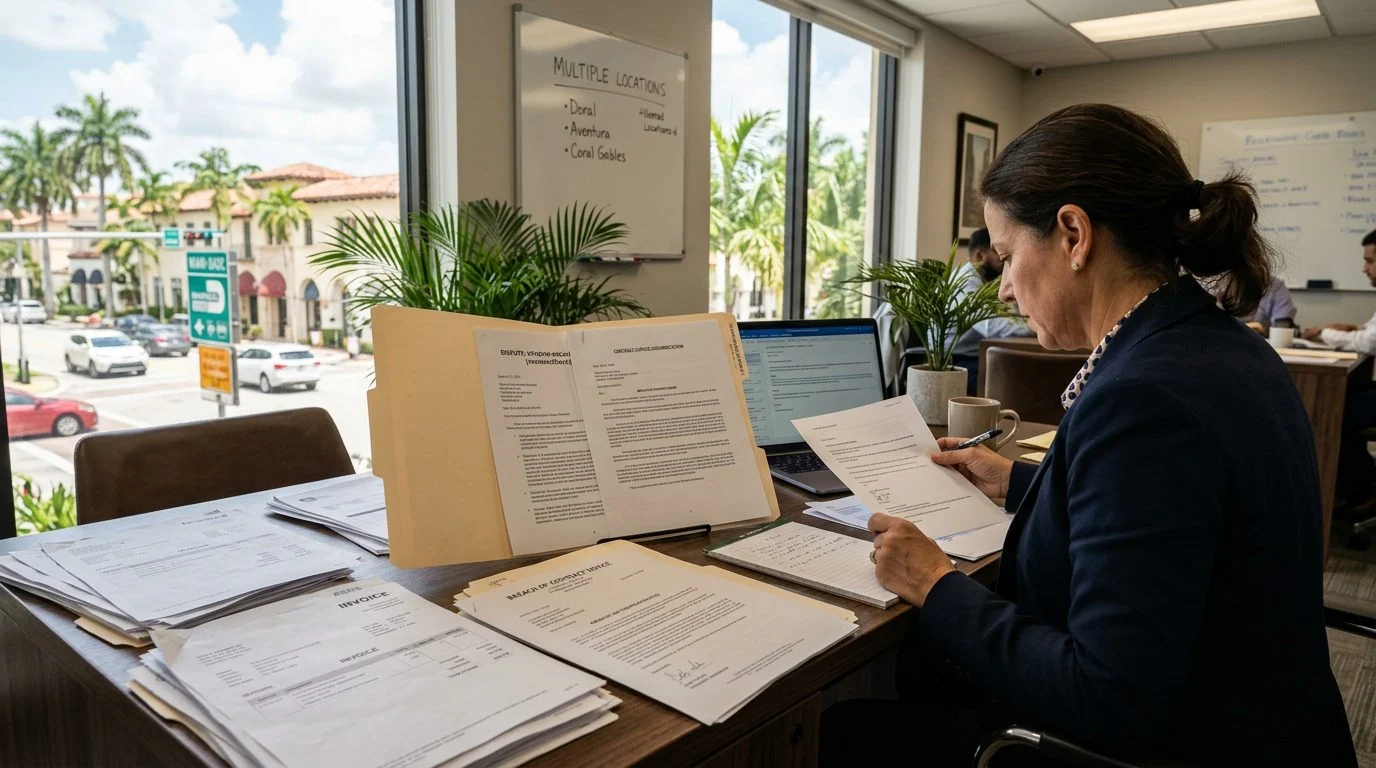
Separate companies can keep a debt or judgment inside the company that owes it, but only if the structure holds up in daily practice.
If your venue companies are Florida LLCs, Fla. Stat. § 605.0304 says a company’s debt is solely the company’s. A member or manager is not personally liable for it just by being a member or manager. Failing to observe formalities is not, by itself, a ground for holding a member or manager liable for the company’s debts.
Those rules protect owners, but shared habits can blur the lines. A shared bank account or informal recordkeeping between venues can make the separation hard to show. Under section 605.0304, Florida Statutes, failing to observe formalities is not a ground for imposing liability on a member or manager for a debt, obligation, or other liability of the company, and a member or manager is not personally liable solely by reason of being or acting as a member or manager. Because that protection covers only liability that exists solely because of your role, an obligation you sign in your own name is a separate question worth reviewing before you sign. A counterparty who finds those gaps will press on them.
Moving assets in a hurry can backfire. Under Fla. Stat. § 726.105, a transfer can be fraudulent as to a creditor if made with actual intent to hinder or defraud. Among other factors, a court may consider whether the transfer was to an insider and whether, before the transfer was made, the debtor had been sued or threatened with suit.
A vendor lapse can also become a premises problem. A contractor’s unfinished work or a maintenance gap that injures a guest raises a question of who must cover the loss. Review indemnity language, additional-insured status and certificates of insurance together. Gaps tend to surface when a dispute, audit, lender review or sale brings entity documents into view. Confirm each venue’s company is active and named correctly with the Florida Division of Corporations.
What to Protect and Document in the First Days
In the first days, preserve the records, avoid informal admissions and keep the venue running with its costs tracked separately.
Preserve everything. Save communications, photos, invoices, delivery logs, inspection reports and texts from staff and the vendor. Don’t delete a message because it looks minor.
Hold off on written admissions. An email that says “our fault, we’ll fix it” can be quoted back later. Don’t agree to new terms until the contract has been reviewed.
Keep the venue open with a documented replacement arrangement. Record its costs separately, with invoices and dates, so any later claim is easy to support.
Standardize going forward. Use consistent entity names, notice addresses, cure periods and insurance requirements across every venue and in your planned hotel and Northeast projects. Rules in other states can differ, so each new state’s contracts need their own review.
Bringing KEW Legal Into a Vendor Dispute Across Your Locations
KEW Legal acts as outside general counsel for business owners and investors in Miami-Dade and South Florida, with offices in Coral Gables and Sunny Isles Beach.
Kristina E. Wilson is responsible for this page. Our lawyers, including Natalie Martinez, handle partnership disputes, business contract and vendor disputes, employment matters for employers, business sales and succession, commercial leases and investment property.
A first conversation would cover the vendor contract, the company that signed it, the notice history and how that venue connects to the rest of your group. The initial consultation is free, confidential and carries no obligation to continue.
Can one vendor’s failure reach my other venues?
Florida’s LLC rules keep a company’s debts with that company. Shared accounts, personal liability on loans and transfers can change that picture.
How long do I have to sue a vendor in Florida?
For a written contract, Florida’s general limit under Fla. Stat. § 95.11(2)(b) applies to an action founded on a written instrument, except for claims against a payment bond and deficiency judgments, which follow their own rules. Check the contract for its own deadlines.
Do I need written notice before ending a vendor contract?
Often yes, when the contract requires it. Read the notice and cure clause before you act.
If a vendor has stopped work at one of your venues, our team can review the signed contract and the company behind it with you, so call 305-990-2300 or send us a message.
Ready to take the next step?
Related practice areas
Request a Consultation
Fill out the short form and we will take it from there.