
Business Contracts & Vendor Disputes | Miami-Dade
Vendor Missed Turnover? Get Counsel Involved Early
KEW Legal works as outside general counsel for business owners, developers, and investors in Miami-Dade and South Florida, including vendor and contract disputes that touch a project's handover.
By Kristina E. Wilson · Published November 16, 2026
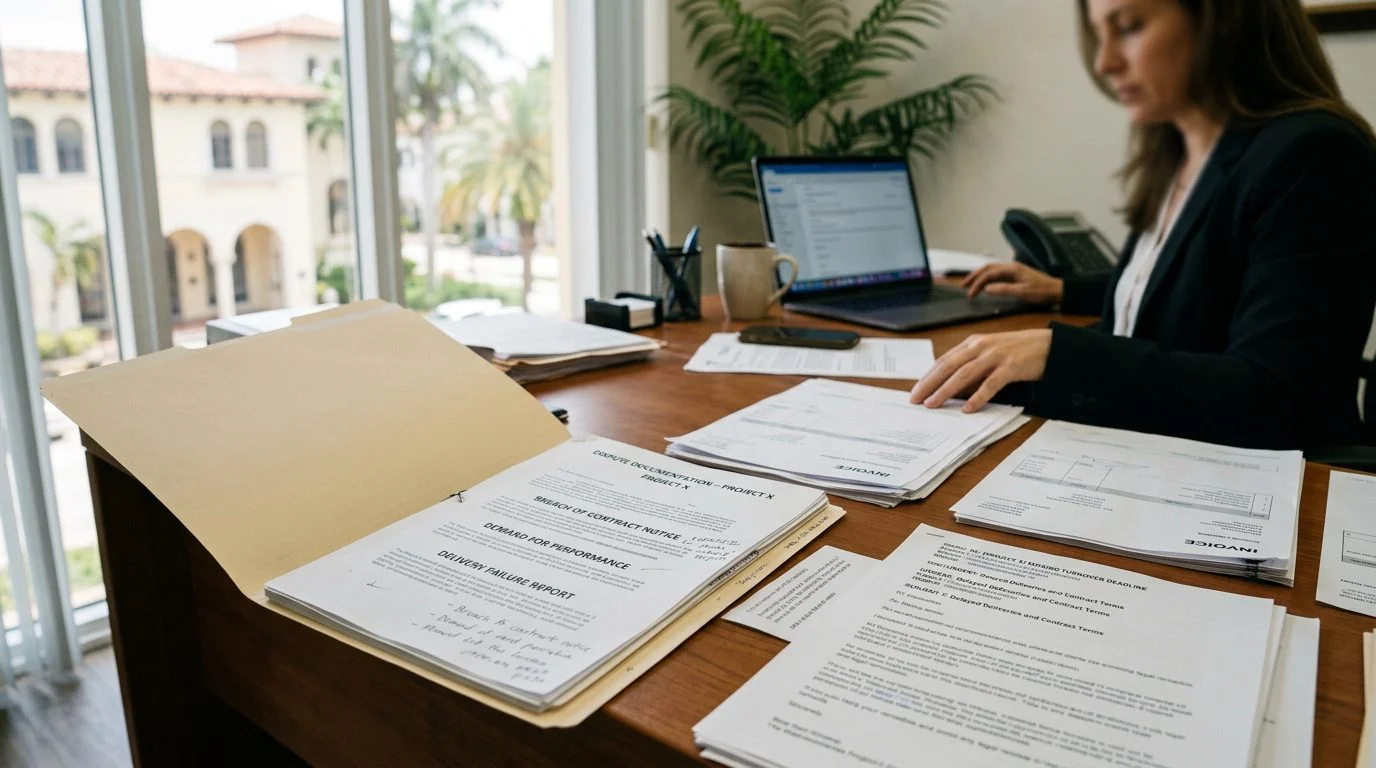
When a vendor misses a deadline on a condo project in Miami-Dade, the schedule slips and pressure builds fast. Your first move is to read the contract, then document the delay and send written notice the way it requires. That order keeps you steady when buyers and lenders start asking questions.
This page was written by Kristina E. Wilson of KEW Legal, a Florida business law firm with offices in Coral Gables and Sunny Isles Beach.
When a Vendor Misses the Turnover Date, Your Schedule Is at Risk
A missed turnover date can touch your vendor contract, your buyer agreements, and your lender paperwork at the same time.
Each document may carry its own deadline, notice rule, and remedy. Your vendor contract sets one timeline. Purchase agreements with buyers set another. Construction loan and joint venture papers may add more.
That is why the order of work matters: read first, document second, communicate third, and decide last. Acting before you know what each document says can create new promises or weaken your position. Buyers and lenders will ask for dates, so you need to know which ones are firm first.
Florida also limits how much a contract can shorten your time to sue. Under Fla. Stat. § 95.03, a contract provision that sets a shorter period than the statute allows is void. A short deadline in a vendor form is not automatically the one that applies.
A missed turnover date can put closings and your rental timeline at risk, and you don't have to map that out alone. KEW Legal can talk it through with you. Talk it through with our team — the first consultation is free, confidential, and carries no obligation.
Start With the Contract: Deadlines, Notice, and Remedies
Your signed contract decides what counts as a missed date and what you must do about it.
Find the completion or turnover date first. Then check whether the contract says time is of the essence, which signals that dates are meant to be strict. Read the exact words rather than relying on memory of the deal.
Next, find the notice rules. Who must give notice, to whom, by what method, and within what period? A missed notice step can weaken a claim, so write these down before you act.
Look also for cure periods, liquidated damages (amounts the parties agree on in advance for delay), force majeure language (excuses for events beyond anyone’s control), termination rights, and the dispute clause, such as arbitration, venue, or a jury waiver.
Florida courts don’t favor treating a step as a condition precedent (something that must happen before a right to sue or terminate arises).
If the vendor breaches, your own performance may be excused.
A delay can be a breach, an excused delay, or a change both sides agreed to in writing. Each leads to different rights, so classify it carefully.
Confirm Which Company Is Bound and Who Is Exposed
The company or person named in the signature block is the party the contract binds.
A development entity, a family holding company, and an individual can each sign different documents on the same project. That choice affects who can enforce the contract and who may face claims.
Florida’s LLC statute sets a baseline. Under Fla. Stat. § 605.0304, a company’s debt or liability is solely the company’s. A member or manager is not personally liable for it solely because of that role.
Check whether anyone signed a personal promise to cover the company’s obligations. That promise is a separate document and can change this picture.
Keeping entities separate helps in another way, though under Fla. Stat. § 605.0304 a failure to observe formalities is not, by itself, a ground for imposing liability on a member or manager of the company. Use separate contracts, bank accounts, and correspondence for the project entity, the sales entity, and the family’s other companies. A clean paper trail also keeps buyer and family information in the right files.
Document the Delay and Send Written Notice the Right Way
Send written notice in the form and by the method your contract requires, and back it with a dated record.
Start a delay log. Record each missed milestone, the vendor’s stated reason, crew counts or site conditions on each visit, and dated photos. Save the agreed schedule, every revised version, and all emails, texts, and meeting notes about the delay.
Your formal notice should state the facts, the missed date, and the rights you are reserving. Keep it factual and leave out accusations.
Avoid informal admissions. Don’t agree to a new date or accept blame in a text before the contract’s notice steps are complete.
Settlement talks get separate treatment. Under Fla. Stat. § 90.408, evidence of an offer to compromise a disputed claim is inadmissible to prove liability or the value of the claim. Label settlement communications as such, since the rule covers offers and statements made in compromise negotiations, not every project message.
Protect Your Closings, Buyers, and Lenders Before You Commit to a New Date
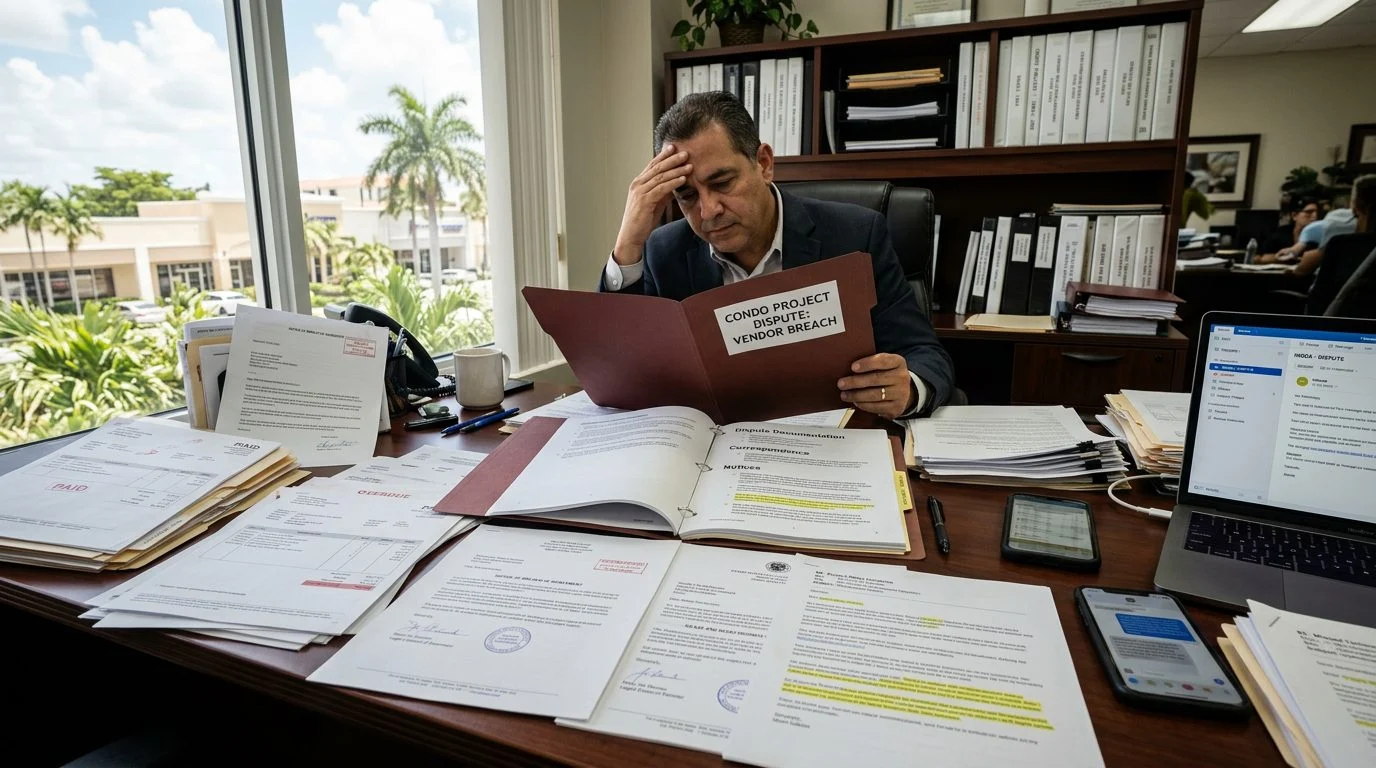
Before you promise a new date, map each deadline against your closings and lender terms.
List every closing date, lender draw deadline, and rental launch date. Mark each one the delay puts at risk. Then decide what each party needs to hear, and when.
Keep buyer and lender messages consistent and accurate. Don’t state a turnover date you cannot yet confirm. Confirm any revised schedule in writing through the amendment process in your contracts before anyone relies on it.
Residential condo sales have their own timing rule. Under Fla. Stat. § 718.503, a developer’s contract for the sale of a residential condo unit, or a lease of one for an unexpired term of more than 5 years, must carry a conspicuous legend. The buyer may void the agreement by written notice within 15 days after signing and receiving all of the required items from the developer, and within 15 days after receiving an amendment that materially and adversely alters the offering. That right ends at closing. Whether a schedule change is such an amendment depends on the facts.
When the Vendor’s Paperwork Conflicts With Your Contract
Compare every vendor form against your signed agreement, because forms often carry different deadlines and remedies.
Purchase orders, change orders, and acceptance forms can each carry their own terms. Look for an order-of-precedence clause that says which document controls when two conflict. If your agreement has none, flag the conflict early.
If the vendor supplies goods, Florida’s rule on additional terms is in Fla. Stat. § 672.207. Between merchants, additional terms generally become part of the contract unless the offer limits acceptance to its own terms, the terms materially alter it, or the other side objects. That rule covers sales of goods, so a services-only contract may not fit it.
For a fuller discussion, read our guide on conflicting purchase order terms in Florida.
Not sure what your next step is?
Talk it through with our team — the first consultation is free, confidential, and carries no obligation.
Decide What You Want Before Choosing a Path
Your main options are negotiating a new schedule, pursuing costs, bringing in a replacement, or filing a claim.
Negotiating keeps the relationship and the work moving, but costs may stay unresolved. Pursuing costs or delay damages can address losses, but it takes time and money. A replacement gets work moving again, though a new vendor brings new deadlines and pricing.
Which path fits turns on your contract’s wording, your deadlines, and your project’s finances.
If your contract has an arbitration clause, Fla. Stat. § 682.02 makes a written agreement to arbitrate valid, enforceable, and irrevocable, except on grounds that exist for revoking any contract.
Outside general counsel can take day-to-day contract, notice, and closing work off your in-house lawyer’s desk, so that lawyer can focus on the bigger decisions. Learn more about outside general counsel for businesses.
Talk Through Your Vendor Delay With KEW Legal
A missed turnover date is a hard place to be, especially with closings and your family’s reputation on the line.
Can a vendor’s contract shorten my time to sue?
No, not below the statute.
Does an arbitration clause keep me out of court?
It can. Florida enforces written arbitration agreements, and whether your clause covers this particular dispute turns on its wording.
Am I personally liable for my company’s vendor contract?
Not just for being a member or manager of an LLC, since the company’s liabilities are its own. A personal promise you signed is a separate question.
If your vendor has missed a turnover date and closings or lender deadlines are at stake, you don’t have to work through it alone. Call 305-990-2300 or send us a message to schedule a consultation. The initial consultation is free, confidential, and carries no obligation to continue.
How KEW Legal Can Help
Contract Review
We read the vendor agreement, its notice provisions, amendments, and any dispute resolution clause to see what the written terms actually say.
Dispute Strategy
We evaluate your options and advise on how to respond, so your position is protected before the disagreement escalates.
Outside General Counsel
For ongoing business matters, we serve as a steady legal resource for owners and managers, not only when a dispute arises.
Clear Communication
We explain each step in plain language, so you can make informed decisions about your project and your business.
Before You Respond in Writing
Letters, emails, and payment decisions sent to a vendor can shape the dispute that follows. Speak with a business attorney before you send a formal response or agree to changes in the contract.
Common Questions We Address
Who Must Act on Turnover?
We look at the contract language, the parties' roles, and the documented record to understand each party's obligations.
Can We Still Keep the Vendor?
We help you weigh cure rights, termination language, and the practical cost of replacing a vendor mid-project.
What If the Contract Has Arbitration?
We review whether a dispute resolution clause applies to this matter and how it may affect where and how the dispute is resolved.
How Do We Document the Problem?
We help organize correspondence, meeting notes, and project records so the dispute is presented clearly.
Talk With Kristina E. Wilson at KEW Legal in Coral Gables. The Initial Consultation Is Free, Confidential, and Carries No Obligation to Continue.
Related practice areas
Request a Consultation
Fill out the short form and we will take it from there.