
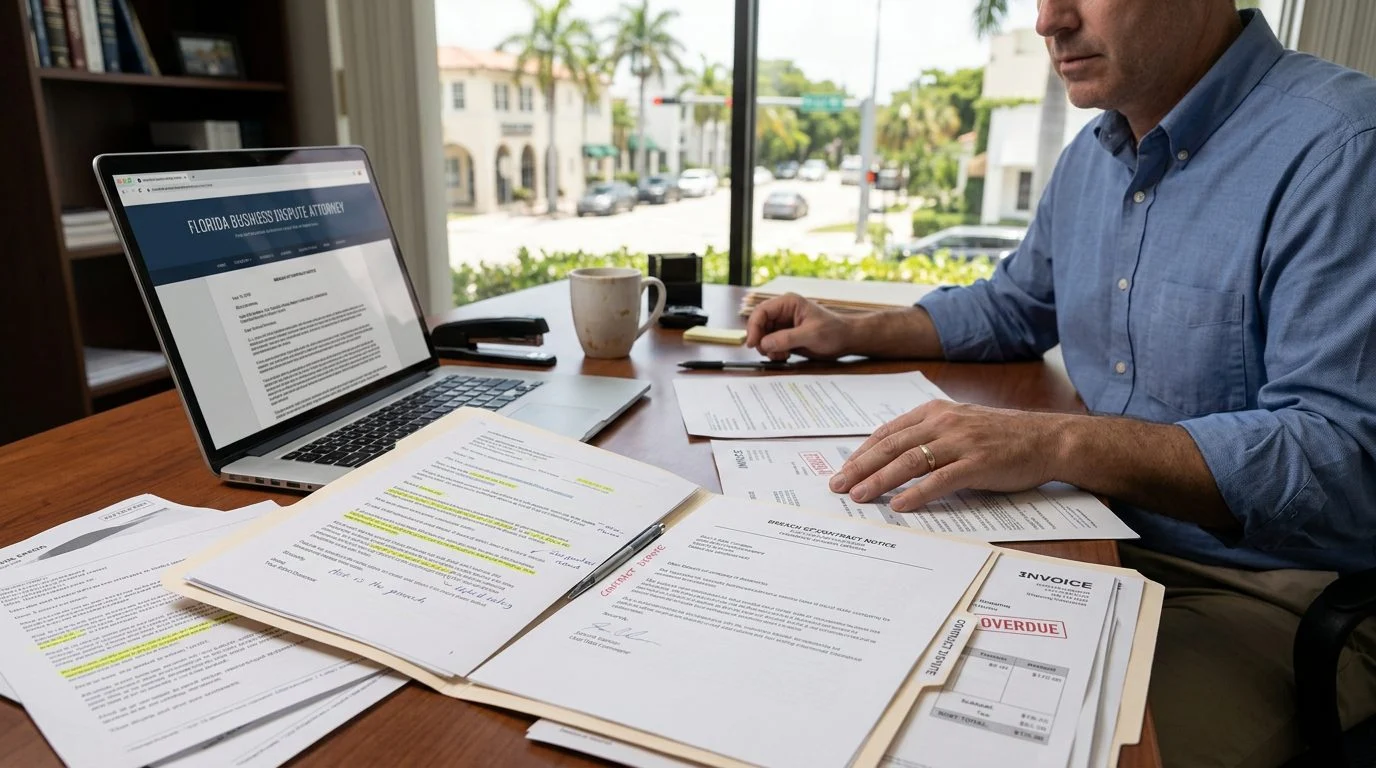
Business Contract & Vendor Disputes | Coral Gables & Sunny Isles Beach
Out-of-State Vendor Disputes, Handled From South Florida
When a vendor in another state stops delivering, bills incorrectly or disputes the terms you signed, a Florida business owner needs to know which contract language controls and where the fight can be brought.
By Kristina E. Wilson · Published November 11, 2026
You’ve signed a supply or equipment deal for a new venue, and the paper says another state’s law applies. Or the vendor’s form names a court far from Florida. You want to know whether that clause binds you.
Short answer: a governing-law clause picks the law that reads the contract. A forum clause picks the court that hears a fight. Florida lets parties choose Florida law in some large deals, and the exact wording decides how far a clause reaches. Read it before a dispute, not after.
When a Vendor Contract Points to Another State’s Law
A clause naming another state’s law can control your deal, so read it before you sign or reuse it.
Vendor paper often gets copied from one location to the next. For a multi-venue operator, that means one governing-law or venue clause can control many deals at once. That includes venues and hotels you haven’t opened yet.
This page is for owners who negotiate and sign vendor terms themselves. If that’s you, you’re the person best placed to spot a clause that doesn’t fit your business. The catch is that you may not notice it until a dispute starts. Reviewing the paper first keeps your options open.
If a new venue or hotel rests on a vendor agreement written under another state's law, you don't have to work out which clauses control on your own. Talk it through with our team — the first consultation is free, confidential, and carries no obligation.

What This Service Covers
The service reviews the legal terms in your vendor and supply agreements, then helps you act on them.
- Governing-law, forum, and venue clauses in existing and proposed vendor agreements.
- Dispute terms, including arbitration clauses, notice and cure periods, and limitation language.
- Indemnification, insurance, and additional-insured requirements in contracts that touch guest injury exposure.
- Demand letters, negotiation with vendors or their counsel, and handling of claims over payment, nonconforming goods, or return of property.
- Advice on where your business may have to defend a claim or bring one.
The guest-injury items matter most for a growing entertainment business. An indemnity promise or insurance requirement can decide who carries a loss tied to one venue.
How Florida Courts Read Governing-Law and Forum Clauses
Florida law lets parties choose Florida law in larger deals, and the clause’s wording controls the result.
- Choice of law. Fla. Stat. § 685.101 lets parties to a contract involving at least $250,000, or services or property of equal value, agree that Florida law governs. This applies to the extent the U.S. Constitution permits. The statute excludes labor and employment contracts.
- Suing outside parties. Fla. Stat. § 685.102 lets a person sue an outside party in Florida when the action arises out of or relates to a contract that chooses Florida law under § 685.101 and in which that party agrees to Florida courts, to the extent the U.S. Constitution permits.
- Reach of Florida courts. Fla. Stat. § 48.193 lists acts that subject a person to Florida court jurisdiction for any cause of action arising from those acts. Operating a business in Florida is one. Breaching a contract by failing to perform acts it requires in Florida is another.
- Venue. Fla. Stat. § 47.011 says actions shall be brought only in the county where the defendant resides, where the cause of action accrued, or where the property in litigation is located, and this section does not apply to actions against nonresidents. It does not apply to actions against nonresidents.
Read the exact words closely. A clause might cover only the contract, or the whole relationship. Each choice changes where a fight can happen.
Where a Florida Business Can Still Push Back
Yes, a clause can be challenged. The first checks are whether it became part of the deal and whether it is fair.
- Unfair terms. A court may refuse to enforce an unconscionable clause, enforce the rest of the contract, or limit the clause. See Fla. Stat. § 672.302. Under § 672.302, if a court as a matter of law finds a contract or any clause of it to have been unconscionable at the time it was made, the court may refuse to enforce the contract, enforce the remainder without the unconscionable clause, or limit the application of that clause to avoid an unconscionable result. When unconscionability is claimed or appears to the court, the parties are afforded a reasonable opportunity to present evidence as to the commercial setting, purpose and effect of the contract or clause to aid the court in making the determination.
- Shortened deadlines. A contract clause that sets a filing period shorter than the statute of limitations is void. See Fla. Stat. § 95.03.
- Notice of breach. For goods you have accepted, you must notify the seller of a breach within a reasonable time after you discover or should have discovered it. Otherwise you may be barred from a remedy. See Fla. Stat. § 672.607.
- Arbitration. An agreement to arbitrate is valid and enforceable under Fla. Stat. § 682.02, except on grounds that allow revoking any contract. Under Fla. Stat. § 682.03(4), a court may not refuse to order arbitration because the claim subject to arbitration lacks merit or grounds for the claim have not been established. Under Fla. Stat. § 682.02(4), if a party to a judicial proceeding challenges the existence of, or claims that a controversy is not subject to, an agreement to arbitrate, the arbitration proceeding may continue pending final resolution of the issue by the court, unless the court otherwise orders. See Fla. Stat. § 682.03. Raise these issues early.
We’ll tell you that up front. The matter may be referred to a lawyer or firm in that state.
How the Process Works
The process starts with your documents, moves to a written review, and ends with a decision on next steps.
- Send the paperwork. Include the contract, purchase orders, amendments, and vendor emails. That lets us map the governing-law and venue terms.
- Get a written review. It shows which clauses control, where a dispute would likely proceed, and which terms create exposure.
- Choose a path. Options can include negotiating a revised clause, sending a demand, or preparing for a filing in the forum the contract allows.
- Act on your decision. You’ll get updates at each stage. Timing varies with how quickly the other side responds and which court applies.
Reviewing terms before a dispute is usually the most useful timing. Terms are generally easier to change while the relationship is still active.
Why Work With KEW Legal on Vendor and Multi-State Contracts
KEW Legal is a Florida business law firm with offices in Coral Gables and Sunny Isles Beach. It serves business owners and investors across Miami-Dade and South Florida.
- Outside general counsel. Our team can review vendor paper and entity structure on an ongoing basis. That helps contract terms and ownership records stay aligned as locations and hotels are added.
- Related practice areas. The firm also handles business contract and vendor disputes, commercial leases, business acquisitions and sales, partnership disputes, and succession planning.
- Responsible lawyer. Kristina E. Wilson is the responsible lawyer for this page and is one of the firm’s lawyers. Natalie Martinez is also one of the firm’s lawyers.
Not sure what your next step is?
Talk it through with our team — the first consultation is free, confidential, and carries no obligation.
Common Questions About Out-of-State Vendor Contract Disputes
Most owners want to know whether another state’s law always applies, and whether they’d have to defend a claim far from home.
Does a Florida company always have to follow the other state’s law?
The answer depends on the facts, so a review of your actual paperwork comes first.
Will I have to litigate in another state?
It can happen if a forum clause is enforced. Reviewing the clause early shows that risk before a dispute starts.
Can a vendor sue in its home state after we start operating here?
That turns on the clause’s wording and the court’s reach.
What does the first meeting cost?
The first consultation is free, confidential, and comes with no obligation to continue.
What should I bring?
Bring the signed agreement, any amendments, purchase orders, invoices, and written correspondence with the vendor.

Talk With KEW Legal Before a Vendor Files
If a new venue or hotel rests on a vendor agreement under another state’s law, the next step is a review before a dispute starts.
If a vendor has just named a distant court, or a supply deal for your next location is waiting on paperwork you haven’t read closely, you don’t have to sort out the clauses alone. Call 305-990-2300 or send us a message to set up a conversation at our Coral Gables or Sunny Isles Beach office.
What We Review in an Out-of-State Vendor Contract
Governing Law Clause
We identify which state's law the agreement selects and how that choice could affect your rights and remedies.
Forum Selection Clause
We check where the contract says a dispute must be heard, since that language can determine whether you litigate in Florida or elsewhere.
Notice and Cure Terms
We look at how the contract requires notices to be sent and what steps it requires before either side can take action.
Payment, Delivery and Termination
We review the obligations, deadlines and termination rights that sit at the center of most vendor disagreements.
How KEW Legal Supports Florida Business Owners
Outside General Counsel
We act as an ongoing legal resource for business owners and investors across Miami-Dade, Broward and South Florida.
Careful Contract Review
We examine your actual paperwork, including purchase orders, amendments and related correspondence, before recommending a path.
Florida Offices
Our offices are located in Coral Gables and Sunny Isles Beach, and we serve clients throughout South Florida.
Confidential First Step
Your initial consultation is free, confidential and comes with no obligation to continue.
Review Your Clauses Before a Dispute Starts
Governing law and forum selection terms are often buried in standard vendor forms. Reading them early shows where a disagreement could be heard and which state's rules may apply, before you are negotiating under pressure.
Common Vendor Dispute Situations
Nonperformance or Late Delivery
A vendor fails to deliver goods or services on the agreed terms, and you need to understand your options.
Billing and Payment Disagreements
An out-of-state supplier claims amounts you believe are not owed, or withholds credits you expected.
Quality and Warranty Issues
Products or services do not meet the specifications in your contract, and the vendor disputes responsibility.
Vendor Suing You Out of State
A vendor files or threatens a claim in another state, and you need to evaluate where and how to respond.
Discuss Your Vendor Contract With KEW Legal
Related practice areas
- Business Contract And Vendor Dispute Attorney
- A Vendor Is Holding Our Brand Files, Accounts or Equipment
- A Vendor Contract Requires Arbitration
Request a Consultation
Fill out the short form and we will take it from there.