
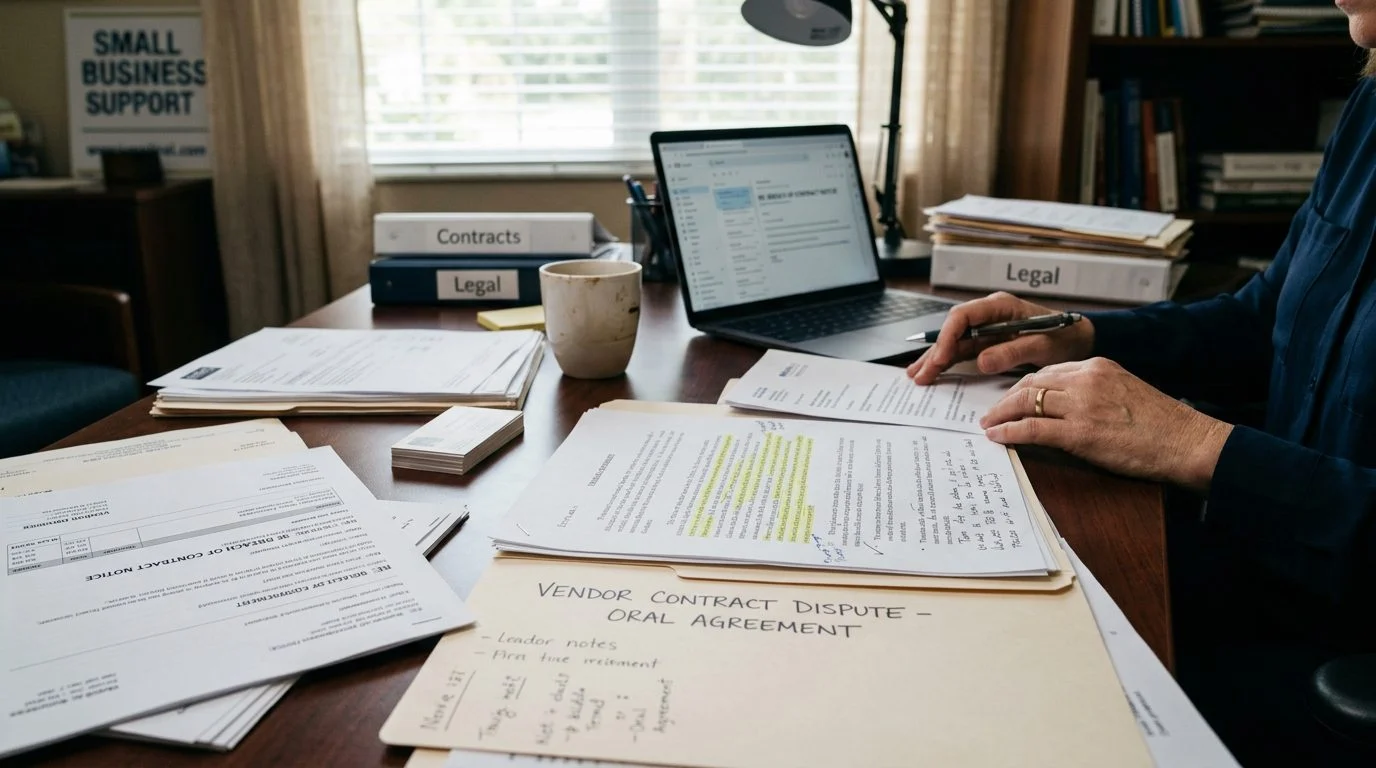
Business Contracts | Coral Gables and Sunny Isles Beach
Is an Oral Agreement with a Vendor Enforceable in Florida?
A handshake deal can still matter legally. KEW Legal helps business owners in Miami-Dade and Broward counties understand where an unwritten vendor arrangement stands.
By Kristina E. Wilson · Published November 2, 2026
Can an Oral Agreement with a Vendor Be Enforced in Florida?
Sometimes. A verbal deal with a vendor can be binding in Florida, but some oral deals cannot be enforced unless they are in writing. Florida’s Statute of Frauds decides which ones.
If you are reading this, you may run a business, manage its vendors, or be helping a partner who does. The deal may have been made by phone, at a job site, or with a handshake. Now the vendor has gone silent, billed you differently than agreed, or says no deal existed at all.
Florida law is flexible about how a deal gets made. A contract for goods can be made in any manner sufficient to show agreement, including conduct both sides use to show a contract exists.
Two rules sort most vendor disputes. The first is the one-year rule in Fla. Stat. § 725.01. The second is the $500 goods rule in Fla. Stat. § 672.201. Each has its own test. The sections below explain both, the proof that helps, and the gaps that weaken a claim.
If a vendor has not delivered or is billing you differently than you agreed, you don't have to sort out these rules alone; our team can review your records with you. Talk it through with our team — the first consultation is free, confidential, and carries no obligation.

When Florida’s Statute of Frauds Requires a Writing
Florida’s Statute of Frauds requires a signed writing for certain agreements. One group is agreements that cannot be performed within one year. Under § 725.01, no action can be brought on an agreement “not to be performed within the space of 1 year from the making thereof” unless the agreement, or a note or memorandum of it, is in writing and signed by the party to be charged.
In plain terms, the question is whether the deal, as agreed, could be fully carried out within one year of when it was made. A single order due in two weeks is one thing. A supply arrangement meant to run for three years is another. Look at the terms the two sides agreed to at the start.
The party to be charged is the person you are trying to hold to the promise. Fla. Stat. § 725.01 reads: “unless the agreement or promise upon which such action shall be brought, or some note or memorandum thereof shall be in writing and signed by the party to be charged therewith or by some other person by her or him thereunto lawfully authorized.” The same statute also covers a lease for longer than one year and any contract for the sale of land or an interest in land. Fla. Stat. § 725.01 reads: “unless the agreement or promise upon which such action shall be brought, or some note or memorandum thereof shall be in writing and signed by the party to be charged therewith or by some other person by her or him thereunto lawfully authorized.” Those are usually not the core of a vendor supply deal. Still, a business that rents space or buys property should check them.
Oral Vendor Agreements for Goods Under Florida’s UCC
A contract for goods priced at $500 or more generally needs a record that shows a contract was made. That record must be signed by the party you are trying to hold to it. It does not have to be a formal contract.
Under § 672.201(1), except as otherwise provided in that section, a contract for the sale of goods for the price of $500 or more is not enforceable unless there is a record sufficient to indicate that a contract was made, signed by the party against whom enforcement is sought. Two points matter here. First, a record is not insufficient just because it leaves out or misstates an agreed term. Second, the contract is enforceable only for the quantity of goods shown in the record.
Many vendor purchases fall under this rule. Parts, inventory, equipment, and supplies are common examples.
The rule has a special path between merchants. Under § 672.104, a merchant deals in goods of the kind, or holds itself out as having skill in the goods. “Between merchants” means both parties are chargeable with that knowledge. Under § 672.201(2), between merchants, if a confirming record sufficient against the sender is received within a reasonable time and the recipient has reason to know its contents, it can satisfy the writing rule against the recipient unless written objection is given within 10 days after receipt. That happens if a written confirmation sufficient against the sender is received within a reasonable time, the recipient has reason to know its contents, and the recipient does not give written notice of objection within 10 days after receiving it. If you get a confirmation of a deal you don’t recall, object in writing within that window.
Section 672.201(3) also lists exceptions. A contract that does not meet the writing requirement but which is valid in other respects can be enforced if the goods are specially manufactured for the buyer and are not suitable for sale to others in the ordinary course of the seller’s business, under circumstances which reasonably indicate that the goods are for the buyer, and the seller, before notice of repudiation is received, has made either a substantial beginning of their manufacture or commitments for their procurement. It can also be enforced if the party against whom enforcement is sought admits in court that a contract was made, though only up to the quantity admitted. Finally, it can be enforced for goods that were paid for and accepted, or received and accepted.
Services and Ongoing Vendor Arrangements
The goods rule covers contracts for the sale of goods. A service deal is generally analyzed under general contract principles instead. Maintenance, cleaning, IT support, staffing, and marketing agreements are examples of service arrangements.
The one-year rule can still apply to services. Section 725.01 covers any agreement that cannot be performed within one year, whether it involves goods or services. A month-to-month arrangement is different from a multi-year contract that cannot be finished in a year.
Part performance is not an exception under § 725.01; the section requires that the agreement, or some note or memorandum of it, be in writing and signed by the party to be charged. Fla. Stat. § 725.01 reads: “unless the agreement or promise upon which such action shall be brought, or some note or memorandum thereof shall be in writing and signed by the party to be charged therewith or by some other person by her or him thereunto lawfully authorized.” Florida courts look at what both sides agreed and what each side actually did. Those facts can be the difference between a claim that is clear and one that is hard to prove.
Ongoing arrangements also raise a practical question. Did the parties agree on a length of time, or did the work simply continue? Written records of renewals, extensions, and price changes help answer that question.
What You Can Prove: Evidence That Supports an Oral Agreement
Your everyday business records usually carry most of that proof.
Useful evidence includes:
- Emails and text messages that mention the price, quantity, or delivery date.
- Purchase orders, quotes, and invoices.
- Delivery tickets and signed receipts.
- Bank or card records that show what was paid and when.
- Calendars, project notes, and work logs.
- Witnesses, such as employees or others who heard the terms discussed or saw the work done.
Electronic messages deserve a closer look. Under § 668.004, unless otherwise provided by law, an electronic signature may be used to sign a writing and shall have the same force and effect as a written signature. Under § 672.206(1)(a), an offer is construed as inviting acceptance in any manner and by any medium reasonable in the circumstances. An accepted order sent by text or email can matter. What the message says still matters most.
Past orders can help too. If earlier purchases followed the same price and terms, that pattern can show what both sides expected. Section 672.204(1) recognizes that a contract may be shown by conduct from both parties.
Florida’s Division of Corporations, known as Sunbiz, keeps records of registered business entities. Checking the vendor’s exact legal name there can help you confirm who you dealt with.
Preserve originals in their native form, including dates and metadata. Keep a dated written summary of the verbal terms, written soon after the conversation.
Gaps That Commonly Weaken an Oral Vendor Claim
These gaps make proof harder, even when the deal itself is real.
- Price or quantity mismatch. The vendor’s invoice and your records disagree, and no written quote settles which is right.
- Unclear scope. No one wrote down which deliverables, specifications, or deadlines were agreed.
- Deposit with no record. An advance payment was made, but no receipt shows what it covered. A payment that was made and accepted can matter under the exceptions in § 672.201(3), so keep the receipt.
- Missing delivery or acceptance records. Without delivery tickets or sign-offs, it’s harder to show what was delivered and received.
- Summaries nobody confirmed. A written summary was prepared after the fact, and the other side never confirmed or answered it.
Each gap leaves a question open about what was agreed. When the Statute of Frauds applies, that question can decide whether a claim is enforceable at all.
Not sure what your next step is?
Talk it through with our team — the first consultation is free, confidential, and carries no obligation.
Remedies When an Oral Agreement Cannot Be Enforced as Stated
When the Statute of Frauds applies and no exception fits, the deal as spoken may not be enforceable. That reality is why the records matter so much.
Fraud is another theory people raise. The Third District has said that a promise of future action can be fraudulent if the promisor had no intention of performing, or a positive intention not to perform, when making it. A Florida appellate decision, Frutafino, S.A.S. v. Dole Chile, S.A., recognizes that a promise of future action may also constitute a fraudulent misrepresentation when the plaintiff can show that the person making the promise had no intention of performing or had a positive intention not to perform. See Frutafino, S.A.S. v. Dole Chile, S.A..
Some readers also ask whether they can recover the value of goods or services already provided. Whether that is possible depends on the facts of the deal and what was provided. Timing and the documents you hold also shape which options are open.
Common Questions About Oral Vendor Agreements
Is a verbal contract legally binding in Florida?
Often, yes.
Does a handshake deal count for a purchase under $500?
The writing rule in § 672.201 applies to goods priced at $500 or more.
Can a text message or email count as a signed writing?
Under Florida law, unless otherwise provided by law, an electronic signature is given the same force and effect as a written signature. Whether a particular message counts turns on what it says and how it was sent.

Talk With KEW Legal About Your Vendor Situation
If a vendor has quit delivering, billed you differently than agreed, or now says no deal existed, you may be handling this while running a business. The facts of your deal decide how these rules apply. Those facts include the dollar value, how long the arrangement runs, and which records you have.
KEW Legal is based in Coral Gables. We serve business owners and managers across Miami-Dade and South Florida on vendor, contract, and partnership questions. This page is the responsibility of Kristina E. Wilson, a lawyer at KEW Legal.
Call 305-990-2300 or send us a message through our contact page to schedule a consultation. Our first consultation is free, confidential, and carries no obligation to continue. We cannot promise any outcome, but we can review your records with you.
What We Look at When Reviewing a Verbal Vendor Deal
What was agreed
We identify the price, scope of work, delivery timing and any other terms the parties discussed, even if they were never written down.
What evidence exists
Emails, text messages, invoices, purchase orders, payments and delivery records can show what each side understood.
How the parties acted
The way both businesses performed, paid and communicated often says as much about the deal as the words used.
Why Businesses Bring Vendor Questions to KEW Legal
Outside general counsel
We work with business owners on vendor relationships as part of ongoing legal support for their company.
Focused on business disputes
Our practice focuses on contracts, vendor disputes and related commercial matters across South Florida.
Offices in Coral Gables and Sunny Isles Beach
We serve clients throughout Miami-Dade and Broward counties, including Miami, Aventura, Doral, Brickell and Fort Lauderdale.
Plain-language guidance
We explain your options clearly so you can decide how to move forward with your vendor.
Don't Wait to Document Your Deal
A verbal agreement can be hard to prove later. Write down what you remember while it is fresh, and keep every message, invoice and payment record connected to the vendor.
Have a Vendor Agreement That Was Never Put in Writing? Let's Talk.
Related practice areas
- Business Contract And Vendor Dispute Attorney
- Battle of the Forms: Purchase Order Dispute in Florida
Request a Consultation
Fill out the short form and we will take it from there.