
Employment Law for Employers | Coral Gables & Sunny Isles Beach
Received a Discrimination Charge? Get Clear Guidance Before You Respond
By Kristina E. Wilson · Published November 1, 2026
Florida Discrimination Charge Deadline: 365 Days
If a discrimination charge just reached your desk, or a firing or pay decision is now in question, our team can check the dates on your paperwork with you. Talk it through with our team — the first consultation is free, confidential, and carries no obligation.
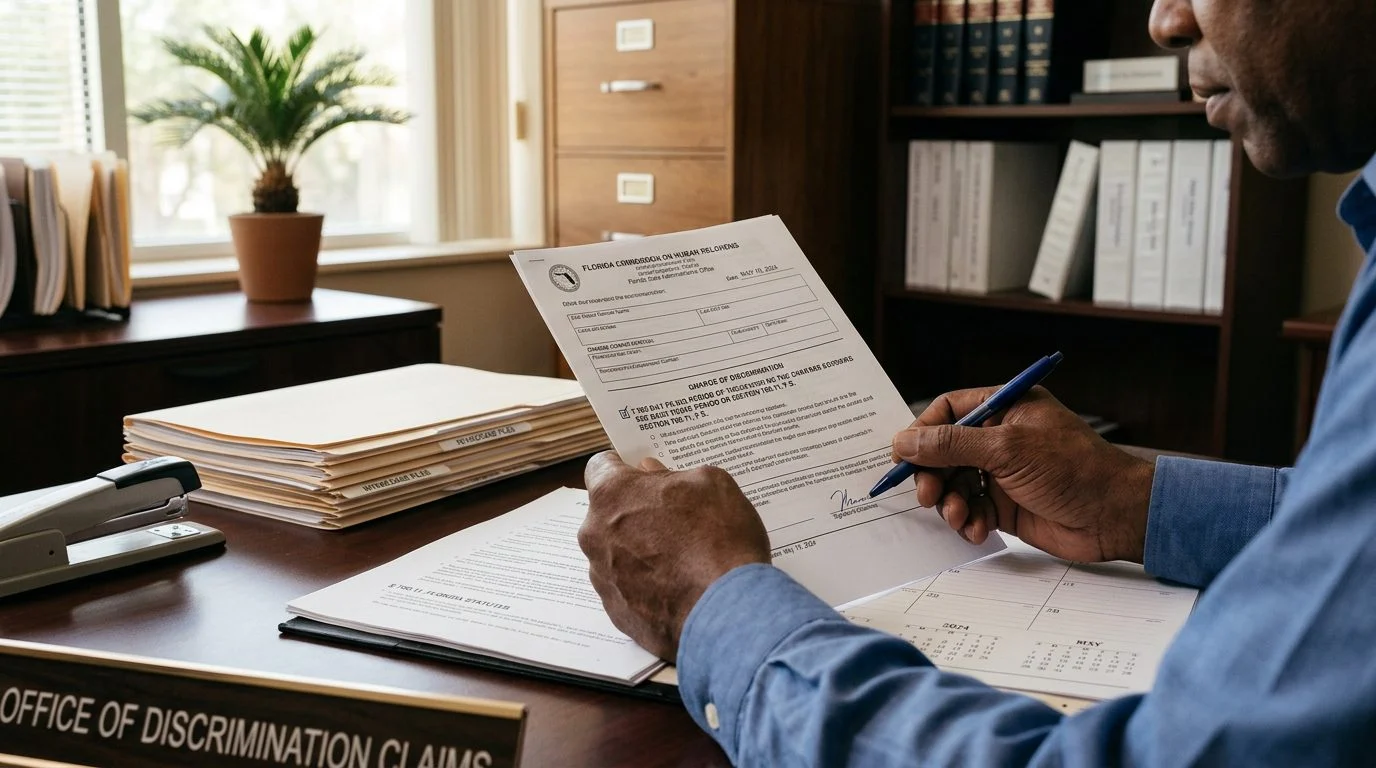
How Long Does an Employee Have to File a Discrimination Charge in Florida?
Under Fla. Stat. § 760.11(1), a person aggrieved by a violation may file a complaint with the Florida Commission on Human Relations within 365 days of the alleged violation.
The statute says a person harmed by a violation may file within that window. The complaint must name the employer and describe the violation.
The Act covers firing, refusing to hire, and treating someone differently in pay or working conditions because of a protected trait. Fla. Stat. § 760.10 lists these unlawful employment practices. Protected traits include race, color, religion, sex, pregnancy, national origin, age, handicap, and marital status.
For employers, this means a charge can arrive long after the original decision. Keep the dates on hand from the start.
When the 365-Day Clock Starts
The 365 days run from the alleged violation, not from the day a charge reaches your desk. Your review starts with the date of the act itself.
Common triggers include a termination, a demotion, a pay decision, or a refusal to hire. Each one is a separate act with its own date.
Some problems involve repeated conduct over time, such as a series of pay decisions. How that conduct is counted depends on the facts.
Here is the practical step. Pull the exact date of each decision, each written notice, and each key message about it. Note the day each decision took effect, not just the day it was discussed. Lay them side by side in one list. Then count 365 days from each alleged act.
Don’t assume the clock started when the paperwork arrived. Written records of each date beat memory.
Florida Commission on Human Relations vs. EEOC: Why the Deadlines Differ
A Florida charge runs on the state 365-day rule. Federal charges follow separate federal filing rules, so the two frameworks need separate labels.
The state statute lets an employee file with the Florida Commission on Human Relations. An employee may instead file with the federal Equal Employment Opportunity Commission or a state fair-employment-practice agency. Fla. Stat. § 760.01 names the Florida Civil Rights Act of 1992 and states its general purposes; the 365-day deadline for filing a complaint with the commission is in Fla. Stat. § 760.11, not in this section. The complaint may instead be filed with the federal Equal Employment Opportunity Commission or with any unit of government of the state that is a fair-employment-practice agency under 29 C.F.R. ss. 1601.70-1601.80, and, under § 760.11(1), the earliest of those filing dates is the date the complaint is filed with the commission.
The earliest date controls. If a charge goes to a federal agency first, that filing date can start the complaint period, but for a civil action the one-year period runs from the Florida commission’s reasonable-cause determination or the EEOC’s issuance of a Notice of Right to Sue, whichever is earlier; if neither is issued within 180 days after the filing of the complaint, a civil action may be commenced no later than 18 months after the filing of the complaint. A single filing date can therefore carry more weight than employers expect.
For federal duties, the EEOC employer guidance explains obligations that sit outside the Florida Act. Those duties are separate from the state window described above.
Write each date next to its agency name in your timeline. A single mixed-up date can send the whole review in the wrong direction.
What Happens Once an Employer Receives a Charge
Once a charge is filed, confirm the filing date and the alleged violation date right away.
Under § 760.11(1), the commission, within 5 days of the complaint being filed, must send a copy of the complaint to the person who allegedly committed the violation. The accused party may file a verified answer within 25 days of the filing date. Both the complaint and the answer must be verified.
Check coverage first. The Act’s definition of employer covers a person with 15 or more employees for each working day in each of 20 or more calendar weeks in the current or preceding calendar year.
Then guard against a second problem. Fla. Stat. § 760.10 also makes it unlawful to discriminate against someone for making a charge or taking part in an investigation. Taking action against the person who filed can create a new claim.
Preserve records now. That includes personnel files, emails, schedules, and performance reviews tied to the decision. Ask your team to keep them unchanged.
Timing Questions Employers Ask About Discrimination Claims
The 365-day window controls when a charge must be filed, not how long the whole matter lasts.
The commission must decide within 180 days of the filing whether there is reasonable cause to believe a discriminatory practice occurred. It must promptly notify both sides of that decision. Fla. Stat. § 760.11 provides that a civil action under this section must be commenced no later than 1 year after the date of the commission’s reasonable cause determination or the EEOC’s Notice of Right to Sue, whichever is earlier; if neither is issued within 180 days after the complaint is filed, the action may be commenced no later than 18 months after the filing of the complaint.
Length varies from case to case. A matter can move through agency review and then into court, and each stage follows its own steps.
In a court action, the court may, in its discretion, allow the prevailing party a reasonable attorney’s fee. That cost risk belongs in your planning from the start.
At-will employment has limits. An at-will employee can be fired at any time, but not for a reason the law prohibits, such as retaliation or unlawful discrimination.
Not sure what your next step is?
Talk it through with our team — the first consultation is free, confidential, and carries no obligation.
Reviewing the Claim Timeline With Counsel
Timing for a specific charge turns on each alleged act’s date and on which agency received the charge.
Early review lets you sort dates into groups: decision dates, notice dates, the filing date, and the answer deadline. A lawyer can compare each group to the state rules and flag gaps before any answer goes out.
The answer must be verified, so every fact in it needs support in your records. Reviewing the timeline first shows which facts your records must back up.
KEW Legal’s employment law work for employers covers charges like this, along with day-to-day HR questions. Kristina E. Wilson is the responsible lawyer for this page. Our team works with business owners and HR decision-makers across Miami-Dade County and South Florida.
For businesses that want ongoing support, KEW Legal also serves as outside general counsel. The firm’s offices are in Coral Gables and Sunny Isles Beach.

Talk With KEW Legal About Your Charge Timeline
If a discrimination charge has reached your desk, or a firing or pay decision is now in question, the dates on that paperwork need attention now. Waiting to count them can cost you clarity.
Call 305-990-2300 or send us a message to set up a conversation with Kristina E. Wilson about your timeline. Our first consultation is free, confidential, and carries no obligation to continue.
Frequently Asked Questions
How long does an employee have to file a discrimination charge in Florida?
Generally 365 days from the alleged violation, under the Florida Civil Rights Act.
When does the 365-day period start?
It runs from the alleged violation. Pull the exact date of each decision to check the count.
Is the federal EEOC deadline the same?
Federal charges follow separate federal rules, so track each agency’s dates apart.
Does the Act cover a small business?
The Act covers an employer with 15 or more employees for each working day in 20 or more calendar weeks of the current or preceding year.
Don't Wait to Review a Charge
A charge can move through agency steps quickly, and early decisions about records, witnesses and communications with the employee can shape how the matter proceeds. Bring every notice and document you have to your first conversation with our team.
How We Help Employers Respond
Review the Charge
We read the agency notice and the underlying allegations together, so you understand what is being claimed and what the company's records show.
Preserve Documents
We advise on gathering and preserving personnel files, schedules, emails and decision records that relate to the employee's claims.
Plan the Response
We help you prepare a position statement and communicate with the agency in a clear, consistent way that protects the business.
Manage Employee Relations
We advise on how to handle ongoing supervision, communications and any related workplace issues while the matter is pending.
Why Business Owners Work With KEW Legal
Outside General Counsel Approach
We work alongside business owners as ongoing outside counsel, so employment questions are handled with the rest of the company's legal needs in view.
Practical, Document-Focused Advice
Our guidance starts with the records and decisions at issue, helping you understand exposure and next steps in plain terms.
Protection of Your Business
We focus on protecting the company's reputation, operations and relationships while the matter is addressed.
Confidential First Conversation
Your free initial consultation is confidential and comes with no obligation to continue.
Speak With KEW Legal About a Charge Against Your Business
Related practice areas
Request a Consultation
Fill out the short form and we will take it from there.