
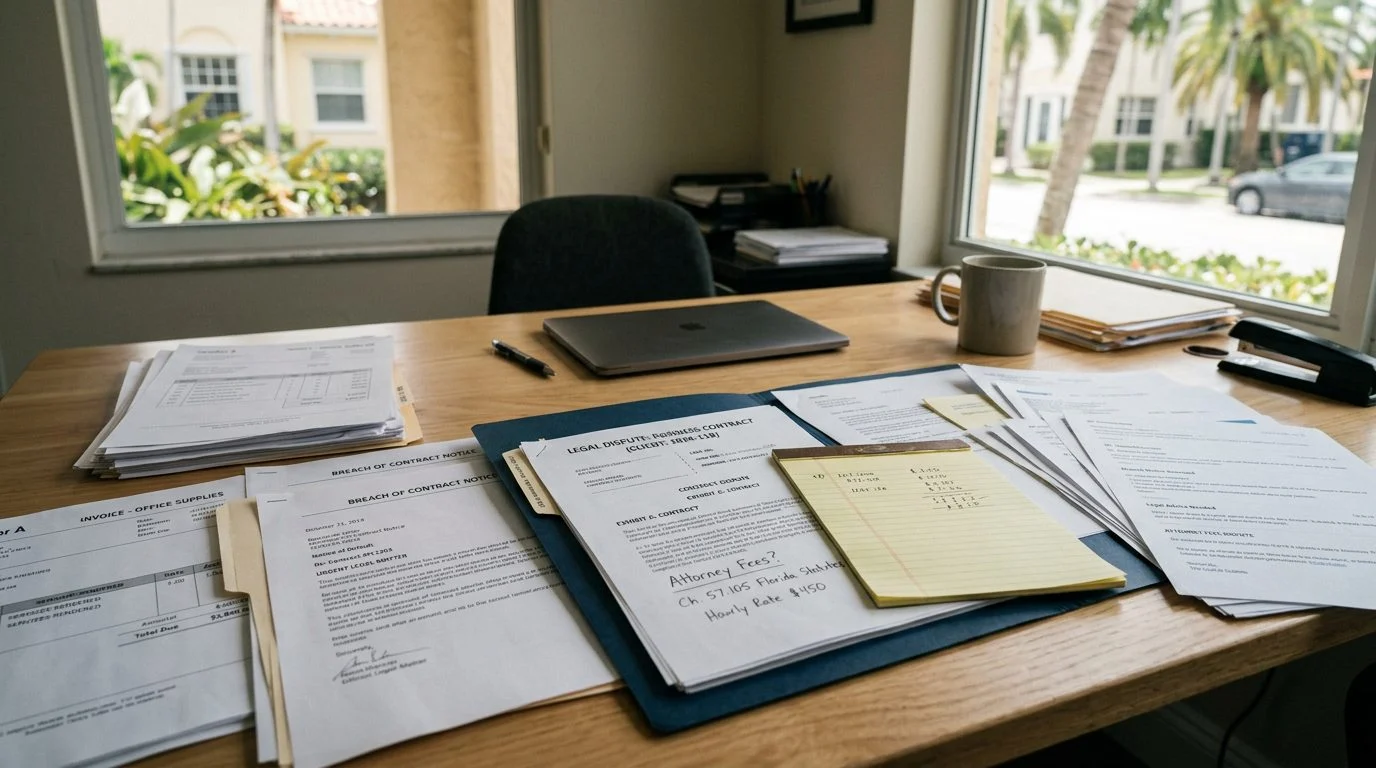
Business Contract Disputes | Coral Gables and Sunny Isles Beach
Who Pays Attorney Fees in Florida Business Contract Disputes?
A single sentence in a contract can change how much a dispute costs, so it pays to understand that language before a disagreement starts.
By Kristina E. Wilson · Published November 18, 2026
You have a contract fight with a vendor or partner, and you want to know who pays the lawyers. In Florida, each side usually pays its own attorney’s fees. Fees can shift when a contract, a statute, or a court’s sanctions power allows it. This page explains each route and the records that support a fee request.
The Short Answer: Florida Follows the American Rule
Each side usually pays its own attorney’s fees in Florida unless a contract or statute provides otherwise. This is the American Rule. The Florida Supreme Court states it in Price v. Tyler: each party generally bears its own attorneys’ fees unless a contract or statute provides otherwise. That includes business contract claims.
That rule is the starting point, not the finish line. Look at the contract’s fee clause first, then at any statute that fits your claim. Many owners assume the winner collects its fees automatically. In Florida, that is not the default, so check the wording before you send a demand letter, reply to one, or file anything.
If a vendor or partner is demanding payment or has sued over your contract, the fee clause may decide who carries the cost, so reach out to KEW Legal now. Talk it through with our team — the first consultation is free, confidential, and carries no obligation.
Prevailing Party Clauses in Business Contracts
A prevailing party clause says the side that wins can recover its attorney’s fees from the other side. You’ll see this wording in vendor, supply, services and partnership agreements. Sample wording might read: “In any action to enforce this agreement, the prevailing party may recover reasonable attorney’s fees.”
Some clauses reach only certain claims, such as claims to collect payment. Others cover any dispute under the agreement. Our business contract and vendor dispute attorney page covers the wider process.
Reciprocity: One-Sided Fee Clauses Can Work Both Ways
If a contract gives fees to only one party, Florida law can still let the other side recover them. Under Fla. Stat. § 57.105, when a contract lets a party recover fees for enforcing it, the court may also allow reasonable attorney’s fees to the other party when that party prevails. The rule reaches any action on the contract, whether that side is the plaintiff or the defendant. Fla. Stat. § 57.105 reads: “(7) If a contract contains a provision allowing attorney’s fees to a party when he or she is required to take any action to enforce the contract, the court may also allow reasonable attorney’s fees to the other party when that party prevails in any action, whether as plaintiff or defendant, with respect to the contract.” It applies to contracts entered into on or after October 1, 1988.
Imagine a vendor agreement that lets only the vendor recover fees. The vendor sues to collect an unpaid invoice and loses. The business, as the party that prevails, may then ask the court for its own reasonable fees under this subsection.
Notice the word “may.” The judge decides whether to award fees, so a one-sided clause can cut either way. Read the fee clause before you file or respond to a demand.
When the Contract Is Silent: Statutes, Offers of Judgment and Court Discretion
When a contract has no fee clause, fees usually depend on a statute that allows them. Whether a statute applies depends on the facts of your claim and the relief you seek.
The Florida Deceptive and Unfair Trade Practices Act (FDUTPA) declares unfair and deceptive acts in trade or commerce unlawful, under Fla. Stat. § 501.204. In litigation under that act, the prevailing party, after judgment and exhaustion of all appeals, may receive reasonable fees and costs from the nonprevailing party, under § 501.2105. The fee claim comes at the end of the case, not during it.
Settlement offers can shift costs too. Under § 768.79, in a civil action for damages, a defendant’s offer not accepted within 30 days can shift reasonable costs and fees if the judgment is no liability or at least 25 percent less than the offer. A plaintiff’s demand can work the same way if the judgment is at least 25 percent greater. The offer must be in writing, state that it is made under that section, name both parties, state its total amount, and state with particularity any amount offered to settle a punitive damages claim.
A second rule, § 45.061, has its own timing. Fla. Stat. § 45.061(1) describes an offer served more than 60 days after service of a summons and complaint on a party but not less than 60 days before trial (or 45 days if it is a counteroffer). However, subsection (6) limits the entire section to causes of action that accrued before that act took effect, so it is generally not a tool you can use in a contract dispute arising today. Fla. Stat. § 45.061 reads: “The offer shall remain open for 45 days unless withdrawn sooner by a writing served on the offeree prior to acceptance by the offeree.” Under § 45.061(1), a served offer remains open for 45 days unless the offeror withdraws it sooner by a writing served on the offeree before acceptance. Offers are a tool, not a shortcut, so each one needs careful drafting.
How a Court Decides Who Prevailed
A judgment on the main claim makes that clear. A dismissal or settlement may not name a winner, so read its terms. When the result is mixed, each side may claim a win. Ask which claim drove the fight and what the judgment actually awards.
Florida also penalizes claims with no support. Under § 57.105(1), the court must award a reasonable fee when it finds the losing side knew or should have known, when the claim or defense was initially presented to the court or at any time before trial, that a claim or defense was not supported by the material facts, or would not be supported by then-existing law applied to those facts. The fee is paid in equal amounts by the losing party and the losing party’s attorney. The statute also has protections for an attorney who acted in good faith based on the client’s representations about the facts.
Timing matters. A sanctions motion must be served first. It cannot be filed unless the challenged claim or defense is not withdrawn or corrected within 21 days after service, under § 57.105.
What Fees Can Be Recovered and What Records Support the Claim
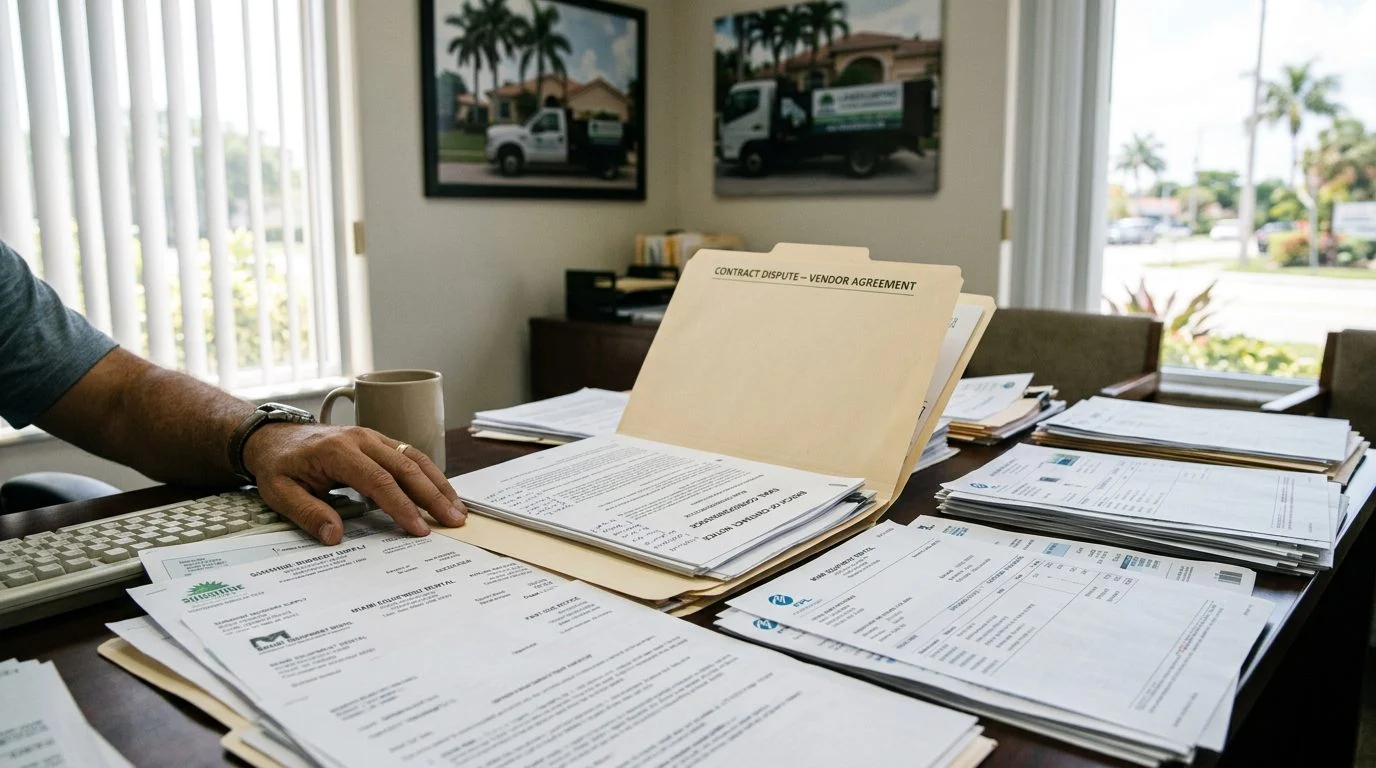
To recover fees, you need records that show the hours worked and why the amount is reasonable. Start keeping a running log of hours and tasks on the day the dispute begins.
Under § 57.104, courts start from a strong presumption that a lodestar fee is sufficient and reasonable. A lodestar fee is built from hours and a reasonable hourly rate. That presumption may be overcome only in a rare and exceptional circumstance, with evidence that competent counsel could not otherwise be retained. The court shall consider, among other things, the time of legal assistants who gave nonclerical, meaningful legal support under an attorney’s supervision.
In a case under the Florida Deceptive and Unfair Trade Practices Act, the attorney for the prevailing party must file a sworn affidavit of time spent and costs. The judge may then award the prevailing party a reasonable fee for the hours actually spent, as sworn in that affidavit, after judgment and exhaustion of all appeals, under § 501.2105.
Court costs, such as filing and service fees, are a separate question from attorney’s fees, so keep those receipts too. Keep these records from the start: the signed contract and any amendments; demand letters and replies; invoices and payment records; and proof of what was delivered or not delivered. Those same records often help show breach. Our page on records that prove breach of contract in Florida explains what to gather.
Not sure what your next step is?
Talk it through with our team — the first consultation is free, confidential, and carries no obligation.
Talk to KEW Legal About Your Contract Dispute
If a vendor or partner is demanding payment or has already sued, read the fee clause before you answer. Your situation may be a demand to pay, a notice to cure, or a lawsuit already filed. One clause can change who carries the cost of the fight, and deadlines in a demand or offer can arrive quickly.
Frequently Asked Questions
Does a prevailing party clause mean the winner always collects its fees?
No. The court decides who prevailed, and the clause’s wording controls which claims it covers.
Can a one-sided fee clause help the party that did not write it?
Yes, in some cases. Under Florida Statute 57.105(7), for any contract entered into on or after October 1, 1988, if a contract contains a provision allowing attorney’s fees to a party required to take any action to enforce the contract, the court may also allow reasonable attorney’s fees to the other party when that party prevails in any action, whether as plaintiff or defendant, with respect to the contract.
Can a settlement offer be used as evidence?
Offers to compromise generally cannot be used to prove liability or value, under § 90.408. Section 45.061 allows evidence of an offer in proceedings to enforce a settlement or determine sanctions.
If you’re facing a demand or lawsuit over a business contract, call 305-990-2300 or send us a message through our contact page before you respond. The initial consultation is free, confidential, and carries no obligation to continue.
KEW Legal is a Florida business law firm with offices in Coral Gables and Sunny Isles Beach. It serves business owners and investors across Miami-Dade County and South Florida. Kristina E. Wilson is the responsible lawyer for this page.
How KEW Legal supports business owners in contract disputes
Contract review
We read the fee, venue and dispute provisions in your agreements so you know what they say before a conflict escalates.
Outside general counsel
Our attorneys act as ongoing legal counsel for businesses and investors across Miami-Dade and Broward counties.
Clear options
We explain the practical paths available, from negotiation to formal proceedings, so you can make an informed decision.
Vendor and partner disputes
We focus on disagreements with vendors, suppliers and business partners that threaten daily operations.
Review fee language before you sign
Attorney fee provisions differ widely from one contract to the next. Reviewing yours early helps you understand what could be at stake if a dispute arises.
Questions to bring to your attorney
What does my contract say?
Look for language about attorney fees, prevailing parties, notice requirements and dispute resolution steps.
Which claims does the clause cover?
Fee language may apply to some claims and not others, so the scope of the wording matters as much as the wording itself.
Is the clause mutual?
Ask whether fee terms apply equally to both sides or favor one party, and how that could affect your position.
What should I do next?
Bring your agreements, correspondence and payment records to a consultation so counsel can assess your situation.
Your first consultation is free, confidential and carries no obligation to continue.
Request a Consultation
Fill out the short form and we will take it from there.